Newfoundland Rules for a Side-by-Side Driver
Figuring out the exact rules for riding your side-by-side in Newfoundland can feel like trying to untangle a ball of fishing line – it’s confusing, and there’s a lot of conflicting information out there. Many folks just want to enjoy their machines responsibly without breaking the law, but the nuances of where you can and can’t go, especially concerning roads, can be a real headache. This guide is here to clear up those frustrations, providing a comprehensive look at what side-by-side drivers need to know to stay legal and safe on the island's varied terrain.
Understanding the Foundation: The Off-Road Vehicles Act
Before we dive into the nitty-gritty of road rules, it’s crucial to understand the legal framework that governs all off-road vehicles (ORVs), including side-by-sides, in Newfoundland and Labrador. The province operates under the [Newfoundland's Off-Road Vehicles Act], which came into full effect in May 2022. This Act modernized the regulations, bringing clarity to many aspects of ORV use, but it also introduced specific considerations for different types of machines.
How Side-by-Sides Are Classified
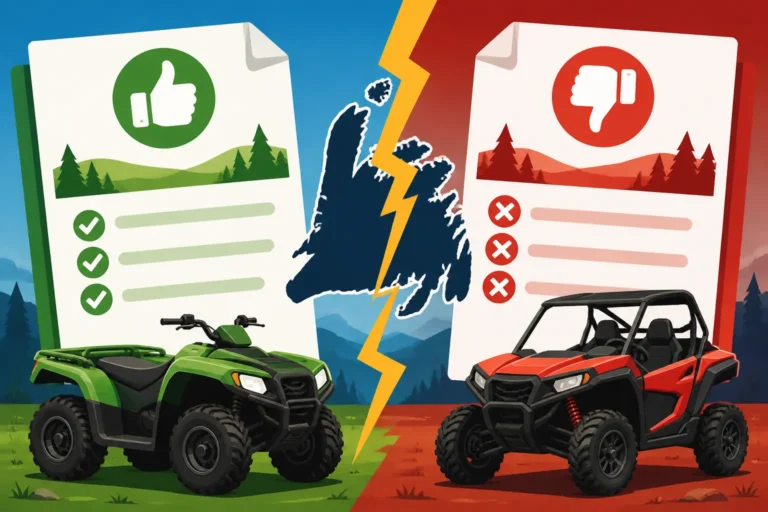
Under the current Act, side-by-sides (UTVs) are recognized as a distinct class of off-road vehicle. This might seem like a small detail, but it's really important because it means they're not just lumped in with ATVs, even if some of the general rules overlap. Previously, the classification was a bit fuzzier, leading to confusion, but the 2022 update helped to specifically define these multi-passenger machines. Side-by-sides were explicitly [Newfoundland Side-by-Sides Added in 2022] to the legislation, acknowledging their growing popularity for both recreational trail riding and utility work, like hauling gear to a cabin or maintaining a property.
The classification means that while your side-by-side has more than one seat and often a larger footprint than a single-rider ATV, it still falls squarely within the "off-road" category for most purposes. This is key because it informs why they are treated differently than standard road vehicles. They are designed for rugged terrain, not highway speeds, and their features, like aggressive tires and robust suspension, are built for trails, bogs, and barrens, not paved roads. You might install a heavy-duty bumper or a full skid plate from SuperATV to tackle the challenging backcountry, but those modifications don't magically make it street legal.
Registration and Paperwork Essentials
Just like ATVs and snowmobiles, every side-by-side operated in Newfoundland and Labrador needs to be registered with the provincial Motor Registration Division. This isn't a suggestion; it's a legal requirement before you ever hit the trails or venture near a road. The registration process itself is fairly straightforward, though it does require specific paperwork to prove ownership and pay the necessary fee. Many riders appreciate that Newfoundland uses a "pay once, own forever" model for ORV registration, meaning you don't have to worry about annual renewals. You register it once, and that registration is valid as long as you own the machine.
When you register your side-by-side, you'll receive an identification plate (often referred to as a "quad plate" even for a side-by-side) and a registration permit. This permit is your proof of ownership and registration, and it’s something you should always carry with you when riding. The process involves submitting documents like a bill of sale, the New Vehicle Information Statement (NVIS) if it's new, and sometimes other forms depending on the machine's history. While the fee for an ATV is [$95 for an ATV], side-by-sides typically fall into a similar fee structure. Make sure all your [Newfoundland Registration Paperwork Explained] is in order before you head to the registry office to avoid a frustrating second trip.
Navigating Newfoundland Roads: The Specifics for Side-by-Sides
This is where much of the confusion and frustration arises for side-by-side owners. Many people see other vehicles on the road and wonder why their capable side-by-side can't do the same. The short answer is: off-road vehicles are generally not considered street legal in Newfoundland, but there are very specific and limited circumstances where they are allowed on or across public roads. Understanding these exceptions is paramount to avoiding fines and ensuring safety for yourself and other road users.
Limited Road Access and Permitted Movements
It's a common misconception that with a few aftermarket add-ons, your side-by-side becomes a road-legal vehicle. This isn't the case in Newfoundland. Unlike some jurisdictions where a UTV can be fully licensed for street use, here, their primary domain remains off-road. You cannot simply drive your side-by-side down the Trans-Canada Highway or through town streets as if it were a car or truck. The Act is quite clear on this: ORVs are generally prohibited from operating on highways, roads, streets, or any other public thoroughfare maintained for motor vehicles.
However, the Act does make allowances for very specific scenarios. These allowances are designed to facilitate access to trails, retrieve game, or cross from one section of land to another, not for general transportation. We're talking about very precise, temporary movements, not cruising. These rules are part of the [Newfoundland ORV Road Rules Explained] and apply to all ORVs, including side-by-sides. If you're pondering whether [Can You Ride an ATV on the Road in Newfoundland?], the answer for a side-by-side is generally "no, with very limited exceptions."
Crossing Highways and Riding Shoulders Safely
The most common permitted road uses for side-by-sides involve crossing highways and briefly riding shoulders to access trails. These aren't rights to travel, but carefully regulated maneuvers.
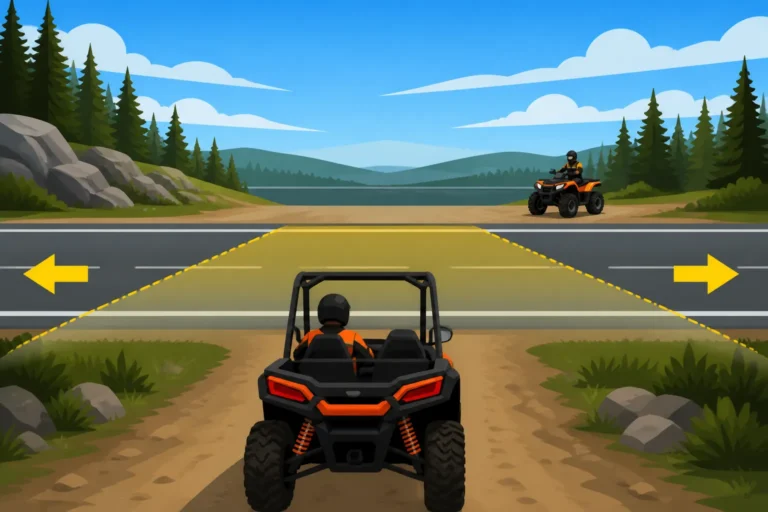
When you need to cross a highway, you must do so at a right angle to the highway, and only when there is at least [Newfoundland's 150-Metre Crossing Visibility Rule] in both directions. This means you can't just pop out from behind a blind corner; you need to see and be seen from a significant distance. The crossing must be made as quickly and directly as possible, yielding to all highway traffic. This isn't the time to check your phone or admire the view; it's a moment of heightened caution.
For riding the shoulder, the rules are even stricter. You are allowed to operate your side-by-side on the shoulder of a highway only to travel from one off-road area to another, or to get to or from a service area (like a gas station) when there's no other reasonable access. This shoulder travel is limited to a maximum distance of [Newfoundland's 1-Kilometre Shoulder Rule] and must be done at a speed no greater than [Newfoundland's 20 km/h Shoulder Limit]. You must always stay as far to the right as possible on the shoulder, giving ample room to pedestrians, cyclists, and other road users. It's a crawl, not a cruise, and it's solely for reaching your destination, not for enjoying the scenery.
Local Bylaws and Municipal Roads
Adding another layer of complexity, municipalities in Newfoundland and Labrador have the power to enact their own bylaws regarding ORV use within their boundaries. This means that while provincial rules set the general framework, a town council might have specific regulations that either further restrict or, in rare cases, permit limited ORV access on certain municipal roads or streets. This patchwork of rules can be incredibly frustrating for riders. What's allowed in one community might be strictly forbidden in the next.
For instance, some smaller, more remote communities might have specific roads or sections of roads designated for ORV use to connect residents to trails or cabins, especially where no practical alternative exists. However, in larger towns or cities, ORV access on municipal roads is usually highly restricted or completely prohibited. The best advice is always to check directly with the specific town or city hall before riding within their limits. Don't rely on what you think the rules are or what you've seen others do, as bylaws can change, and enforcement can vary. A quick call to the municipal office can save you a significant headache and a hefty fine.
| Permitted Road Maneuvers for Side-by-Sides | Description | Key Restrictions |
|---|---|---|
| Highway Crossing | Traveling directly across a highway to access an adjacent trail or property. | Must be at a right angle. Minimum 150 meters visibility in both directions. Yield to all highway traffic. Execute as quickly and safely as possible. |
| Shoulder Riding | Using the shoulder of a highway to reach an off-road area, trail, or service (e.g., gas station) when no other reasonable access exists. | Max 1-kilometre distance. Max 20 km/h speed. Must stay as far right as possible on the shoulder. Not for general travel or leisure. |
| Municipal Road Access | Limited access on specific municipal roads as permitted by local bylaws. This is not common in larger centers. | Varies widely by municipality. Always check with the local town council or city hall for specific rules and designated routes. May require special permits or adhere to strict speed/time limits. |
| Private Road/Land | Operating on private roads or land with the explicit permission of the landowner. | Not considered "public road" use. Permission is key. Ensure you have clear, preferably written, consent. |
Essential Equipment and Driver Requirements
Operating a side-by-side safely and legally involves more than just knowing where you can ride; it also means ensuring your machine is properly equipped and you, as the driver, meet certain criteria. These regulations are in place to protect you, your passengers, and others on the trail or during those limited road maneuvers. Ignoring these rules isn't just risky; it can lead to significant penalties.
Mandatory Safety Gear for Operators and Passengers
Safety should always be your top priority, and Newfoundland's ORV Act reflects this with clear requirements for safety gear. The most critical piece of equipment is a helmet. Every single person on a side-by-side – the operator and any passengers – must wear an approved helmet, and it must be properly fastened with the chin strap. This isn't just a recommendation; it's [Newfoundland Helmet Law for Every Rider]. The helmet must meet recognized safety standards, such as those from the Canadian Standards Association (CSA), US DOT, or ECE. No exceptions are made for short distances or slow speeds, even if you're just moving the machine from the driveway to the garage.
Beyond helmets, eye protection is also mandatory, unless your side-by-side is equipped with a full windshield that provides adequate protection. Goggles or a helmet with a visor are crucial for shielding your eyes from dust, debris, insects, and the elements, especially when you're tearing through the barrens or negotiating a muddy trail. And, of course, your side-by-side comes equipped with seat belts for a reason. These aren't decorative; they are vital safety devices. Everyone in the machine must wear their seat belt whenever the machine is in operation. Many SuperATV models or aftermarket accessories include reinforced seat belt options to keep you secure on rough terrain.
Machine-Specific Equipment Rules
Your side-by-side itself needs to meet certain equipment standards to be considered legal for operation, especially if you plan on any road interactions. First, proper lighting is non-negotiable, particularly if you're riding from sunset to sunrise or in low visibility conditions. This includes working headlamps, tail lamps, and reflectors. These ensure that your machine is visible to others, which is critical during those brief road crossings or shoulder rides. Amber lights are generally required at the front, and red lights at the rear.
Mufflers are another key component. While Newfoundland doesn't have a specific spark arrestor rule, the Act does require that your exhaust system be in good working order and not produce excessive noise. Modified or "cut-out" exhausts that make your machine significantly louder than its factory specification are illegal and can earn you a fine. The intent is to ensure ORVs don't create unnecessary noise pollution for residents or wildlife. Finally, ensure your tires are low-pressure, as designed for off-road use, and that all standard safety features are in place and functioning correctly. Always ensure your machine is in top condition; reputable brands like SuperATV offer replacement parts and upgrades that adhere to safety standards, helping you keep your machine compliant and ready for the trail. These [Newfoundland Equipment Requirements] are in place for everyone's safety.
Licensing, Age, and Insurance Requirements
To legally operate a side-by-side, certain personal requirements must also be met. If you are operating your side-by-side on any section of a highway (even for a permitted crossing or shoulder ride), you must possess a valid driver's licence. This means you can't just be an experienced off-road rider; you need a licence that is valid for operating a motor vehicle on a public road. For many riders, this will simply be their regular Class 5 passenger vehicle licence. [Newfoundland Licence Requirements on a Highway] states this clearly.
There are also age restrictions for operating side-by-sides. Generally, you need to be at least 16 years old to operate an ORV unsupervised, though there are rules for younger riders under adult supervision on specific types of machines. It's crucial to understand these age and supervision rules, especially if you have younger family members who want to ride. Finally, and perhaps most importantly, adequate insurance is mandatory. Every registered side-by-side must have liability insurance, with a minimum coverage of [Newfoundland Minimum Insurance Requirement]. This insurance protects you and others in the event of an accident. You must carry proof of this insurance with you whenever you are operating the machine, and be prepared to produce it if requested by a peace officer within two business days.
Enforcement and Consequences of Non-Compliance
Riding an off-road vehicle in Newfoundland is an incredible experience, but it comes with the responsibility of adhering to the rules. Ignoring the regulations can lead to serious consequences, not just for your wallet, but potentially for your freedom to ride at all. Enforcement officers, including the Royal Newfoundland Constabulary (RNC), RCMP, and wildlife officers, are authorized to stop ORV operators and ensure compliance with the Act.
Common Infractions and Associated Penalties
Peace officers actively patrol trails and areas where ORV use is common, and they are well-versed in the regulations. Common infractions that side-by-side drivers might face range from minor equipment deficiencies to major offences involving illegal road use or impaired operation.
Here’s a table outlining some typical infractions and the potential penalties:
| Infraction | Common Penalties (Ranges) | Severity |
|---|---|---|
| Operating an unregistered machine | Fines from $100 to $1,500 for a first offence. | High |
| No insurance or proof of insurance | Fines from $200 to $2,500. | High |
| No helmet or unfastened helmet | Fines from $100 to $500. | Medium-High |
| No eye protection (without windshield) | Fines from $100 to $500. | Medium |
| No seat belt | [Newfoundland Fines for No Seat Belt] can range from $100 to $500. | Medium |
| Illegal operation on a highway/road | Fines from $100 to $1,500 for a first offence, potentially higher for repeat offences. | High |
| Operating under the influence (impaired) | Significant fines, licence suspension, potential jail time, and machine seizure. | Very High (Criminal Offence) |
| Excessive noise (modified muffler) | Fines from $250 up. | Medium |
| Failure to yield or obey traffic rules | Fines from $100 to $1,500, similar to general traffic infractions. | Medium-High |
| Operating outside approved areas | Fines from $100 to $500, plus potential machine seizure depending on the area (e.g., protected lands). | Medium-High |
| No valid driver's licence (on highway) | Fines from $100 to $1,500. | High |
Beyond monetary fines, serious or repeated infractions can lead to the seizure and impoundment of your side-by-side, and in cases of impaired operation, even criminal charges and suspension of your driver's licence. The province takes these rules seriously because they are fundamental to public safety and environmental protection. For example, [Newfoundland Penalties for Riding Illegally] can quickly escalate, turning a fun day into a very expensive lesson.
The Importance of Carrying Documentation
When you're out riding, whether on a trail or making a permitted road maneuver, you are required to carry specific documents. This includes your valid ORV registration permit, proof of insurance, and if you're on a highway, your driver's licence. If an officer stops you and asks to see these documents, you must be able to produce them. While the Act allows for a two-business-day window to produce proof of insurance at a police station if you don't have it on you at the time of the stop, it's far better to have everything readily accessible.
This documentation serves as proof that you are legally entitled to operate the machine and that you are meeting all the necessary safety and liability requirements. Keep your registration permit and insurance card in a waterproof bag or container on your side-by-side, or carry them with you, perhaps in a pocket of your riding gear. Don't risk a fine for something as simple as forgetting your papers.
Staying Informed and Riding Responsibly
The landscape of ORV rules can shift, with new bylaws or amendments to the provincial Act. It's the responsibility of every side-by-side driver to stay informed. The best sources for up-to-date information are the official government websites for Newfoundland and Labrador's Motor Registration Division and the Department of Fisheries, Forestry and Agriculture. Additionally, local ORV clubs and associations often provide excellent resources and advocacy for riders, and they can be a great place to connect with other enthusiasts and learn about trail conditions or new regulations.
Ultimately, responsible riding is about more than just avoiding fines; it's about respecting the land, wildlife, and other users. It means sticking to marked trails, keeping noise levels down, and minimizing your environmental impact. It also means being a good ambassador for the sport, ensuring that access to Newfoundland's incredible wilderness remains open for everyone to enjoy for years to come. By understanding and adhering to these rules, you contribute to a safer and more sustainable riding community.
Disclaimer
This article is for general informational purposes only and does not constitute professional advice. Laws, prices and regulations vary by location and change over time. Consult a qualified professional for guidance on your specific situation.