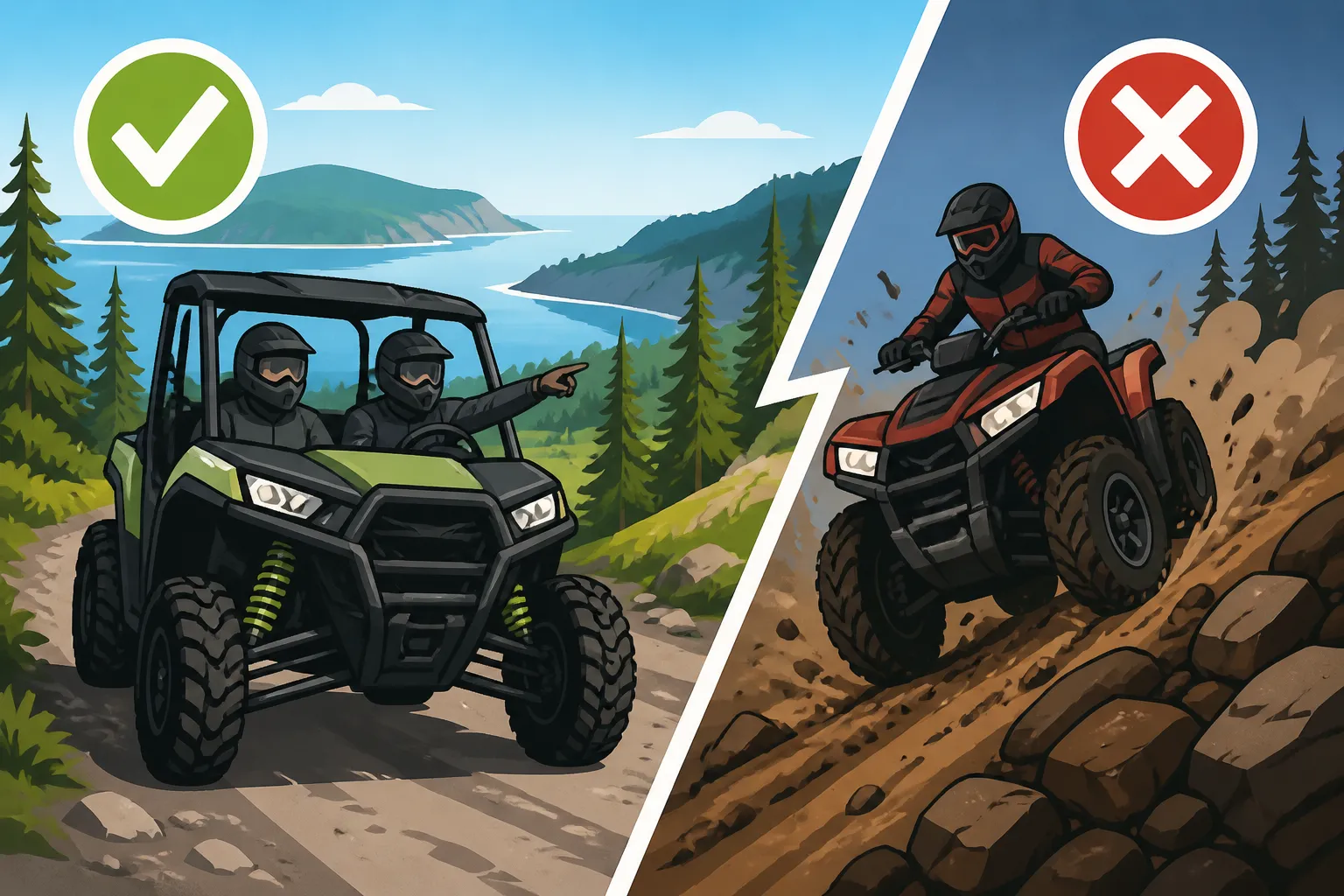
Shoulder Riding Is for Reaching a Trail Only
It's incredibly frustrating when you just want to get your ATV or UTV from point A to point B, perhaps to a new trail or just around a short bend to your cabin, and you're left wondering what the rules actually are for riding on the shoulder of a road. Many riders in Newfoundland grapple with confusing regulations that can quickly turn a simple trip into a costly ticket. This guide will clarify exactly what the law says about using road shoulders for your off-road vehicle, emphasizing that it's strictly for reaching a trail and not for general travel.
Understanding Newfoundland's Core Philosophy on ORVs and Roads
Riding an ATV or UTV in Newfoundland is an incredible experience, offering access to breathtaking barrens, winding woods roads, and countless kilometres of trails. But when it comes to mixing with highway traffic, things get a little more complicated. The province has a clear, foundational philosophy when it comes to off-road vehicles and public roads, and understanding this is key to staying out of trouble.
The "Trail Only" Mindset
At its heart, Newfoundland's legal framework, particularly [Newfoundland's Off-Road Vehicles Act], views ATVs, UTVs, snowmobiles, and other off-road vehicles (ORVs) as precisely that: off-road vehicles. This isn't just semantics; it's a fundamental principle that dictates how and where these machines can be operated. The law is designed to separate ORV traffic from conventional highway traffic as much as possible. We all appreciate the convenience of being able to hop on our machines right from home or quickly cut across a piece of pavement, but the provincial government's primary concern is safety—the safety of ORV riders, passenger vehicle occupants, and pedestrians alike. This "trail only" mindset aims to reduce collisions, minimize conflicts, and ensure that everyone can enjoy the province's natural beauty without unnecessary risk on roadways. It acknowledges that while our machines are incredibly versatile, they aren't designed or equipped for the same speeds and conditions as cars and trucks on paved highways.
Why Shoulders Are Not Open Season
It’s a common and understandable misconception: "If it's not the main road, it must be fair game, right?" After all, shoulders often seem wide and empty, offering a convenient path around traffic. However, this line of thinking can lead directly to fines and dangerous situations. Shoulders exist primarily for emergencies, broken-down vehicles, or cyclists and pedestrians in certain areas—not as an alternative route for ATVs and UTVs. Mixing high-speed highway traffic with slower, less visible, and less protected ORVs on a shoulder presents a significant safety hazard. Cars are travelling at highway speeds, and an ORV suddenly appearing on the shoulder, especially if it's kicking up dust or operating inconsistently, can be a serious distraction and a collision risk. The roads, including their shoulders, were designed and built for conventional vehicles, and the legal framework reflects this historical intent. The limited allowance for ORV use on shoulders is a carefully controlled exception, not an invitation for widespread use. Understanding this distinction is crucial for every rider.
The Specifics of Shoulder Riding: What the Law Says
So, if shoulders aren't open season, when can you use them? The law in Newfoundland is quite precise, outlining very specific conditions and limitations for off-road vehicle use on road shoulders. It's not a free-for-all; it's a narrowly defined privilege.
The 1-Kilometre Rule and Its Purpose
One of the most important regulations to commit to memory is [Newfoundland's 1-Kilometre Shoulder Rule]. This rule is designed for one singular purpose: to allow you to legally get your ORV from a point of access (like your home, a parking lot where you've unloaded your machine, or a specific parcel of private land) to an actual trail that is nearby. It is explicitly not for leisure riding, travelling between towns, or extending your trail ride beyond its designated boundaries.
Imagine you've trailered your side-by-side to a popular trailhead parking lot, but the official trail entrance is just 800 metres down the paved road. Instead of having to find an alternative, illegal route or awkwardly push your machine, the 1-kilometre rule provides a legal pathway. Similarly, if your cabin access road is just a few hundred metres from the main highway, this rule allows you to legally bridge that short gap. The key is "reaching a trail." If you're riding the shoulder for a kilometre, then another, then another, without connecting to a recognized trail network, you're breaking the law. This rule acknowledges the practical realities of trail access while strictly limiting exposure to highway traffic. It's a short transit, a brief connection, never a riding destination in itself.
The Strict 20 km/h Limit on Shoulders
Coupled with the distance restriction is an equally critical speed limit: [Newfoundland's 20 km/h Shoulder Limit]. This isn't just a suggestion; it's a mandatory maximum speed when operating on the shoulder of a public road. Why so slow? The answer is simple: safety. At 20 km/h, you have significantly more time to react to unexpected hazards, whether it's a sudden ditch, a pedestrian, or a vehicle pulling onto the shoulder. It also gives drivers in the main lanes more time to see and react to your ORV, reducing the element of surprise.
Think about it: an ATV or UTV travelling at higher speeds on a gravel or dirt shoulder can kick up a considerable amount of dust, impairing visibility for everyone. The slower speed minimizes this. Furthermore, ORVs handle differently than cars, especially on varied shoulder surfaces. Keeping the speed low ensures better control and stability, reducing the risk of tipping or losing control. The temptation to speed up, especially on a seemingly clear stretch, can be strong, but doing so not only invites a ticket but dramatically increases the risk of an accident. This limit is a non-negotiable part of responsible shoulder riding and directly contributes to the safety of all road users.
Crossing Highways: The 150-Metre Visibility Requirement
While not technically "shoulder riding," the rules for crossing a highway are often encountered directly before or after using a shoulder to access a trail. If your intended trail or access point requires you to cross a paved public highway, you must adhere to [Newfoundland's 150-Metre Crossing Visibility Rule]. This means that before you even think about crossing, you must ensure that there are no vehicles approaching from either direction within a distance of 150 metres.
To put 150 metres into perspective, it's roughly the length of one and a half Canadian football fields, or about three times the length of a typical hockey rink. This is a considerable distance, and the intent is clear: you need ample time to safely cross without interfering with oncoming traffic. You must come to a complete stop, look carefully in both directions, and proceed only when the path is unequivocally clear. This isn't a race; it's a moment of extreme caution, akin to a pedestrian crossing a busy intersection. The safety of everyone involved hinges on your judgment and adherence to this rule. It's a critical component of ensuring that your ORV travels remain safe when interacting with the main road network.
Practical Implications and Avoiding Fines
Knowing the rules is one thing, but applying them correctly in the real world is another. Nobody wants the fun of a ride cut short by a ticket, or worse, an accident. Being prepared and understanding the practical implications of Newfoundland's ORV laws will help you avoid unnecessary trouble and ensure a smoother, safer riding experience.
Equipment and Licencing for Road-Adjacent Travel
Even for the briefest stint on a road shoulder, your off-road vehicle and you, as the operator, must meet certain requirements. First and foremost, a proper helmet is non-negotiable. [Newfoundland Helmet Law for Every Rider] applies whether you're on a trail, crossing a road, or traversing a shoulder. Make sure your helmet meets approved standards and is properly fastened.
Secondly, you absolutely need insurance. [Newfoundland Insurance Requirements for Riders] dictate a minimum liability coverage, which is crucial should any incident occur, even a minor one, during your short road-adjacent journey. Carrying proof of this insurance with you is essential.
Thirdly, regarding your driver's licence: if you are operating your ORV on a highway or its shoulder, or indeed any public road, you generally need to possess a valid driver's licence. This is addressed in [Newfoundland Licence Requirements on a Highway]. It’s easy to assume that because you’re "off-road," your car licence isn’t relevant, but the moment you touch public tarmac or its adjacent shoulder, these rules apply.
Finally, consider your machine's visibility. While not explicitly required for short shoulder transits during daylight hours, having good lighting—both front and rear—is always a smart move. Aftermarket accessories, like robust LED light bars or enhanced mirror kits from brands like SuperATV, can significantly improve your presence to other drivers. This added visibility can be a lifesaver, especially on dusty shoulders or during overcast conditions, making your machine more noticeable to fast-moving highway traffic.
Common Mistakes and Enforcement
Riders often fall into a few common traps when it comes to shoulder riding. The biggest one is extending the 1-kilometre rule, thinking "just a little further won't hurt." Another is exceeding the 20 km/h speed limit, especially if the shoulder looks clear and wide. Both of these actions can quickly lead to trouble. Peace officers are vigilant, and they understand the law thoroughly. Ignorance of the law is never an excuse, and fines can be substantial. [Newfoundland Fine Ranges by Offence] show that penalties can be costly, not to mention the potential for your machine to be impounded in serious cases.
Consider these scenarios:
- Mistake: You ride 3 kilometres down the shoulder to visit a friend’s cabin, thinking it’s "close enough."
- Correct: You trailer your machine to within 1 kilometre of the friend’s cabin or ride a designated trail that connects closer to their property.
- Mistake: You speed up to 40 km/h on a smooth shoulder to "get it over with" quickly.
- Correct: You maintain a strict 20 km/h, even if it feels slow, prioritizing safety and compliance.
Always ensure you have all your necessary [Newfoundland Registration Paperwork Explained] and your safety certificate with you. Officers can and will ask for these documents, even during a brief encounter on a shoulder. Being prepared saves time and potential headaches.
Planning Your Route to Minimize Road Use
The best way to comply with the shoulder riding rules, and to keep yourself safest, is to minimize your time on or adjacent to public roads altogether. This means careful route planning before you even hit the throttle. Look for maps of approved trails and designated access points. Many communities now have specific areas where you can unload your machine directly onto a trail, or where short, designated feeder trails connect directly to the main network, completely bypassing the need for shoulder use.
If you know a significant portion of your journey would involve riding a shoulder, it's often far better to trailer your machine closer to your actual riding destination. Use a truck and trailer to cover the long distances, and save your ORV for what it was made for: the trails. This approach not only keeps you within the legal framework but also reduces wear and tear on your machine from road riding. Furthermore, a machine equipped with quality components, like those from SuperATV, designed for tough trail conditions, will perform much better and more safely on trails than constantly navigating paved or gravel shoulders alongside highway traffic. Investing time in planning your routes can significantly enhance your overall riding experience and help maintain positive relationships with local authorities and other road users.
Here’s a quick summary of the key shoulder riding rules in Newfoundland:
| Feature | Rule | Purpose & Notes |
|---|---|---|
| Purpose | Strictly for reaching an approved trail. | Not for general travel, leisure, or convenience. |
| Distance Limit | Maximum 1 kilometre (0.62 miles) from your access point to the trail. | Beyond 1 km, you are in violation. Plan to trailer your machine if the trail is further. |
| Speed Limit | Maximum 20 km/h (12.4 mph). | Enhances safety, reduces dust, allows more reaction time for all road users. |
| Crossing Roads | Must have 150 metres (approx. 492 feet) clear visibility in both directions before crossing. | Critical safety measure; ensures you can cross without impeding traffic. |
| Insurance | Mandatory liability insurance (minimum $200,000). | Protects you and others in case of an accident. Always carry proof. |
| Licence | Valid driver's licence required if operating on any public road/shoulder. | Your standard driver's licence is generally sufficient. |
| Helmet | Mandatory for all operators and passengers. | Must meet approved safety standards (e.g., CSA, DOT, ECE) and be properly fastened. |
| Vehicle Reg. | ORV must be properly registered with the province. | Carry your registration permit. |
| Training | Safety certificate required if you registered your first machine after May 2022 or are under 16. | Always carry proof of your safety training certificate. |
| Visibility | Lights on (head and tail lamps required sunset to sunrise). Good mirrors and reflective elements help. | Enhance your visibility to other road users, especially with accessories from SuperATV. |
Conclusion
Riding your ATV or UTV in Newfoundland is an incredible way to experience the province's rugged beauty, but it comes with the responsibility of understanding and following the rules. When it comes to road shoulders, the message is clear and unwavering: their use is a very specific, limited privilege, designed solely for reaching a trail. It's not a shortcut, not a scenic bypass, and certainly not an extension of the trail itself. By respecting the 1-kilometre distance limit, adhering to the strict 20 km/h speed, exercising extreme caution when crossing highways, and ensuring your machine and licensing are in order, you contribute to a safer riding environment for everyone. Plan your routes, know the law, and keep your adventures focused on the fantastic trails that Newfoundland has to offer.
Disclaimer
This article is for general informational purposes only and does not constitute professional advice. Laws, prices and regulations vary by location and change over time. Consult a qualified professional for guidance on your specific situation.