Why 1 Kilometre Is the Hard Limit
Riding your ATV or UTV in Newfoundland and Labrador offers an incredible sense of freedom, connecting you to some of the most breathtaking landscapes out there. But when you need to use a highway shoulder to get from one trail to another, confusion often sets in. Many riders wonder, "How far can I actually go?" This guide is here to clear up the mystery around the one-kilometre limit for riding off-road vehicles on highway shoulders, helping you understand the rules so you can ride safely and legally without worry.
The Shoulder Riding Rule: A Necessary Evil for Access
Let's face it, sometimes the only way to get to that next epic trail or even just to another section of your property is by briefly using a highway shoulder. The provincial government recognizes this practical need, but they've put very specific rules in place to ensure everyone's safety – both ORV riders and highway motorists. It’s not about convenience for long hauls; it's about providing a controlled, limited pathway for essential transitions. Ignoring these rules isn't just a risk for a fine; it's a risk to your safety and the safety of others.
The province isn't trying to make your life harder, but they are trying to prevent serious accidents that can occur when off-road vehicles, which are designed for different terrains and speeds, mix with faster-moving highway traffic. This balance between access and safety is at the heart of the shoulder riding rule. It’s a compromise that allows you some flexibility while maintaining strict guidelines to protect everyone on the road.
Why the 1-Kilometre Limit Exists
The primary reason for the [Newfoundland's 1-Kilometre Shoulder Rule] is safety. Highways are built for high-speed vehicular traffic, and ATVs and UTVs simply aren't designed to keep pace or offer the same level of protection. The one-kilometre limit is a pragmatic solution, acknowledging that you sometimes need to bridge a gap between trails or properties, but it severely restricts the exposure of off-road vehicles to the inherent dangers of a highway environment. Think of it as a brief, regulated detour rather than a legitimate travel lane.
This limit is designed to minimize the time an ORV spends in close proximity to highway speeds. Imagine a scenario where you're slowly puttering along the shoulder while cars are whizzing past at 80, 90, or even 100 km/h. The speed differential creates a massive hazard. The rule isn't an arbitrary number; it's a measured response to the very real risks of a slow-moving, often less visible vehicle operating alongside much faster, heavier traffic. It forces riders to be strategic about their routes and seek alternatives for longer distances, which is precisely its intent.
Furthermore, this rule helps to delineate the purpose of ORVs. They are for off-road adventure, hunting, and utility work – not for commuting down the Trans-Canada Highway. The short distance reinforces this, ensuring that the primary use remains off-pavement, preserving the integrity of both the ORV experience and highway safety standards. It's a clear signal from the authorities: use the shoulder for direct, necessary access, and nothing more.
What Qualifies as a "Shoulder"
In Newfoundland, the "shoulder" is generally defined as the unpaved or paved strip immediately adjacent to the main travelled portion of a highway. It's the area between the white fog line and the ditch or embankment. It’s crucial to understand that the shoulder is not the main driving lane, nor is it the ditch itself, though sometimes these lines can blur in rural areas. The intent is to use the dedicated space that runs alongside the roadway, specifically designed to give some separation from active traffic.
However, shoulders in Newfoundland can vary wildly. You might encounter beautifully paved, wide shoulders in some areas, while others are narrow, gravelly, and barely distinguishable from the surrounding terrain. Regardless of its condition, the rule applies. It's important to differentiate this from a "woods road" or "cabin road" which, while sometimes adjacent to a highway, might have different rules governing their use. Always assume you are on a highway shoulder if you are directly next to a main provincial road.
This means you need to be constantly aware of where your machine is positioned. If you stray into the main traffic lane, even for a moment, you're in violation and, more importantly, in extreme danger. Conversely, veering too far into the ditch could lead to an accident. The shoulder is your designated, albeit temporary, pathway, and staying strictly within its confines is non-negotiable for both legality and safety.
The 20 km/h Speed Restriction
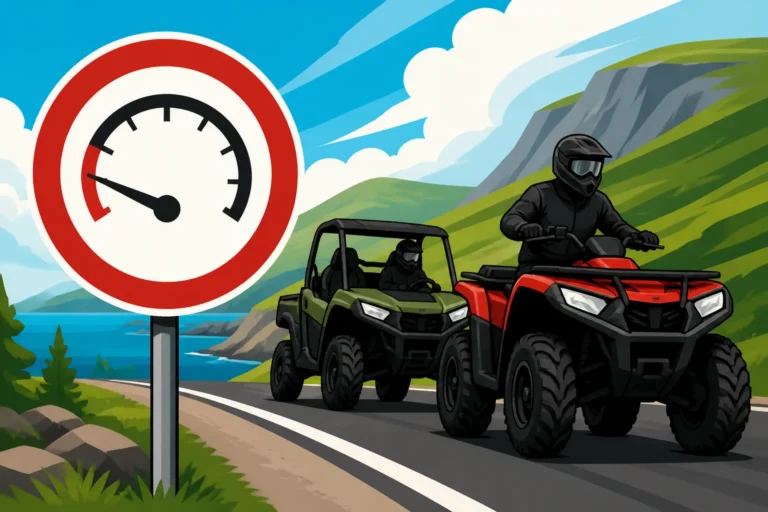
Hand-in-hand with the one-kilometre limit is the critical [Newfoundland's 20 km/h Shoulder Limit]. This isn't just a suggestion; it's a mandatory speed restriction designed to further mitigate the risks associated with mixing ORVs and highway traffic. Going 20 km/h might feel incredibly slow, especially if you're used to higher speeds on trails, but it's deliberately set low to give you maximum reaction time and to reduce the severity of any potential collision.
When you're riding at 20 km/h, you have more time to react to unexpected obstacles, other vehicles, or changing road conditions. It also makes you more predictable to highway drivers who might be approaching from behind or passing you. Imagine trying to quickly stop or swerve at a higher speed on a potentially uneven or gravelly shoulder – it's a recipe for disaster. This reduced speed helps ensure that even if a mishap occurs, the impact is less severe for everyone involved.
Many riders, perhaps out of impatience or a misjudgment of safety, are tempted to push past this limit. But remember, an officer observing you exceeding 20 km/h on a highway shoulder can issue a ticket. This speed limit is a fundamental component of the safety framework, reinforcing the idea that shoulder use is a temporary, highly regulated privilege, not a right to mimic highway speeds. Adhering to [20 km/h on a Shoulder] shows you are a responsible rider, respecting the rules designed to keep you and others safe.
Understanding the Exceptions and What to Avoid
While the one-kilometre, 20 km/h shoulder rule is pretty straightforward, there are nuances and situations where it might not apply, or where different rules take precedence. It's not a blanket permission to ride anywhere along a highway. Knowing these exceptions and what behaviours to steer clear of can save you a lot of grief, both legally and physically. Understanding the spirit of the law, which is about minimizing risk, is key to avoiding common pitfalls.
Riders often have questions about specific scenarios – "What if my trail access is 1.5 km away?" or "Can I just ride to the gas station quickly?" These are valid concerns, but the law is quite strict on this particular point. The goal is to funnel ORV traffic onto designated trails and off public roadways as much as possible, using the shoulder only as a very last resort for short, essential transitions.
No Joyriding or Prolonged Travel
Let’s be absolutely clear: riding on the highway shoulder is strictly for the purpose of getting to or from an off-road trail or private property that is inaccessible by other legal means. It is not for cruising, taking a scenic tour, or simply extending your ride. The provincial regulations are very specific that you are permitted to ride the shoulder [1 Kilometre to Reach a Trail] but only for that express purpose.
If an officer observes you riding back and forth, or traveling a prolonged distance, they will likely view it as a violation of the spirit and letter of the law. You could be pulled over and face penalties, even if you technically stay within the one-kilometre physical limit. The intent of your travel matters here. The law aims to prevent ORVs from becoming a regular fixture on public roads, where they pose a disproportionate risk compared to road-legal vehicles.
This also means you shouldn't be using the shoulder to travel between towns, to visit friends, or for any activity that could reasonably be accomplished by trailering your machine. The "temporary and direct access" clause is paramount. This rule is a practical allowance, not a loophole for general highway travel. Think of it as a brief, necessary evil, not an enjoyable part of your ride.
When the 1 Kilometre Rule Doesn't Apply
There are specific situations where the one-kilometre shoulder rule either doesn't apply or is superseded by other regulations. For example, the rules for [Newfoundland Rules for Crossing a Highway] are separate. While crossing, you might be on the road surface itself for a very brief period, but this is a distinct action from riding along the shoulder. When crossing, you must yield to all highway traffic and ensure [Newfoundland's 150-Metre Crossing Visibility Rule] applies.
Also, many municipalities in Newfoundland and Labrador have their own bylaws regarding ORV use within their town limits. A town council might have designated specific roads or sections of roads where ORVs are permitted, or they might have outright banned them from all roads and shoulders within their jurisdiction. These local bylaws often take precedence over the provincial shoulder rule if they are more restrictive. It is always wise to check [Newfoundland Municipal Road Bylaws] before you ride in any incorporated area.
Lastly, some private lands, or areas like national parks, have their own specific rules. For instance, national parks generally prohibit ORV use off designated highways, making the shoulder rule irrelevant within their boundaries. Always confirm access and rules for the specific area you plan to ride, especially if it's not a well-established provincial trail. Knowing these variations will prevent you from inadvertently breaking rules specific to a location.
Penalties for Exceeding the Limit
Ignoring the one-kilometre limit or the 20 km/h speed restriction can lead to significant consequences. Peace officers, including the RCMP and provincial wildlife officers, have the authority to enforce the Off-Road Vehicles Act. If you're caught exceeding the distance or speed limit, you can expect a ticket, and fines can range from a few hundred dollars for a first offence. These penalties are designed to be a deterrent, emphasizing the seriousness of these safety regulations.
Beyond the immediate financial hit, repeated violations could lead to more severe outcomes, such as your machine being impounded or even forfeiture in extreme cases. Imagine having your prized ATV or UTV seized because you pushed your luck on a highway shoulder. The costs associated with impoundment, including towing and storage fees, can quickly add up, far exceeding the initial fine. This is why it's so important to adhere strictly to the rules.
An officer might also consider other factors, such as whether your machine is properly registered (e.g., [Newfoundland Charges $95 for an ATV]), whether you have the necessary [Newfoundland Insurance Requirements for Riders], or if you’ve completed your [Newfoundland Safety Training Is Mandatory]. A stop for a shoulder riding infraction can quickly snowball into multiple citations if other requirements aren't met. It’s a costly lesson to learn, so always err on the side of caution and follow the letter of the law.
Practical Tips for Navigating the 1-Kilometre Rule
Riding legally and safely is all about preparation and common sense. While the one-kilometre rule can feel restrictive, especially if your desired trail access is just a little further, there are practical strategies you can employ to stay compliant and minimize risks. It's about being a smart rider, planning ahead, and making safety your top priority. Remember, the rules are there for a reason, and adhering to them protects you and others.
Thinking through your route before you even put your helmet on can make a world of difference. Sometimes, a small detour or a different starting point can completely eliminate the need for shoulder riding, or at least keep it within the legal limits. Don't just hop on and go; consult a map, talk to local riders, and ensure your plan is solid.
Planning Your Route to Minimize Shoulder Use
The best way to adhere to the one-kilometre rule is to avoid needing to use the shoulder for more than that distance in the first place. This requires some advance planning. Before you head out, consult maps – both paper and digital – to identify your start and end points and the available trails. Look for alternative access points to trails that might reduce or eliminate the need for shoulder riding.
Perhaps there’s a side road, a [Newfoundland Woods Road Riding] that parallels the highway, or another managed trail entry point that keeps you entirely off the shoulder. Sometimes, driving an extra few kilometres in your truck with your machine trailered to a different trailhead can save you from a potential ticket and unnecessary risk. For longer trips along the [Newfoundland ATV Trails: The T'Railway and Beyond], you'll be on dedicated multi-use trails, circumventing most highway shoulder concerns.
Always map out your entire intended route, noting any sections where you might need to use the shoulder. If a section looks like it might exceed the one-kilometre limit, consider re-routing or finding a different place to put your machine on the ground. Apps and GPS devices can be incredibly helpful here, allowing you to measure distances accurately and make informed decisions about your path.
Safety First: Visibility and Awareness
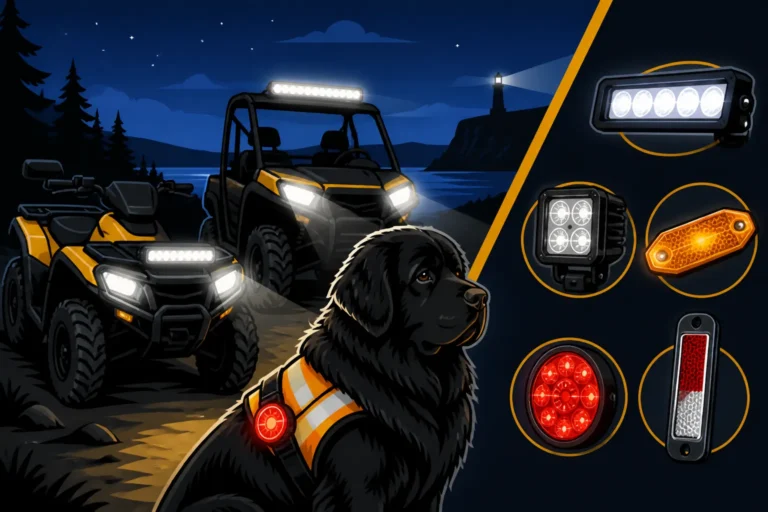
When you absolutely must use the highway shoulder, making yourself as visible as possible is paramount. Remember, highway drivers are often not expecting to see an ORV on the shoulder, especially one traveling at 20 km/h. Brightly coloured riding gear is a good start. Adding reflective tape to your helmet and machine, especially for evening or foggy conditions, can significantly increase your visibility.
Consider aftermarket accessories that enhance visibility. Products from brands like SuperATV, for instance, offer a range of LED light bars, brighter headlamps, and even turn signal kits that can make your UTV or ATV more noticeable to other drivers. While not explicitly required for shoulder riding, these enhancements are a smart investment in your safety. Ensure your machine's stock head and tail lights are fully functional, as these are critical, particularly when riding at dawn, dusk, or in inclement weather.
Beyond visibility, maintaining constant awareness is crucial. Scan ahead for road debris, potholes, or changes in the shoulder's surface. Keep an eye on your mirrors for approaching highway traffic, especially large trucks that create significant wind buffeting. Avoid distractions and maintain a steady, predictable path. Your focus should be 100% on the road and your surroundings during any shoulder-riding segment.
What to Do When You Need More Than 1 Kilometre
Sometimes, despite your best planning, you might find yourself needing to cover more than one kilometre on a highway shoulder. In such situations, the safest and most legal option is almost always to avoid riding the machine on the shoulder at all.
Consider trailering your machine to the next safe access point or a designated parking area where you can offload and continue your ride on legal trails. While it might seem like a hassle to load and unload, it's a far better alternative to risking a ticket, a fine, or worse, an accident on the highway. Many riders keep a small, lightweight ramp in their truck for quick loading and unloading.
If you know you'll frequently encounter longer stretches between legal trail access, invest in a good trailer or explore alternative routes that might involve more gravel roads or designated multi-use trails. For example, some areas might have [Newfoundland Cabin Road Riding] rules that allow for more flexibility than highway shoulders. Don’t try to bend the rules; understand that they are fixed limits for your safety. Always prioritize legality and safety over convenience.
Beyond the Shoulder: Other Road Access Rules
While the one-kilometre shoulder rule is a significant part of ORV road use, it's just one piece of the puzzle. Newfoundland and Labrador have a comprehensive set of regulations governing how and when ATVs and UTVs can interact with public roads. Understanding these broader rules is essential for any responsible rider, ensuring you're compliant whether you're crossing a highway, navigating a municipal street, or just moving between properties.
The province's [Newfoundland ORV Road Rules Explained] aim to create a clear framework that balances public safety with the desire for riders to access the vast wilderness. It's not just about what you can't do, but also about the specific conditions under which certain actions are permitted.
Highway Crossings and Visibility
Distinct from riding along the shoulder is the act of crossing a highway. This is often necessary to connect two trail systems or access property on the opposite side of a main road. The rules for [Crossing a Newfoundland Highway Needs 150 Metres of Visibility] are quite specific. Before you cross, you must ensure that you have at least 150 metres of clear visibility in both directions. This means you can see oncoming traffic, and oncoming traffic can clearly see you, for a significant distance.
You must yield to all highway traffic, essentially waiting for a safe gap before proceeding. This isn't a race; it's a careful manoeuvre. The crossing should be made at a right angle to the highway, as directly and quickly as possible, minimizing your time on the paved surface where you are most vulnerable. It's crucial to understand that during a crossing, you are briefly on the main travelled portion of the highway, making awareness and caution even more critical.
Never attempt to cross a highway on a blind corner, over a crest, or where there’s heavy traffic. It's simply not worth the risk. If you can't see, or if traffic is too continuous, you must find an alternative crossing point or another route. A good rule of thumb is: if you have to question whether it's safe to cross, it probably isn't.
Municipal Bylaws and Local Variations
It's absolutely vital to remember that provincial rules, including the one-kilometre shoulder limit, can be superseded or supplemented by local municipal bylaws. Many towns and cities in Newfoundland and Labrador have their own regulations regarding where ORVs can and cannot be operated within their boundaries. Some may permit limited access on certain streets, while others have blanket bans on all road use.
Before you ride your ATV or UTV in or near any incorporated community, it is your responsibility to check their specific bylaws. A quick call to the town office or a visit to their website can save you a significant headache and potential fine. For example, [Newfoundland Rules for Riding in St John's] will be very different from rules in a smaller, more rural community. What's perfectly legal in an unorganized territory might be strictly prohibited just down the road inside a town boundary.
These local rules are often put in place due to noise complaints, safety concerns in residential areas, or to protect specific infrastructure. Respecting these local variations is not only a legal requirement but also a way to maintain good relationships with communities and help ensure continued access for riders where it is permitted. Always check [Newfoundland Municipal Bylaws Lookups Before You Ride] to avoid surprises.
Importance of Registration, Insurance, and Training
Regardless of whether you're on a trail, crossing a highway, or briefly riding a shoulder, your machine and you as the operator must meet fundamental legal requirements. This includes ensuring your ATV or UTV is properly [Newfoundland ORV Registration You Pay Once]. An unregistered machine is an illegal machine, full stop. The province charges different rates depending on your machine type, for instance, [Newfoundland Charges $95 for an ATV] and [Newfoundland Charges $5 for a Trail Bike].
You also need valid [Newfoundland Insurance Requirements for Riders]. The minimum liability coverage is set to protect you and others in case of an accident. While specific policy details vary, having this insurance is non-negotiable for riding anywhere, especially when you might encounter public roads. Officers can ask for proof of insurance, and if you can't produce it within a specified timeframe, you could face penalties.
Finally, proper safety training is mandatory for many riders. If you are a first-time registrant or under the age of 16, [Newfoundland Safety Training Is Mandatory]. Even if you're exempt, taking a safety course is always a good idea, as it equips you with the knowledge and skills to ride responsibly and safely in all conditions, including those tricky moments on a highway shoulder.
Key Road Access Rules for Off-Road Vehicles in Newfoundland
To make things a bit clearer, here's a quick summary of the main points regarding ORV access on and near public roads in Newfoundland.
| Rule Category | Specifics | Key Restriction/Condition |
|---|---|---|
| Shoulder Riding | Use of unpaved/paved strip adjacent to highway. | Max 1 kilometre, 20 km/h speed limit. For direct access only. |
| Highway Crossings | Traversing the main travelled portion of a highway. | 150 metres clear visibility, yield to all traffic, cross at right angle. |
| Municipal Roads | Riding within incorporated town/city limits. | Subject to local bylaws; provincial rules may not apply. Check with municipality. |
| Registration | All ORVs must be registered with the province. | Valid registration document and display plate required. |
| Insurance | Mandatory minimum liability coverage for all ORVs. | Proof of insurance must be carried. |
| Safety Training | Mandatory for first-time registrants and riders under 16 (with exemptions). | Proof of training must be carried. |
| Visibility | Essential when near roads, especially at dawn/dusk/night. | Use lights, reflective gear. SuperATV accessories can enhance. |
This table provides a snapshot, but remember, the details within each category are what truly matter. Always refer to the full regulations and local bylaws for comprehensive guidance.
Disclaimer
This article is for general informational purposes only and does not constitute professional advice. Laws, prices and regulations vary by location and change over time. Consult a qualified professional for guidance on your specific situation.