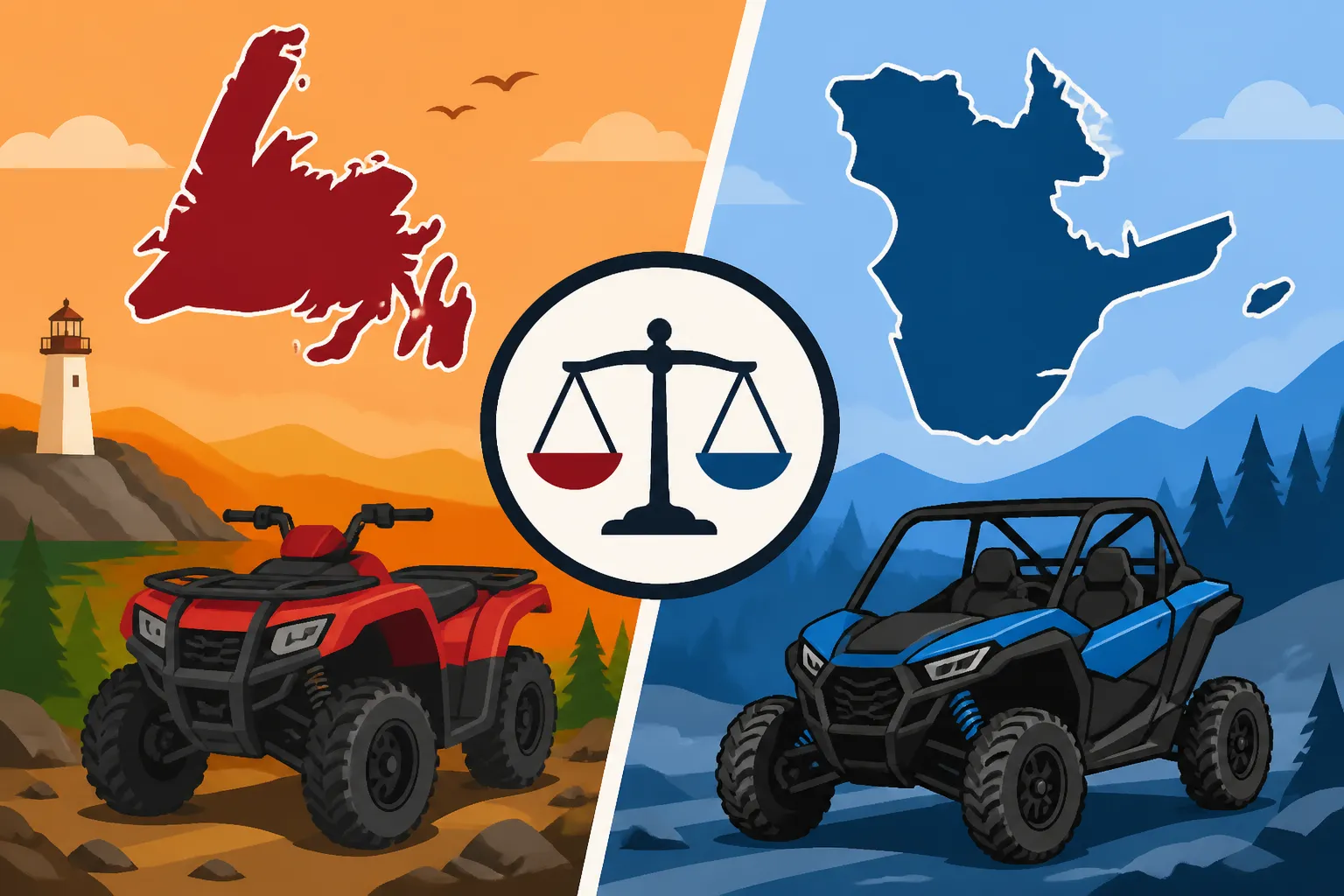
Newfoundland Registration Compared to Quebec
Thinking about getting an ATV or UTV registered can feel like navigating a maze, and that feeling only intensifies when you're looking at different provinces. If you've ever found yourself scratching your head, wondering how Newfoundland's off-road vehicle registration system stacks up against Quebec's, you're not alone. It can be confusing when rules that seem straightforward in one place are completely different just a few hundred kilometres away. This guide is here to untangle the nuances, compare the processes, and help you understand the core differences between registering your machine in Newfoundland and Labrador versus Quebec.
Understanding Newfoundland and Labrador's Registration System
Newfoundland and Labrador has a unique approach to off-road vehicle registration that often surprises riders from other provinces. The province has put in place a system that, once you understand it, is designed for long-term simplicity for owners.
The "Pay Once, Own Forever" Philosophy
One of the most striking differences you'll find in Newfoundland and Labrador is the "pay once, own forever" philosophy when it comes to ORV registration. Unlike many other jurisdictions that require annual renewals, Newfoundland's system is a one-time fee. This means that once your machine is registered and you've paid the initial fee, that registration remains valid for as long as you own the vehicle. You won't receive annual renewal notices in the mail, and you won't have to worry about missing a payment and facing fines for an unregistered machine. It's a significant departure from the typical annual sticker or plate renewal cycle many riders are accustomed to, providing a sense of long-term stability and predictability. For a new ATV, the fee is a fixed [Newfoundland Charges $95 for an ATV], a point of relief for many owners. Similarly, a trail bike has a remarkably low [Newfoundland Charges $5 for a Trail Bike] registration fee. This is definitely one of the biggest benefits of the system. In fact, many people ask [Why a Newfoundland ATV Registration Never Needs Renewing], and the answer is simply that the province decided to make it a perpetual registration once completed. This also means your [Newfoundland Registration Valid While You Own It].
This one-time fee structure also means less administrative hassle over the years. Imagine not having to mark a renewal date on your calendar or dig out your credit card every spring. For many riders who plan to keep their machines for a long time, this system feels like a breath of fresh air. It removes a common source of frustration and oversight, allowing you to focus more on enjoying the trails and less on provincial paperwork. It really is a simple concept: [The Newfoundland Fee You Pay Once and Never Again].
What You Need to Get Registered in Newfoundland
Getting your off-road vehicle registered in Newfoundland and Labrador involves a specific set of documents and steps to ensure everything is above board. Whether you're buying new from a dealer or picking up a used machine from a private seller, the process is clearly outlined to prevent issues down the road.
For a brand new machine, the most critical piece of paperwork is the New Vehicle Information Statement (NVIS). This document is provided by the dealer and proves that the vehicle is new and has never been registered before. Without it, you won't be able to complete your initial registration. When you're buying used, the chain of ownership becomes paramount. You'll need [Newfoundland Bills of Sale From Each Owner] leading back to the original registered owner. This can sometimes be a headache if a previous owner misplaced a bill of sale, but it's essential for the registry to confirm the legal transfer of ownership. For a clear understanding of the full process, you can consult [Newfoundland Registration Paperwork Explained].
In situations where a clear bill of sale history is hard to trace, especially for older machines or those acquired through non-traditional means, the province does have provisions for a sworn affidavit and an indemnity form. These forms essentially allow you to declare ownership under oath and indemnify the province against future claims. While a bill of sale is always preferred, having these alternative solutions can be a lifesaver for those facing lost paperwork. If you ever find yourself in a bind needing to create these kinds of official documents, especially for a private sale, resources like LawDepot can be helpful for generating templates that adhere to general legal standards, though you should always confirm provincial requirements.
Transferring Ownership in Newfoundland
The process of transferring ownership when buying or selling a used off-road vehicle in Newfoundland and Labrador is also fairly streamlined, but it has its own specific requirements and costs. This is where the one-time registration fee benefit truly shines, as the machine itself is already "in the system."
When you sell a machine, the existing registration isn't tied to you personally, but rather to the vehicle itself. The buyer simply needs to complete a transfer of ownership at a Motor Registration Division office. This involves providing the bill of sale, the previous owner's registration permit, and paying a transfer fee. While the initial registration is a one-time deal, transferring ownership does incur a separate, much smaller fee. For most transfers, there's a standard cost, but the province also offers a reduced rate for seniors: [Newfoundland Transfers Cost $16 for Seniors]. This consideration for senior riders is a nice touch, easing the financial burden slightly. The whole process is clearly detailed in [Newfoundland Transfer of Ownership Explained].
One particularly empathetic aspect of Newfoundland's system is how it handles transfers after the owner passes away. In these often difficult circumstances, the province simplifies the process by making the transfer of ownership completely free for the beneficiaries. This eliminates an unnecessary financial strain during a challenging time, allowing families to manage the estate without added costs for vehicle transfers. It's a small but significant detail that reflects a thoughtful approach to registration regulations, something you might not see universally. If you're managing an estate, understanding [Newfoundland Transfers on Death Cost Nothing] can provide some relief.
Navigating Off-Road Vehicle Registration in Quebec
Quebec's approach to ATV and UTV registration, while also designed for clarity, operates on a fundamentally different principle than Newfoundland's. Riders in Quebec will find a system more aligned with conventional vehicle registration in many parts of North America, featuring annual renewals and distinct physical identification.
The Annual Renewal Expectation in Quebec
Unlike the enduring, one-time registration in Newfoundland, Quebec's system requires off-road vehicle owners to renew their registration annually. This means every year, typically before a certain date, you'll need to pay a fee to keep your ATV or UTV legally registered for use on trails and approved areas. The registration comes with a specific plate or sticker that must be displayed on your machine, signifying its current registration status. This system, while common, can be a source of frustration for some riders who prefer a more "set it and forget it" approach.
The annual renewal isn't just a matter of convenience; it's a legal requirement. Failing to renew your registration can lead to fines, and operating an unregistered machine can result in more serious penalties. This means riders in Quebec must be diligent about tracking their renewal dates and ensuring their paperwork and payments are up to date. While it provides an annual touchpoint for the province to manage its ORV fleet, it also places an ongoing responsibility on the owner. You'll need to budget for these recurring costs and stay on top of any changes to the fee structure.
Costs and Documents for Quebec Registration
The costs associated with registering an off-road vehicle in Quebec typically include an initial registration fee, followed by the annual renewal fees. These fees can vary based on the type of machine (e.g., ATV, side-by-side, dirt bike) and sometimes its engine size or weight. It's not just about the initial purchase; you're signing up for an ongoing financial commitment. These annual fees contribute to the maintenance of trails, enforcement, and other aspects of the province's off-road vehicle management.
When registering a machine in Quebec, you'll generally need proof of ownership, such as a bill of sale or previous registration certificate, and personal identification. For new machines, documentation from the dealer is standard. For used machines, a clear paper trail from the previous owner is important. Ensuring your bill of sale is properly executed and complete is critical for both the buyer and seller. Generic legal document providers like LawDepot offer templates for bills of sale and other transfer documents that can help ensure you have all the necessary details covered, which can be particularly useful in private sales where there isn't a dealer to handle the paperwork.
Transferring Ownership in Quebec
Transferring ownership of a used off-road vehicle in Quebec also follows a structured process. When a machine is sold, the seller is usually responsible for notifying the Société de l'assurance automobile du Québec (SAAQ) of the transfer, and the buyer must then register the machine in their name. This typically involves presenting the bill of sale, the previous registration certificate, and personal identification at an SAAQ service outlet.
The transfer will usually incur a fee, and the new owner will then be responsible for the annual renewals going forward. This system ensures that the province always has an accurate record of who owns which registered machine, which is important for enforcement, accident reporting, and other administrative purposes. For sellers, providing a clear bill of sale and making sure to complete their part of the transfer process helps to avoid any lingering liability for a machine they no longer own. Whether you're in Quebec or Newfoundland, ensuring a robust bill of sale, perhaps even using a template from a service like LawDepot, can provide peace of mind for both parties in a private sale.
Newfoundland vs. Quebec: A Direct Comparison for Riders
When you put the two systems side-by-side, the differences become quite clear. For a rider planning to purchase or move an ORV, these distinctions can significantly impact the long-term cost and administrative burden.
Registration Fees and Ongoing Costs
This is arguably the most significant difference between the two provincial systems.
In Newfoundland and Labrador, you're looking at a one-time registration fee when you first register your machine, which is then valid indefinitely as long as you own it. There are no annual renewal fees, making it a very cost-effective option over the lifespan of the vehicle. For example, [Why an ATV Registration Costs $95 in Newfoundland] is a question with a clear, one-time answer.
Quebec, conversely, operates on an annual renewal system. Riders must pay a registration fee every year to keep their machines legally registered. While the initial fee might be comparable or even lower than Newfoundland's one-time charge, the cumulative cost over several years can certainly add up. This recurring expense is a key budgeting consideration for Quebec riders.
| Feature | Newfoundland and Labrador | Quebec |
|---|---|---|
| Registration Fee | One-time fee, valid for lifetime of ownership | Annual registration and renewal fees |
| Renewal Required | No | Yes, annually |
| Physical Marker | Identification plate/sticker | Identification plate/sticker |
| Transfer Fees | Yes, for ownership change (reduced for seniors, free for death) | Yes, for ownership change |
| Long-Term Cost | Lower, due to no annual renewals | Higher, due to cumulative annual renewals |
Identification Plates and Stickers
Both provinces require physical identification on your off-road vehicle, but the specifics of what you get and how it's renewed differ.
Newfoundland and Labrador issues an identification plate (or sticker, depending on the machine class) that is permanently attached to your ORV. Since there are no annual renewals, you won't be getting a new sticker each year to update the plate. This permanent identification signifies that the machine is registered in the provincial system. You'll want to ensure this plate is kept clean and visible; [Newfoundland Plates Kept Free of Mud] is a common enforcement reminder. The province also issues a registration permit, which is your proof of registration and should be carried with you while riding. People often ask, [Do You Get a Plate or a Decal?], and it depends on the specific class of machine.
In Quebec, you'll receive a plate or sticker that needs to be renewed annually. This annual renewal typically involves receiving a new sticker to affix to your plate, showing that your registration is current for the given year. This system is very familiar to anyone who's registered a car or motorcycle in most provinces. It's a visual cue for enforcement officers that your machine is legally compliant for the current period.
Impact on Out-of-Province Riders and New Residents
For riders moving to either province or simply visiting, these differing registration rules become particularly important.
If you're visiting Newfoundland and Labrador from Quebec, your Quebec registration is typically recognized for a specific period. [Newfoundland's 30-Day Visitor Exemption] allows you to ride your properly registered and insured machine from another jurisdiction for up to 30 days. Beyond that, you would need to register your machine in Newfoundland. Similarly, new residents have a window to transfer their registration: [Newfoundland's 90-Day New Resident Rule].
Conversely, if a Newfoundland-registered ORV rider visits Quebec, their Newfoundland plate would likely be accepted for a visitor period, provided all other Quebec operating rules (like insurance, helmet laws, and trail access permits) are met. However, if you're moving from Newfoundland to Quebec, you would definitely need to go through the full Quebec registration process, including paying the initial fees and committing to annual renewals. This transfer involves more than just an ownership change; it's a fundamental shift from a one-time system to an annual one.
Understanding these differences is crucial not only for compliance but also for budgeting and managing your off-road adventures effectively. Whether you appreciate the long-term simplicity of Newfoundland's system or are accustomed to Quebec's annual checks, knowing what to expect can save you time, money, and headaches on the trail.
Disclaimer
This article is for general informational purposes only and does not constitute professional advice. Laws, prices and regulations vary by location and change over time. Consult a qualified professional for guidance on your specific situation.