Newfoundland Fire Season Dates
Newfoundland’s fire season dates matter if you ride an ATV or UTV, carry camping gear, or plan to stop for a cookout. The season does not automatically ban every campfire, but it does mean wildfire rules and local restrictions deserve a place in your trip plan. Here’s how the dates work, what they do and don’t mean, and what to check before you head out.
Newfoundland and Labrador fire season dates
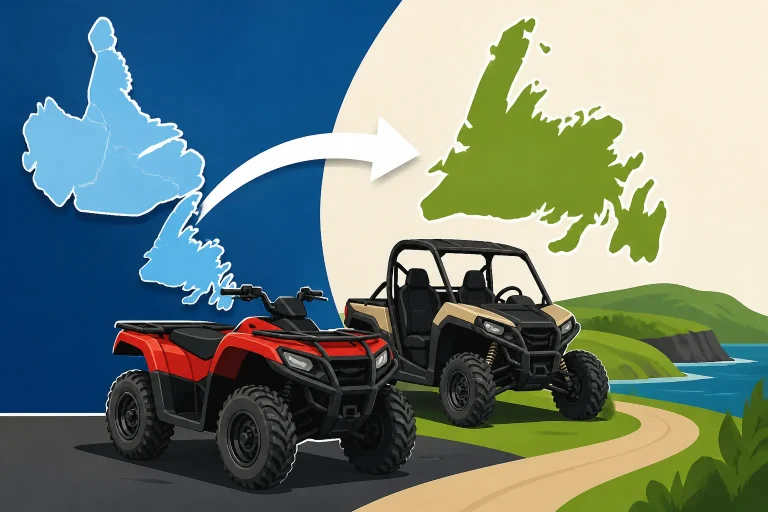
The usual provincial dates differ between the island of Newfoundland and Labrador:
| Area | Usual fire season dates | Practical planning point |
|---|---|---|
| Newfoundland island | May 1 through September 30 | Check for local restrictions and current fire notices before lighting any fire or burning debris. |
| Labrador | May 15 through September 30 | Do not assume the island’s start date applies in Labrador; check the rules for your specific area. |
The season begins earlier on the island than in Labrador, but both usual seasons end on September 30. You can read more about the date distinction in Newfoundland’s Fire Season Starts the First of May and Labrador Fire Season From Mid-May. For the shared end date, see Both Fire Seasons End on September 30.
Treat those dates as the standard calendar framework, not as a promise that every activity is allowed throughout the period. Fire danger can rise well before a planned trip, and restrictions can change with conditions. A fire ban or area closure may be in effect when you arrive, even if your trip was planned weeks earlier. Conversely, the fact that it is fire season does not by itself mean every campfire is automatically prohibited.
Check current provincial fire information before you travel, and check again close to the day you ride. If you will be on a managed trail, private land, in a park, or near a community, also ask the organization or land manager responsible for that place. A provincial notice may not be the only rule that applies.
What the dates mean for a ride
For ATV and UTV riders, fire season is a useful reminder to think about ignition risks as well as campfires. A hot exhaust, dry grass trapped near the machine, a cooking fire, or a badly placed cigarette can all create trouble in dry conditions. A ride that does not include camping still deserves a quick look at fire conditions, especially if the route crosses exposed barrens, woodland, or dry vegetation.
Do not plan around the calendar alone. Weather, recent rain, wind, vegetation, and local notices all affect the practical risk. A wet morning does not guarantee that the ground is safe for a fire later in the day, and a forecast that looks manageable at home may not reflect conditions at your destination.
Fire season does not mean every fire is banned
The main distinction to keep in mind is between the official fire season and a fire restriction or ban. The season is the period when wildfire prevention rules and seasonal controls apply. A restriction or ban is a specific limit on an activity, usually introduced because conditions or local risks require it.
That distinction matters because riders often make one of two mistakes: assuming they can have a fire because there is no blanket provincial ban, or assuming every fire is forbidden simply because the season has started. Neither assumption is reliable. The current rules depend on the activity, location, land manager, and any active notices.
A campfire for cooking, a fire for warmth, a brush pile burn, and an ATV exhaust near dry vegetation are not necessarily treated the same way. The requirements for open burning can differ from the rules for a small recreational fire. If you are considering burning brush or other debris, do not treat a campfire rule as permission to do so. Check the applicable permit requirements and restrictions for that type of burning.
Likewise, a permit does not necessarily override a fire ban, closure, municipal bylaw, or landowner restriction. If an activity is restricted, having a permit for a different purpose does not make it acceptable. The safest approach is to confirm the exact activity you intend to do, rather than asking only whether “fires” are allowed.
For more detail on restrictions that affect riders, see [Newfoundland Fire Season Riding Restrictions]. If your plan includes an open fire on a trail or at a stop, check Newfoundland Burning Permits for a Campfire on the Trail as well as current notices. When the wording is unclear, contact the relevant authority or land manager before you light anything.
Check the place, not just the province
A ride may pass through several types of land in one day. Rules can differ on provincial land, private property, managed trails, municipal land, and protected areas. A community may have its own fire or outdoor-burning bylaw. A trail operator may close a section or prohibit campfires at a staging area. A park may apply separate conditions.
That means a general provincial fire-season date is only the starting point. Before you set out, identify where you plan to stop and who manages that location. If you are riding through an area with access restrictions, verify those too. Fire permission does not grant permission to ride on land where vehicle access is prohibited; [Newfoundland Crown Land Access Rules] explains why land access and fire rules need to be considered separately.
What ATV and UTV riders should check before leaving
A short pre-ride fire check can prevent a frustrating change of plans and reduce the chance of causing a wildfire. Make it part of the same routine as checking the trail, fuel, weather, and machine.
- Confirm the location’s fire-season dates. Check whether your route is on the island of Newfoundland or in Labrador. If you are near a boundary or your route covers a wide area, confirm the relevant rules for every part of the trip.
- Look for current restrictions or closures. Check provincial fire notices close to departure, not only when you first book a trip. Look for updates from the municipality, park, landowner, or trail operator as well.
- Decide whether you actually need an open fire. A cold meal or a stove used where permitted may be a safer alternative to a campfire. Do not assume a stove is exempt from every restriction; check the terms of any active notice.
- Check the weather and ground conditions. Wind, dry vegetation, and exposed peat or grass can make even a small ignition risk more serious. Be cautious when conditions have changed since the last rain.
- Inspect your machine. Remove grass, peat, leaves, and other debris from around the exhaust and other hot areas. Check again after riding through thick vegetation or bog.
- Pack suitable fire-control equipment. If you choose to carry an extinguisher, secure it where it can be reached and make sure it is appropriate for the hazards you may encounter. Carry water where practical, but do not rely on a small amount to put out a spreading fire.
- Tell the group the plan. Make sure everyone knows whether fires are allowed, where the group will stop, and what to do if someone spots smoke or an unattended fire.
- Have a no-fire alternative. If a ban is announced or conditions deteriorate, be ready to skip the fire rather than trying to find a loophole.
For a fuller look at seasonal trail planning, see Newfoundland Trail Conditions Before You Ride. A route can be technically open while a particular activity at a campsite, trailhead, or roadside stopping place is not.
Recheck on the day
A notice you checked several days earlier may no longer be current. Conditions can change quickly, and an area can be restricted after a dry spell or a change in wind. Before lighting a fire, check for the latest information again. If you cannot confirm the rules, do not light it.
For a group ride, assign someone to make the final check rather than relying on “I thought someone else looked.” If a group splits up, the people at each stopping point should know that the original plan does not automatically carry over to a different site.
Campfires, cooking, and open burning
Not all outdoor fires are the same. A small recreational fire, cooking equipment, and a debris burn can have different rules and risks. The details depend on the location and current conditions, so avoid broad assumptions such as “small fires are always allowed” or “a stove is always fine during a ban.”
Before using any fire or cooking device, confirm what the current restriction covers. Read the full notice rather than relying on a short headline or an old post shared in a group chat. If the notice is unclear about your equipment or intended use, ask the issuing authority or land manager.
For open burning, check the specific permit and safety requirements for the material and location. Do not use a recreational campfire as a model for a brush burn. A debris fire can produce more heat and embers, and it can escape even when it appears contained. Do not start a burn if conditions are windy, the ground is dry, or you cannot keep it attended and fully controlled.
For any permitted fire, choose a suitable location and follow the directions that apply there. Keep it away from dry grass, brush, roots, and other combustible material. Do not build it under low branches or beside a machine, trailer, fuel container, or stack of gear. Keep people, children, and pets at a safe distance. Never leave a fire unattended, even for a quick ride or a short walk.
When you are finished, extinguish the fire completely. Add water carefully, stir the ashes and embers, and repeat until nothing is smouldering or giving off heat. Do not assume that covering embers with soil is enough; buried material can remain hot and reignite. If water is unavailable or the fire cannot be put out safely, do not start it in the first place.
Alternatives for a trail stop
For a short stop, a packed meal may be simpler than bringing a fire setup. Where permitted, a properly used portable cooking device may be another option, but restrictions can cover more than open flames. Confirm the current notice before relying on it. Carry fuel and cooking gear securely, away from hot machine parts, and do not refuel a hot device.
If your group is used to having a campfire, decide in advance what you will do if the rules prohibit one. That avoids pressure to light a fire simply because everyone expected it. It also makes the trip more comfortable: riders can bring warm layers, food that does not need cooking, and a sheltered stopping plan instead.
Reduce ignition risks from your machine
An ATV or UTV does not need an open flame to create a fire hazard. Hot exhaust components can ignite dry material, and vegetation can collect around the engine or underbody. This is especially relevant after riding through long grass, brush, or boggy ground where plant matter and peat may cling to the machine.
Stop on a surface that is clear of dry vegetation when you can. Avoid idling over dry grass, brush, or other material that could touch hot components. After a demanding section, inspect the underside and exhaust area before parking for a longer break. Remove trapped debris only when it is safe to do so; hot parts can burn you.
Do not treat the absence of a spark-arrestor requirement as proof that a machine cannot start a fire. Equipment rules and fire risk are separate questions. The practical guidance in Why No Spark Screen Is Required in Newfoundland should not be read as permission to ride carelessly through dry vegetation. Your machine must still meet applicable equipment and muffler requirements, and you should take reasonable steps to avoid ignition.
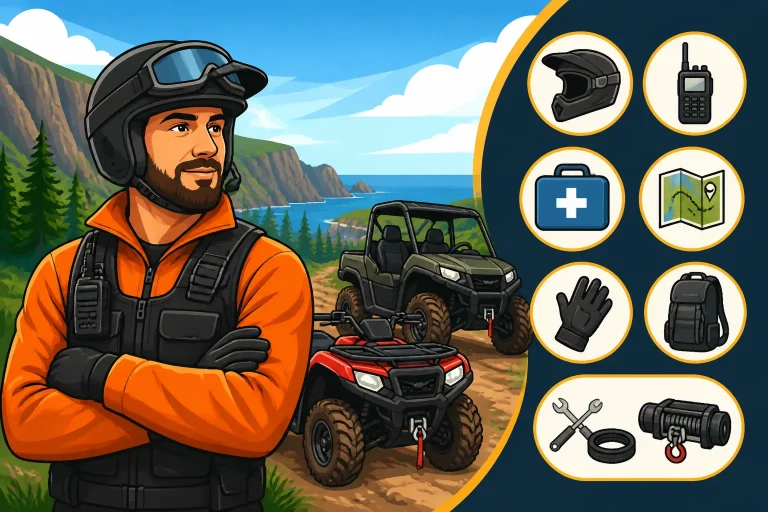
A practical fire-safety kit can include a suitable extinguisher, a small shovel, water, and a way to communicate if there is an emergency. Choose equipment that fits your machine and ride; secure it so it cannot shift, block controls, or become a hazard in a rollover. A small extinguisher is useful only if it is accessible and the fire is still small enough to address safely. Do not put yourself in danger trying to fight a spreading wildfire.
You can compare basic outdoor safety gear at local retailers or on Amazon, but check the product’s suitability, condition, mounting method, and instructions before relying on it. A compact tool is not automatically adequate for every fire, and the correct choice depends on the machine, route, and intended use.
Keep fuel and hot equipment apart
Carry fuel only in suitable, secured containers and keep it away from heat, flames, and electrical sources. Do not refuel while a machine or cooking device is hot. If you carry a portable stove, store its fuel and components according to the manufacturer’s instructions. A loose fuel bottle bouncing around in a cargo box is a poor arrangement on rough ground.
After a long ride, give the machine time to cool before parking it near dry vegetation or placing a cover over it. A cover can trap heat or contact hot parts if used too soon. If your vehicle has a winch, auxiliary lighting, or other accessories, make sure their wiring is in good condition; damaged electrical components are another reason to inspect a machine before a long trip.
When comparing compact extinguishers, shovels, or fire-resistant storage options, Amazon may offer a broad selection, but do not buy by size or appearance alone. Check the label, intended use, mounting requirements, and whether the item can handle the conditions of your ride. Keep the instructions with the equipment or make sure someone in the group knows how to use it.
What to do if you see smoke or a fire
If you spot smoke or flames, do not assume another rider has already reported it. Move to a safe place, contact emergency services or the appropriate fire authority, and give a clear location. Use recognizable landmarks, road or trail names, direction of travel, and any other details that will help responders find the site. Do not ride toward the smoke to investigate.
If a small fire has just started and you can address it without putting yourself or others at risk, use the equipment you have and follow its instructions. Leave immediately if it is spreading, producing heavy smoke, or moving toward your group. Do not attempt to fight a wildfire with a small extinguisher, a few bottles of water, or a shovel if doing so would expose you to heat, smoke, or an escape route that is closing.
Once you are safe, report what you saw as accurately as possible. Avoid exaggerating or guessing about the cause. If the fire is near a trail, tell the operator or land manager as well, but do not delay an emergency report while trying to find the right office.
Keep your group together as you leave. Smoke can reduce visibility, and a fast exit may separate riders. If the route back is threatened, use a safe alternative rather than continuing toward the fire or entering an area with poor visibility. Follow directions from responders and authorities, even if that means ending the ride early.
A responsible rider also reports a fire that appears to have been extinguished but may still be smouldering. Peat, roots, and buried organic material can hold heat below the surface. Do not assume that a fire is out because flames are no longer visible.
Planning rides through the season
The fire-season calendar is useful for scheduling, but a good plan accounts for changing conditions. A spring trip can still encounter dry vegetation, and an autumn ride before the season ends can still be affected by a temporary restriction. Think of the dates as a prompt to check, not as a complete safety forecast.
If you are arranging a weekend, club ride, or overnight trip, make fire conditions part of the go-or-no-go decision. Choose a backup meal plan and a campsite or stopping area that does not depend on a fire. If the route includes managed trail facilities, ask the operator about current closures or fire-related rules before the group arrives. For other trail obligations, see [Newfoundland Managed Trail Rules].
For rides in more remote areas, prepare for limited communication. Let someone know your route and expected return time, and carry a way to contact help that suits the area. A paper map can be useful when phone coverage is unreliable. Avoid taking a route into a restricted or closed area just to get around a fire notice; the closure may be in place for safety, access protection, or both.
Build a seasonal checklist
Before each ride during fire season, confirm:
- The correct start and end dates for the part of the province you will visit.
- Whether a fire ban, restriction, or area closure is active.
- Whether your planned stopping place is managed by a municipality, park, landowner, or trail operator with additional rules.
- Whether your intended fire or cooking method is allowed under the current notice.
- Whether the machine is clear of vegetation around hot parts.
- Whether your fire-control gear is accessible, in working order, and secured.
- Whether everyone in the group knows how to report a fire and where to go if the route is affected.
- Whether you have a no-fire meal and overnight plan.
The checklist is not a substitute for current rules, but it helps stop common oversights. It is particularly useful when several people are making arrangements and one person assumes someone else has checked the restrictions.
Keep the plan flexible
A fire restriction can be announced after you leave home. Leave room in your itinerary for a changed route, an early return, or a different overnight stop. If you are already riding when a notice changes, follow directions from the responsible authority and do not continue into a closed area.
For visitors, do not rely on advice from a previous trip or assume that conditions are the same across the province. The island and Labrador have different usual start dates, and local notices can differ even within the same region. A quick check with the relevant official source or trail operator is a better basis for a decision than a remembered rule.
Fire season is manageable when you separate the calendar from the day’s conditions. Know the usual dates, confirm the current restrictions, and treat your machine and camp setup as potential ignition sources. That approach lets you enjoy a ride without making a preventable fire risk part of the trip.
Disclaimer
This article is for general informational purposes only and does not constitute professional advice. Laws, prices and regulations vary by location and change over time. Consult a qualified professional for guidance on your specific situation.