Newfoundland Rules for an Out-of-Province Machine
Riding your ATV or UTV in a new province can be an exciting adventure, but it often comes with a whole lot of head-scratching about local rules and regulations. If you're bringing your off-road machine to Newfoundland from out-of-province, you're probably wondering what paperwork you need, if your registration from home is still valid, and when (or if) you'll have to deal with the local Motor Registration Division. This guide is designed to cut through the confusion and explain exactly what's expected of you and your machine, whether you're here for a short visit or making Newfoundland your new home.
The Initial 30-Day Grace Period for Visitors
Newfoundland & Labrador welcomes off-road vehicle enthusiasts, and the province actually has a pretty sensible system in place for visitors. You don't have to scramble to register your machine the moment your tires hit the pavement off the ferry. There's a grace period designed to let you enjoy the trails without immediate bureaucratic hurdles.
What Qualifies as a "Visitor" and the Time Limit
When the Off-Road Vehicles Act refers to a "visitor," it's talking about someone who doesn't ordinarily reside in the province. This means if your permanent home address is in Nova Scotia, Ontario, or anywhere else outside of Newfoundland and Labrador, you're considered a visitor. The crucial part of this is the 30-day exemption. For the first 30 days that your out-of-province machine is in Newfoundland, it can be operated without requiring local registration or an identification plate. This allows you to bring your quad or side-by-side, hop off the ferry, and head straight for the amazing trails without delay. It's a fantastic feature that many other jurisdictions don't offer, making it easier to plan a riding vacation.
However, this 30-day window is a hard limit. It doesn't mean 30 days of riding; it means 30 calendar days from when your machine first enters the province. So, if you're planning an extended stay or multiple short visits over a longer period, you'll need to keep a close eye on the calendar. After those 30 days are up, the exemption no longer applies, and your machine would technically be operating illegally if it hasn't been registered in Newfoundland. Understanding [Newfoundland's 30-Day Visitor Exemption] is crucial for any non-resident rider.
Keeping Your Home Province's Registration and Insurance Valid
While you're enjoying the 30-day exemption, it's absolutely vital that your machine remains properly registered and insured in your home province or state. Newfoundland's rules allow your out-of-province registration to stand in for a local one during this period, but that doesn't mean you can slack off on your home jurisdiction's requirements. Think of it this way: Newfoundland is temporarily accepting your home province's paperwork as sufficient. If that paperwork isn't valid back home, it's not valid here either.
This also extends to insurance. You're still required to carry proof of at least the minimum liability insurance required by Newfoundland, which is currently $200,000. Most policies from other Canadian provinces or U.S. states will meet or exceed this, but it's always wise to double-check with your insurer before you travel. Having your [Newfoundland Insurance Requirements for Riders] in order, even as a visitor, is a non-negotiable safety net. Always carry physical or digital proof of your valid registration and insurance with you when you ride, as an officer can ask to see it at any time.
What Happens If You Stay Longer Than 30 Days?
If your Newfoundland adventure extends beyond the 30-day mark, or if you decide you love it so much you want to make it your permanent home, the rules change. Once that 30-day visitor exemption expires, your out-of-province registration is no longer recognized. At this point, you must register your off-road vehicle in Newfoundland. This isn't just a suggestion; it's a legal requirement, and riding an unregistered machine can lead to fines and even seizure of your ATV or UTV.
For those simply extending a visit, it means a trip to Motor Registration is in order. For those making the permanent move, there's a slightly different process. We'll dive into the specifics of permanent moves next, but for visitors, be mindful of that 30-day limit. If you plan to be here longer, proactively plan to get your machine registered locally to avoid any unpleasant surprises. It's better to spend a bit of time at the registry than risk a significant fine or having your machine impounded.
Becoming a New Resident and Registering Your Machine
Deciding to make Newfoundland and Labrador your new home is a big step, and bringing your off-road machine with you means you'll eventually need to switch its registration over to the province. Unlike the visitor exemption, there's a specific timeframe for new residents to get their affairs in order.
The 90-Day Window for Newcomers
If you're moving to Newfoundland and Labrador to become a permanent resident, the province offers a more generous window than the visitor exemption: 90 days. This means you have three months from the date you establish residency to transfer your out-of-province off-road vehicle registration to a Newfoundland registration. This 90-day period gives you a bit more breathing room to settle in, find a place, and get acquainted with your new community before tackling the paperwork. It’s an important distinction from the 30-day rule for temporary visitors, acknowledging the greater logistical challenges of a full relocation.
During this 90-day period, your machine's existing out-of-province registration and insurance are still considered valid, similar to the visitor rule. However, just like with visitors, your home province's documents must be current and valid. You can't let your old registration lapse, expecting the 90-day Newfoundland window to cover you. The intent of this rule is to provide a smooth transition, not a loophole. Understanding [Newfoundland's 90-Day New Resident Rule] is key to a hassle-free move.
Required Paperwork for Out-of-Province Transfers
Transferring an out-of-province registration isn't overly complicated, but it does require specific documents. You'll need to gather these before heading to Motor Registration. The provincial government expects you to provide proof of ownership, which usually means the original bill of sale or your existing registration document from your previous jurisdiction that clearly shows you as the owner. If you don't have the original bill of sale, the previous registration or title document from your old province will often suffice.
You'll also need proof of your Newfoundland and Labrador address, like a utility bill or lease agreement. Of course, a valid piece of government-issued identification will be required. For machines that were purchased new in another province and are being registered here for the first time by a new resident, you might need the New Vehicle Information Statement (NVIS) if it's a newer machine. This certifies that the machine is indeed new and hasn't been previously titled. For most used machines, a valid out-of-province registration in your name, along with the bill of sale, should be sufficient. Don't forget, if you financed your machine, you'll need any lien information to be cleared or acknowledged as part of the process. Bringing [Newfoundland Registration Paperwork Explained] will help ensure a smooth visit to Motor Registration.
Understanding the Costs and Process
The actual process of registering your out-of-province machine once you become a resident is similar to any other new registration in Newfoundland. You'll need to book an appointment at a Motor Registration office, which is always a good idea to save time. When you arrive with your paperwork, a registry agent will process your application. You'll fill out a form, declare the vehicle's details, and pay the one-time registration fee. This fee varies depending on the type of machine. For example, a typical ATV costs $95, while a trail bike is only $5, and a snow groomer costs $10. These are one-time fees, as [Newfoundland Registrations Never Expire] as long as you own the machine.
You'll also be assessed for any applicable sales tax (HST) if the machine was purchased recently and tax wasn't collected or was collected at a lower rate in your previous jurisdiction. This can sometimes be a surprise for newcomers, so be prepared for it. Once everything is processed, you'll be issued a Newfoundland identification plate or decal, which must be affixed to your machine in a visible, unobstructed manner. Make sure you understand [Newfoundland Permits, Plates and Decals] to ensure compliance. The entire process is usually straightforward if you have all your documents in order, but allow ample time for your appointment.
Essential Riding Rules for All Machines, Regardless of Origin
Whether you're a visitor for 30 days or a new resident settling in, every off-road vehicle operator in Newfoundland and Labrador must abide by the province's operating rules. These aren't just suggestions; they are laws designed to keep everyone safe and preserve the beautiful, rugged landscape.
Mandatory Safety Gear and Machine Equipment
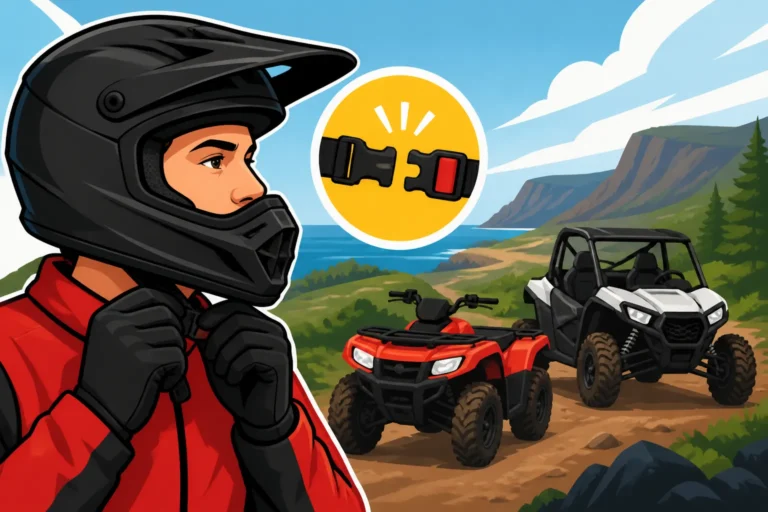
Safety is paramount when riding ATVs and UTVs, and Newfoundland's rules reflect this. For starters, helmets are mandatory for both operators and passengers on any off-road vehicle. This isn't just about wearing one, but ensuring it's properly fastened and meets recognized safety standards (like CSA, DOT, or ECE). No helmet, no ride. Eye protection is also required, unless your machine has a windshield or an enclosed cab, as is common with many side-by-sides. If you're riding a side-by-side, seat belts must be worn if the machine is equipped with them from the factory. These are basic, non-negotiable requirements for everyone on board.
Beyond personal gear, your machine itself needs to be properly equipped. If you're riding after sunset or before sunrise, or in any conditions with reduced visibility like heavy fog, your machine must have working head and tail lamps that are clearly visible. Reflectors are also a good idea. Your exhaust system must be in good working order and meet manufacturer specifications; loud, modified, or "cut-out" exhausts are illegal and can lead to fines. Make sure your tires are appropriate for the machine and the terrain. For example, while [Newfoundland Tire Chains Are Now Allowed] on certain machines and conditions, it's about making smart choices for safety and impact on the trails. You'll want to ensure all your machine's components, perhaps even considering aftermarket upgrades from companies like SuperATV for enhanced safety or performance, are in top shape.
Navigating Roads: Crossings, Shoulders, and Highways
Newfoundland's landscape often requires off-road vehicle operators to interact with public roads, but this must be done very carefully and under strict regulations. You cannot simply ride your ATV or UTV down a public highway. There are specific rules for crossing roads and using shoulders to connect trails.
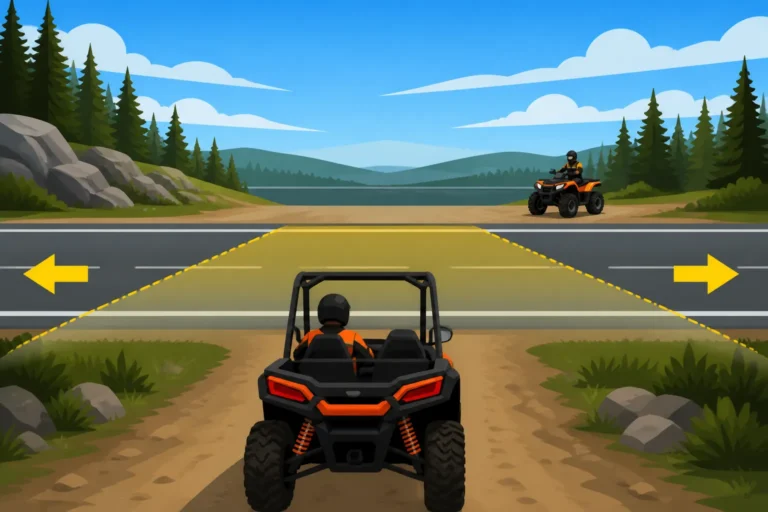
To cross a highway, you must do so at a right angle, yielding to all highway traffic. Crucially, you need to have 150 metres of visibility in both directions. If you can't see that far, you can't cross. This rule is in place for your safety and the safety of other motorists. As for riding on highway shoulders, it's generally only permitted for a maximum of 1 kilometre to get from one trail section to another. This is not for pleasure riding or commuting. When on the shoulder, your speed limit is 20 km/h, and you must stay as far to the right as safely possible. Again, highway traffic always has the right-of-way. Operating a machine on a public road, even the shoulder, typically requires you to possess a valid driver's license for that class of vehicle. Understanding [Newfoundland ORV Road Rules Explained] is critical to avoid fines and accidents.
Trail Access, Managed Trails, and Crown Land
Newfoundland boasts an incredible network of trails, including the iconic 883-kilometre T'Railway. However, access isn't always unrestricted. Many popular trails, particularly the T'Railway, are part of a managed trail system. To ride on these managed trails, you'll typically need to purchase a managed trail sticker from the designated trail operator, such as the Newfoundland and Labrador Snowmobile Federation (NLATV). This sticker fee goes directly back into trail maintenance and development. You can either affix this sticker to your machine or carry proof of purchase with you. [Managed Trail Stickers Come From the Trail Operator], so it's wise to check with them before you head out.
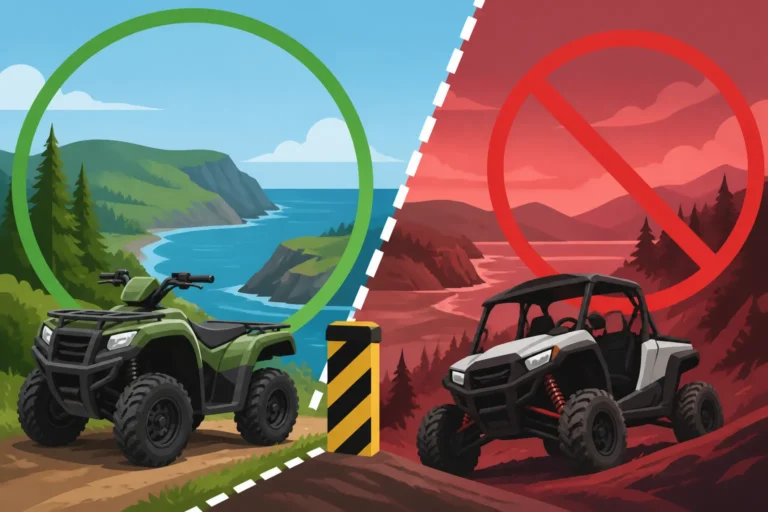
Riding on Crown Land is generally permitted in "approved areas," but there are "restricted areas" where off-road vehicle use is limited or prohibited entirely, often to protect sensitive ecosystems or wildlife like caribou. Always be aware of local signs and respect closures. National Parks, like Gros Morne, have very strict rules, generally prohibiting ORVs on any trails within their boundaries, only allowing them on public highways passing through. Always check [Newfoundland Crown Land Riding Rules] and local municipal bylaws, as some communities have specific restrictions on ORV use within their boundaries. Remember, even on approved land, responsible riding means staying on marked trails, avoiding sensitive wetlands, and being respectful of other trail users.
Preparing Your Machine for Newfoundland's Unique Terrain
Newfoundland's terrain is stunningly diverse, from rocky barrens and coastal paths to deep bogs and dense woods. Preparing your machine properly for these conditions will ensure a safer and more enjoyable experience.
Checking Your Machine for Local Conditions
Before you even load your machine onto the ferry, give it a thorough once-over. Basic maintenance is key: check your tires for proper inflation and wear, inspect your brakes, lights, and fluid levels. Newfoundland weather can be unpredictable, often changing rapidly from sun to fog to rain, even in summer. Ensure your machine is ready for varying conditions. For example, if you plan on tackling particularly muddy or wet areas, consider if your stock tires are up to the task or if an upgrade might be beneficial.
While Newfoundland doesn't have a specific spark arrestor rule (relying instead on muffler regulations to control noise), ensuring your exhaust system is factory-compliant is still important for both noise and fire prevention. If you're coming from a jurisdiction that requires a spark arrestor, keeping yours in place is certainly not a bad idea. For more rugged riding, especially on the T'Railway with its old railway ballast or through rocky sections, investing in quality skid plates can protect vital undercarriage components. Companies like SuperATV offer a wide range of protection gear that can make a huge difference in preventing costly damage.
Recommended Upgrades and Maintenance
Depending on the type of riding you plan to do, some upgrades might be worth considering. Given the prevalence of water crossings and potential for boggy terrain, a winch is an invaluable piece of equipment. You never know when you or a fellow rider might get stuck. If you're truly adventurous and plan on deep water crossings, a snorkel kit could protect your engine, though this is for advanced riders and specific conditions.
Reliable lighting is crucial. Even if you don't plan to ride after dark, unexpected delays can mean you're out longer than anticipated. Upgrading to brighter LED lights, or adding auxiliary lighting, can significantly improve visibility for both you and others. [Newfoundland Lighting Requirements on a Machine] dictate minimum standards, but exceeding them for safety is always a good call. Regular maintenance, especially after a long ride through mud or dust, will extend the life of your machine and prevent breakdowns far from home. This includes cleaning air filters, checking bearings, and lubricating moving parts.
Packing Smart for the Unexpected
When riding in Newfoundland, assume you might be out longer than planned or encounter unexpected weather. Always carry a basic toolkit with common wrenches, screwdrivers, and pliers. A tire repair kit and a small air compressor can save a long walk back to the truck. A tow strap (and knowing how to use it safely) is essential, especially if you're riding with others. For electronics, consider a portable charger for your phone or GPS.
Weather-wise, even on a sunny day, pack rain gear and extra layers. Fog can roll in quickly, and temperatures can drop without warning, especially on exposed barrens. [Packing for Weather That Changes Every Hour] is not an exaggeration. Don't forget bug spray, a first-aid kit, and plenty of water and snacks. If you're heading into remote areas with no cell service, a satellite messenger or two-way radio is a wise investment for emergencies. Knowing that [Newfoundland Has No Spark Arrestor Rule] doesn't mean you can ignore fire safety; carrying a small extinguisher can also be a smart addition, especially during dry seasons.
| Requirement / Item | For Visitors (Under 30 Days) | For New Residents (After 90 Days) |
|---|---|---|
| Machine Registration | Valid out-of-province registration accepted | Required: Newfoundland registration |
| Identification Plate | Your home province's plate/decal | Newfoundland identification plate/decal |
| Liability Insurance | Valid out-of-province insurance (min. $200,000) | Newfoundland insurance (min. $200,000) |
| Driver's License (on roads) | Valid driver's license from home province | Valid Newfoundland driver's license |
| Safety Training | Not typically required for out-of-province adults | Required: Newfoundland safety training certificate for first-time registrants and minors |
| Managed Trail Sticker | Required for use on managed trails (e.g., T'Railway) | Required for use on managed trails (e.g., T'Railway) |
| Paperwork to Carry | Out-of-province registration, insurance proof, ID | Newfoundland registration, insurance proof, ID, training certificate |
| HST on Purchase | Not collected by NL if tax paid elsewhere and remaining a visitor | May be assessed if tax was not paid or was lower in former province |
Disclaimer
This article is for general informational purposes only and does not constitute professional advice. Laws, prices and regulations vary by location and change over time. Consult a qualified professional for guidance on your specific situation.