Supervisors Must Confirm Training Before a Minor Rides
A young rider’s training certificate is easy to overlook when a family is getting ready to head out. In Newfoundland and Labrador, though, a supervisor has a specific responsibility: make sure an operator under 16 has completed the required safety training before riding. Here’s what to check, what supervision involves, and how to avoid treating a certificate as a substitute for safe riding.
What supervisors must confirm before a minor rides
Safety training is mandatory for off-road vehicle operators under 16 in Newfoundland and Labrador. That includes young operators of ATVs, UTVs and snowmobiles. The requirement applies to the young rider, and it is the supervisor’s job to make sure the rider has completed an eligible training program before operating.
According to Digital Government and Service NL, anyone supervising a person under 16 must ensure that person has completed a training program. Government of Newfoundland and Labrador guidance also says that an operator under 16 cannot ride unless supervised by someone who is at least 18 and holds a valid driver’s licence. These are related but separate checks: the young operator needs the required training, and the adult must meet the supervision requirements.
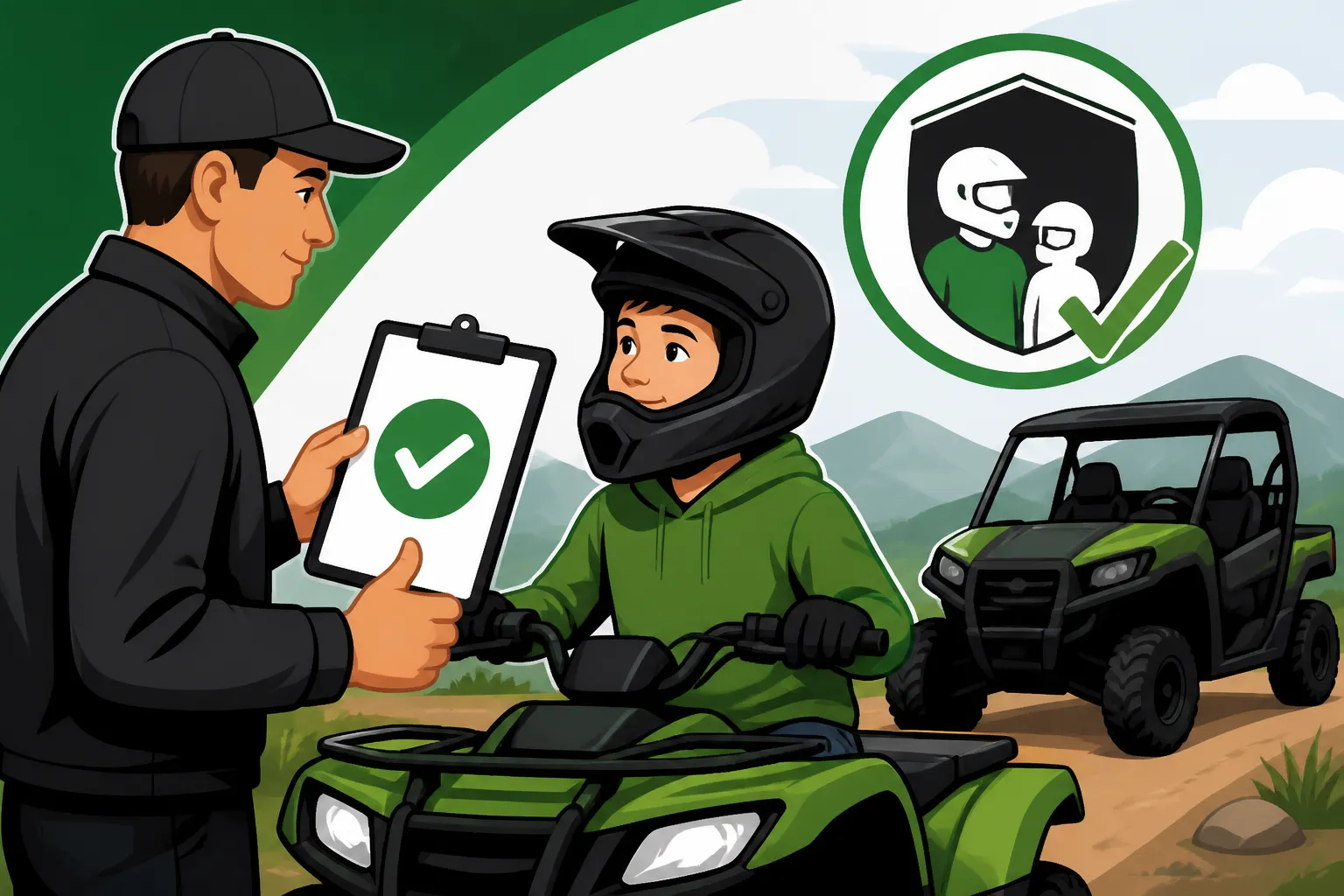
A parent or other adult should not assume training is complete because the young person has ridden before, owns the vehicle, or has watched someone else complete the course. Ask to see the certificate or otherwise confirm completion before setting out. If the rider still needs training, wait until it is done.
Training rules can also apply to adults in other situations. Government of Newfoundland and Labrador says training is required for anyone registering an off-road vehicle for the first time, as well as for certain people directed to complete training after an offence and a registration suspension or cancellation. For the related first-registration requirement, see Newfoundland Training for First-Time Registrants.
A practical pre-ride check can be brief:
- Confirm the young rider completed an accepted safety training program.
- Check that the adult supervising is at least 18 and holds a valid driver’s licence.
- Confirm that the vehicle is suitable for the young rider’s age and weight.
- Make sure the adult can supervise the ride in person, not just be available by phone.
- Check the vehicle’s registration and required safety equipment.
- Choose a route and riding conditions appropriate for the child’s ability.
These checks are a starting point, not a guarantee that every route or riding situation is permitted. The supervisor still needs to pay attention throughout the ride and make sensible decisions as conditions change.
How to verify training and keep proof available
Newfoundland and Labrador offers a free off-road vehicle safety training program through MyGovNL. Digital Government and Service NL advises users to review the Off-Road Vehicles Handbook before completing the program. Other courses approved by the Registrar of Motor Vehicles, including in-person training, are also accepted.
Government Services says a score of at least 80 percent is required to pass the safety training test. If the young rider has not passed, do not treat an unfinished course or a failed attempt as proof of completion. Find out what further steps are needed and confirm that the approved training has been completed.
After completing the program, users can print a certificate to carry while using an off-road vehicle, according to Digital Government and Service NL. Ask the young rider to show you the certificate before the trip, then agree on who will carry it. A small document pouch can help protect printed proof from rain and mud; a simple sleeve from a local store or Amazon may do the job.
Government Services says operators who are required to complete mandatory training must provide proof of completion within 2 business days if a peace officer requests it. Carrying the certificate during the ride is a straightforward way to be prepared, rather than relying on someone else to retrieve it later. For details on the printable document, see A Newfoundland Certificate You Print at Home. The available course and test process is explained further in Taking the Free Safety Test on MyGovNL.
| Check | What the supervisor should confirm |
|---|---|
| Training | The rider under 16 has completed an accepted safety training program |
| Proof | The rider can produce proof if requested by a peace officer |
| Adult supervision | The supervisor is at least 18 and has a valid driver’s licence |
| Vehicle fit | The engine size meets the manufacturer’s recommendation for the rider’s age and weight |
| Equipment | Required protective equipment is available and worn |
| Route | The planned area and route are appropriate and permitted |
The certificate is useful evidence of training, but it is not permission to ride anywhere or on any machine. A trained child still needs the right supervision, a suitable vehicle, and the required equipment. Training also does not replace the adult’s responsibility to keep the young rider within sight and provide direction.
Supervision means staying involved
The adult’s role is more than being somewhere nearby. Government of Newfoundland and Labrador says supervisors of operators under 16 must be able to see the young operator at all times, provide direction, and ensure the young operator can see them. That makes the riding setup important: the route, pace, terrain and distance between riders all affect whether supervision is real and continuous.
If trees, terrain, weather or other riders block the supervisor’s view, the adult may not be able to meet the visibility requirement. Choose a route where you can keep the young rider in sight, and stop if the group becomes separated. A supervisor following far behind, riding on a different trail, or relying on occasional phone calls is not a sound substitute for direct oversight.
Before starting, agree on simple instructions: where to stop, what to do if the rider cannot see the adult, and how to respond if the route becomes difficult. Keep the pace slow enough for the young rider to follow safely. If the child is tired, upset, or struggling with the controls, end the ride or take a break rather than pressing on.
Supervision should match the rider’s experience and the terrain. A child who has completed the training may still need close guidance when handling unfamiliar ground, a change in weather, or a machine they have not used before. The adult should be prepared to redirect the route or stop the ride if the young operator cannot follow instructions reliably.
The adult’s qualifications matter too. Government of Newfoundland and Labrador states that a person under 16 must be supervised by someone at least 18 years old with a valid driver’s licence. The training program does not erase this condition, and a child’s certificate does not make an underage or unlicensed person an eligible supervisor. For more on the adult’s responsibilities, see Newfoundland Supervisors and Training Duties.
Check the vehicle and riding conditions too
A completed training program does not establish that every machine is appropriate for every child. Government of Newfoundland and Labrador says a person under 16 may operate only an off-road vehicle with an engine size that meets the manufacturer’s recommendation for the rider’s age and weight. Check the machine’s manufacturer guidance rather than judging suitability by appearance or by whether another child has used it. See Newfoundland Engine Size for Age and Weight for more on that requirement.
Confirm the machine is registered before riding. Off-road vehicles, including ATVs, UTVs and snowmobiles, must be registered with the Motor Registration Division, according to Digital Government and Service NL. Registration is separate from safety training: a certificate does not register the vehicle, and registration does not prove that the young operator has completed training. If you are preparing to register a vehicle, review Newfoundland Registration Paperwork Explained.
Protective equipment is another separate check. Digital Government and Service NL says helmets are required for off-road vehicle riders and passengers, subject to a specific hunting and trapping exception involving frequent stops and speeds under 20 km/h. Government of Newfoundland and Labrador also requires safety glasses, goggles or a face shield when the vehicle does not have a windshield of sufficient height. If the machine has seatbelts installed by its manufacturer, riders must wear them. Review Newfoundland Helmet Law for Every Rider for more about helmet requirements.
Before leaving, inspect the equipment and make sure it fits the person who will use it. A helmet that is available but not properly worn does not solve the safety problem. In a side-by-side, check that the young rider can sit correctly with the seatbelt fastened; follow the vehicle’s manufacturer instructions and applicable rules for the machine.
A supervisor should also consider whether the route itself is suitable and permitted. Training does not authorize riding on a managed trail without the required trail permit, and a registered vehicle is not automatically allowed on every road, trail or parcel of land. Check the access rules for the specific area before setting out. If the outing involves a highway crossing or shoulder travel, confirm the requirements in advance rather than assuming ordinary trail rules apply.
A simple pre-ride routine for families
A consistent routine makes it less likely that a key check gets missed when everyone is eager to leave. Keep the steps short enough to use before every outing, especially when the rider, machine or route is different.
- Ask the young operator to show their training certificate or confirm completion of an accepted program.
- Check that the supervisor is at least 18 and has a valid driver’s licence.
- Confirm that the vehicle is registered and suitable for the operator’s age and weight under the manufacturer’s recommendations.
- Check helmets, eye protection, seatbelts and any other required equipment.
- Explain the route, stopping points and instructions for what to do if the rider loses sight of the supervisor.
- Start only if you can maintain visual supervision and provide direction for the entire ride.
If the certificate is missing, the machine does not fit the manufacturer’s recommendations, or the planned route makes continuous supervision difficult, postpone the ride or change the plan. That is a practical safety decision, not a reason to rely on the training certificate as a substitute for adult judgment.
Training gives a young rider a foundation, but it cannot account for every trail condition or decision. The supervisor is responsible for checking that training is complete, ensuring the adult meets the supervision requirements, staying involved, and stopping when the circumstances are no longer safe.
Sources
- Government Services — How to Register an Off-road Vehicle – Government Services (checked November 3, 2026)
- Government Services — Off-Road Vehicles Safety – Government Services (checked November 3, 2026)
- Government of Newfoundland and Labrador — Off-Road-Vehicle-Training-Manual-24173.pdf (checked November 3, 2026)
- Digital Government and Service NL — Public Advisory: Off-Road Vehicle Training Now Available on MyGovNL – News Releases (checked November 3, 2026)
- Digital Government and Service NL — Public Advisory: Helmets and Seatbelts Mandatory for Off-Road Vehicles as of May 19 – News Releases (checked November 3, 2026)
- Digital Government and Service NL — Public Advisory: Residents Reminded to Practice Off-road Vehicle Safety – News Releases (checked November 3, 2026)
- Digital Government and Service NL — New Legislation Increases Safety for Off-Road Vehicle Users – News Releases (checked November 3, 2026)
- Government of Newfoundland and Labrador — Offroadsafety-summer.pdf (checked November 3, 2026)
- Government of Newfoundland and Labrador — Offroadsafety-winter.pdf (checked November 3, 2026)
Disclaimer
This article is for general informational purposes only and does not constitute professional advice. Laws, prices and regulations vary by location and change over time. Consult a qualified professional for guidance on your specific situation.