Newfoundland Insurance Proof at a Trailhead
When an officer or trail operator asks for insurance proof, it can be easy to confuse an insurance document with your registration permit or trail pass. In Newfoundland and Labrador, the rules depend on where and how you ride. Here’s what to carry, when proof may be requested, and what to confirm before leaving home.
Insurance proof at a trailhead: what the rules say
The key distinction is between being asked to show proof and being subject to a specific requirement to carry insurance. According to the Government of Newfoundland and Labrador, riders must have insurance and provide proof when crossing or travelling along a highway. Peace officers may also request proof of a valid insurance policy. The rules do not set out a general requirement to display insurance paperwork at every trailhead.
That means a trailhead request does not automatically tell you whether the request is based on a highway-use rule, an officer’s authority to ask for proof, a trail operator’s conditions, or another circumstance. Ask politely what document is needed and why. A calm, specific question can help you distinguish an insurance request from a request for your registration permit, plate, training certificate, or trail pass.
| Document | What it establishes | Practical point |
|---|---|---|
| Insurance policy document or insurer-issued proof | That you have a valid insurance policy | Carry current proof in a form you can produce if asked. |
| Registration permit | That the off-road vehicle is registered | Registration is not the same as insurance. |
| Licence plate | Identifies the registered vehicle | Keep it attached and clearly visible. |
| Safety training certificate, when required | That the operator completed required training | Keep it available if you are subject to the training requirement. |
| Trail pass or permit, where required | That you have the permission or pass needed for that managed trail | Check the relevant trail operator’s rules before riding. |
The Government of Newfoundland and Labrador says off-road vehicles must be registered with the Motor Registration Division, and Digital Government and Service NL says licence plates must be affixed to the vehicle and clearly visible. Neither a registration permit nor a plate proves that the vehicle has insurance. For registration details, see Newfoundland Registration Paperwork Explained and Newfoundland Permits, Plates and Decals.
Insurance requirements can matter before you reach a trailhead. According to the Government of Newfoundland and Labrador, an off-road vehicle may cross a highway only when the operator has a driver’s licence and insurance, and visibility is at least 150 metres in both directions. The same government says an off-road vehicle may travel along a highway shoulder to access a trail for up to one kilometre, at no more than 20 kilometres per hour. For the specific limits, see Newfoundland Rules for Crossing a Highway and Newfoundland Rules for Riding a Shoulder.
If your route includes a highway crossing or shoulder travel, do not treat the trailhead as the first point at which insurance becomes relevant. Have valid proof with you before the ride begins. The route to the trail may involve different requirements from riding on a trail itself, so check your planned access route as well as the destination.
The Government of Newfoundland and Labrador also says insurance may be required for off-road vehicles. That broad statement does not establish that every trailhead has a blanket rule requiring riders to show a policy before entering. It is safer to confirm the requirements for your specific route and trail operator rather than assuming either that insurance is never needed off-road or that every trail has the same proof rule.
What to carry and how to prepare
For practical purposes, carry insurance proof in a form you can retrieve quickly, such as an insurer-issued paper document or a digital document on your phone. Check that the information is current and that you can open it without relying on a signal. A downloaded document can be useful where reception is unreliable; a paper copy can serve as a backup if a phone battery runs down or the screen is difficult to read outdoors.
Keep insurance proof separate from registration paperwork in your mind, even if you store the documents together. If an officer asks for insurance, handing over a registration permit alone may not answer the request. Keep your registration permit available too, since it relates to a different requirement. Newfoundland Insurance Proof on the Trail covers the same issue from the perspective of producing proof while riding, and What an Officer Can Ask You to Produce may help you prepare for a roadside interaction.
Before you leave, use this quick check:
- Confirm that the policy applies to the vehicle you plan to ride. If you are using a borrowed or newly purchased machine, do not assume another person’s policy automatically covers your use.
- Confirm that the policy is valid for the planned ride and that you can produce the insurer’s proof document.
- Check whether your route requires crossing or travelling along a highway. The Government of Newfoundland and Labrador identifies insurance as a requirement for those highway-use circumstances.
- Check the managed trail operator’s current entry and permit conditions. Digital Government and Service NL says off-road vehicles are not permitted on managed trails without trail permits; that is a separate issue from proving insurance.
- Carry the registration permit and any other documents that apply to you, such as a required safety training certificate.
- Make sure your phone is charged if you rely on a digital copy, and consider carrying a paper backup.
If you are uncertain whether your policy covers a particular vehicle or type of use, ask your insurer before riding. Do not guess based on the vehicle’s registration status, the fact that a dealer completed paperwork, or the coverage another rider says they have. The policy wording and the insurer’s confirmation are the right places to resolve coverage questions.
A small waterproof document pouch can help protect paper proof from rain, mud, and storage-area wear. If you need one, Amazon is one place to look for a basic waterproof pouch; the important thing is choosing a pouch that stays closed and is easy to reach without leaving documents exposed. This is a storage convenience, not a substitute for having valid insurance.
If you ride a borrowed machine, confirm both who is responsible for arranging insurance and what proof you should carry. If you have just bought a used vehicle, ask when coverage begins and whether you can obtain a proof document before taking the machine on a ride. Registration and insurance are separate matters: completing one does not confirm the other. For the registration process, see Newfoundland Registration Before Your First Ride.
What to do if someone asks for proof
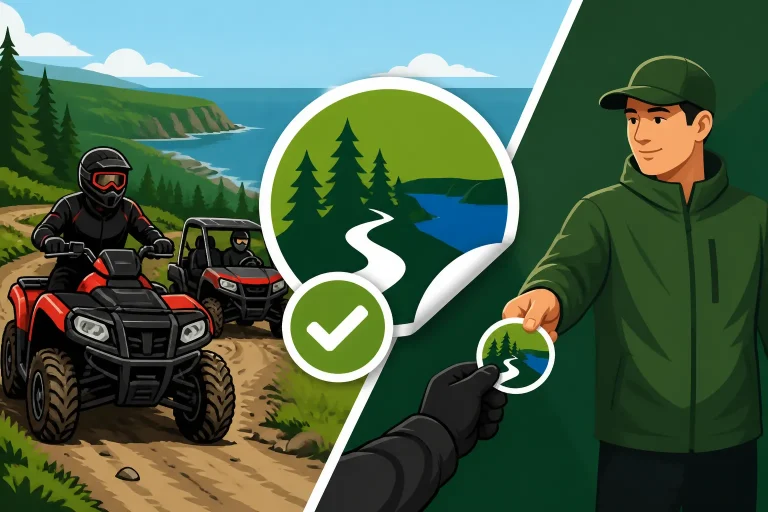
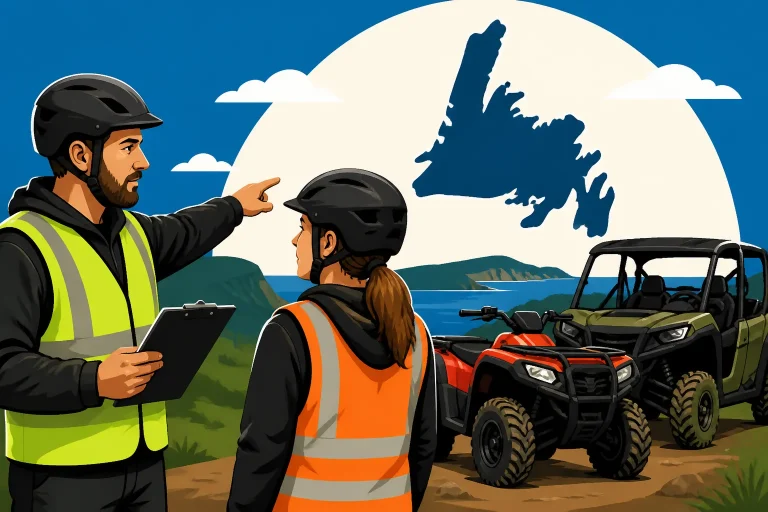
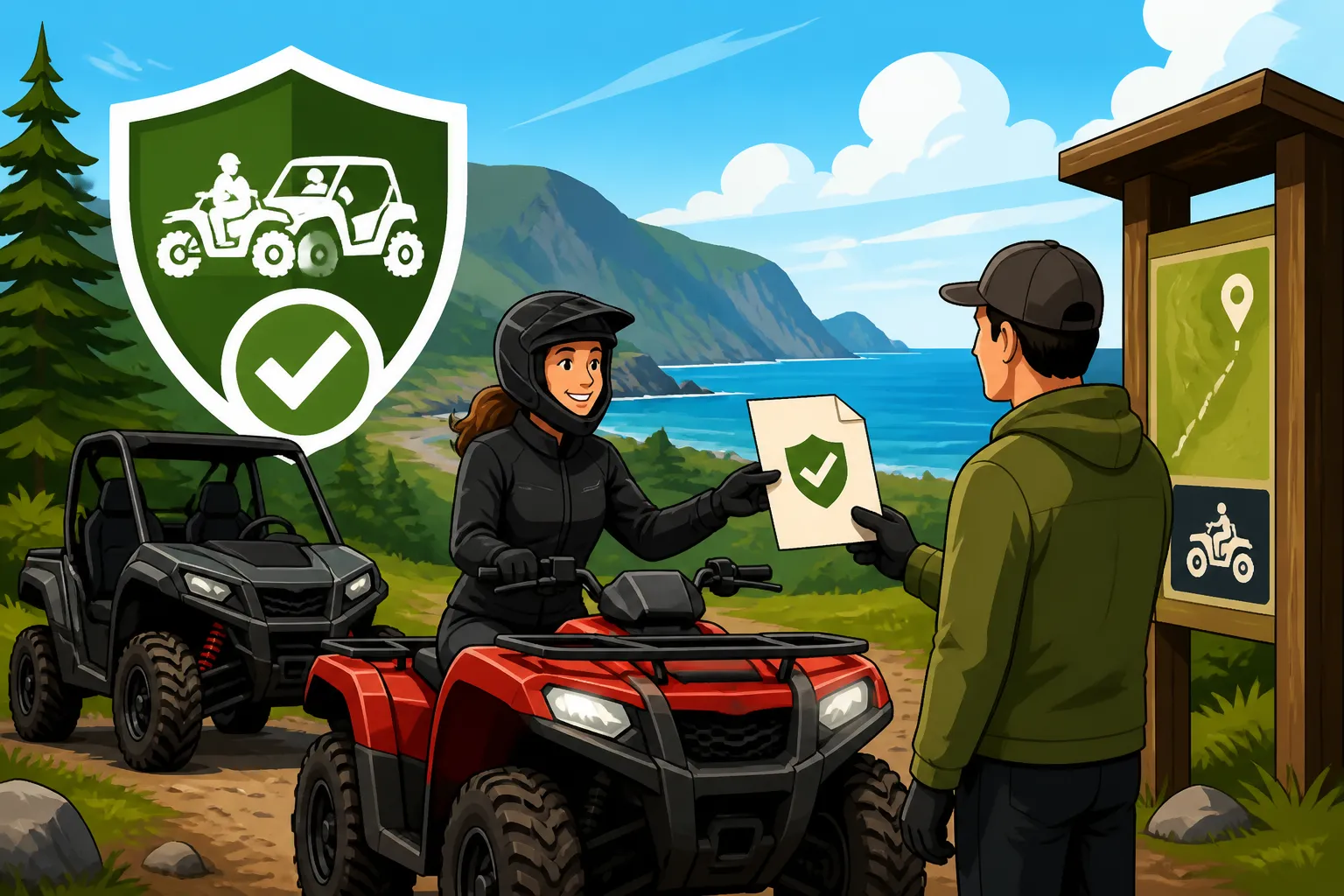
If a peace officer asks to see insurance proof, respond courteously and provide the document you have. The Government of Newfoundland and Labrador says peace officers may request proof of a valid insurance policy. If you are using a digital document, open it and make the relevant information easy to read. If the request is at a managed trail entrance, ask whether the operator needs insurance proof specifically or a different document, such as a trail pass or registration permit.
If you cannot produce proof immediately, explain the situation clearly rather than presenting a registration permit as though it were insurance. Ask whether another form of proof is acceptable, such as a document from your insurer. Do not assume that a verbal statement, a photograph of an old policy, or another rider’s paperwork will meet the request. If you are unsure what is acceptable, contact your insurer or the relevant authority before continuing the ride.
A request at a trailhead can also expose a separate paperwork problem. A vehicle may be registered but lack the insurance proof you need for a highway approach, or you may have insurance but have forgotten the registration permit. Check both before departure. Government Services says off-road vehicles, including ATVs, UTVs, and snowmobiles, must be registered. It also says registration does not expire and remains valid while you own the vehicle, but that continuing registration does not replace the need to confirm insurance. Newfoundland ATV Insurance Requirements explains the insurance issue in more detail.
For a new or used off-road vehicle, registration also involves its own process. According to Government Services, registering either type requires an appointment and a vehicle registration application. New vehicles require a manufacturer-issued New Vehicle Information Statement, while used vehicles require a bill of sale. Those are registration documents, not insurance proof. If you are buying or registering a vehicle, keep the paperwork organized so you can tell each document apart.
For a young operator, insurance is only one part of the pre-ride check. The Government of Newfoundland and Labrador says safety training is required for anyone under 16 and for anyone registering an off-road vehicle for the first time. It also says an operator under 16 must be supervised by a licensed driver who is at least 18. Digital Government and Service NL says operators who are required to complete training can print a certificate to carry while using an off-road vehicle. Check the operator’s requirements before the ride, rather than trying to sort out training paperwork at the trailhead.
The practical takeaway is simple: carry insurance proof even when you do not expect a routine trailhead inspection, and be especially prepared if your route includes highway use. Keep insurance proof distinct from registration and trail-permit documents. When the request or rule is unclear, ask what proof is needed and confirm the requirement with the insurer, the relevant authority, or the trail operator before riding.
Sources
- Government Services — Off-Road Vehicles Safety – Government Services (checked November 3, 2026)
- Government of Newfoundland and Labrador — Off-Road-Vehicle-Training-Manual-24173.pdf (checked November 3, 2026)
- Digital Government and Service NL — Public Advisory: Off-Road Vehicle Training Now Available on MyGovNL – News Releases (checked November 3, 2026)
- Digital Government and Service NL — Public Advisory: Helmets and Seatbelts Mandatory for Off-Road Vehicles as of May 19 – News Releases (checked November 3, 2026)
- Digital Government and Service NL — Public Advisory: Residents Reminded to Practice Off-road Vehicle Safety – News Releases (checked November 3, 2026)
- Digital Government and Service NL — New Legislation Increases Safety for Off-Road Vehicle Users – News Releases (checked November 3, 2026)
- Government of Newfoundland and Labrador — Offroadsafety-summer.pdf (checked November 3, 2026)
- Government of Newfoundland and Labrador — Offroadsafety-winter.pdf (checked November 3, 2026)
Disclaimer
This article is for general informational purposes only and does not constitute professional advice. Laws, prices and regulations vary by location and change over time. Consult a qualified professional for guidance on your specific situation.