Newfoundland Training for a First Registration
A first ATV or UTV registration in Newfoundland can involve more than proving who owns the machine. Safety training is part of the process, and sorting it out early can help you avoid a delayed application or an awkward first ride without proof. Here’s what to expect, how to choose a training route, and what to confirm before applying.
What training means when you register for the first time
In Newfoundland and Labrador, safety training is tied to off-road vehicle use and the first-registration process. If you are registering your first machine, plan to complete the required training and have proof ready before you apply. Do not assume the requirement is only for children or that owning a registered machine means every operator is automatically trained.
The important distinction is that registration is about the machine and its recorded owner, while safety training is about the person who will operate it. A registration document does not replace a training certificate, and completing training does not register an ATV or UTV. You may need to deal with both requirements.
The province’s requirements also cover more than one kind of off-road vehicle. An ATV and a side-by-side are not necessarily treated as identical for every riding rule, but both fall within the broader off-road vehicle framework. If you are registering a UTV, check the rules for that class rather than assuming guidance written specifically for a quad answers every question. Newfoundland Side-by-Sides Added in 2022 explains the class distinction.
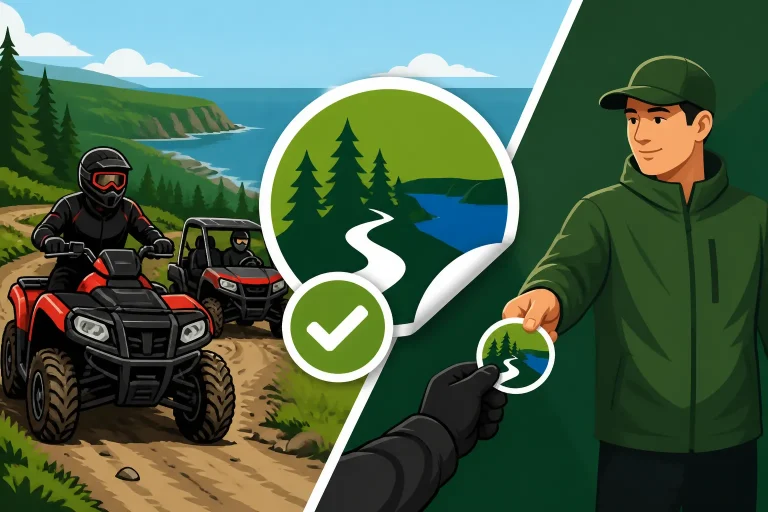
A useful starting point is to treat training as an operator requirement that can matter each time you ride, not a one-time paper form attached to the machine. Keep your certificate accessible and find out what proof you must carry. The province’s general approach is summarized in Newfoundland Safety Training Is Mandatory and Carrying Your Safety Certificate on Every Ride.
Why first-time registration is the point to plan ahead
People often focus on the ownership documents and leave training until the registration appointment. That can create an avoidable second trip if the registry needs evidence of completion or if you have not yet printed or saved your certificate.
Training is also a separate issue from the machine’s registration paperwork. A bill of sale, vehicle identification details, and other ownership records support the application, but they do not stand in for a safety certificate. For a wider document checklist, see Newfoundland Registration Paperwork Explained.
If you are not sure whether your situation counts as a first registration, ask the Motor Registration Division before booking or submitting the application. This is particularly sensible if the machine is being registered jointly, transferred from someone else, or registered in a business’s name. Those situations can raise questions about who must complete training and whose details belong on the application.
Choose an accepted training route
There are two practical routes to look into: the provincial online safety test and an approved alternative course. The online option may suit someone who is comfortable learning independently and wants a straightforward way to complete the requirement. A course may be a better fit if you prefer guided instruction or need help understanding how rules apply in practice.
| Training route | May suit you if | What to check |
|---|---|---|
| Online safety test | You prefer to study and test independently | Use the official provincial route, confirm the current pass requirement, and save your certificate |
| Approved alternative course | You want structured instruction or already plan to take a course | Confirm the provider and course are accepted, and ask how proof of completion is issued |
| Unsure which route applies | Your registration, age, or operator situation is unusual | Ask the registry or the relevant training contact before paying for or starting a course |
The online test is offered through MyGovNL. The test information in the provincial guidance describes a test of 15 questions, with 12 correct answers required to pass. Requirements and instructions can change, so check the official test page before you begin rather than relying on an old printout or someone else’s notes. Taking the Free Safety Test on MyGovNL and Newfoundland Safety Test Pass Mark cover the online route.
An approved course can be an alternative to the test, but “safety course” does not automatically mean “accepted for Newfoundland registration.” Confirm that the provider and course are approved for the relevant requirement before enrolling. Ask whether the course applies to your vehicle type and whether the certificate or completion record will be available in a form the registry accepts. You can check Newfoundland Approved Course Providers for more on this route.
If the applicant is a minor
If the first registrant or operator is under 18, ask about parental consent and supervision requirements before starting. A minor may need consent to take training, and completing training does not remove separate rules about age, machine suitability, or adult supervision. See [Newfoundland Parental Consent Forms] and Newfoundland Supervisors and Training Duties for issues that may affect a young rider.
Do not use an adult’s registration or training status as a shortcut around rules for a younger operator. The person riding must meet the requirements that apply to them. If more than one person will ride the machine, check what each operator needs to complete and carry.
A practical sequence from training to registration
A little planning makes the process easier. The sequence below keeps training, proof, and machine paperwork distinct so you can catch a missing item before your application is reviewed.
- Confirm the vehicle and the applicant. Identify whether the machine is an ATV, side-by-side, or another type of off-road vehicle, and decide who will be listed as the registrant. If ownership will be shared or held by a business, ask whether that affects the training requirement.
- Check the current training instructions. Use the official provincial information to confirm whether you should take the online test or an approved course. Check the current rules for your age and circumstances.
- Complete the training and keep the proof. Save the certificate or completion record in a place you can retrieve later. If the system lets you print the certificate, keep a paper copy as well as a digital copy.
- Collect the machine’s registration documents. Gather the ownership evidence and vehicle details needed for the application. A new machine may have different paperwork from a used machine, so review What to Bring to Your Registration Appointment and the relevant registration instructions.
- Ask how the application is handled. Confirm whether you need an appointment, whether the registry needs to see a paper certificate, and whether any documents must be completed before you arrive.
- Keep the training proof available after registration. Store it with other riding documents, and make sure every operator knows what they need to carry. Registration does not remove the operator’s separate obligations.
Training first is often the simplest choice because it gives you time to resolve a failed test, certificate issue, or course-approval question before you are waiting on the registration itself. If you have already booked an appointment, contact the office rather than assuming the certificate can be supplied later.
The registration application may require information about the person registering the machine as well as the machine itself. Make sure names and ownership details are consistent across the bill of sale and application. If a machine has changed hands more than once, or the paperwork is incomplete, training will not resolve the ownership issue; deal with that separately. Collecting a Bill of Sale From Every Prior Owner explains why a clear ownership chain can matter.
Common snags and what to do before you ride
The most common planning mistake is treating training as a registration formality that can be sorted out after the machine is ready to use. It is better to know the process before you choose a test, book a course, or set a registration date.
Assuming a certificate is the same as registration. It is not. Training confirms that an operator has met a training requirement; the registration process records the machine and its ownership. Keep the documents separate and complete both steps.
Taking a course without checking approval. A course may cover useful riding skills but still not meet the provincial requirement. Confirm acceptance before paying or setting aside time for it. If you cannot verify the provider’s status, use the official online route or contact the appropriate office for direction.
Losing the certificate after passing. Save a digital copy and, where possible, print one. Check that the saved file is readable and includes the details the registry or an officer may need to see. Avoid keeping the only copy in a place you cannot access on the trail.
Assuming a family member’s certificate covers everyone. Training belongs to the individual operator. If several people will use the machine, check the requirement for each rider. A registered owner who never rides and an operator who uses the machine regularly may have different practical responsibilities.
Confusing training with permission to ride anywhere. A certificate does not grant access to a trail, private property, or restricted area. You still need to follow land-access rules, managed-trail requirements, and local restrictions. For example, Finding Approved Areas on the Provincial Map can help with the separate question of where riding is allowed.
Leaving the rules check until the day of the ride. Training is only one part of being ready. Operators may also need to meet equipment, helmet, insurance, and age requirements. A new registrant should review the rules for the specific vehicle and route, especially before riding on or near a public road.
If the official instructions and what you have been told do not match, pause and confirm the requirement with the Motor Registration Division or the relevant provincial training contact. Have the vehicle type, intended registrant, age of the operator, and training route ready to explain. A specific question is more likely to get a useful answer than a general request to confirm whether “the ATV paperwork” is complete.
A good first-registration checklist is simple: confirm who is applying, complete accepted training, save proof, assemble the ownership documents, and verify the appointment or submission process. Then check the rules that apply to the actual ride. That approach helps prevent training from becoming a last-minute obstacle and keeps the certificate useful after the machine is registered.
Disclaimer
This article is for general informational purposes only and does not constitute professional advice. Laws, prices and regulations vary by location and change over time. Consult a qualified professional for guidance on your specific situation.