What Is on the Newfoundland ATV Safety Test
Newfoundland’s ATV safety test can seem like a small hurdle, but the rules behind it matter on the trail and when a young rider is involved. The online test is short, yet it covers practical safety and legal responsibilities worth understanding before you ride. Here’s what to expect, how to prepare, and what to confirm about training requirements.
What the Newfoundland ATV safety test is
The Newfoundland ATV safety test is an online knowledge test for off-road vehicle riders. It checks whether you understand the safety rules and responsibilities that apply when operating a machine. The test has 15 questions, and you need at least 12 correct answers to pass.
Passing earns a certificate that you can print. Keep it somewhere accessible, and check whether you must carry proof while riding. A certificate does not replace registration, insurance, a trail sticker where required, or compliance with age and supervision rules. Those are separate requirements.
Training requirements can depend on the rider’s age and situation. Young riders have additional rules, and training may also matter for a first-time registrant or after a suspension. Do not assume that taking the test automatically satisfies every requirement that applies to you. For age-specific rules, see Newfoundland ATV Age Requirements and Newfoundland Training Required Under 16. If you are unsure which training applies, confirm with the registry or the relevant official service before relying on a certificate.
The test is not a substitute for reading the operating rules. Passing shows you met the test’s threshold; it does not mean every riding situation is covered or that every answer will be easy to recall months later. The safest approach is to understand why a rule exists and how it applies before you take a machine out.
Topics to review before you start
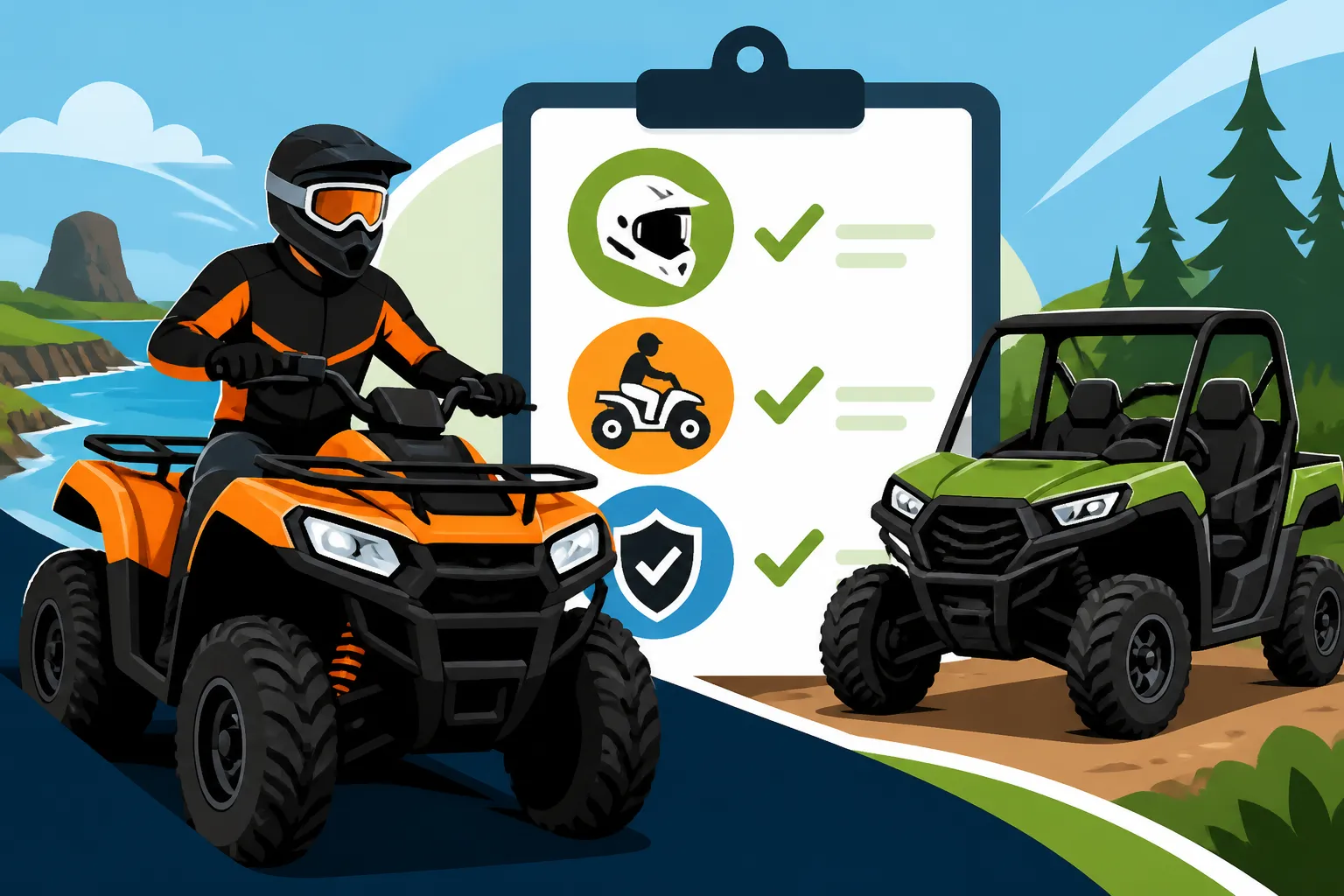
The test is intended to check safety knowledge, not mechanical expertise. Review the core rules for operating an ATV or other off-road vehicle in Newfoundland, especially the ones that affect the rider, passengers, and other people sharing the route.
| Topic to review | What to understand |
|---|---|
| Helmets and protective equipment | When a helmet is required, approved helmet standards, and why the chin strap must be fastened |
| Age and supervision | Restrictions for young riders, supervision duties, and why a child’s size and ability matter |
| Passengers | Which seats may be used and why a passenger needs a proper, manufacturer-installed seat |
| Road and shoulder use | When a highway crossing or shoulder travel is allowed, and the limits that apply |
| Insurance and registration | The difference between having a registered machine and carrying required insurance proof |
| Visibility and equipment | Lighting, reflectors, tires, exhaust, and other equipment that affects safe operation |
| Trail and land access | The difference between being allowed to operate a machine and being allowed to ride on a particular piece of land |
A few points deserve extra attention because riders can confuse them with ordinary road rules. ATV road access is limited; registration does not grant permission to ride on any road. When a highway crossing is permitted, visibility and the crossing rules still matter. Shoulder travel is also restricted and is not a general way to ride along the road. Review Newfoundland Rules for Crossing a Highway and Newfoundland Rules for Riding a Shoulder so you can distinguish a permitted connection to a trail from riding on a road as a route.
Equipment rules are not just about making a machine look roadworthy. A helmet must meet an accepted standard and be secured correctly. A passenger must use a proper seat, not a cargo rack or a spot that happens to be available. Machines with installed seat belts must use them, and visibility equipment matters when riding after dark. The related pages on Newfoundland ATV Helmet Law and Newfoundland Equipment Requirements can help you review the details.
Also understand that training and permission to ride are different questions. A rider may pass a test and still need to follow the rules for age, supervision, insurance, registration, and access. Managed trails can have their own requirements, including a trail sticker. If your ride includes managed trails, review Newfoundland Managed Trail Rules before setting out.
How to take the test and keep your certificate
The online test is available through MyGovNL. It is free, and you can take it online rather than arranging an in-person class for the test itself. Plan to complete it somewhere you can concentrate. Even a short test is easier when you are not rushing or trying to answer between other tasks.
Use this simple process:
- Review the rules first. Focus on age and supervision, helmets, passengers, road crossings, insurance, and equipment.
- Open the safety test through MyGovNL. Follow the current instructions shown on the official service.
- Read each question carefully. Look for the specific condition in the question. A rule that applies to a highway crossing may not apply to normal trail riding.
- Submit your answers and check the result. You need 12 correct answers out of 15 to pass.
- Print or save your certificate. Keep a copy where you can retrieve it, and check the current requirement for carrying proof while riding.
- Confirm whether additional training applies. This matters particularly for young riders and anyone whose registration or riding circumstances trigger a separate requirement.
If you do not pass, the test’s threshold gives you a clear way to judge what to review. Revisit the subjects that were difficult, then follow the instructions for taking it again. Do not treat a failed attempt as a reason to guess through the material; the purpose is to build knowledge that helps prevent injuries and legal trouble.
Keep the certificate legible and available. A printed copy is practical if a phone battery runs down or you are riding somewhere without reliable service. If you save a digital copy as well, make sure you can open it offline. The certificate proves completion, but it does not replace the machine’s registration documents or proof of insurance. See Newfoundland Proof Carried While Riding for the separate documents and proof riders may need.
Common misunderstandings and a sensible study plan
One common misunderstanding is that every rider faces exactly the same training requirement. Requirements can depend on age and other circumstances, so verify what applies rather than relying on a friend’s experience or an old certificate. The test itself is one step; it does not erase age limits, supervision rules, or other restrictions.
Another is thinking that a safety certificate makes a machine legal to ride wherever you choose. It does not. Land access, trail rules, municipal restrictions, and road-use limits are separate matters. Before riding somewhere unfamiliar, check the route and the relevant access rules. For a broader overview, read Newfoundland’s Off-Road Vehicles Act.
A focused study session is usually more useful than trying to memorize a long list of penalties. Start with the practical situations a rider is likely to face:
- Can the rider operate this machine at their age and under these supervision conditions?
- Is every person riding on a proper seat, with the required protective equipment?
- Is the planned route a permitted trail, road connection, or private property where permission has been granted?
- Does the machine meet the relevant equipment requirements?
- Are registration and insurance in order, and can the operator produce required proof?
For each question, identify the rule and the situation where it applies. That helps with questions phrased around exceptions or specific circumstances. If a rule seems unclear, check the official wording rather than relying on a social media post or a general ATV safety tip from another province.
If you are helping a child prepare, take the test review seriously even when an adult will supervise the ride. A young operator needs to understand what the machine can do, when to stop, and how to respond to hazards—not just how to reach a passing score. A supervisor also has responsibilities. Review Newfoundland Supervisors and Training Duties and confirm the child’s machine is appropriate under the applicable age and size rules.
Visitors should not assume that a certificate or training completed elsewhere automatically settles every Newfoundland requirement. The rules for visitors and machines registered in another province can differ from the rules for residents. Check Newfoundland Visitors Registered Elsewhere before planning a ride, especially if the visit will be extended or includes managed trails.
The best result is not simply a printed certificate. It is a rider who can explain the basic rules, recognize when a ride is not permitted, and make safer choices when conditions change. Use the test as a starting point, then keep the certificate and the rules that affect your machine and route close at hand.
Disclaimer
This article is for general informational purposes only and does not constitute professional advice. Laws, prices and regulations vary by location and change over time. Consult a qualified professional for guidance on your specific situation.