Newfoundland Supervisors and Training Duties
A young rider’s safety certificate does not, by itself, make every ride legal in Newfoundland and Labrador. The adult supervising may also need to meet specific age and driver’s-licence requirements, while the machine and the child must meet separate rules. Here’s how to sort out the supervisor’s role, training duties and checks to make before setting out.
What supervision and training require
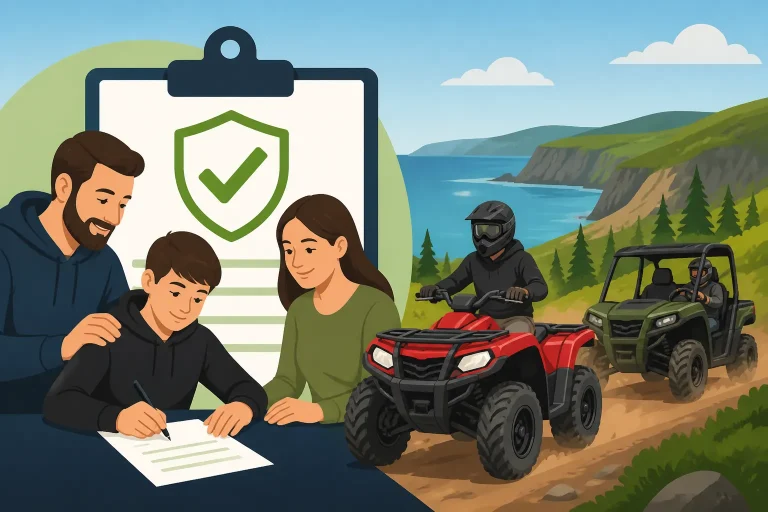
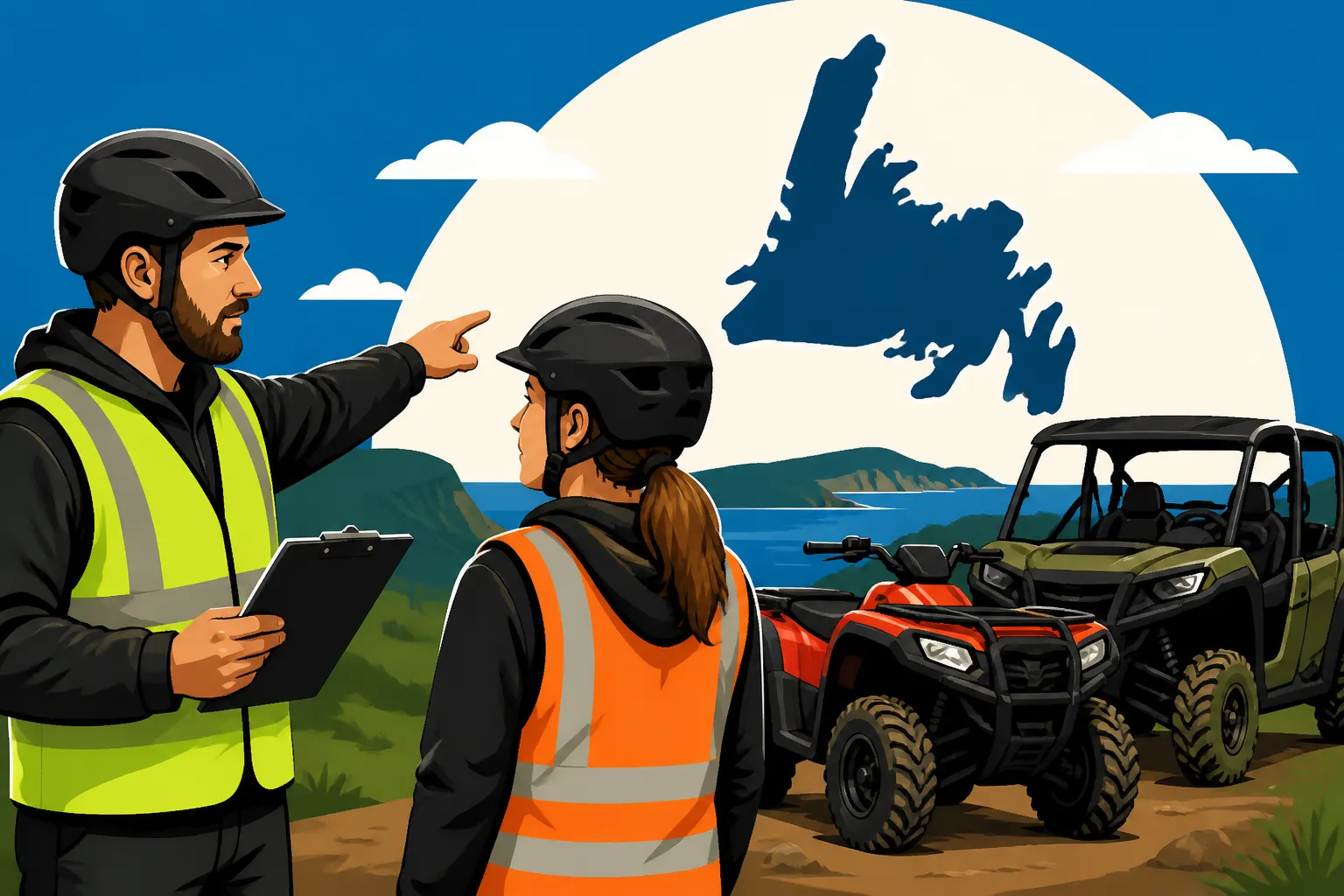
For young riders, Newfoundland and Labrador’s off-road vehicle rules make training and adult supervision separate responsibilities. A supervisor is not simply someone who happens to be nearby: the adult must meet the applicable eligibility requirements, and the young rider must meet the training requirements that apply to them.
The rules identified for supervisors include being at least 18 and holding a driver’s licence. Training requirements apply to young operators, including riders under 16. The practical point is that both sides of the arrangement matter. A trained child with an ineligible supervisor may still be riding outside the rules, and a properly qualified supervisor cannot make up for a child who has not completed required training.
| Check | What to establish before the ride |
|---|---|
| Supervisor | The adult is at least 18 and holds a valid driver’s licence that meets the applicable rule |
| Young rider | The rider has completed the training required for their circumstances |
| Training evidence | The rider can produce the accepted certificate or proof when required |
| Machine | The ORV is appropriate for the rider under the applicable age and size rules |
| Ride location | The route is legal for that machine, and any local access conditions are met |
| Other obligations | Registration, insurance, helmet and equipment requirements are also satisfied |
The training obligation is not a substitute for age-related operating limits. A course may teach a young rider how to use an ORV safely, but it does not automatically authorize a machine or riding situation that the rules otherwise restrict. Check Newfoundland ATV Age Requirements and Newfoundland Engine Size for Age and Weight alongside the training rules.
Likewise, supervision does not remove the operator’s obligations. The child still needs to follow the rules that apply to the machine and location, including equipment and riding restrictions. The adult’s role is to supervise in a way that supports safe, lawful operation—not to take responsibility away from the rider.
A useful starting point is Newfoundland Safety Training Is Mandatory. For the specific requirements affecting children, see Newfoundland Training Required Under 16 and Newfoundland Supervision Rules for Young Riders. These are related but distinct topics: one concerns whether training is required, while the other concerns the conditions for adult supervision.
Who can supervise a young rider
The supervisor requirements are an eligibility test, not just a suggestion about who seems experienced. Before assigning an adult to supervise, confirm that they meet the minimum age and driver’s-licence conditions. A person who is a capable ORV rider may still not qualify if they do not meet those formal requirements.
The rule described for supervisors sets the minimum age at 18 and requires a driver’s licence. Do not assume that a learner’s permit, an expired licence, or an off-road vehicle certificate is equivalent to the required driver’s licence. If there is any doubt about the licence type or status that qualifies, confirm it with the provincial authority before the ride.
A supervisor’s eligibility also does not depend only on whether they are riding a machine themselves. The essential question is whether the adult is fulfilling the legally required supervision role. A parent, relative, family friend or other adult should not be treated as qualified merely because they know the child or have ridden the trail before. Check the actual requirements, then make a deliberate plan for how supervision will work on that trip.
Make supervision real, not nominal
Even when the adult meets the formal qualifications, the arrangement needs to be practical. The supervisor should know where the young rider is, what machine they are operating, and what route the group is taking. A group that spreads out over a long trail can make it difficult for an adult to keep track of a child or respond promptly if something goes wrong.
The law may set the minimum threshold, but safe supervision calls for more than checking an adult’s age and licence. Before riding, agree on simple boundaries:
- Keep the child within the distance and conditions that allow effective supervision.
- Choose terrain and a pace suited to the rider’s ability, not just the adult’s experience.
- Set a clear signal or stopping point if the group becomes separated.
- Stop if the child is tired, cold, distracted or struggling to control the machine.
- Avoid letting a young rider follow a route or group that the supervisor cannot monitor.
- Make sure the adult can focus on the child rather than being responsible for several competing tasks.
These are sensible safeguards, not a replacement for the legal definition of supervision. If the required form or degree of supervision is unclear, check the provincial rule rather than relying on a personal interpretation of what “supervised” means.
One adult may not be enough for every group
A single adult might be able to supervise one young rider on a familiar, low-pressure route. That arrangement can become less effective when several children ride different machines, the group has a wide spread of abilities, or the terrain makes it hard to see everyone. The rules still apply regardless of how many riders are present, but the adult should consider whether they can actually provide the required oversight.
For a group ride, decide in advance which adult is responsible for which child. Do not assume another parent or rider is supervising unless they have agreed to do so and meet the requirements. If the group divides, make sure every young rider remains with an eligible supervisor under the applicable rules.
More adults do not automatically mean better supervision. A clear assignment is more useful than a larger group in which nobody knows who is watching whom.
What training does and does not do
Required training gives a rider a foundation for understanding safe operation and applicable rules. Depending on the accepted training route, the young person may complete a safety test or an approved course. The certificate is evidence of training; it is not a blanket permission to ride any ORV, at any age, on any route.
This distinction matters because several separate requirements can apply at once. A rider may need to meet the training rule and still be restricted by their age, the machine’s characteristics, the location, or other operating conditions. A supervisor’s licence does not change those limits either.
For the rider, check the required course or test and the accepted proof before leaving home. The provincial information on Newfoundland’s Online Training Test can help identify the test route, while Newfoundland Approved Course Providers is relevant if the rider is considering an alternative course. Confirm that the particular course is accepted for the rider’s situation before enrolling; a general ATV course is not automatically interchangeable with training recognized under provincial requirements.
Keep proof accessible
If the rider is required to carry training proof, make sure they know where it is and can produce it during the ride. A certificate stored at home may be difficult to use if an officer asks for it on the trail. Check the accepted form of proof and whether it must be carried by the rider, rather than assuming a photo, an email or an adult’s copy will always suffice.
The supervisor can help by checking the certificate before departure and reminding the young rider to carry it. That is a useful safety check, but it does not transfer the certificate to the adult or replace any requirement that applies to the operator. For details, see Carrying Your Safety Certificate on Every Ride.
If a certificate is lost, unclear or difficult to access, resolve that before riding. Do not assume that having passed a test is enough if the rider cannot show the proof required by the rules.
Training does not replace the machine check
A young rider may have completed training but still be paired with an unsuitable machine. Review the age and size rules that apply to the ORV, and consider whether the rider can reach and operate the controls safely. The machine should be in proper working condition, and the route should match the rider’s actual ability.
The supervisor should also make sure other requirements are covered. Depending on the machine and where it will be used, these can include registration, insurance, helmets, passenger restrictions and access permissions. A course certificate does not replace any of them. See Newfoundland Equipment Requirements for a separate look at machine requirements.
A pre-ride check for supervisors and families
A short pre-ride check can catch problems that are easy to miss when everyone is focused on loading the machines or getting to the trail. Use it for each young rider, rather than assuming a document or decision from an earlier trip still applies.
- Confirm the adult qualifies. Check that the designated supervisor meets the minimum age and driver’s-licence requirements. If there is uncertainty about the licence, verify it before riding.
- Confirm the rider’s training status. Establish whether the young person must complete training for this situation and whether their accepted certificate or proof is available.
- Check age and machine suitability. Make sure the ORV and its operating conditions comply with the rules for that rider. Training alone does not settle this question.
- Choose a manageable route. Consider distance, terrain, weather, traffic, visibility and the rider’s experience. A route suitable for an adult may be too demanding for a child.
- Agree on supervision. Identify who is watching each young rider, how the group will stay together, and what to do if someone falls behind.
- Check the rest of the legal requirements. Confirm registration, insurance, protective equipment and any trail access conditions that apply.
- Explain the stop rule. Make sure the young rider knows to stop and wait if they become separated, lose control, encounter a hazard or feel unable to continue.
For registration and documents, the relevant starting points are Newfoundland Registration Paperwork Explained and Newfoundland Proof of Ownership on the Trail. They address separate paperwork issues, but they help avoid treating training proof as the only document that might matter on a ride.
If the young rider is visiting from another province, do not assume that a training card from home automatically settles every Newfoundland and Labrador requirement. The visitor may have obligations concerning registration, insurance, training or the particular route. Check Newfoundland Rules for an Out-of-Province Machine and Newfoundland Visitors From Nova Scotia as applicable, and confirm recognition of any out-of-province training with the appropriate authority.
Common mistakes that put a ride at risk
Assuming any adult can supervise. Familiarity with ORVs is not the same as meeting the formal supervisor conditions. Check the age and driver’s-licence requirements instead of relying on a person’s experience or relationship to the child.
Treating the certificate as permission to ride without limits. Training does not erase age-related machine limits, route restrictions or other rules. Check all of them separately.
Leaving supervision to chance. “Stay with the group” is not a complete plan if the group is large or the route has poor visibility. Assign responsibility and choose a pace that lets the adult keep track of the child.
Assuming a parent’s presence is enough. A parent or guardian still needs to meet the applicable qualifications and provide the required supervision. The relationship alone does not establish eligibility.
Forgetting proof. A rider who has completed training may still have difficulty demonstrating it if the required certificate is not accessible. Confirm the accepted proof and carry it as required.
Using a course without checking that it counts. A course can be useful without being an approved substitute for the required training. Verify acceptance before relying on it.
Confusing supervision with highway privileges. A supervisor’s driver’s licence does not by itself give a young ORV operator permission to ride on a highway. Highway use has separate rules, and the route must be checked independently.
Overestimating a young rider’s readiness. Passing training does not mean the rider is ready for every trail, weather condition or group pace. Build the ride around the child’s skill and comfort, and be prepared to turn back.
When in doubt, pause the ride until the rules are clear. Confirm uncertain training, supervision or documentation questions with the provincial authority, and check local access conditions with the relevant trail operator or land manager.
Frequently Asked Questions
Does a young rider’s training certificate qualify an adult to supervise?
No. The adult must independently meet the supervisor requirements, including the specified minimum age and driver’s-licence conditions. The young rider’s training and the supervisor’s eligibility are separate checks.
Can an experienced adult supervise without a driver’s licence?
Experience alone does not meet the stated requirement. A supervisor must hold the qualifying driver’s licence, as well as meet the age requirement. Confirm any uncertainty about licence status before riding.
Does completing training allow a child to ride any ATV or UTV?
No. Training does not override age-related machine limits, supervision rules, access restrictions or other operating requirements. Check the machine and route as well as the rider’s certificate.
Should the young rider carry training proof?
Carry the accepted proof if the rules require it. Confirm what form is accepted and make sure the rider can access it during the ride. See Carrying Your Safety Certificate on Every Ride for more on keeping proof available.
Disclaimer
This article is for general informational purposes only and does not constitute professional advice. Laws, prices and regulations vary by location and change over time. Consult a qualified professional for guidance on your specific situation.