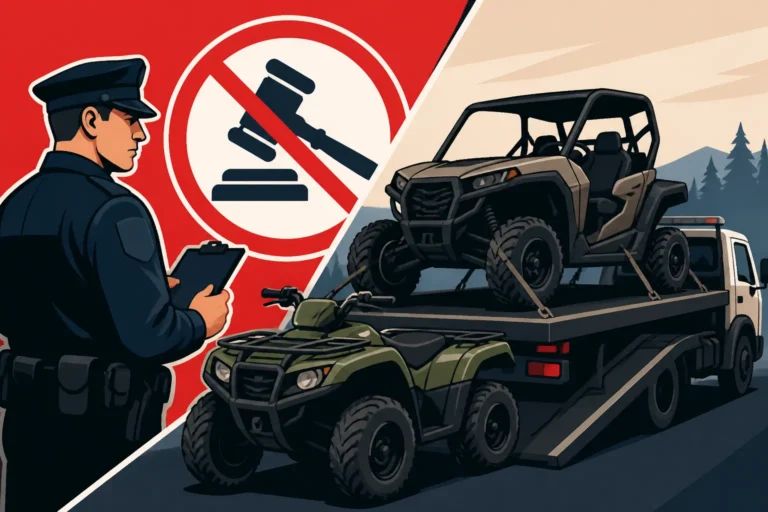
Why a Conviction Can Cost You the Machine
A ride that begins as a shortcut across a bog or a detour around a closed trail can turn into a serious legal problem if the route crosses land where riding is prohibited. In Newfoundland and Labrador, some offences can have consequences beyond a fine, including the possible loss of the machine. This guide explains the difference between seizure and forfeiture and how to reduce the risk before riding.
How a riding offence can put your ATV or UTV at risk
A ticket, a seizure and forfeiture are not the same thing
It is easy to hear that an ATV was “confiscated” and assume that every rider who gets a ticket could lose their machine. That is not a safe assumption. A ticket or charge, a temporary seizure, a court conviction and a final forfeiture are separate steps, and one does not automatically mean all the others will happen.
A machine may be seized in connection with an alleged offence. That means authorities have taken control of it while the matter is dealt with; it does not, by itself, establish that the rider is guilty or that ownership has permanently changed. Forfeiture is the more serious outcome: the machine may be taken permanently if the applicable law and the circumstances of the case allow it.
The type of alleged conduct, the place where it happened, the law being applied and the court’s decision can all matter. That is why the phrase “a conviction can cost you the machine” should be understood as a serious possibility in certain cases—not a guaranteed result for every off-road vehicle offence. For a closer look at the potential consequence, see Newfoundland Machine Confiscation on Conviction.
Why Crown land and restricted areas deserve extra care
Riders may be used to following familiar tracks, but a visible track does not necessarily mean riding is permitted. Land status and access rules can vary along a route. A trail may pass through approved areas, restricted areas, private property or sensitive land where machine use is limited. A rider who crosses a boundary without realizing it may still face an enforcement problem.
Before setting out, learn the basics of Newfoundland Crown Land Riding Rules and check whether the route enters a restricted area. Some places may require permission or allow machine use only on specified trails. The relevant details are covered in [Newfoundland Restricted Area Permissions]. When you are planning a trip, checking the access rules can be just as important as checking fuel, weather and trail conditions.
The risk is not limited to someone deliberately ignoring signs. A rider could follow a group, take a wrong turn at an unmarked junction, or assume that a route used last season is still open. Those situations are frustrating, especially when the machine is expensive and the landscape makes boundaries difficult to recognize. But “I didn’t know” may not resolve the underlying issue. Good route planning and paying attention to signs are practical ways to avoid an accidental entry into a prohibited area.
What happens after authorities take a machine
Seizure does not automatically mean the machine is lost
If an ATV or UTV is taken during an enforcement matter, focus first on understanding the status of the machine and the case. Ask which offence is alleged, what authority was used to seize the vehicle, where it is being held, and what process applies to getting it back. Keep any paperwork, notices or receipts you receive, and write down the names, dates and details while they are fresh.
Do not assume that paying a fine, if one is offered or imposed, automatically resolves every question about the machine. Likewise, do not assume the machine can be collected immediately. The outcome may depend on the charge and the steps taken by the authorities or the court. What Happens to a Machine After It Is Seized can help you understand why seizure and final forfeiture need to be treated as distinct issues.
If the machine is registered to someone other than the rider, or it is financed, rented or jointly owned, tell a lawyer promptly. The registered owner, lender or rental operator may have interests that need to be considered. Keep documents such as the registration, purchase paperwork, loan records and insurance information together, and avoid transferring or hiding the vehicle to interfere with an active investigation.
Get legal advice before making assumptions
A machine seizure can create urgent practical and financial pressure. You may need the ATV for work, access to a cabin or a planned trip, and storage or recovery arrangements can add stress. Still, avoid trying to resolve a serious charge through an informal conversation if you do not understand the potential consequences. Ask a lawyer familiar with the relevant provincial and land-use rules to review the charge, the location, the seizure and any documents you have received.
The details matter. A lawyer can help clarify whether the allegation relates to riding in a restricted area, damaging land, ignoring a closure or another offence, and what responses or deadlines may apply. If you are unsure what to ask, start with: What exactly am I charged with? What legal authority supports the seizure? Is forfeiture being sought? What must happen before the machine can be returned? Are there deadlines for responding or attending court?
Keep your account factual. Note where you entered the trail, what signs were present, who was riding with you, and whether you have photos, maps or messages that show the route. Do not edit or delete relevant records. These steps do not determine the outcome, but they can help your legal adviser understand what happened and assess the available options.
How to reduce the risk before a ride
Confirm that the route is open and permitted
Use more than one clue when deciding whether a route is legal to ride. A line on a phone map, tire tracks on the ground or another group travelling ahead is not, on its own, proof that access is permitted. Look for official information about approved and restricted areas, check posted signs, and contact the relevant land manager or trail operator when the boundary or access rule is unclear. Newfoundland Approved and Restricted Areas is a useful starting point for understanding why land status matters.
Mapping apps can help you plan, but treat them as navigation aids rather than legal permission. For example, onX Offroad may help riders review routes and identify places to investigate before leaving home. Still, compare any app information with official maps and current notices; do not rely on a displayed trail line as proof that a route is open.
Before a longer trip, check for closures, seasonal restrictions and changes to trail conditions. In remote areas, an unexpected detour can tempt riders to cut across land they have not checked. Save your planned route offline if your mapping tools allow it, carry a backup map, and agree with your group that nobody will continue into an uncertain area just to stay on schedule. Finding Approved Areas on the Provincial Map and Newfoundland Trail Conditions Before You Ride are useful topics to review during planning.
Make a simple pre-ride access check
A few minutes of checking can prevent a costly misunderstanding. Use this sequence before starting the engine:
- Identify the land and route. Confirm where the trail begins, where it runs and whether any section crosses private or restricted land.
- Check official access information. Look for approved-area information, closures, signs or guidance from the responsible operator.
- Ask when the answer is unclear. Contact the relevant land manager, trail operator or community office rather than guessing.
- Plan an alternative. If a route is closed or access cannot be confirmed, choose another route instead of pressing ahead.
- Brief the group. Make sure everyone understands the intended route and agrees to stop if the group reaches a closure sign or an uncertain boundary.
onX Offroad can be one part of that preparation when you want to organize a route or keep track of where the group has travelled. It should not replace permission, official land-status information or attention to signs on the ground. A route that appeared reasonable on a screen can still lead to a closed area or a boundary that needs to be respected.
A useful rule for group rides is to make the least certain rider’s concern a reason to pause. If someone spots a sign, questions a junction or thinks the group may have left the approved trail, stop in a safe place and check. That small delay is far easier to manage than an enforcement matter involving the machine.
The consequences and the choices riders can make
A possible fine is only one part of the exposure
The financial impact of an offence may go beyond a ticket. Depending on the situation, a rider may also face towing, storage, legal expenses, missed work or the disruption of losing access to a machine while a matter is unresolved. If forfeiture is pursued and ordered under the applicable law, the loss can be far more significant than the immediate cost of a fine.
That does not mean every allegation ends with the same result. The offence, evidence, location and court process all matter, and outcomes should not be predicted from a story about another rider. For broader context on the potential monetary consequences, see Newfoundland Crown Land Fines for Riders. Treat that information as a reason to plan carefully, not as a substitute for advice about an actual charge.
Responsible riding protects access for everyone
A restricted trail or damaged wetland can affect more than one ride. Ruts, erosion and unauthorized access may prompt closures that affect local riders and visitors alike. Choosing an approved route, respecting a closure and turning back when access is uncertain helps protect the places people want to ride.
If you witness a closure or find that a planned route is no longer passable, update your group and adjust the trip. Share reliable access information with other riders without presenting an unverified track as an approved route. The goal is not to make every ride complicated; it is to avoid letting assumptions put a machine, a landscape or future access at risk.
When a charge or seizure has already happened, take the paperwork seriously, preserve relevant records and seek qualified legal advice promptly. When you are still at the planning stage, verify access before you go. That simple distinction—checking first rather than explaining later—can make a big difference.
Disclaimer
This article is for general informational purposes only and does not constitute professional advice. Laws, prices and regulations vary by location and change over time. Consult a qualified professional for guidance on your specific situation.