Newfoundland Machine Confiscation on Conviction
A machine being stopped or held after an alleged offence can leave a Newfoundland rider wondering whether they will get it back. Seizure and confiscation are not the same thing, and a conviction does not automatically mean every ATV or side-by-side is forfeited. This guide explains how to understand the distinction, what may happen next, and how to protect your options.
Seizure and confiscation are different legal steps
A machine being held is not necessarily a final loss
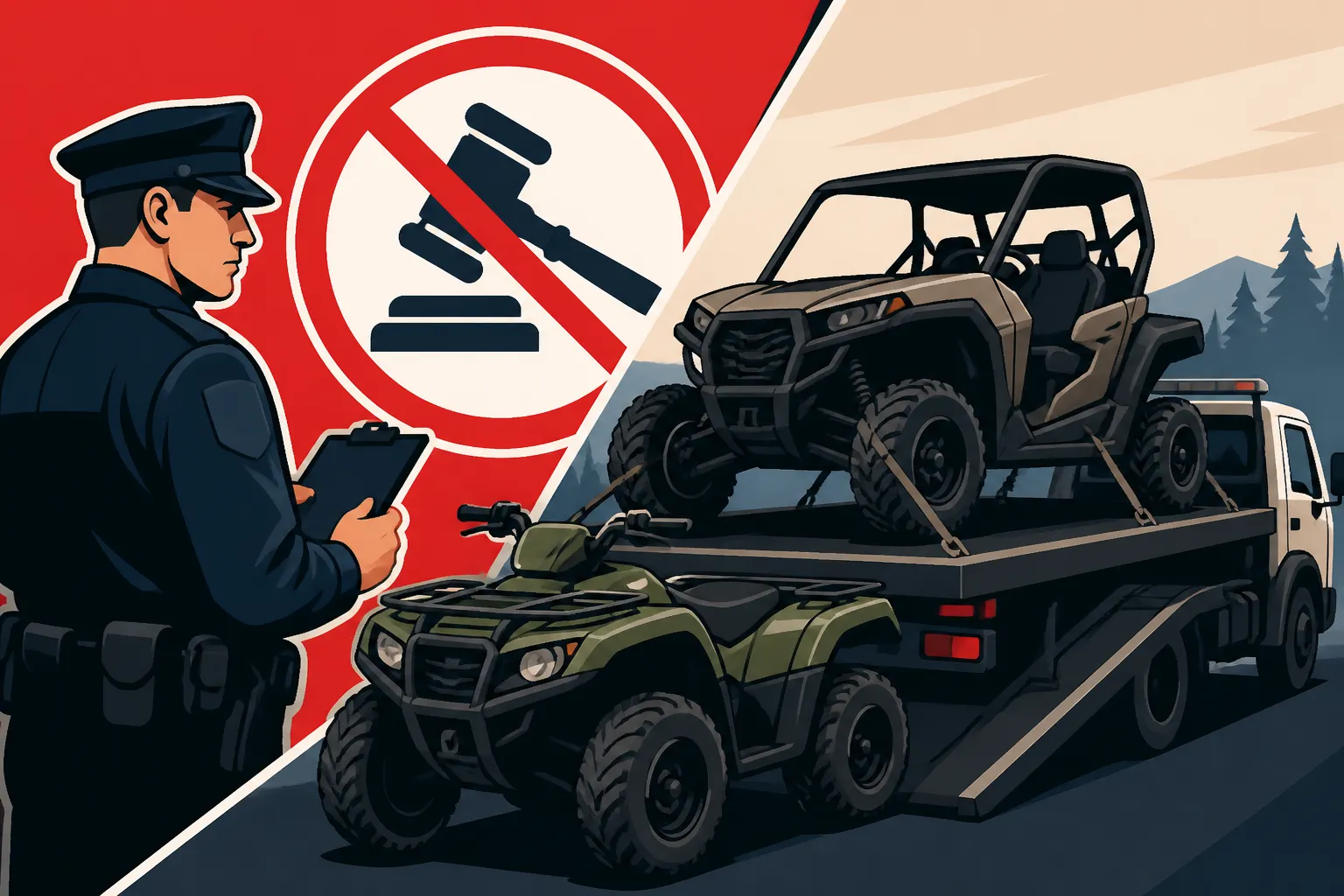
When an officer takes or holds an off-road vehicle, it can feel as though the decision has already been made. Legally, however, a machine being seized or held during an investigation is different from a court ordering it forfeited after a conviction. A seizure may preserve evidence, address an immediate enforcement concern, or occur under a specific legal power. Confiscation or forfeiture is a further consequence that depends on the law applying to the alleged offence and what happens in court.
That distinction matters if your machine is suddenly unavailable. Ask what authority is being relied on, whether the machine is being held temporarily, and what steps must happen before it can be released. Do not assume that paying a fee, receiving a ticket, or being told the vehicle is impounded settles the question of ownership. The legal status can depend on the particular incident and the order, notice, or paperwork issued.
The article [What Happens to a Machine After It Is Seized] can help clarify the difference between an initial seizure and what may follow. For a broader look at the law governing off-road vehicles in the province, see [Newfoundland's Off-Road Vehicles Act]. Read the documents you receive carefully, keep copies, and note the name and contact details of the office handling the matter.
Forfeiture depends on the offence and the court process
The phrase “confiscated on conviction” can sound as if forfeiture happens automatically as soon as a rider is found guilty. It is safer not to make that assumption. Whether a machine can be forfeited, and whether a court actually orders that result, depends on the applicable legal provision, the facts, and the outcome of the case. A conviction may expose a rider to consequences beyond a fine, but the consequences are not necessarily identical for every offence.
The machine’s connection to the alleged conduct may also matter. For example, the circumstances surrounding the ride, the place where it happened, and the offence charged can all be relevant to understanding the possible outcome. A rider should not rely on a general account of another person’s case as a prediction for their own. Two incidents that sound similar in conversation may involve different charges, evidence, or legal authority.
If you have been charged, ask a lawyer familiar with provincial offences and off-road vehicle matters to review the charge and any seizure documents. The linked guide [Newfoundland Machine Confiscation on Conviction] addresses the specific possibility of a machine being lost after conviction, while [Newfoundland Penalties for Riding Illegally] provides wider context on enforcement consequences. Neither a general article nor an informal conversation can replace advice based on your actual paperwork.
| Situation | What it may mean | What to clarify |
|---|---|---|
| An officer stops the machine | An enforcement interaction has occurred; the machine may or may not be held | Was it only stopped, or formally seized or impounded? |
| The machine is held during an investigation | It may be temporarily unavailable while a legal process continues | What authority permits the hold, and how can release be requested? |
| A charge is laid | The matter may proceed through a court process | What offence is alleged, and what deadlines apply? |
| A conviction occurs | A court has found the rider guilty or the rider has pleaded guilty | Does the law permit forfeiture for this offence, and is an order being sought? |
| A forfeiture order is made | The rider may lose the machine, subject to the order and legal process | What does the written order say, and are there review or appeal options? |
Why riding location and conduct can matter
A trail or open-looking route may not be legally open
Newfoundland riders use many kinds of routes: established trail corridors, woods roads, cabin roads, private land, and open-looking stretches of Crown land. A route that appears passable is not necessarily authorized for every machine or every kind of riding. Access rules can depend on the land classification, posted restrictions, trail conditions, local bylaws, and any permits that apply.
That is why an enforcement matter can involve more than the vehicle itself. The location, the route taken, and the rider’s permission to be there may all be relevant. Near a managed trail or on a shared corridor such as the T’Railway, riders should also pay attention to the operator’s directions and the rules for other trail users. A route shown on a recreational map is not, by itself, proof that riding is permitted.
Before setting out, check the relevant provincial or local information and contact the land manager or trail operator when access is unclear. [Newfoundland Crown Land Access Rules] and [Newfoundland Restricted Areas and Approved Trails] are useful starting points for understanding why one route may be open while another nearby route is restricted. If you ride near a community, check local requirements too; [Newfoundland Municipal Road Bylaws] explains why a provincial rule may not answer every local access question.
A mapping app is useful for planning, not permission
A digital trail map can help riders plan a route, keep track of where they have travelled, and avoid getting turned around when a trail branches. Tools such as onX Offroad may be useful for organizing a planned ride and reviewing route information before leaving home. They should not be treated as the final authority on whether a specific piece of land is open to ATVs or UTVs.
This is an important distinction in Newfoundland, where roads, trails, private parcels, and Crown land can meet in ways that are not obvious from the seat of a machine. Map layers may be incomplete, boundaries can be difficult to interpret in the field, and a trail shown on a screen may cross land with separate access rules. If a route is important to your trip, confirm its status with the appropriate authority rather than relying only on a map display.
A practical approach is to use onX Offroad as one planning aid, save the route details you need, and then check the access information with the relevant land manager or operator. Carry another way to navigate if your phone loses signal, and avoid riding past a gate or sign simply because a digital track continues beyond it. The resource [Reading the Signs That Mark an Approved Area] offers a useful reminder: signs and current local directions can matter more than the appearance of a route on a screen.
What to do if an officer holds your machine
Stay calm and get the details in writing
A roadside stop can be stressful, especially when the machine is being loaded or the officer says it will be held. Keep your interactions respectful. Do not argue physically, interfere with the officer, or try to remove the machine yourself. Ask what is happening, whether the vehicle is formally seized or impounded, and which office or agency will handle the next step.
Write down what you can while the details are fresh: the date, time, location, names or identifying numbers provided, the reason given, and the documents you received. If there were witnesses, record their contact information. If the machine has visible damage or accessories that could be confused with someone else’s, take photographs when it is lawful and practical to do so. Keep receipts, registration documents, proof of ownership, and any relevant trail or land-access permissions together.
Ask for the procedure to request release, the location where the machine is being stored, and any deadlines stated in the paperwork. Do not assume that a verbal estimate of what may happen is the same as a formal decision. If the documents are unclear, contact the listed office and ask for an explanation in writing. [What an Officer Can Ask You to Produce] provides additional context about roadside interactions and documents a rider may be asked to show.
Avoid actions that could complicate the case
After a seizure or charge, it can be tempting to post a detailed account online, message everyone involved, or contact a witness to “clear things up.” Those actions may create confusion or affect evidence, even when the rider is trying to be helpful. Before discussing the facts publicly or contacting witnesses about what they should say, get legal advice. Keep original messages, photographs, receipts, and documents, and do not edit or discard material that may relate to the incident.
If you believe the machine was taken in error, set out the concern clearly and preserve the paperwork that supports your position. For instance, you may have proof that you were on a permitted route, that the machine belongs to someone else, or that a document was misunderstood. These details should be raised through the correct legal process rather than through an argument at the storage yard or a heated exchange with an enforcement officer.
Check whether someone else has a legal or financial interest in the vehicle. A machine may be jointly owned, financed, leased, or registered to a business. The registered owner and the person riding it may not be the same person, and that difference can affect who needs to receive notices or seek advice. If registration or ownership is part of the dispute, [Newfoundland Registration and Lien Records] and [Newfoundland Registration With Two Owners] may help you identify records and issues to discuss with a professional.
What can happen after a charge or conviction
The charge and the possible consequences need to be understood separately
A charge describes what the person is accused of doing; it is not, by itself, a conviction. Read the exact wording on the charge document instead of relying on a brief verbal description. The specific offence matters because different provisions can carry different consequences and may involve different requirements for proving the case.
Ask a lawyer to explain what the prosecution must establish, what evidence may be relevant, and what outcomes are legally available. If a machine forfeiture is being considered, ask whether that possibility is written into the applicable provision, whether the prosecution is seeking an order, and how the court will consider it. Do not treat an officer’s statement at the roadside as a guarantee that a court will—or will not—order forfeiture.
A rider should also understand the practical impact of the case. If the machine is used for work, family travel, or access to a cabin, explain that to your lawyer and bring documents that support the circumstances. Those facts do not automatically decide the legal outcome, but they may be relevant to the advice you receive and to how you prepare. Keep discussions focused on verifiable details rather than assumptions about what “usually happens.”
If there is a conviction, read the court’s order carefully
After a conviction, do not rely on a short summary of the result. Obtain and read the written court disposition and any separate order dealing with the machine. Check the exact language, the vehicle identified, the person or organization affected, and any instructions about delivery, release, or forfeiture. If something does not match your understanding of the hearing, raise it promptly with your lawyer.
If the machine belongs to another person, a business, or a lender, that party may need to understand what has happened and what steps are available. Do not assume that the rider’s conviction automatically answers every question about ownership. Conversely, do not assume that another person’s name on registration will prevent the machine from being affected. The precise law and the court’s order are what matter.
Deadlines following a court decision can be short, and the options depend on the case. If you are considering an appeal or another legal step, get advice promptly rather than waiting to see whether the vehicle is returned. For readers trying to understand the general enforcement picture, [Newfoundland Machine Seizure Rules] can be read alongside [Newfoundland Court Costs for a Citation], but neither replaces a review of the actual decision.
Reduce the risk before your next ride
Plan the route and check access before unloading
A little preparation can prevent a ride from turning into a costly legal problem. Before towing to a trailhead, confirm that the route is open to your type of machine and that any required sticker, permit, or other proof is in order. Do not assume that an old track, a friend’s saved route, or a trail shown in a mapping app is still available for riding.
For example, a rider heading toward the west coast may be considering a route near the T’Railway, while someone on the Avalon may be riding near a patchwork of private and public land. In either case, check the specific route rather than relying on a broad description such as “Crown land” or “old railbed.” Closures, access limits, and land ownership can change along a route, so a starting point that is legal does not necessarily make every connecting track legal.
Use onX Offroad or another mapping tool to plan your ride, but pair that preparation with information from the trail operator, relevant land authority, or local community. Keep an offline route or a paper backup if you expect poor service, and identify a turnaround point before reaching a confusing sign or blocked entrance. For a closer look at planning a route lawfully, see [Newfoundland Approved and Restricted Areas] and [Newfoundland Trail Conditions Before You Ride].
Keep ownership, registration, and ride records organized
A well-organized set of documents can make a stressful situation easier to manage. Keep your registration information and proof of ownership accessible, and make sure the machine’s identification details are legible. If you borrow a machine, confirm that you have the owner’s permission and know what documents you should carry. If the machine has changed hands, keep the sale and transfer records instead of assuming the registration paperwork will tell the whole story.
It can also help to keep a simple ride record: intended route, date, who was riding, and any permission or operator information you relied on. This is not a guarantee against a charge or a substitute for legal advice. It is simply a way to remember details accurately if an incident occurs, especially when a ride involves multiple trail connections or a group travelling together.
For questions about paperwork before riding, [Newfoundland Proof of Ownership on the Trail] and [Newfoundland Registration Before Your First Ride] offer relevant background. If the route involves a managed trail, check the sticker and training requirements as well. The guide [The Trail Sticker and Training Proof Newfoundland Requires] can help you identify those separate obligations. Staying organized will not settle every dispute, but it can prevent an avoidable paperwork problem from adding to an already difficult situation.
Disclaimer
This article is for general informational purposes only and does not constitute professional advice. Laws, prices and regulations vary by location and change over time. Consult a qualified professional for guidance on your specific situation.