Newfoundland Big Game Transport Trips
A moose or caribou can be a long, difficult haul from a remote Newfoundland hunting area, especially when the ground is wet, the trail is rough, or daylight is fading. This guide explains the five-trip limit for moving big game by off-road vehicle, what that allowance does—and does not—permit, and how to plan a safe, lawful recovery.
What the five-trip limit means
A narrow allowance for retrieving harvested big game
Newfoundland’s rules include a limited allowance for using an off-road vehicle to move a legally harvested big game animal. The important boundary is the five-trip limit: it is a restricted exception for retrieving game, not a general right to drive an ATV or UTV wherever hunting takes you. The rule is connected to the specific task of getting an animal out, and it should not be treated as permission to use an unapproved trail or enter a restricted area.
That distinction matters because it is easy to blur “I am hunting” and “I am allowed to ride here.” A hunting licence, an animal that has been legally harvested, and a practical need to recover it do not automatically make every route lawful. You still need to understand where machine travel is permitted, whether access restrictions apply, and what other rules govern the area.
The phrase “five trips” is also worth checking carefully before you set out. Do not assume it means five different riders, five loads per person, five days, or five separate animals. The limit is a cap associated with moving a big game animal, so plan conservatively and confirm how the applicable rules define and count a trip. For a closer look at the limit itself, see [Five Trips to Move a Big Game Animal] and [Newfoundland Game Transport Trip Limits].
What the allowance does not give you permission to do
The five-trip allowance does not turn closed land into open land, authorize travel through a restricted area, or replace trail-access requirements. It does not mean you may take a machine across any bog, barren, wetland, private parcel, or marked trail simply because the animal is difficult to retrieve. A recovery plan should start with the legal route, not with the shortest line between the animal and the truck.
It is also not a general licence to use an ATV or UTV as a hunting vehicle throughout the season. There is a meaningful difference between using a machine for a permitted recovery task and riding it around to search for game, follow tracks, or reach places where motorized travel is not allowed. Check the rules that apply to the specific hunt and location rather than relying on how other people in the area describe the practice.
If your planned route crosses Crown land, a managed trail, private property, a park boundary, or a restricted area, each may raise a separate access question. Reviewing [Newfoundland Crown Land Access Rules] and [Newfoundland Restricted Area Permissions] can help you identify those issues before the hunt. When the route remains unclear, ask the relevant land or trail authority before relying on the recovery allowance.
How to count and plan the trips
Make a conservative trip plan before the hunt
A useful plan begins with the return point: the place where the animal can be transferred to a road-legal vehicle, trailer, or other lawful transport. From there, map the likely route to the hunting area, note the distance and difficult sections, and consider how you will move the animal in manageable loads. An ATV that can reach the site may not be able to carry the full animal safely in one journey.
Write down the proposed movements before you ride. Include who is operating the machine, where each load will go, and whether the planned route changes between trips. That record will not change the legal limit, but it can help everyone in the party understand the plan and avoid making an extra run out of confusion or habit.
Do not leave the counting until you are tired, cold, or trying to work around a changing weather forecast. When a trip’s status is uncertain, the safest approach is to treat the limit as a hard ceiling and plan to stay below it where possible. Confirm the precise counting rule with the appropriate authority before the season, especially if several machines or hunters will be involved.
| Planning question | Why it matters | Practical step |
|---|---|---|
| What is the legal route? | A recovery allowance does not automatically open restricted land or trails. | Check the route and its access rules before the hunt. |
| What counts as a trip? | Misunderstanding the count can lead to an extra run. | Confirm how the applicable rule defines a trip. |
| Where will the animal be transferred? | A recovery route needs a safe, lawful end point. | Identify the road, staging area, or other transfer point in advance. |
| Can the machine carry the load safely? | Overloading affects steering, braking, traction, and stability. | Plan manageable loads and use suitable equipment. |
| What happens if the route is blocked? | Weather, water, gates, and trail damage can change the plan. | Set a turnaround point and a non-machine backup plan. |
Keep the recovery separate from general riding
When possible, make the recovery route direct and task-focused. Avoid adding sightseeing loops, scouting detours, or unrelated errands that make the machine use harder to explain and may increase pressure on the trip count. The more clearly the ride is tied to moving the harvested animal, the easier it is for the group to stay within the narrow purpose of the allowance.
A change in plan can create confusion. For example, one rider may take a load to a staging point while another travels back to collect equipment, and someone may count only the loaded runs. Do not assume that an unloaded return or repositioning movement is excluded from the rules. Ask how the trips are counted, then build a plan that does not depend on a generous interpretation.
Keep a simple written note of the date, route, machine, operator, and each movement made for the recovery. This is a practical record, not a substitute for compliance or formal documentation. It can help the party stay organized and avoid conflicting recollections if conditions force a change or an officer asks what the machine is doing.
Check access before riding
Crown land and approved areas
Newfoundland has distinct rules for motorized travel on Crown land, and an area that looks open on the ground may not be approved for riding. A wide, dry-looking track is not proof that it is legal to use. Before the hunt, identify the approved area or route and check for restrictions that could affect the recovery plan, including seasonal closures and limits on where machines may travel.
A map is a planning aid, not a legal ruling. onX Offroad can help you review terrain and build a route, but map lines do not establish that a trail is currently open or that a rider has permission to use it. Compare any digital route with official information and posted signs, and do not treat an app’s apparent access status as permission.
This is especially important on exposed barrens and in wet ground, where a detour around a difficult section can leave a durable track or cause damage that is hard to undo. If the marked route ends, the ground becomes unsafe, or you encounter a closure, stop and reassess rather than creating a new route. For location-specific planning, review [Finding Approved Areas on the Provincial Map] and [Newfoundland Trail Conditions Before You Ride].
Private land, managed trails, and protected places
A route that passes close to a cabin, community, or public road may still cross private land. Do not assume that an old track, an open gate, or a neighbour’s customary route gives you permission to cross a parcel. Where private property is involved, get permission from the landowner before the hunt and make sure everyone in the party understands the agreed route.
Managed trails may have their own requirements, including trail stickers or operator rules. A recovery exception does not necessarily cancel those requirements. Ask the trail operator whether the planned route is open and whether a recovery ride is permitted under its rules. If access is denied or the route is closed, do not try to solve the problem by bypassing a gate or riding around a sign.
Protected areas also deserve special care. National parks, provincial parks, wildlife-sensitive areas, and other restricted zones can have rules that are stricter than the general rules for riding. A hunting plan should be checked against those boundaries before the season, not improvised after an animal has been harvested. See [Newfoundland Hunting Season Trail Rules] and [Permission From a Landowner Before Crossing Private Ground] when sorting out access questions.
Prepare the machine and the load
Match the machine to the terrain and task
A machine that feels capable on a dry trail can behave very differently when it is loaded, crossing soft ground, or climbing a wet slope. Consider the ATV or UTV’s capacity, the condition of its tires and brakes, and whether the route includes steep grades, water, deep ruts, or loose rock. A large load changes how the machine turns and stops, so do not plan around the machine’s unloaded performance.
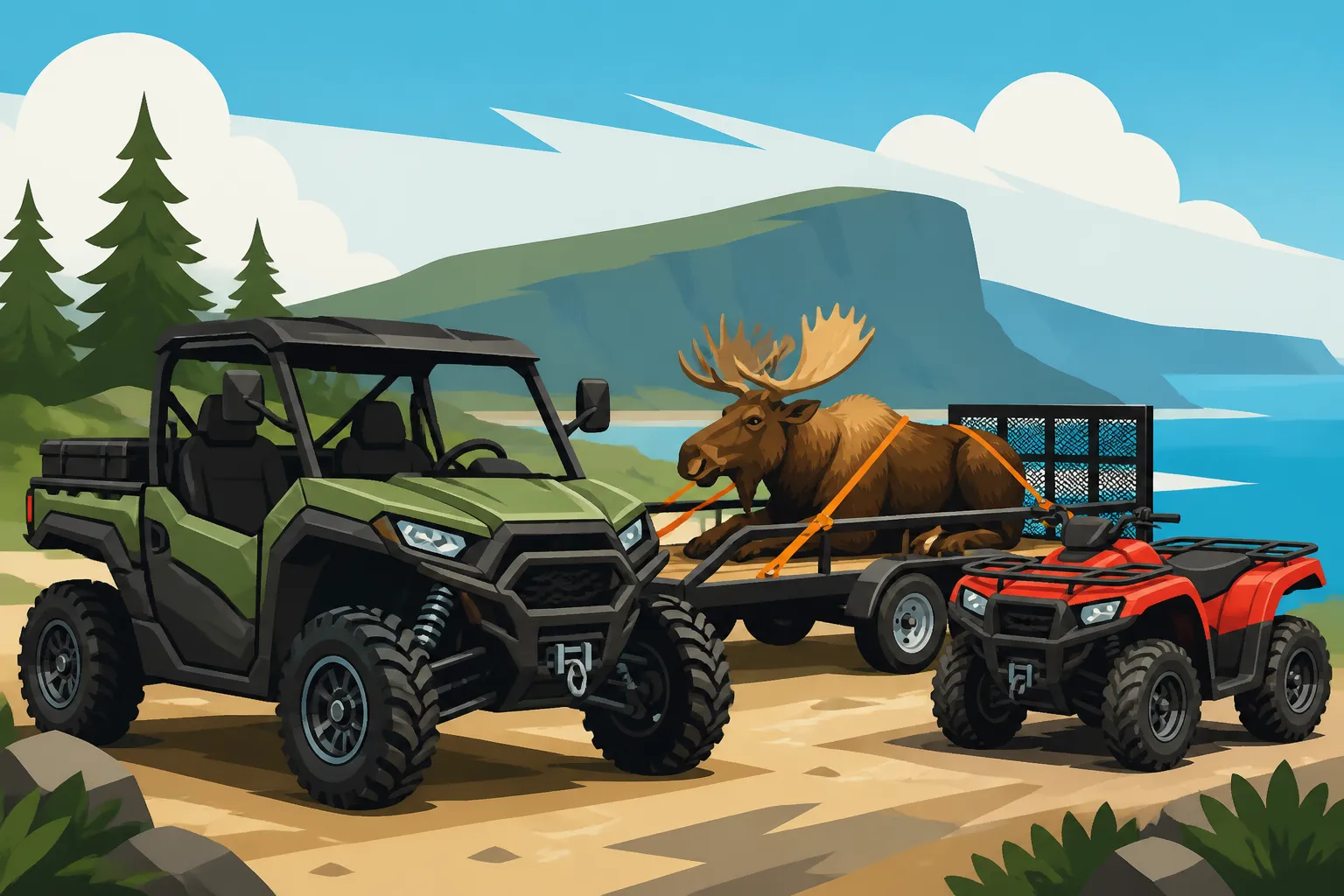
Check the manufacturer’s limits for carrying and towing, and use suitable racks, trailers, or other approved equipment. Keep the load low, stable, and secured so it cannot shift when the machine leans or crosses uneven ground. If the animal or equipment cannot be secured without exceeding the machine’s capacity, reduce the load or choose another lawful method rather than forcing the machine to carry more.
A UTV’s extra space can be helpful, but it does not erase payload limits or make steep, unstable terrain safe. Likewise, a powerful ATV may still be a poor choice for a narrow, wet trail. Think about the weakest part of the route, not just the machine’s engine size. For a long ride over exposed or rough terrain, carry the equipment described in [What to Carry for First Aid on the Barrens] and consider how you would manage a breakdown.
Secure the load and protect the machine
Before each movement, stop on stable ground and check that the load is balanced and tied down. Straps should be appropriate for the job, in sound condition, and arranged so they cannot catch in wheels, tracks, or moving parts. Recheck them after the first short distance; rough ground can loosen a load even when it seemed secure at the start.
Keep visibility and control in mind. A load that blocks the operator’s view, interferes with steering, or shifts weight too far to one side is not safe to carry. Do not stack equipment where it can obscure lights or identification plates. If the animal cannot be positioned without compromising safe operation, use a different transport method or make a lawful adjustment to the plan.
Mud, water, and plant material can collect around the radiator, brakes, axles, and drive components during a recovery. Stop periodically to inspect the machine, especially after crossing a wet or muddy section. A small problem noticed early is easier to deal with than a failure several kilometres from the staging point. Keep tools and recovery gear secured rather than loose on a rack where they can fall off on rough ground.
Make a safer recovery in Newfoundland conditions
Weather, daylight, and difficult ground
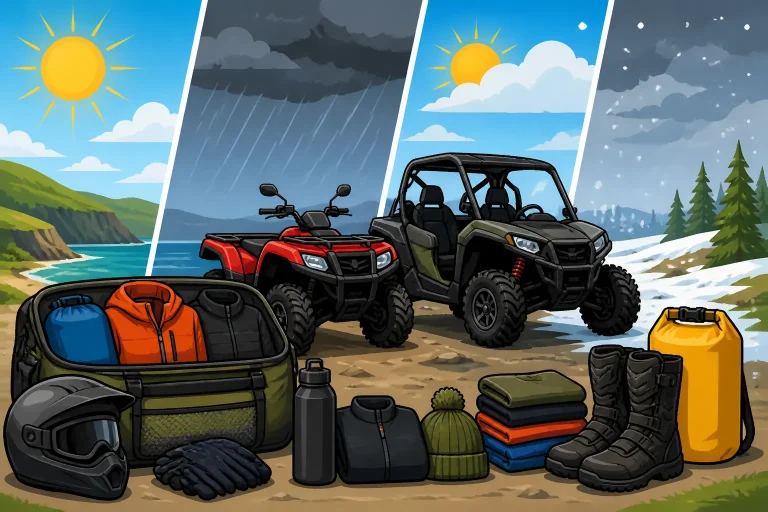
Newfoundland weather can change quickly, particularly on open barrens and along exposed routes. Rain can turn a firm trail slick; fog can reduce visibility; and wind can make a loaded machine harder to control. Check the forecast and local conditions before starting, but make the decision to turn back based on what you see on the ground, not on how much work has already gone into the recovery.
Plan the recovery with daylight to spare. A trip that seems short on a map can take much longer when the route is rutted, the load is awkward, or the machine needs to stop for inspection. If the animal is far from the staging point, consider whether completing the work safely is realistic before the light fades. Avoid letting the five-trip limit or the desire to finish push the group into a rushed final run.
Ground conditions matter as much as distance. A route that passes through soft bog or a wetland may be inappropriate even if it appears to be the most direct option. Deep ruts can damage the land and trap a loaded machine, while a detour may cross an area where riding is not permitted. Check [Newfoundland Trail Damage and Bog Ruts] and [Newfoundland Wetland Protection Rules] when planning routes through sensitive terrain.
Wildlife, other trail users, and communication
A recovery ride may take place in an area used by hikers, cyclists, other hunters, or riders. Slow down where visibility is limited, especially near bends, trail junctions, and shared-use corridors. Give other users room, avoid sudden manoeuvres with a load, and stop in a safe place if you need to let people pass.
Wildlife can be unpredictable, and an animal encountered on the route may affect the safety of the whole group. Do not chase or crowd wildlife with a machine. Give animals space and adjust the route if needed. In a region where caribou or other sensitive wildlife may be present, check any local closures or restrictions before riding; a recovery task does not justify ignoring wildlife protection measures.
Tell someone outside the hunting party where you are going, what route you expect to use, and when you plan to return. Make sure the group has a way to communicate if the route separates riders or cell service disappears. A paper map is useful where a phone has no signal, and a clear turnaround plan can prevent one rider from continuing alone when the rest of the party is delayed. onX Offroad may help with route preparation, but download or carry the information you need before entering an area with limited coverage.
Avoid common mistakes
Treating the allowance as permission to ride anywhere
One of the most costly misunderstandings is assuming that the five-trip limit is a blanket authorization to reach any harvest site by machine. It is not. The trip allowance and access rules answer different questions: one concerns the limited recovery use, while the other concerns where a machine may travel. A route can be short and still be prohibited.
Another mistake is treating a visible trail as an approved one. Old tracks may be unofficial, abandoned, damaged, or closed. A route shown on a recreational map may also be out of date or may not reflect a local restriction. Check official maps and notices, confirm with the land or trail authority, and respect signs on the ground.
It is also risky to assume that common local practice settles a legal question. People may have different understandings of what counts as a trip or where a recovery exception applies. If the details matter to your route, get clarification before the hunt. A conversation in advance is far easier than trying to interpret an unclear rule after a machine has been stopped or a trail has been damaged.
Overloading or rushing the recovery
A heavy, poorly balanced load can make even a familiar machine feel unstable. Overloading can affect braking, steering, traction, and the ability to climb or descend safely. If the machine begins to struggle, do not try to make up time by accelerating harder or taking a steeper line. Stop in a safe place and reconsider the load and route.
Rushing can also lead to preventable errors: loose straps, missed turns, forgotten equipment, or a decision to take a shortcut through sensitive terrain. Before each run, check the load, confirm the route, and make sure the operator is fit to ride. Fatigue and cold can make a difficult job more dangerous, especially when the party is focused on getting the animal out before dark.
Finally, do not add an extra journey simply because the first plan was inconvenient. The limit is not a target to stretch. If the recovery cannot be completed within the applicable rules and safe operating limits, pause and seek guidance or another lawful transport option. [Why a Big Game Licence Allows Only Five Trips] offers additional context on why the allowance is limited.
A practical planning checklist
Before the hunt
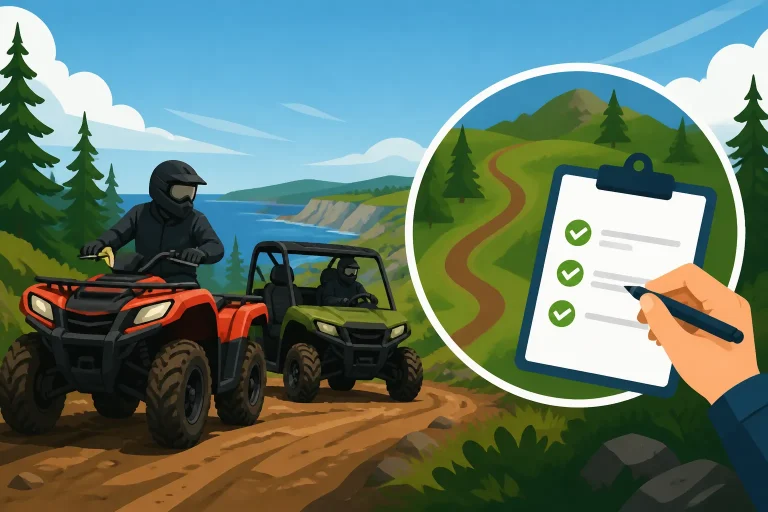
Start with the rules, route, and access—not just the machine. Identify where the hunt will take place, confirm the status of the planned riding area, and check whether any seasonal closure or local restriction applies. Ask the relevant authority or trail operator about any uncertain section. If you expect to cross private land, arrange permission before the hunt rather than trying to find the landowner after a harvest.
Confirm how the five-trip limit applies to your situation. Decide who will operate each machine, how movements will be counted, and where the animal will be transferred. Check the ATV or UTV’s capacity and prepare suitable straps or other equipment. Tell someone your intended route and return time, and plan for poor weather, a breakdown, or a blocked trail.
If your route involves unfamiliar terrain, use more than one source of information. A digital route-planning tool such as onX Offroad can help you study distances and terrain, while official maps and local authorities are essential for checking access and closures. Carry offline route information where possible, and do not rely on mobile coverage being available in remote areas.
At the harvest site and during each run
Once the animal has been harvested, pause before moving it. Confirm that the route remains safe and lawful, assess the condition of the trail, and decide whether the machine can carry the load without exceeding its limits. If conditions have deteriorated or the planned route is blocked, do not improvise a route through land where you may not ride.
Before each movement, secure and balance the load, check that the operator has a clear view, and make sure the machine is in good working condition. Keep track of each trip in a written note, and have the group agree on what counts as a trip under the applicable rules. If anyone in the party is uncertain, stop and resolve the question before continuing.
After the recovery, clean mud and debris from the machine where appropriate, inspect it for damage, and report any incident that requires reporting. Take care not to leave straps, packaging, or other waste at the site or along the route. A considerate recovery protects the land and helps keep access open for hunters and riders who come after you.
Questions to resolve before you rely on the allowance
A few specific questions can prevent a difficult day from becoming a legal or safety problem. Ask how the five-trip limit is counted, whether unloaded return movements are included, and whether the rule applies to the exact type of machine and recovery you are planning. Do not rely on assumptions about whether the limit is per animal, per party, per machine, or per person unless the applicable rule clearly says so.
Also ask whether the planned route crosses a managed trail or restricted area, whether a trail sticker or other requirement applies, and who can confirm current access conditions. If the route passes through private land, confirm permission and any conditions the landowner sets. For hunting-season details, check [Newfoundland Big Game Licence and Machine Use] and [Retrieving an Animal From a Barren].
If you cannot get a clear answer before the hunt, do not build a plan that depends on a doubtful interpretation. Choose a route and method that clearly fit the rules, or make arrangements for another lawful way to move the animal. The five-trip allowance can be useful, but it is only useful when the recovery stays within the rules and the machine, rider, and terrain can handle the job safely.
Disclaimer
This article is for general informational purposes only and does not constitute professional advice. Laws, prices and regulations vary by location and change over time. Consult a qualified professional for guidance on your specific situation.