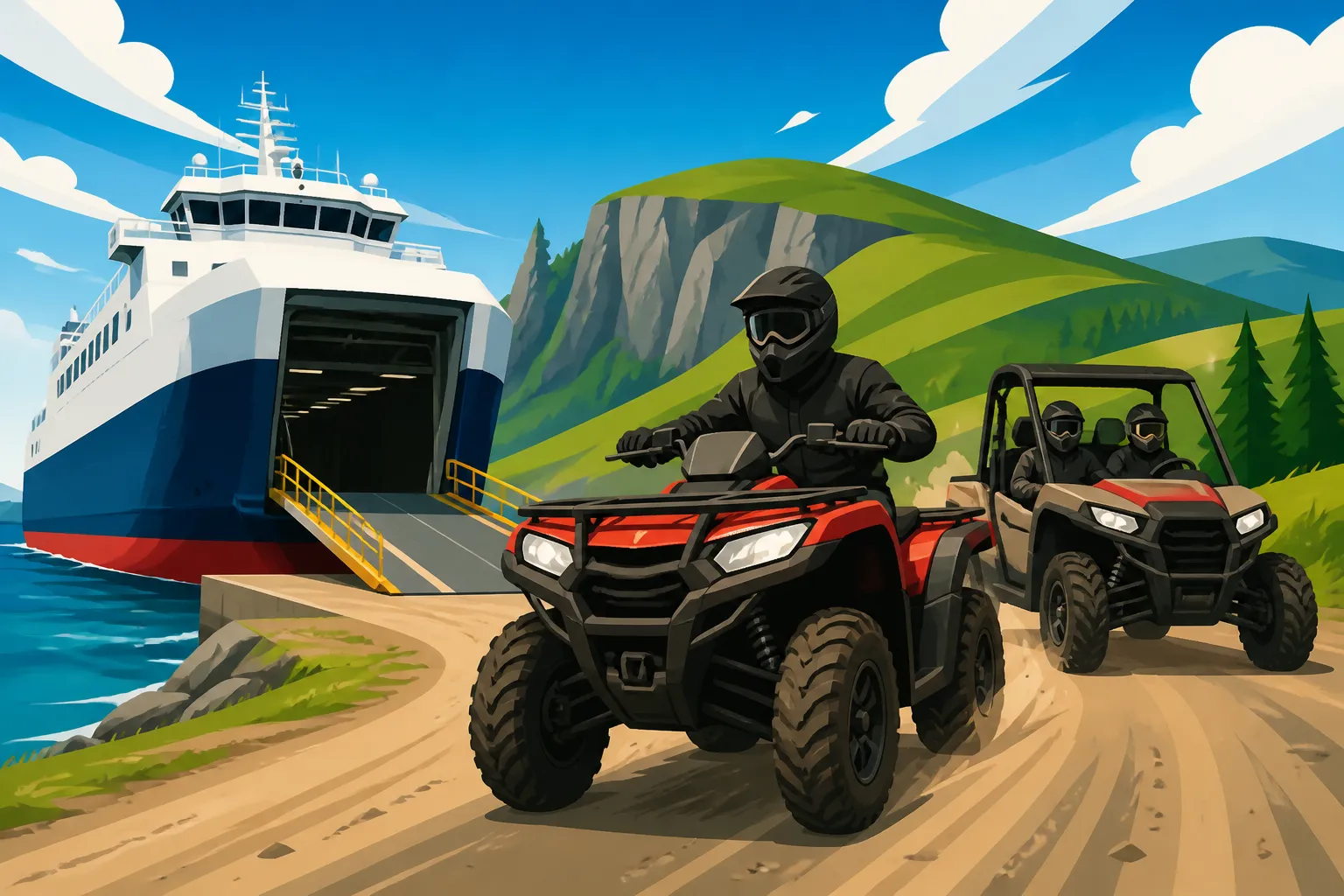
Riding Out of Port aux Basques
Arriving in Port aux Basques with an ATV can make it tempting to unload and head straight for the railbed, but the route from the ferry to a legal riding area is not something to guess. This guide explains how to plan a ride from the town, check access and trail conditions, prepare your machine, and avoid turning a scenic outing into a stressful detour.
Planning an ATV ride from Port aux Basques
Know what the T’Railway is and what it is not
Port aux Basques sits at the western end of Newfoundland’s T’Railway, a long recreational corridor built along a former railway route. Its gravel and ballast sections can be a useful starting point for exploring the island, but the corridor is shared and its conditions vary. A familiar-looking railbed is not automatically a smooth, open ATV trail, and access rules can differ from one section to another.
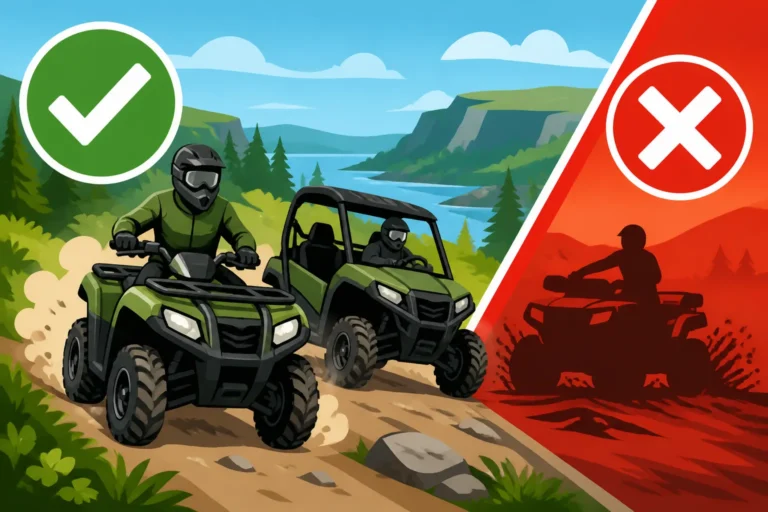
Before unloading, confirm where machines are permitted and how riders can legally reach the route from their starting point. A ferry terminal, town street, roadside pull-off, private access lane, or trail entrance can each have different rules. Do not assume that a machine may be ridden between them simply because the distance looks short on a map. If a legal connection is unclear, ask the relevant trail operator or local authority before setting out.
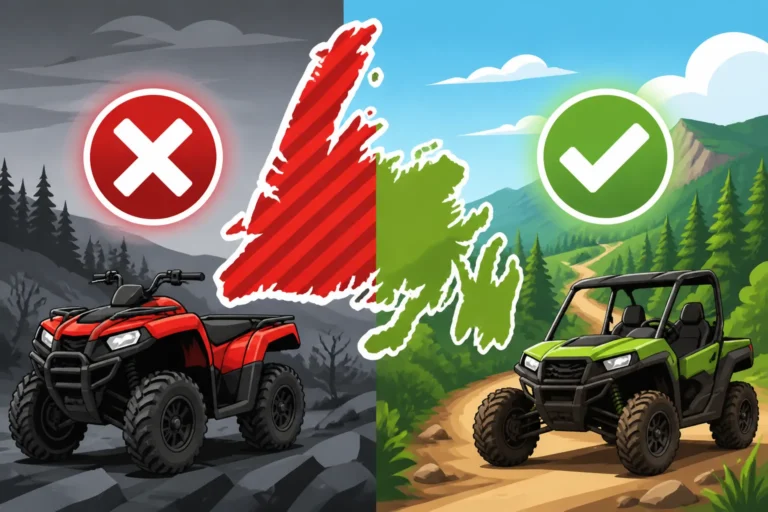
It also helps to distinguish the T’Railway as a broad provincial corridor from the specific managed trail sections and local routes you may want to ride. Check Newfoundland’s Old Railbed Turned Trail for background on the corridor and Newfoundland Approved and Restricted Areas before treating a line on a map as permission to ride. The main planning question is not just “Where does this track go?” but “Is this section open to my machine, and can I legally get there?”
Treat your arrival day as a logistics day
After a ferry crossing, the first few hours can be more tiring than expected. You may be dealing with a trailer, luggage, fuel stops, weather changes, or a machine that has shifted during transport. It is reasonable to use arrival day to get organized rather than trying to fit in a long ride before you know the local access points.
Confirm where you can safely park and unload, and make sure your trailer is not blocking a business, road, or access gate. If you plan to meet a riding group or use a managed trail entrance, ask where they expect riders to stage. A town street or roadside shoulder may not be suitable for unloading, even if it seems convenient. Keep the towing vehicle and trailer positioned so other traffic can move freely.
For a first outing, build in time to check the machine, review your route, and ask about closures. The practical details are covered further in Trailering a Machine Along the Trans-Canada Highway and Where a Ten-Machine Group Can Unload Safely. If your trip begins with a rental rather than your own quad, confirm the operator’s pickup and return arrangements before you plan a ride away from town.
Check conditions and access on the day you ride
Trail conditions can change after heavy rain, wind, washouts, or seasonal maintenance. A route that was passable on a previous visit may have deep puddles, loose ballast, blocked sections, or a temporary closure. Ask locally about the section you intend to ride, not just the destination at the far end. “The trail is open” may not answer whether a particular bridge, spur, or connecting road is usable.
Use a map to plan, but do not let a map decide what is legally open. A digital tool such as onX Offroad can help you visualize terrain and organize a route, particularly when you are comparing possible loops. Still, confirm permitted use, current closures, and private-land access with the relevant local or provincial sources. A mapped line is useful information; it is not permission.
Coverage can also be inconsistent once you leave town. Save route information before you go, carry a paper map or written notes, and make sure everyone in the group understands the planned turnaround point. If visibility drops or the route becomes harder than expected, turning around is a sound decision, not a failed ride. For remote sections, see Cell Dead Zones Along the Railbed and Carrying a Paper Map Where There Is No Signal.
Getting the rules and paperwork right
Confirm that your machine and ride meet the requirements
Before riding, make sure the ATV or side-by-side has the required registration, identification plate, safety equipment, and insurance for the kind of travel you intend to do. Riders arriving from elsewhere should not assume their home-province paperwork answers every Newfoundland requirement. Rules may differ for visitors, residents, and machines that remain in the province for an extended stay.
Managed trails may also have a separate sticker or access requirement, along with safety-training obligations. These are not interchangeable with registration. Check The Trail Sticker and Training Proof Newfoundland Requires and Newfoundland Visitor Rules and the 30-Day Limit if you are visiting with an out-of-province machine. If you are uncertain whether your planned section is managed, contact the trail operator before you ride rather than waiting until you reach a gate.
A quick pre-ride document check can prevent an avoidable interruption. Keep the registration and insurance information accessible, and make sure the machine’s plate is visible and securely attached. For an overview of the rules that affect machine use on roads and trails, read Newfoundland ORV Road Rules Explained. If your plan includes a public road connection, do not assume that a short distance or quiet road makes it legal.
Understand the difference between trail riding and road travel
The railbed and other designated riding areas are not a blanket authorization to use nearby roads. Some situations may involve a permitted crossing or limited road-related travel, but the details matter. Check the route before riding any public road, shoulder, or town street, and verify local bylaws as well as provincial rules. A route-planning app can show where a road runs, but it cannot determine whether your ATV is allowed on it.
This is especially important around a community where a rider may need fuel, supplies, or a legal route to a trail entrance. Do not follow another machine onto a road without knowing whether that rider has permission or is complying with the rules. If a connection requires a public-road segment, confirm the applicable requirements and plan a compliant route. Newfoundland Municipal Road Bylaws explains why local rules matter, while Can You Ride an ATV on the Road in Newfoundland? addresses the broader road-use question.
On a shared corridor, slow down around walkers, cyclists, other riders, and maintenance activity. Give people space, avoid creating dust where it could affect others, and do not tear up soft or waterlogged ground. A route that is technically accessible can still be a poor choice when weather or trail conditions make it unsafe or damaging. Check Riding Etiquette on a Shared Railbed before joining a busy section.
Make a simple decision table before you leave
A short planning check is often more useful than trying to remember every detail once the machine is loaded. Use the table below as a prompt, then verify the specific requirements for your route and machine.
| Planning question | What to confirm | Why it matters |
|---|---|---|
| Is the section open to ATVs or UTVs? | Current access rules and any closure notices | A visible trail or old railbed may not be open to your machine |
| Can you reach it legally from your starting point? | The route between staging area and trail entrance | Nearby roads, town streets, and private lanes may have different rules |
| Are your documents in order? | Registration, plate, insurance, and any visitor requirements | A trail sticker does not replace machine paperwork |
| Is a trail sticker required? | Whether the section is managed and who issues access stickers | Requirements can depend on the trail and operator |
| Is training proof required? | What certificate or proof riders must carry | Riders may need to meet training rules even when experienced |
| Is the route suitable today? | Weather, recent rain, closures, and surface conditions | Gravel, ballast, mud, and water can change quickly |
| Can you navigate without cell service? | Offline route information, paper map, and group plan | Signal may not be available along remote sections |
Preparing the machine and your group
Inspect the ATV before leaving town
A small mechanical problem is much easier to handle before you are far from help. Check tire condition and pressure, lights, brakes, steering, belts where applicable, fuel, and any visible leaks. Make sure the plate is secure and not obscured by mud, cargo, or a trailer tie-down. If the machine was just transported, look over the straps and attachment points before removing them, then inspect the vehicle for anything that may have shifted or been damaged.
Carry basic tools and a few supplies matched to the machine and route. A spare belt may make sense for some models, while another rider may prioritize a tire repair kit, tow strap, pump, or compact first-aid kit. Avoid packing so much loose cargo that it can move into the controls or block the plate. These small checks are particularly worthwhile before a longer ride beyond the immediate Port aux Basques area.
Be realistic about your fuel range. Do not assume that a fuel stop will be available at the trailhead or along the route. Plan your turnaround point around the machine’s usable range, the group’s comfort, and the possibility of slow travel. Gravel and ballast can make a ride take longer than a distance estimate suggests, especially when the route is shared or rough.
Pack for Newfoundland weather and changing terrain
The weather near the coast can feel different from what you experienced at home or during the ferry crossing. Fog, rain, wind, and temperature changes can affect visibility and comfort, even when the ride begins in pleasant conditions. Bring rain protection, warm layers, gloves, and eye protection appropriate for the day. A spare dry layer can make a significant difference after a wet stretch or an unexpected stop.
Keep water, food, medication, and a basic first-aid kit with the group. If you are riding with children or someone new to ATVs, plan additional breaks and keep the route within their experience level. Agree on a meeting point if the group gets separated, and make sure each rider knows who is leading and who is sweeping at the back.
A compact safety plan should include the route, an expected return time, and a person outside the group who knows where you are going. Make sure that person knows whom to contact if you do not check in. For a more detailed packing list, see Packing for Weather That Changes Every Hour and What to Carry for First Aid on the Barrens. onX Offroad may be useful for keeping a planned route visible, but carry a backup that does not depend on a phone signal or battery.
Ride within the group’s ability
The first stretch of a ride is a good time to assess the surface and pace. Ballast, washboard, loose stones, mud, and standing water can feel very different from a groomed trail. Give each rider room, keep a pace that allows people to react, and stop somewhere safe if the group needs to regroup. Avoid pressuring a less experienced rider to cross an obstacle they are uncomfortable with.
Plan a turnaround point before setting off. That gives the group a clear decision if the route is slower than expected, the weather worsens, or someone becomes tired. Do not make the farthest point of the ride the only measure of success. A shorter outing with enough daylight, fuel, and energy left for the return is often the better ride.
If you are uncertain about a section, pause and check rather than committing because the rest of the group has already moved ahead. A route can narrow, become soft, or lead toward a gate or private access. Keep onX Offroad or another mapping aid in its proper role: useful for orientation, but not a substitute for signs, local guidance, or permission.
Building a practical Port aux Basques ride plan
Choose a realistic first outing
For a first ride from Port aux Basques, keep the plan modest. Choose a section whose access you have confirmed, leave a comfortable fuel and time margin, and avoid tying the day to a distant destination. A simple out-and-back ride makes it easier to turn around when conditions change. It can also help you learn how quickly the group moves over local terrain before you commit to a longer route.
If you are new to the area, ask a local trail operator, club, or knowledgeable rider about current access and conditions. Ask specific questions: which entrance is suitable for your machine, where people are allowed to stage, whether the section is open, and whether a sticker or other proof is needed. General advice such as “there’s a trail nearby” may not answer the practical details you need.
Use an updated map to mark your intended route, planned stops, and turnaround point. onX Offroad can help you compare route options and keep your planned track organized, but check the map against local guidance before relying on it. If route details are uncertain, simplify the plan instead of adding more distance. A clear, legal route is better than a complicated one that depends on assumptions.
Respect shared spaces and local access
The T’Railway and nearby trails can serve people with very different reasons for being outdoors. Walkers and cyclists may be using the corridor, while local residents, trail crews, and other riders may be moving through the same area. Slow down when visibility is limited, yield space, and avoid sudden acceleration near other users. Keep noise down where possible and leave gates, signs, and barriers as you find them.
Stay on permitted routes and avoid creating new tracks around puddles or blocked sections. A short detour across soft ground can leave ruts that persist after the weather changes. If a section is closed or damaged, do not bypass the closure to keep your ride on schedule. Turn around and report a hazard or access issue to the appropriate operator when you can.
Carry out everything you bring in, including food wrappers, broken straps, and repair materials. Park and unload only where permitted, and do not block access for emergency vehicles, maintenance crews, or other trail users. These habits help protect access for riders who return after you.
Give yourself a safe return window
A ride plan should account for the trip back, not just the distance out. Set a return time that leaves daylight and enough reserve for a slow section, a minor repair, or a regrouping stop. If fog, heavy rain, or fading light makes navigation harder, shorten the ride. Continuing because the group is “almost there” can turn a manageable outing into a difficult return.
Before leaving the trail area, check that all riders are present, the machines are secure for any road or trailer travel, and no gear has been left behind. Once back in town, inspect the machines for mud buildup, loose parts, or damage that may need attention before the next ride. Cleaning mud from lights and plates also helps keep required markings visible.
For help planning other sections of the corridor, Riding the T’Railway From St John’s to Port aux Basques provides a broader perspective on the route, while Newfoundland Trail Conditions Before You Ride is useful when weather or maintenance may affect your plans. onX Offroad can remain one part of your route-planning routine, alongside local access checks, a backup map, and sensible decisions on the trail.
Disclaimer
This article is for general informational purposes only and does not constitute professional advice. Laws, prices and regulations vary by location and change over time. Consult a qualified professional for guidance on your specific situation.