Newfoundland Trails Through Bog
Bog riding in Newfoundland can turn a scenic route into a long, exhausting recovery if peat, water, and changing weather catch you off guard. The key is knowing which routes are actually open, recognizing soft ground before you enter it, and carrying the right gear. This guide covers practical planning, riding technique, recovery choices, and ways to limit damage.
Plan a Newfoundland bog ride before you leave
Confirm that the route is open and permitted
A track on a map does not automatically mean you may ride it. Bog and wetland areas can be environmentally sensitive, and access may be restricted or limited to marked routes. Before unloading, confirm that the trail or area is approved for your machine and that any local restrictions, seasonal closures, or landowner conditions are clear. The rules can differ between public land, private property, managed trails, and protected areas.
Start with the official or locally managed information that applies to the area you intend to visit. If you are riding near a community, check with the relevant trail operator or local authority rather than assuming that a route shown online is open. For broader context on permitted places to ride, review [Newfoundland Crown Land Approved Areas] and [Newfoundland Wetland Protection Rules]. If a route crosses private land, get permission before riding through it.
This matters even when a trail looks well-used. A route may have been closed, rerouted, or damaged since someone last recorded it. An app such as onX Offroad can help you organize and review route information, but do not treat a mapped line as proof of legal access or current trail conditions. Cross-check it with reliable local information before your trip.
Check conditions and make a route plan
Bog conditions change with rain, temperature, snowmelt, and recent traffic. A route that seemed manageable during a dry spell may become soft and waterlogged after heavy rain. Conversely, a familiar track can be rougher than expected after repeated use or a weather event. Check conditions shortly before you ride and be willing to choose another route if the ground is saturated or a closure is in place. [Newfoundland Trail Conditions Before You Ride] offers more context for checking conditions before setting out.
Plan a route that gives your group options. Identify a reasonable turnaround point, note places where you can stop without blocking the trail, and agree on what to do if one machine becomes stuck. Share the route and expected return time with someone who is not riding with you. If cell service is uncertain, download maps or save route details before leaving coverage; onX Offroad may be useful for reviewing your planned route offline, but keep a separate backup such as a paper map. See [Carrying a Paper Map Where There Is No Signal] for why that backup matters.
| Before you ride | What to check | Why it matters |
|---|---|---|
| Access | Whether the route is open and approved for your machine | A visible track is not necessarily a legal trail |
| Weather | Recent and forecast rain, fog, and temperature changes | Wet ground can become difficult to read and traverse |
| Route | Distance, turnaround points, and alternate exits | A manageable route should still have an exit plan |
| Communication | Cell coverage, offline maps, and a person expecting your return | Help may not be reachable from every trail section |
| Group | Rider experience, machine capability, and recovery gear | One stuck machine can affect everyone’s ride |
Read the ground before committing
Recognize the signs of soft bog
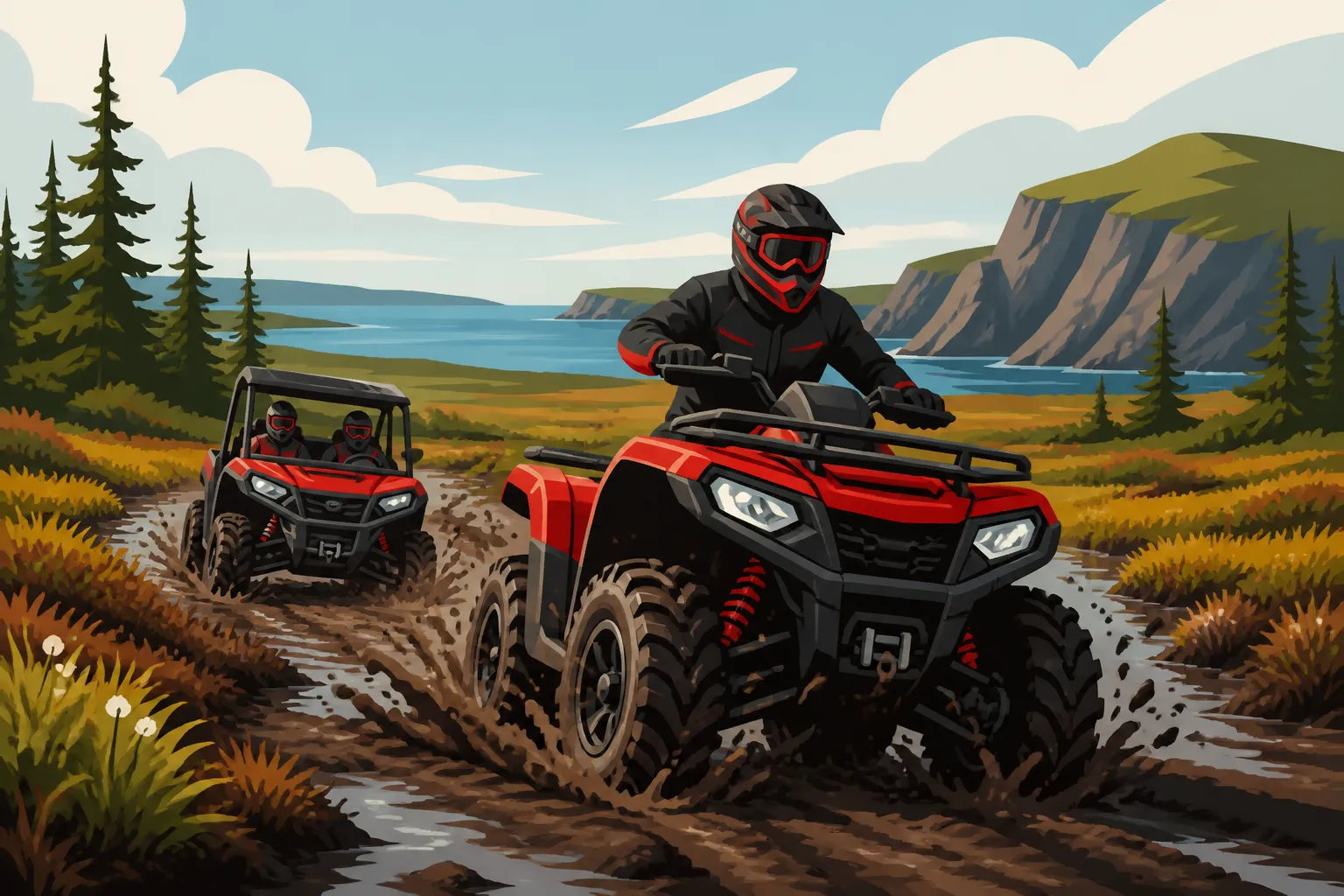
Bog is not simply a puddle with a trail through it. The surface can conceal saturated peat, soft edges, deep ruts, and standing water. A route that looks firm from the seat may have a weak crust that gives way under a machine’s weight. Dark, wet ground, fresh deep tracks, water pooling in ruts, and vegetation pushed aside or churned up can all be reasons to slow down and reassess.
Pay attention to what the ground is doing beneath the tires. If the machine starts sinking, the tires spin without moving you forward, or the rut deepens quickly, stop before the problem grows. Continuing to accelerate can dig the machine in and make recovery harder. If you are riding with others, have a spotter watch from a safe, stable place where they are not standing in the machine’s path or on fragile ground.
Wetland damage can last much longer than a ride. Deep ruts may channel water, disturb plants, and make the route less stable for the next person. If a marked path is damaged or blocked, do not create a new bypass across the vegetation to get around it. Turn back or follow a clearly permitted alternative. [Newfoundland Bog and Machines] explains more about the relationship between machines and soft ground, while [Newfoundland Trails Across the Barrens] provides useful context for exposed, open-country riding.
Choose a line carefully
Where riding is permitted, stay on the established route and avoid widening it. Approach uncertain sections slowly enough to judge the surface, but avoid stopping in the deepest or softest part if you can safely choose a firm place nearby. Keep enough space between machines that the lead rider can identify a hazard and the next rider has room to react. Following too closely can put several machines into the same weak section before anyone has time to reassess.
Do not assume the edge of a wet area is firmer than the middle. The margins can be soft too, and a sideways detour may cross vegetation that was not part of the trail. If the route is impassable without leaving the marked track, the safest choice may be to turn around. The point is not to prove that a machine can get through; it is to finish the ride without injury, damage, or an avoidable impact on the area.
Tires, machine weight, load, and ground conditions all affect how a vehicle behaves in soft terrain. A heavier machine or a passenger and cargo load can change how it settles into a rut. Rather than relying on a tire choice to make a questionable route safe, use it as one factor in a broader decision about whether to ride. [Which Tires Float Best on Soft Bog] can help explain why tire design matters, but it cannot replace checking access and conditions on the ground.
Ride with control and protect your machine
Use smooth inputs and avoid digging in
In soft ground, abrupt throttle, sharp steering, and sudden braking can make a machine lose traction or sink deeper. Use measured inputs and maintain a controlled pace that suits the surface and visibility. Avoid spinning the tires in an attempt to power through. Wheelspin can dig a deeper hole, increase the strain on the machine, and make it harder for the group to recover safely.
Keep your weight balanced and follow the machine’s operating guidance. The right body position varies by machine and terrain, so avoid copying a technique that is intended for a different vehicle or situation. On a side-by-side, occupants should remain properly seated and belted as required by the machine and applicable rules. On an ATV, riders should avoid carrying more people or cargo than the machine is designed for.
Slow down when visibility narrows or the trail becomes unfamiliar. In Newfoundland, fog and sudden weather changes can make it harder to judge distance, water depth, and the edge of a rut. If you cannot see enough of the route to choose a safe line, stop in a safe place and reassess rather than riding forward into unknown ground. For rides across open areas, [Packing for Weather That Changes Every Hour] is a useful companion topic.
Reduce peat and water buildup
Peat, mud, and vegetation can collect around a machine’s underbody and cooling system. Before departure, check that the machine is in good working order and that any protective equipment is properly installed. During a long ride, stop at a safe location to inspect for buildup if the conditions warrant it. A radiator screen can help reduce debris entering the radiator area, but it still needs attention: a clogged screen can restrict airflow.
Do not wait until the machine is overheating or behaving strangely before checking it. Follow the manufacturer’s guidance for inspecting and cleaning the machine, and avoid reaching into moving or hot components. [Radiator Screens for Peat] provides more detail on this specific concern. When you return, clean the machine in a suitable place and dispose of debris responsibly rather than washing mud and peat into a wetland or waterway.
Protective gear and basic supplies are part of the plan too. Bring water, weather-appropriate layers, a first-aid kit, and tools suited to your machine. A small issue can become more serious if the group is wet, cold, or far from a trailhead. Keep gear secured so it cannot shift into the wheels or obstruct a plate or light.
Handle a bog recovery without making it worse
Stop, assess, and choose a safe recovery
If a machine starts to sink, stop adding throttle. Check that everyone is safe, keep bystanders clear, and assess the ground around the vehicle before anyone approaches. A recovery line under tension can injure people if it snaps or releases suddenly, so follow the equipment manufacturer’s instructions and keep people out of the line’s path. Do not attach a strap to a part of the machine that is not designed for recovery.
Think through the safest option before pulling. A controlled recovery may involve reducing load, using a suitable recovery point, or winching from a stable anchor where permitted and safe. Avoid putting a helper in front of the machine or asking someone to stand on soft ground beside a loaded line. If the machine is deeply embedded, the attachment point is unclear, or the ground offers no safe anchor, stop and seek experienced help rather than improvising.
A winch is not a guarantee that every bog can be crossed or recovered from easily. Recovery equipment needs to match the machine, be maintained, and be used correctly. [Winching a Machine Out of Deep Bog] covers additional considerations. If recovery would require damaging vegetation, cutting a new path, or entering restricted land, back out of the plan and contact the appropriate trail operator or land manager.
Learn from the ride and adjust the next one
After a difficult section, note what caused the problem. Was the route recently wet? Did the group follow too closely? Was the machine carrying more load than expected? Did the track become hard to identify? These details can help you choose a safer route next time and decide whether to ride with a smaller group, lighter load, or different equipment.
If you use onX Offroad or another mapping tool, update your own notes with hazards and turnaround points, but avoid marking an unofficial bypass as a recommended route. Share useful observations with the relevant trail operator when appropriate, especially if you encounter a blockage, dangerous washout, or damage on a managed route. Do not publish a shortcut across sensitive ground that could encourage others to leave the established trail.
A successful bog ride is not measured by how far a machine can push into soft terrain. It is measured by making a sound access decision, respecting the route, and getting everyone home safely. When the ground is too wet, the trail is unclear, or recovery would require risky improvisation, turning around is a practical riding decision—not a failure.
Disclaimer
This article is for general informational purposes only and does not constitute professional advice. Laws, prices and regulations vary by location and change over time. Consult a qualified professional for guidance on your specific situation.