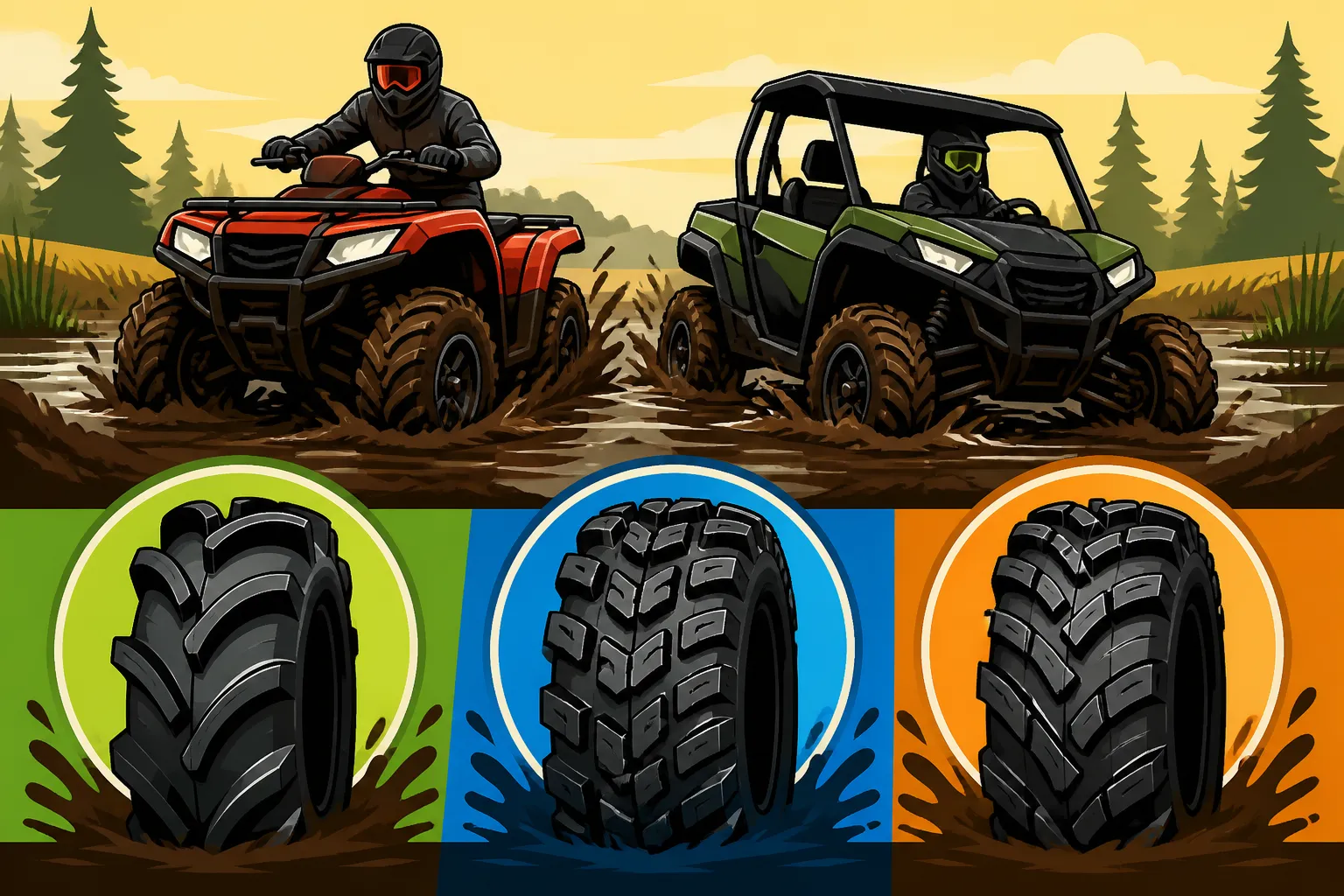
Which Tires Float Best on Soft Bog
Soft Newfoundland bog can swallow a quad that feels perfectly capable on gravel, and spinning the tires often turns a small mistake into a deep rut. The best setup usually prioritizes a broad footprint, a tire that can safely run at low pressure, and a tread suited to the ground you actually ride. Here’s how to choose tires, manage pressure, and avoid damaging sensitive terrain.
What makes a tire float on soft bog
A wider footprint spreads the load
A tire does not literally float over peat like a boat. It helps a machine stay closer to the surface by spreading its weight across a larger patch of ground. That is why tire width and the shape of the tire’s footprint matter so much when you are choosing ATV tires for bog riding.
Imagine two riders on machines of similar weight. One has narrow, aggressive tires that sink quickly into soft ground. The other has a broader tire that presses down over more area. The second machine may travel farther before sinking, especially when the bog is firm enough to support a careful crossing. But no tire can make every wetland safe to ride across. Deep, saturated peat can give way under a broad tire, too.
A wider tire is not automatically better in every situation. Extra width can make steering heavier, change the way the machine tracks through ruts, and leave less clearance around the suspension or bodywork. Oversized tires can also affect gearing and put added strain on drivetrain parts. Check the machine maker’s size guidance and the tire maker’s specifications before moving up in size.
For a new machine, think about the riding you’ll genuinely do rather than choosing the largest tire available. A rider who mostly follows firm railbed or gravel routes may find a moderate all-terrain tire more practical than a large mud tire. Someone who regularly rides permitted, soft trails may have different needs—but should still treat bog crossings as a terrain and access question, not just a tire question.
Tire construction and pressure work together
A tire’s construction affects how it deforms under load. Some tires are designed to operate at lower pressures than typical road-oriented tires, which can help the tread spread out over soft ground. That flexibility can improve flotation, but only within the pressure range the manufacturer allows for that tire and machine.
Lower pressure generally lets a tire flatten more at the contact patch. That can help it ride over softer ground instead of cutting down into it. The trade-off is that too little pressure can make the tire unstable, increase the chance of damaging the sidewall, or allow it to come off the rim. Pressure that is suitable for one tire, machine, load, or speed may not be suitable for another.
Start with the machine and tire manufacturers’ guidance. Consider whether you are carrying a passenger or cargo, and remember that a loaded machine behaves differently from an unloaded one. Do not treat a pressure used by another rider as a universal setting. If you adjust pressure for a particular ride, check it again before returning to faster or firmer surfaces.
Newfoundland’s rules also matter. Check Newfoundland Low Pressure Tire Rules before riding so your setup meets the requirements that apply to your machine. Tire choice is not just about performance: a machine needs to be equipped and operated lawfully as well as safely.
Choosing a tread for Newfoundland bog and trail conditions
Mud tires are not a magic answer
Mud tires often have tall, widely spaced lugs designed to clear mud as the tire turns. That tread can be useful in some conditions, but a very aggressive pattern is not always the best choice for soft bog. If the lugs dig in and the rider keeps applying throttle, the tire can excavate peat, deepen a rut, and bury the machine farther.
In other words, a tire that “hooks up” aggressively can sometimes work against you. In a soft spot, the goal is often to maintain forward movement gently rather than clawing for grip. If the machine starts to bog down, repeatedly spinning the tires is likely to make recovery harder and leave more damage behind.
A less aggressive, broader tire may be a better fit for mixed riding where the route includes firm trail, gravel, and occasional soft sections. But there is no single tread pattern that works best in every Newfoundland condition. Peat depth, water, recent rainfall, slope, machine weight, and riding technique all affect how a tire performs.
| Tire style | Potential benefit on soft ground | Trade-offs to consider |
|---|---|---|
| Broad, low-pressure tire | Spreads the machine’s load over a larger contact area | Must be matched to the machine and used within approved pressure limits |
| Aggressive mud tire | Can provide traction in mud and help clear some material from the tread | May dig into soft peat if spun; can be less comfortable or predictable on firm trail |
| Moderate all-terrain tire | Offers a practical compromise for mixed trail surfaces | May not provide the same traction as a purpose-built mud tire in deep mud |
| Oversized tire | May increase ground clearance and footprint, depending on the setup | Can affect steering, clearance, gearing, braking, and drivetrain load |
Use this table as a starting point, not a promise that a particular tire will carry a machine across a bog. If you are comparing a few options, look at the tire’s intended use, construction, load guidance, and compatibility with your machine—not just its appearance or lug height.
Match the tire to the whole ride
A tire that helps in bog may feel cumbersome elsewhere. On a long ride over firm railbed, for example, a very soft, wide setup may not feel as precise as a more moderate tire. If your route includes exposed rock or ballast, look at sidewall protection and puncture resistance as well as flotation. Skid Plates for Ballast Rock can also help you think through protection for the machine’s underside, although that addresses a different problem from tire choice.
Before buying, ask yourself where the machine spends most of its time. Is the route a maintained trail with only occasional wet patches? Is it a permitted trail that crosses soft ground? Are you carrying a passenger, hunting gear, or supplies to a cabin? The answer can change which tire trade-offs make sense.
A larger tire can also change how the machine fits in a trailer or clears its own fenders. Check the available space through the suspension’s travel, not just while the machine is parked. If the tire rubs, catches on bodywork, or limits steering, the setup may create new problems even if it offers more ground contact.
Riding soft ground without burying the machine
Read the surface before entering
Soft bog can look deceptively firm. A thin layer of vegetation may hide waterlogged peat, and a set of older tracks may appear usable even when the ground has softened. Stop before entering an uncertain section. Look for deep ruts, standing water, torn vegetation, and places where earlier riders have spun their tires.
Weather is part of the decision. A route that felt firm during a dry spell may become much softer after prolonged rain or thaw. Check Newfoundland Trail Conditions Before You Ride and consider Newfoundland Riding After Heavy Rain when planning a trip. If conditions look marginal, turning around is often the safest choice—and usually leaves less cleanup and repair for everyone.
Know whether the route is open to your machine before you ride it. A bog’s appearance does not tell you whether it is an approved riding area. Use Newfoundland Crown Land Approved Areas and Finding Approved Areas on the Provincial Map as starting points for checking access, then confirm any local restrictions or closures that apply to the route.
Mapping tools such as onX Offroad can help with route planning and keeping track of where you intend to ride. Use onX Offroad as one planning aid, not as proof that a particular stretch of wetland is open to vehicles. Check the relevant local or provincial information, and pay attention to signs and closures on the ground. A line on a map is not permission to cross sensitive terrain.
Keep momentum gentle and avoid wheelspin
If you have confirmed that the route is open and the ground is suitable, approach slowly enough to assess it, but avoid stopping in the softest part if you can safely keep moving. Smooth throttle is generally more useful than sudden bursts. Let the tires roll rather than dig. Sharp steering inputs can also push the front tires sideways and widen a rut.
If the machine starts to lose forward progress, resist the urge to keep revving. Ease off, assess whether you can reverse along your own track, and avoid making repeated attempts that churn up the ground. A passenger should not jump off into unknown bog unless there is a clear, safe place to stand. Soft ground can be unstable for people as well as machines.
If you ride with a group, leave room between machines and avoid following directly through a freshly damaged rut. One machine’s tracks can make the next crossing harder, especially when the first rider has spun the tires. Good habits matter as much as tire choice; Newfoundland Trail Etiquette Locals Expect offers useful context for sharing routes responsibly.
Preparing for a bog recovery and protecting the trail
Carry recovery gear and make a plan
Even an experienced rider can misjudge a soft patch. Before a ride, make sure everyone knows how the group will respond if a machine becomes stuck. A tow strap, suitable recovery points, and a basic plan can prevent a stressful moment from turning into a rushed, unsafe pull. Why a Tow Strap Belongs Under Your Seat is worth reviewing before heading onto a remote route.
If you do get stuck, stop before the tires dig in farther. Look for a stable recovery direction and a suitable anchor point, and keep people clear of a loaded strap. Never attach recovery gear to a part of the machine that is not intended to take the load. If the machine is deeply buried, the ground is unstable, or nobody in the group is confident about the recovery, it may be safer to get experienced help than to improvise.
A tool such as onX Offroad may assist with planning and navigation, but do not assume you will have a usable signal everywhere. Share your intended route and expected return time with someone who is not riding with you. For remote outings, carry a backup navigation method and enough supplies to manage a delay.
After a recovery, check the machine for mud and debris around the tires, brakes, cooling system, and moving parts. A bog recovery can pack material into places that are easy to miss when everyone is focused on getting home. Cleaning and inspecting the machine after a wet ride can help catch damage before the next outing.
Leave wetlands in better shape than you found them
A rut is more than an ugly mark. Repeated traffic can tear vegetation and change how water moves across a wet area. In some places, that damage can persist long after the riders have gone. That is why the right response to a questionable bog is often to avoid it, not to fit more aggressive tires and push through.
Read Newfoundland Wetland Protection Rules before planning a ride that may pass near sensitive ground. If a route is closed, restricted, or showing clear damage, choose another permitted route. A tire setup that is capable of crossing soft ground does not make every crossing appropriate or legal.
If you are choosing tires mainly because a local route has become difficult, pause and ask whether the route is open and in suitable condition. Check with the relevant land manager or trail operator when the status is unclear. Planning tools such as onX Offroad can help organize a route, but local access information and posted signs remain essential.
The best tire for soft bog is usually one that spreads the machine’s weight without compromising safe fit, pressure, steering, or control. Pair that setup with a light touch on the throttle, careful route checks, and the willingness to turn around when the ground is too soft. Those choices protect your machine—and help keep Newfoundland’s trails and wetlands rideable for others.
Disclaimer
This article is for general informational purposes only and does not constitute professional advice. Laws, prices and regulations vary by location and change over time. Consult a qualified professional for guidance on your specific situation.