Enforcement by Several Agencies at Once
A ride can cross a managed trail, Crown land, a municipal road, or private property in a single afternoon, and the rules may change with the ground beneath your tires. That can make an officer’s roadside question feel confusing. This guide explains why more than one agency may have a role, what each may be checking, and how to prepare without assuming one permit or map settles everything.
Why more than one agency may be involved
Newfoundland ATV and UTV rules can come from different sources: provincial off-road vehicle law, rules for the land you are on, municipal bylaws, and requirements for using a managed trail. Those layers can overlap. An agency’s involvement usually depends on the issue and location, rather than on a single organization having responsibility for every part of a ride.
One ride can cross several kinds of land
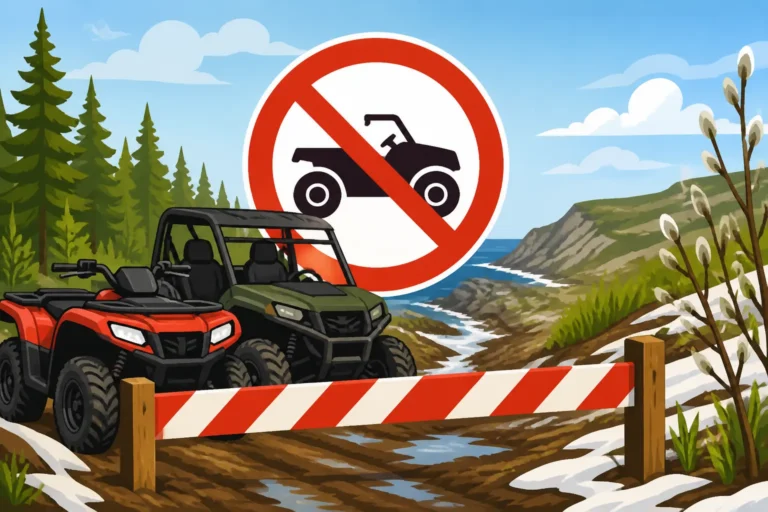
Imagine leaving a community on a road where local rules apply, joining a managed section of trail, and then continuing through an area of Crown land. Registration, equipment and insurance requirements may follow the machine and rider, while land-access rules can depend on where you are and whether that area or route is open to riding. A trail sticker or safety certificate does not automatically give permission to cross every parcel or enter every restricted area.
This is why it helps to separate two questions: “Is my machine and rider compliant?” and “Am I allowed to ride here?” The first may involve registration, insurance, equipment, and any applicable training or proof requirements. The second may involve trail access, land status, posted restrictions, private-property permission, or a local bylaw. For an overview of provincial law, see Newfoundland’s Off-Road Vehicles Act. For land-access basics, see [Newfoundland Crown Land Access Rules] and [Newfoundland Restricted Area Permissions].
A route that looks continuous on a screen may also pass through land with different rules. Before heading out, check the route, posted signs, local information, and any relevant permissions. A planning app such as onX Offroad can help you review a route and notice possible boundary or access questions, but a digital map should not be treated as official permission or a definitive legal ruling. If access is unclear, stop and verify it before riding through.
Different agencies may handle different concerns
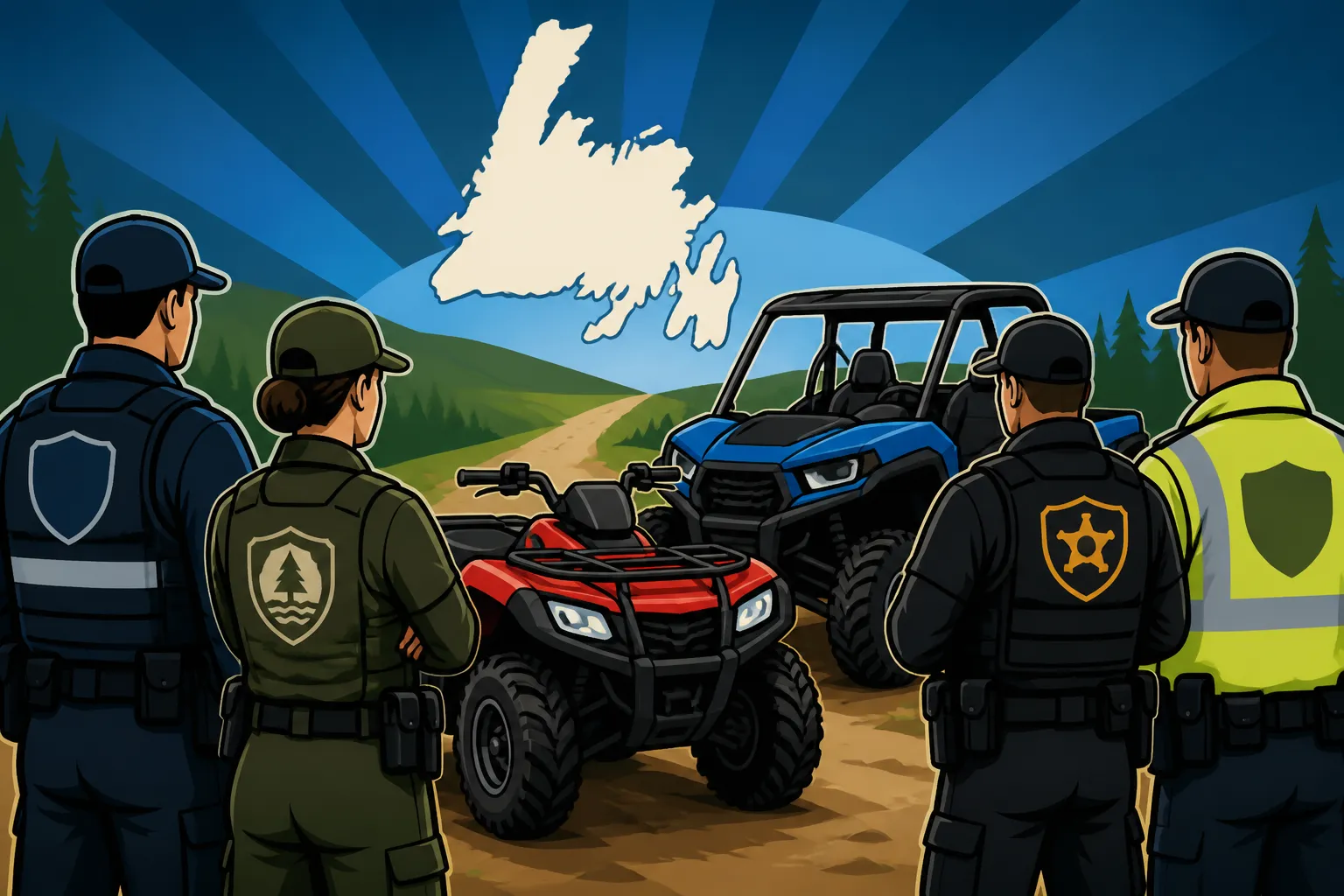
There is not necessarily one agency that handles every part of an ATV or UTV outing. Provincial officers and police may have responsibilities connected to off-road vehicle rules and enforcement. A municipality may be responsible for its local bylaws. A trail operator may manage access to a managed trail and check requirements associated with that trail. The organization responsible for a particular area may also be the right place to ask about closures or local restrictions.
These roles can overlap in practice. For example, a concern about riding in a restricted area may be different from a question about a machine’s registration or required equipment. If officers or officials are present in the same area, they may be addressing separate issues, even if their checks happen during one stop or event. That does not mean every agency has authority over every subject; the relevant role depends on the law, land, and circumstances.
| Who may be involved | What the concern may relate to | What to do as a rider |
|---|---|---|
| Provincial enforcement officers or police | Off-road vehicle rules, documents, safe operation, or an incident | Cooperate, ask what requirement is being checked, and provide relevant documents |
| Municipal officials or enforcement personnel | Local road access, municipal restrictions, or bylaws | Check the municipality’s rules for the specific street or area |
| Managed trail operator | Trail access, posted closures, and trail-specific requirements | Confirm current access conditions and carry required proof |
| Land or area manager | Access restrictions, closures, or permission for a specific area | Verify the route and obtain permission where required |
The table describes general kinds of responsibilities, not a guarantee that a particular official will be present or that every organization has the same powers in every situation. For the rules that can apply on local roads, review Newfoundland Municipal Road Bylaws. For managed trails, review Newfoundland Managed Trail Rules.
What an enforcement check may cover
A stop or inspection may focus on one issue or several. A rider who has confirmed that a trail is open, for instance, still needs to consider whether the machine and operator meet other applicable requirements. Keeping documents and equipment in order is less stressful than trying to reconstruct the details at the trailhead—or during a roadside conversation.
Machine documents, insurance, and operator proof
Depending on the circumstances, an officer may ask for documents or proof connected to the machine and rider. That can include registration information, insurance proof, or training and trail-related proof where those requirements apply. Rules can differ for visitors, new residents, young riders, and machines used on particular land or trails, so do not assume that a friend’s paperwork or an out-of-province registration answers every question.
Make a simple pre-ride check: confirm that the registration details match the machine, that required insurance is in place, and that the operator has any required proof available. Keep documents in a dry, accessible place rather than buried under cargo. For more detail about checks and documents, see Newfoundland Insurance Requirements for Riders, Newfoundland Equipment Checks by Officers, and What an Officer Can Ask You to Produce.
If a group is riding together, each operator should know what proof applies to their own machine and situation. A group leader may carry a route plan and emergency contacts, but that does not replace each rider’s responsibility to meet the rules. A rented or borrowed machine also deserves a quick check: clarify who supplies the registration, insurance information, and any trail-related proof before leaving.
Equipment, riding conduct, and incident response
A compliance check may also involve the machine’s condition or the way it is being operated. Helmets, lighting, tires, mufflers, passenger arrangements, and other equipment can be governed by specific requirements. The exact check depends on the applicable rules and the machine. A helmet that looks protective, for example, is not a substitute for checking that it meets the relevant standard and is properly secured.
Riding conduct matters too. Speed, road crossings, shoulder use, passengers, and operation around other trail users can all raise separate safety or compliance questions. Shared routes such as sections of the T’Railway require particular care around walkers, cyclists, and other riders. Give people room, slow down when visibility is limited, and follow signs or instructions rather than assuming a familiar route is unchanged.
If there is a collision, injury, or significant damage, take practical steps to keep people safe and follow the applicable reporting requirements. Record the location and circumstances when it is safe to do so, and avoid moving an injured person unless there is an immediate danger. For reporting considerations, see Newfoundland Accident Reporting Rules. Requirements can depend on the incident, so contact the appropriate authority when you are unsure what must be reported.
How to prepare for a ride and handle a stop
The best preparation is specific to the route. A generic checklist is useful, but it cannot tell you whether a particular trail is open, whether a municipal road permits ATV use, or whether a private landowner has granted access. Build a little time into your planning to check each of those details before the machines are unloaded.
Check route access instead of relying on one map
Start with the route you actually plan to ride, not just a destination name. Identify the trailhead, roads you intend to use, known closures, and any points where the route enters a different land or management area. Check posted notices and contact the relevant trail operator, municipality, or land manager when access is uncertain. A route that was open on a previous visit may be affected by a closure, damage, seasonal restrictions, or a change in local access.
Digital mapping can help you spot questions to investigate. onX Offroad may be useful as one planning reference, but do not rely on it alone for legal access decisions. Compare what you see with local signs and official information, and ask before crossing private land or entering a restricted area. If a boundary is unclear on the ground, the cautious option is to stop and confirm rather than ride through and hope the line on your screen was accurate.
For a managed route, check the operator’s requirements separately from land access. A managed trail sticker or other trail-specific proof may be relevant on that trail, but it is not a substitute for registration, insurance, training, or permission required elsewhere. That distinction is especially important on a long ride that links communities, trail corridors, and remote areas.
Stay calm, be clear, and keep useful records
If an official asks you to stop, pull over safely and make the machine visible to other traffic. Turn it off when appropriate, keep your hands visible, and listen to the question before reaching into a bag or pocket for paperwork. If you do not understand what is being requested, ask politely which document or requirement they mean. A calm, direct answer is usually more productive than arguing from memory about what you believe the rules say.
Keep a record of the ride plan, the documents you brought, and any permission or trail information you checked. If an issue arises, write down the location, time, and relevant details as soon as it is practical. If you receive a notice or citation, read it carefully and follow the stated process and deadlines. You can seek clarification from the issuing authority or qualified legal help if you do not understand your options; do not assume a conversation at the roadside replaces the formal process.
Before departure, use this final check:
- Confirm the route and check for closures, restricted areas, and local bylaws.
- Verify that the machine’s registration and insurance are appropriate for the ride.
- Carry the proof required for the operator, machine, and managed trail, if applicable.
- Check helmets, lights, tires, passenger seating, and other required equipment.
- Tell someone where you are going and when you expect to return, especially on remote routes.
- Recheck signs and conditions at the trailhead, and turn back if access is uncertain.
Several agencies or organizations may have a role during a single outing because the ride can involve different laws, land managers, and access rules. The practical response is not to guess which one “owns” the whole situation. Know what each part of your ride requires, carry the relevant proof, and verify access where the rules change. For possible consequences of non-compliance, see Newfoundland Penalties for Riding Illegally.
Disclaimer
This article is for general informational purposes only and does not constitute professional advice. Laws, prices and regulations vary by location and change over time. Consult a qualified professional for guidance on your specific situation.