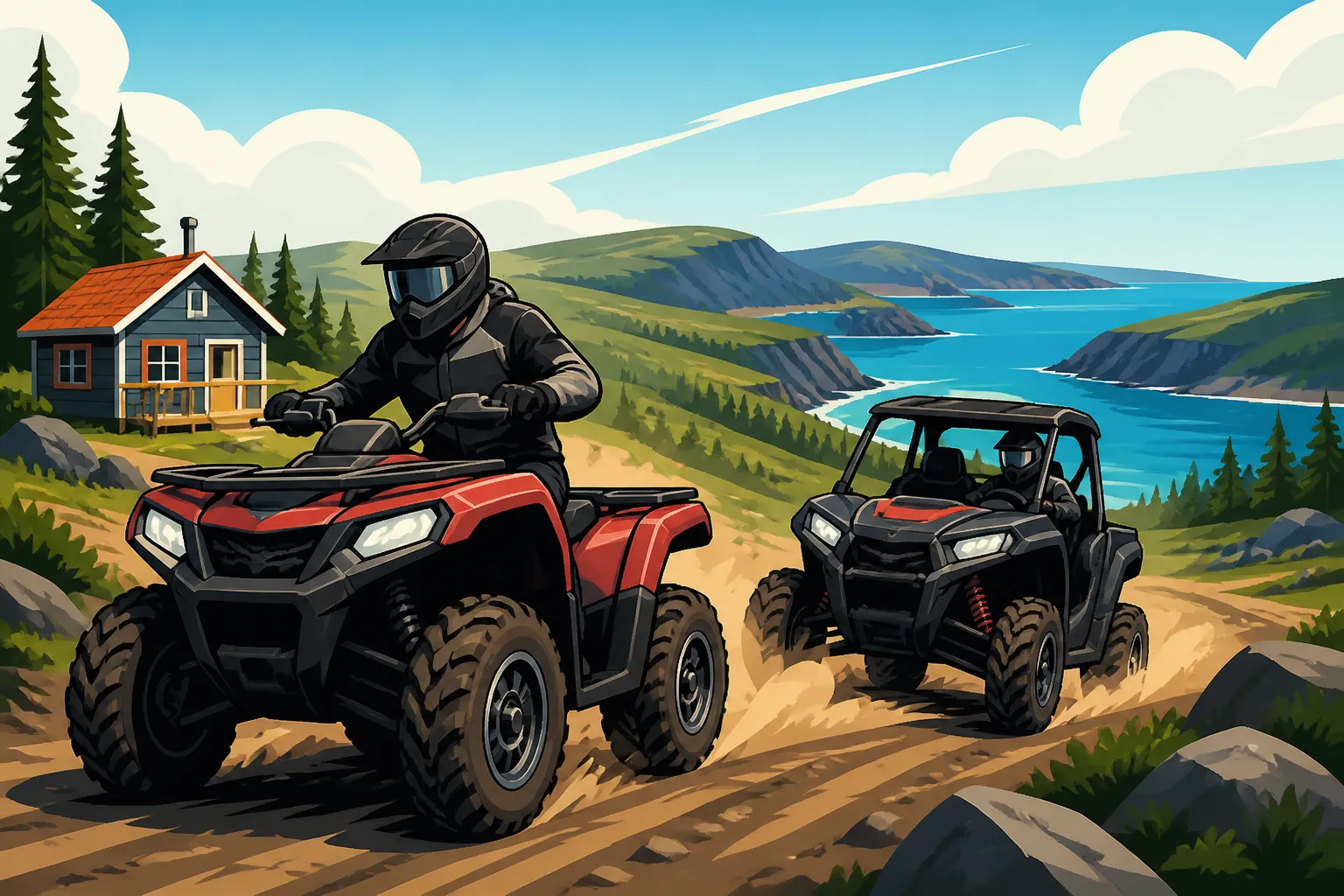
Newfoundland Cabin Road Riding
A cabin road can look like an easy ATV route: it is wide enough to ride, leads toward a familiar fishing spot, and may seem quiet enough to use without much planning. But in Newfoundland, a road’s appearance does not tell you who controls it or whether riding is allowed. This guide explains how to check access, prepare your machine, and travel cabin roads responsibly.
What counts as a cabin road in Newfoundland
A familiar route is not necessarily a public trail
“Cabin road” is an everyday description, not a guarantee about a road’s legal status. It might mean a private access lane to a cabin, a woods road used by several landowners, a road built for forestry work, or a route that connects with a managed trail. Two roads that look nearly identical can have different owners, permitted uses, and restrictions.
That distinction matters when you are riding in places such as central Newfoundland, near Gander, or outside Corner Brook. One stretch may be open to authorized users, while the next crosses private land, a restricted area, or a road where motorized access is not permitted. A route you used last summer may also be affected by new signs, seasonal closures, maintenance work, or a change in land access.
Before treating a cabin road as part of your ride, find out who controls it and ask whether ATVs or side-by-sides are allowed. Do not assume that a road is open because there is no gate, because someone else has driven it, or because it appears on a phone map. A missing sign is not the same thing as permission.
Cabin access and trail access are different questions
It helps to separate two questions that are easy to mix together: “Can I reach this cabin?” and “Am I allowed to ride this route?” A cabin owner may have permission to travel over a particular access road without having permission to invite other riders along it. Likewise, being allowed to enter a property does not necessarily mean you can use every road, trail, or adjoining parcel on the way there.
A route may also cross several kinds of land. The first section could be a private lane, followed by a woods road, then a marked trail. You may need to check each section separately instead of assuming permission carries from the trailhead to the cabin. If your route crosses a managed trail, find out whether that trail has its own operator requirements. [Newfoundland Managed Trail Rules] explains why a route’s managed status can matter independently of the destination.
A useful habit is to write down the route in segments before leaving. Note where you start, which roads you expect to use, where the road changes character, and who you contacted about access. If the answer is unclear for one section, treat that as a reason to pause and confirm rather than as a reason to ride ahead and see what happens.
Registration does not grant permission to ride
A valid registration identifies a machine under the applicable system. It does not give you permission to cross someone else’s property, enter a restricted area, or use a road that is closed to ATVs. This catches riders who have handled the paperwork and reasonably feel “ready to go,” only to discover that access and machine registration are separate responsibilities.
Newfoundland registration questions can be different depending on whether the machine is an ATV, a trail bike, a snowmobile, or a side-by-side. If you are unsure what category applies, start with [Do You Need to Register an ATV in Newfoundland?] and [Registering a Side-by-Side in Newfoundland]. These are especially useful when a household has more than one kind of machine and assumes the same rules automatically apply to every vehicle.
Registration is also separate from trail stickers, safety training, insurance, and any access permission a landowner or trail operator requires. A cabin trip can involve several of these obligations at once. Check each one individually rather than treating a plate as an all-purpose pass. [Newfoundland Registration Before Your First Ride] is a useful place to begin with the basic pre-ride paperwork question.
How to check whether a cabin road is open to ATVs
Identify the owner or manager before you ride
Start with the person most likely to know who controls the road. That might be the cabin owner, a landowner, a forestry or road operator, a trail organization, a local council, or a government office responsible for the land. If you are visiting a cabin owned by a friend or relative, ask for the actual access details instead of relying on “we always go that way.”
Ask specific questions. Is the road open to ATVs and side-by-sides, or only to vehicles with another kind of authorization? Does permission cover the entire route or just a particular section? Are there seasonal restrictions, active work, weight limits, gates, or other conditions? Is the permission for your machine, your group, or only the cabin owner’s own travel?
If the route begins near a town, do not assume that the rules stop at the town boundary or that every road is governed the same way. Municipal bylaws can affect where machines may travel, and local signs may identify restrictions that are not obvious from a map. [Newfoundland Municipalities With ORV Bylaws] and [Newfoundland Bylaw Lookups Before You Ride] can help you think through what to check with a community.
Read signs and barriers carefully
A sign can answer a question that a map cannot. Watch for notices indicating private property, restricted access, seasonal closure, construction, or a road reserved for a particular use. Take each sign seriously, including signs placed at a junction rather than directly at the cabin road entrance. If a route passes through a gate, do not assume that an open gate means public access. It may have been left open for authorized traffic or work vehicles.
If a gate is closed, chained, or marked, do not bypass it or ride around it. The barrier may protect the land, prevent unauthorized entry, or keep traffic away from a hazard. Even if you have used the road before, conditions and permissions may have changed. Stop and contact the responsible person rather than treating an old memory as current authorization.
Some roads are used by logging trucks, maintenance crews, or other work traffic. A road that appears quiet when you arrive may become busy later, and a rider on a narrow road has limited room to react. If work is underway or the road manager has asked riders to stay away, choose another route. [Sharing a Woods Road With Loaded Logging Trucks] offers a reminder of why work-vehicle access needs to be part of your planning.
Use maps as planning aids, not proof of permission
Digital maps are helpful for seeing where roads appear to run, locating junctions, and planning a route before you leave. An app such as onX Offroad can be one planning layer, particularly when you are trying to make sense of an unfamiliar network of roads. Still, a line on a screen does not establish who owns the land, whether the road is open, or whether your machine is permitted.
Compare your planned route with the information provided by the road owner, land manager, trail operator, municipality, or relevant provincial resource. Check signs on the ground as well. If a map shows a connection that is not marked or that the cabin owner says not to use, follow the more authoritative access information and do not try the route simply because it appears to connect.
Download or save the information you need before leaving areas with reliable service. Around the barrens, in wooded areas, and along remote routes, signal can become unreliable. If a route depends on a turn you cannot identify without a phone connection, carry a backup way to navigate and make sure someone at home knows your intended plan. [Carrying a Paper Map Where There Is No Signal] covers this practical problem in more depth.
Paperwork and requirements before a cabin ride
Check registration, plates, and machine documents
A machine stored at a cabin is still a machine that needs a clear paperwork plan. Do not assume that keeping it off the highway, using it only on weekends, or storing it at a remote property removes every registration requirement. The details can depend on the type of machine and the rules that apply to it. [Newfoundland Registration for a Cabin Machine] focuses on that common situation.
Before leaving, check that the registration document matches the machine you are taking and that its identifying details are readable. Make sure the plate is properly attached and not covered by mud, cargo, a fuel can, or a rack. In Newfoundland, registration and plate details matter even when a ride is short and familiar. If the plate has been damaged or obscured, resolve the problem before setting out rather than hoping it will not be noticed.
Keep your documents in a place where they will survive a damp ride and can be produced if needed. A sealed pouch or another protected storage spot can prevent papers from becoming wet, muddy, or unreadable. For a broader explanation of what to keep with your machine and how to think about documents during a ride, see [Carrying Papers on a Cabin Road].
Separate trail stickers and training from registration
Some riders hear “registration” and assume it covers all the riding-related requirements. It does not. Depending on where you ride and who is operating the machine, separate trail sticker or safety training requirements may apply. A cabin driveway or private lane should not be casually treated as a managed trail, but nor should a rider assume that calling a trip a “cabin run” creates an exemption.
The location and ownership of the land matter. The rules can differ between riding on land you own, land owned by immediate family, a managed trail, and other Crown or private land. If your route leaves the cabin property or joins a trail network, check the requirements for every section. [Newfoundland Exemptions on Your Own Land] and [Newfoundland Exemptions for Immediate Family Land] address two situations that riders often confuse.
Training requirements can also matter for younger riders and may be relevant when a machine is registered for the first time. Check the age, training, supervision, and proof requirements for the specific rider rather than assuming that an adult’s certificate covers everyone in the group. [Carrying Your Safety Certificate on Every Ride] is a practical reminder to make required proof accessible, not buried under tools or packed in a vehicle left far away.
Confirm insurance and access permission separately
Insurance is another item to check before riding, and it is not a substitute for permission to use a road. A policy may address certain liability risks, but it does not authorize access to private property or cancel a road closure. Conversely, a landowner’s permission does not make it safe to ride without confirming the required insurance arrangements.
If the machine is borrowed, rented, newly purchased, or shared between family members, ask who is responsible for confirming insurance and whether the rider and intended use are covered. Do not rely on a casual assumption that “the machine is insured.” Make sure you understand what proof is available and how to access it if asked.
A simple pre-ride checklist can keep these separate responsibilities from getting muddled:
| Check | What to confirm | Why it matters |
|---|---|---|
| Road access | The owner or manager allows your machine on the route | A visible road is not proof of public access |
| Registration | The documents and plate match the machine | Registration is separate from road permission |
| Trail requirements | Sticker, training, or other requirements for the route | Requirements may change when you leave cabin property |
| Insurance | The rider and intended use meet applicable requirements | Permission and insurance solve different problems |
| Local restrictions | Signs, closures, bylaws, and work activity | Access can vary by location and conditions |
| Emergency plan | Route, contacts, supplies, and backup navigation | Remote roads may have limited service or assistance |
Planning a safe route to a cabin
Map the whole journey, not only the last stretch
A cabin road may be only the final piece of a longer trip. Plan the route from your launch point through every road, trail, and land boundary you expect to cross. A route that looks direct on a screen may include a private access lane, a closed section, a steep grade, a stream crossing, or a junction that is difficult to identify in poor visibility.
Mark the intended route and a reasonable alternative. The backup does not need to be a second full-day adventure; it can simply be a safe place to turn around or a different authorized access point. If the road is blocked, flooded, damaged, or actively used by work crews, having an alternative reduces the temptation to push forward or take an unverified shortcut.
Tell someone who is not riding with you where you plan to go and when you expect to check in. Include the cabin destination, likely route, machine descriptions, and the point at which they should raise concern if they do not hear from you. This is especially useful when the cabin is remote, your group is small, or you expect to travel outside areas with reliable phone service.
Match the route to the machine and group
A route that is manageable for one rider on a smaller ATV may be uncomfortable or unsuitable for a side-by-side, a two-machine family group, or a rider carrying supplies. Think about width, turning room, surface condition, clearance, and safe places to pull aside. A larger machine may have trouble on a narrow lane where a smaller ATV can turn around easily.
Consider the least experienced rider in the group when setting the pace and route. A new rider may find ruts, loose rock, mud, steep sections, or tight turns stressful even if an experienced rider treats them as ordinary. Keep the group together, agree on stopping points, and make sure no one feels pressured to continue through a section they are not comfortable with.
A cabin trip often involves extra cargo, which changes how a machine handles. Secure bags, tools, food, fuel, and other supplies so they cannot shift, drag, or cover lights and plates. Balance loads according to the machine’s instructions, and avoid packing so much that riders cannot move freely or see clearly around the vehicle.
Build weather and road conditions into the decision
Newfoundland weather can change quickly, and a route that is comfortable in dry conditions may become slippery, muddy, or difficult after rain. Check the forecast, but also think about what the road may be like after recent weather. A wet section can become a source of deep ruts or damage, especially where the surface is soft and drainage is poor.
Do not assume that the fastest route is the safest one. A longer, firmer road may be a better choice than a short cut across a boggy area or a poorly drained track. If a road is already showing deep ruts, standing water, exposed roots, or crumbling edges, turn around if continuing would risk injury or damage.
Fog, wind, and low visibility can make navigation more difficult on open terrain, and dark conditions can be especially challenging on a narrow cabin road. Give yourself enough time to reach the cabin before conditions deteriorate. [Packing for Weather That Changes Every Hour] and [Newfoundland Trail Conditions Before You Ride] can help you think through weather and surface conditions before setting out.
Riding cabin roads responsibly
Share the road with people and work traffic
Cabin roads are often shared spaces, not private riding tracks. You may meet a pickup truck, a person walking, a cyclist, a dog, a work vehicle, or another group of riders around a bend. Slow down where sightlines are limited, keep to a speed that allows you to stop safely, and leave space for other users to pass.
Dust can be a real nuisance on dry roads. If another vehicle is ahead, give it room rather than following so closely that the driver or riders are left in a cloud. If you meet people on foot or bicycle, reduce speed well before reaching them and pass only when it is safe. A friendly wave is welcome, but it does not replace slowing down and giving them space.
Be alert for active forestry or maintenance work. Work vehicles may be wide, heavy, and unable to stop quickly on a rough road. If you see a truck, machinery, workers, or a warning sign, move to a safe place if possible and follow instructions. The fact that a road is familiar to cabin owners does not make it safe to share casually with equipment operating in the area.
Protect the road, land, and water
A road that leads to a cabin can cross wet ground, drainage ditches, streams, or sensitive vegetation. Riding around a muddy section may seem like an easy way to keep moving, but repeated bypasses can widen the road and damage the land beside it. If a section is too soft or deeply rutted to cross without causing harm, turn around rather than creating a new track.
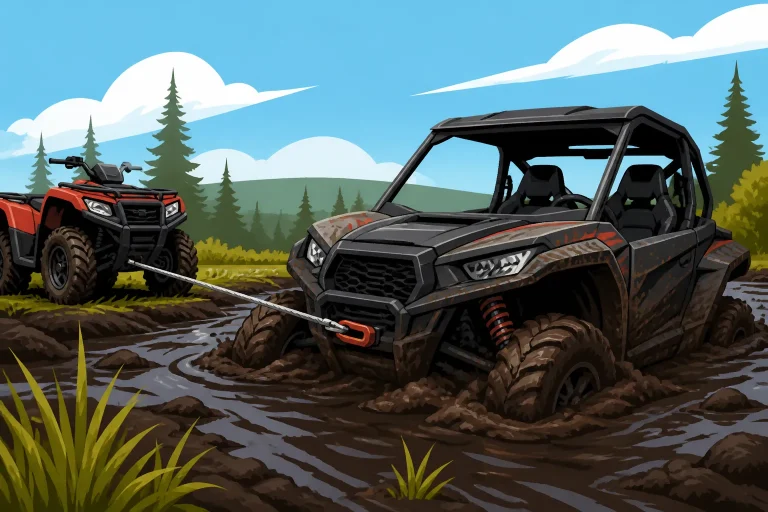
Avoid spinning the tires or taking a machine into a wet area simply because it looks like a challenge. A bogged machine can cause significant surface damage, and a recovery attempt may make the problem worse. If your group encounters an impassable area, use the route you know is permitted and durable, or postpone the trip until conditions improve.
Pack out anything you bring in, including food wrappers, cans, broken straps, and damaged parts. Do not leave household waste at the cabin road, trailhead, or turnoff. Keep noise reasonable, especially near cabins and communities, and avoid revving engines unnecessarily. Responsible use helps protect access for people who live and work in the area as well as riders who come back season after season.
Treat private property and local rules with care
A cabin owner’s invitation is valuable, but it may not extend to every adjoining parcel. Stay on the road you were authorized to use and do not cut across a field, yard, or wooded property to save time. If a road appears to cross someone else’s land, ask before using it rather than assuming the cabin owner has permission to grant access on behalf of another landowner.
Be cautious around posted land, gates, chains, and private driveways. Do not move a barrier or follow another rider through a restricted area unless you have clear permission. If you are uncertain, stop and contact the owner or manager. [Asking a Landowner for Written Permission to Ride] explains why written confirmation can prevent confusion, especially when a group is travelling or permissions have been discussed informally.
Local rules can apply even when a road feels remote. A ride that starts outside a town may eventually reach a community street or another area with additional restrictions. Check the route as a whole, including where it ends. [Asking a Town Office Whether a Street Is Open] may help if the final part of your trip passes through a community and you are unsure whether that street is available to ORVs.
Preparing for the trip and handling problems
Carry what you need for a remote ride
A cabin run can be short and still leave you far from help if the machine breaks down or the weather turns. Carry a charged phone, a way to navigate without dependable service, water, food, basic first aid supplies, and weather-appropriate clothing. The right list depends on the season, route length, group size, and whether you can reach the cabin on foot if the machine becomes unusable.
Bring equipment suitable for the machine and the route, such as basic tools or a tow strap where appropriate. Know how to use what you carry. A recovery strap is not useful if no one in the group understands safe attachment points, and an extra part is not helpful if it is incompatible with the machine. Keep cargo secured so emergency equipment can be reached without unloading everything into mud or rain.
Plan for the possibility that the trip takes longer than expected. A slow section, a breakdown, a closed gate, or a rider who needs a rest can change the schedule. Let your contact person know what to do if your check-in is delayed, and avoid relying on a last-minute message from an area where the phone may have no service.
Know when to turn around
Turning around is not a failure. It is often the safest decision when permission is unclear, a road is closed, a water crossing looks unsafe, weather is worsening, or the machine is not handling the terrain well. Riders sometimes keep going because they have already travelled most of the way to the cabin. That sunk-cost feeling can make a poor choice seem reasonable, especially when the destination is close.
Set a group rule before you leave: anyone can call for a stop or a change of plan, and the group pauses together. This is particularly important when riding with children, new riders, or people operating unfamiliar machines. Do not let a confident rider’s comfort level become the standard for everyone else.
If you need to turn around, do so in a safe, authorized place. Avoid damaging the edge of a road or opening a new path through vegetation just to make a tight turn. If there is no safe place to turn, backtrack to a wider area slowly and with a spotter where necessary.
Respond carefully to a breakdown or incident
If a machine breaks down, move the group to a safe location if possible and make sure other road users can see you. Do not leave an injured or stranded person alone while the rest of the group rides on for help. If there is an injury or immediate danger, contact emergency services when possible and give them clear location information, including recognizable landmarks and the route you used.
A photo of the machine, road conditions, signs, or a damaged area may help explain what happened later, but do not put yourself at risk to take one. Keep track of your location and avoid moving a damaged machine if doing so could create further danger. If the road is used by work vehicles, take special care not to block the route.
After the incident, review what led to it. Perhaps the group left too late, the map did not reflect a closure, the road was softer than expected, or the cargo was not secure. Adjust the next trip based on what you learned. For the rules around reporting a crash, see [What You Must Report After an ORV Crash].
A practical pre-ride checklist for cabin road riding
Before leaving home
Confirm the road’s access status with the person or organization responsible for it. Ask about closures, current work, seasonal limits, and any conditions attached to permission. If your route crosses several kinds of land or roads, check each section rather than relying on a general answer about the cabin.
Verify that the machine’s documents, plate, insurance, and required training or trail proof are in order. Check tires, brakes, lights, fuel, and other basic equipment before loading. If the machine has been stored for a long period, take time to inspect it rather than assuming it is ready because it was running at the end of last season.
Make sure everyone knows the plan. Agree on the route, speed, stopping points, communication method, and what to do if the group becomes separated. Identify the least experienced rider and plan for a pace that keeps that person comfortable.
At the road entrance
Stop long enough to read signs and check for barriers or changes. Look for evidence of active work, road damage, standing water, or recent closures. If anything conflicts with what you were told or what your map shows, do not press on until you have clarified the situation.
Confirm that every rider is carrying the required proof and that plates and lights are visible. Secure loose cargo and check that it does not interfere with steering, visibility, or safe passenger seating. If you are carrying equipment for the cabin, make sure the load is within the machine’s limits and cannot shift on rough ground.
Take a moment to assess the group’s energy and the weather. If someone is already uncomfortable, cold, or unwell, it is better to adjust the trip before reaching a remote stretch. A short delay at the start is easier to manage than a problem several kilometres from help.
On the road and at the cabin
Ride at a speed suited to the surface and visibility, leave room for other users, and stay on the authorized route. Stop well before a barrier or unclear junction. Do not treat another rider’s tracks as proof that a route is open, and do not create a new path around an obstacle.
At the cabin, park where you are allowed and avoid blocking access for residents, emergency responders, or work vehicles. Keep noise and waste under control. If you plan to explore beyond the cabin, check that the additional route is also permitted; reaching the destination does not automatically authorize further riding.
Before returning, reassess the weather, daylight, and condition of the road. A route that was manageable on the way in may be harder in rain, darkness, or after other traffic has disturbed the surface. Let your contact person know when you are safely back, and make a note of any sign, hazard, or access change that should be checked before your next trip.
Disclaimer
This article is for general informational purposes only and does not constitute professional advice. Laws, prices and regulations vary by location and change over time. Consult a qualified professional for guidance on your specific situation.