Permission From a Landowner Before Crossing Private Ground
A route that looks open on a map or well-used by other riders may still cross private land. In Newfoundland and Labrador, getting permission before you enter is the simplest way to avoid trespass disputes, damaged property and a ride cut short at a gate. Here’s how to identify who to ask, what permission should cover, and what it does—and does not—allow you to do.
Why permission matters before you ride
Private land is not automatically open to ATV or UTV traffic just because there is a track through the woods, no fence, or tire marks on the ground. A route may cross a privately owned lot, a leased area, a working forest, a cabin property or several parcels in succession. The person who maintains a trail may not own the land beneath it, and permission from one landowner does not cover the next property.
Before setting out, identify the land status along your intended route. A trail map can help you plan, but a line shown on a map does not, by itself, prove you have a right to ride there. If you cannot tell whether a route is on private land, Crown land or an authorized trail, pause and check rather than relying on its appearance. For background on public-land access, see Newfoundland Crown Land Access Rules and Finding Approved Areas on the Provincial Map.
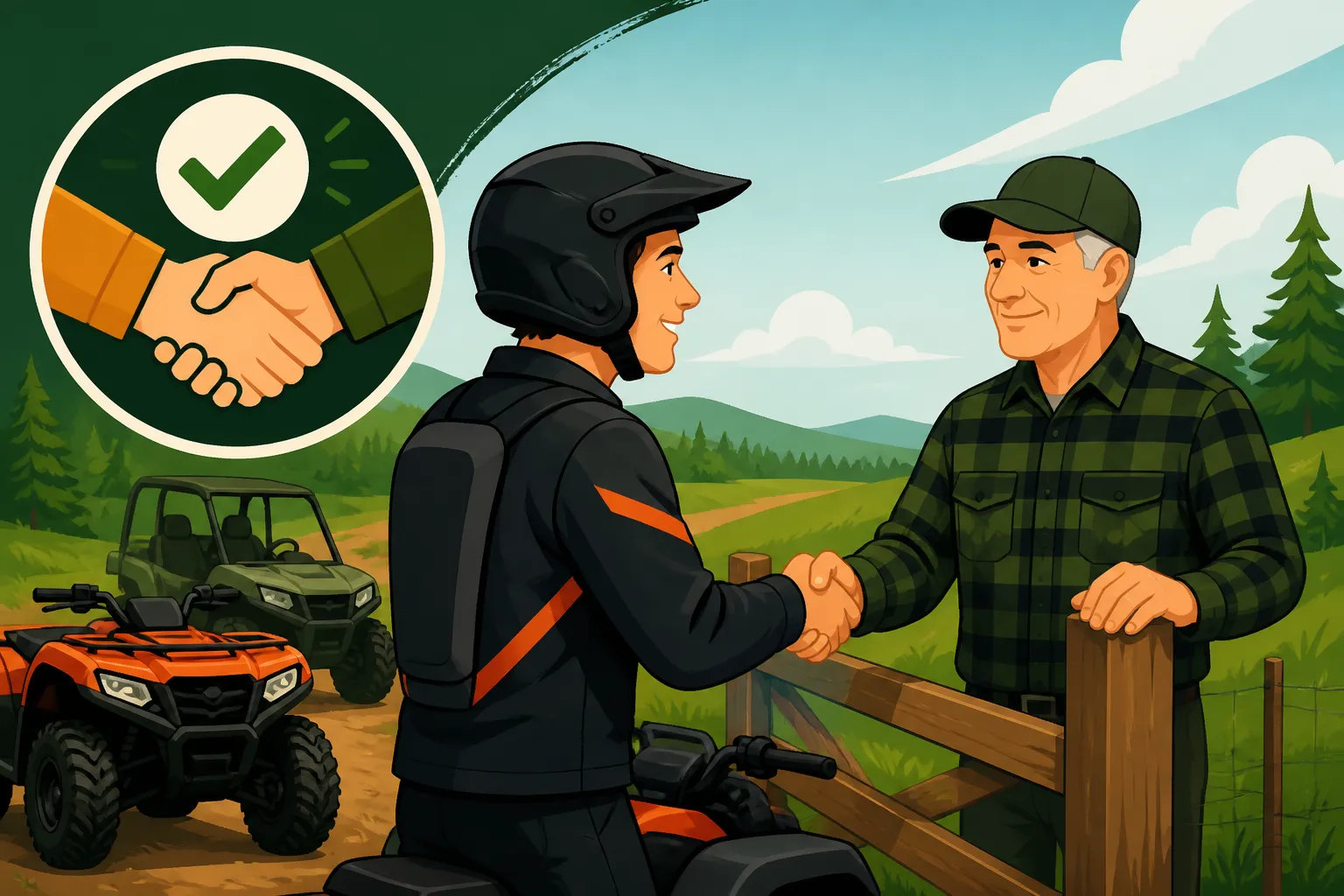
Ask before entering private ground, not after you have ridden across it. A landowner may be willing to let you cross for a specific trip but not want regular use, overnight parking, hunting access or a larger group. Permission is about the activity and route the landowner agrees to—not a general right to use the property.
| Situation | What to do before riding |
|---|---|
| A route appears to cross private land | Identify the landowner or authorized manager and ask before entering |
| A road or trail has a gate, chain or posted notice | Do not treat an open gate or missing sign as permission |
| You have permission for one crossing | Stay on the agreed route and follow any limits |
| The route reaches Crown land after crossing private property | Check Crown land rules separately; private-land permission does not grant Crown land access |
| The trail is managed by an operator | Confirm its access rules and any required sticker or other proof |
Permission is also separate from the requirements that apply to your machine and ride. It does not replace registration, safety training, insurance, equipment rules or any managed-trail requirements. Check Do You Need to Register an ATV in Newfoundland? and Newfoundland Managed Trail Rules for those separate obligations.
How to find the right person and ask clearly
Start with the specific parcel or stretch you want to cross. If you know the owner, contact them directly. If you do not, ask a nearby property owner, cabin association, community office or trail operator whether they can identify the person or organization responsible. A trail operator may help with route information, but do not assume it can grant permission for land it does not own or manage.
For a route with multiple private parcels, you may need to ask more than one owner. Permission from a neighbour does not extend across another person’s land, even if the track is continuous. If an owner refers you to a land manager, leaseholder or other authorized contact, confirm that person can approve the type of access you are requesting.
Make the request specific enough that the landowner can make an informed decision. Include:
- The route or property area you want to cross, preferably with a map or clear landmarks.
- The date or date range and whether you are asking for a one-time trip or repeated access.
- How many machines and riders will be travelling.
- Whether you plan to stop, camp, hunt, fish, tow a trailer or carry passengers.
- How you will prevent damage and respond if the route is blocked or conditions are poor.
- A contact number in case the landowner needs to reach you.
A simple request is more useful than a vague question such as “Can we ride around your land?” For example, explain that you want to cross a named section of track on a particular day, identify the number of machines, and say you will remain on that track without stopping. If your plans change, ask again rather than assuming the original approval covers the new activity.
Written permission is usually the clearest option, even when the landowner is comfortable with a verbal agreement. A text or email can record the route, dates and conditions without turning a straightforward request into a complicated document. For more on recording an agreement, see Asking a Landowner for Written Permission to Ride and Newfoundland Landowner Permission Forms.
Keep a copy of the response with you, either on your phone or on paper. A written record can help prevent confusion about what was agreed, especially if another rider in your group is stopped or questioned. It does not guarantee that every dispute will be resolved in your favour, but it gives you a clear reference to the permission you received.
What permission should cover—and what it does not
Permission can be limited. A landowner might allow a single crossing but prohibit riding around the property, leaving the track, bringing guests, or using the route during a particular season. Treat any conditions as part of the agreement. If you are unsure what a phrase such as “use the back road” means, ask before you ride rather than interpreting it broadly.
It helps to confirm the following details:
- Route: Which entrance, track or exit may you use? Are there branches or side trails you must avoid?
- Timing: Is access for one day, a season or a specific time of day? Does permission expire?
- Riders and machines: Does it cover only you, or everyone in your group? Is there a limit on machine type or group size?
- Activities: Is it for crossing only, or may you stop, unload, hunt, fish or camp?
- Conditions: Are there gates to close, livestock to avoid, speed limits to follow or areas that must remain untouched?
- Changes: Who should you contact if weather, trail damage or a changed itinerary affects the plan?
Permission to cross is not permission to use the whole property. Stay on the agreed route, do not create a new trail, and do not enter buildings, yards, fields or other areas unless the owner has specifically allowed it. Avoid spinning tires, cutting vegetation, moving barriers, disturbing drainage or leaving rubbish. A route that is dry and passable when permission is granted may become damaging after rain or thaw; if conditions deteriorate, turn back or ask the landowner what they prefer.
A gate or chain deserves particular care. Do not interpret a gate that is open as an invitation. It could have been left open for a vehicle, livestock, forestry work or another authorized user. If you have permission and the owner tells you to pass through a gate, clarify whether it must be closed behind you. Do not cut a chain, move a locked barrier or use an alternative entrance without approval. For more on how to read these situations, see Gates and Chains Across a Woods Road and What Posted Land Means on a Woods Road.
Permission also does not settle every question about responsibility if a machine causes damage or someone is injured. Ride cautiously, keep to the agreed route and ask the landowner about any special hazards. Do not assume that a landowner’s agreement waives your responsibility for your actions or covers damage to property. If the landowner sets conditions, make sure everyone in the group understands them before entering.
When the route is not clearly private or access is disputed
Some routes are difficult to classify. A woods road may look public because it connects communities or appears on a map, yet it may cross private parcels or be controlled by a company or other manager. Conversely, a route across private land may have a separate public access arrangement. Do not decide access solely from the road’s appearance, the absence of a fence, or the fact that other vehicles have used it.
If signs, a gate, a landowner’s request or a disagreement makes the situation unclear, stop before entering and seek clarification. Do not confront a landowner or force a passage. If you are already on the property and are asked to leave, do so calmly by the route the person indicates, if it is safe. Record the details afterward and check the route’s status before planning another trip.
A landowner’s permission only applies to the property and access they are authorized to control. It cannot authorize you to ride through a neighbouring private parcel, onto restricted Crown land, or along a managed trail contrary to its rules. Likewise, permission to cross a private section does not waive trail-sticker or registration requirements that apply elsewhere. If the route connects several kinds of land, treat each section as a separate access question. For privately owned roads and property, the practical advice in Newfoundland Rules for Riding Private Land is a useful starting point; for Crown land, confirm the applicable access rules independently.
If you cannot identify the landowner or obtain a clear answer, choose another route. That may mean a longer ride or a different trailhead, but it is better than treating uncertainty as consent. Before travelling, check with the relevant owner, manager or trail operator and make sure the route remains open for the kind of machine you plan to use.
A simple pre-ride checklist
- Identify every private section on the planned route.
- Get permission from the owner or authorized manager before entering.
- Confirm the exact route, dates, group size and allowed activities.
- Ask about gates, seasonal closures, sensitive areas and other conditions.
- Save the permission and share its conditions with every rider.
- Turn back if the route is blocked, unsafe or damaging to the land.
- Check registration, training, insurance and any trail requirements separately.
Clear permission makes access more predictable and helps preserve relationships with landowners. It also gives you a practical plan if the route is blocked or conditions change. When in doubt, ask first and keep to what the owner agreed.
Disclaimer
This article is for general informational purposes only and does not constitute professional advice. Laws, prices and regulations vary by location and change over time. Consult a qualified professional for guidance on your specific situation.