Newfoundland Group Size on a Managed Trail
A large ATV or UTV group can be harder to manage than it looks on a map: riders get separated, trailheads fill up, and a narrow route leaves little room to pass. For a managed trail in Newfoundland, don’t assume one group-size number applies everywhere. Confirm the operator’s current conditions, then plan a group size and riding order that suit the route.
Is there a fixed group-size limit on Newfoundland managed trails?
A managed-trail sticker gives access under the applicable trail rules; it does not, by itself, tell you how many machines may travel together. Don’t assume that a group size allowed on one trail, during one event, or in another province applies to every managed trail in Newfoundland.
The practical answer is to check the current conditions for the specific trail. A trail operator may set limits or conditions for its managed area, and an organized event may have separate approval requirements. Posted notices, temporary closures, and directions from the operator or land manager matter too. If you cannot find a group-size rule, ask before you arrive rather than treating the absence of a posted number as permission to bring an unlimited convoy.
It also helps to distinguish a legal or operator-set maximum from a sensible riding size. A trail may not publish a specific cap, but a very large group can still cause problems: it can block a narrow section, make it difficult for other trail users to pass, and create a long delay if one machine needs assistance.
| Question | What to check | Why it matters |
|---|---|---|
| Is there a stated maximum? | Current conditions from the trail operator and any posted notices | A limit may apply to a particular trail, section, or event |
| Does the outing count as an organized event? | Event approval and permit requirements | A planned group event can have conditions beyond ordinary trail access |
| How many machines can the trailhead handle? | Parking and unloading space | A group may fit on the trail but overwhelm the staging area |
| Can the group stay together safely? | Route width, visibility, terrain, and rider experience | A smaller group is easier to manage on tight or difficult sections |
| Does everyone have the required access documents? | Sticker, registration, training proof, and other applicable requirements | Group size does not replace individual rider and machine requirements |
The managed trail system has its own access conditions. Review Newfoundland Managed Trail Rules and confirm how the sticker requirement applies on your route with Managed Trails Require a Sticker on Your Machine. Those requirements are separate from deciding how many machines should ride together.
If the operator does not list a maximum, ask a direct question: “Is there a limit on the number of machines travelling as one group, and are there any conditions for a large group?” Mention your planned machine count, date, route, and whether the outing is a club ride, tour, or other organized activity. A clear answer is more useful than guessing from an old post or a rule that applies somewhere else.
What can affect the permitted or practical group size?
Trail operator and event conditions
A managed trail can have specific access conditions, and they may not be identical across every trail or operator. Check for current notices before the ride, especially if your route crosses different managed areas or includes a section with a separate operator. A group that starts on one trail does not automatically have the same conditions for the entire trip.
An ordinary ride with friends is not necessarily the same as a formally organized event. If you are advertising a ride, inviting the public, collecting registrations, or coordinating a large club outing, ask whether an event permit or other approval is needed. The requirements may depend on the activity and the land or trail involved. Start with Newfoundland Event Permits for a Ride and contact the relevant trail operator rather than assuming that a sticker covers event approval.
A permit or operator approval may include conditions about numbers, timing, route, safety arrangements, or other details. Follow the conditions issued for that event; do not rely on a general group-size guideline in place of them.
Route width, terrain, and sightlines
A broad, open section with good visibility can accommodate a group differently from a narrow, winding trail, a steep slope, or a muddy stretch where machines may need room to manoeuvre. The route’s tightest or most difficult section often sets the practical limit for keeping everyone together.
Consider the whole route, not just its easiest part. A group that moves comfortably along a wide railbed may bunch up at a bridge, a gate, a washout, or a busy intersection. If riders cannot see the machine ahead clearly, they need more space and a plan for stopping safely. Avoid stopping around blind corners or in a way that blocks the trail.
The guidance in How Big a Group a Narrow Trail Can Take is useful when you are deciding whether to split a large outing into smaller riding units. A smaller unit can make it easier to pass other users, handle obstacles, and respond if someone needs to stop.
Trailhead capacity and local use
Group size is not only a trail question. A trailhead may have limited room for trucks, trailers, unloading, and turning around. Arriving with a large convoy can obstruct other users or leave vehicles parked unsafely, even if the group could travel on the trail itself.
Ask about parking and unloading when you contact the operator. If several vehicles are involved, agree on an arrival plan so everyone does not try to unload in one tight space at once. Never use a road shoulder, private property, or an informal access point as overflow parking without confirming that it is allowed.
Other trail users matter as well. Managed routes may be shared with people travelling on foot or by bicycle, and some sections may have local operating conditions. Read Newfoundland Trail Etiquette Locals Expect before setting the pace and spacing for a mixed-use route.
Rider and machine readiness
A group is only as capable as its least-prepared rider and machine. On a long or remote route, an inexperienced operator, a machine with a developing mechanical issue, or a rider who cannot comfortably manage the terrain may change how quickly the group can travel and how often it needs to stop.
For a mixed-experience group, plan for the least experienced rider rather than expecting that person to keep up with the fastest machines. Keep the pace moderate, choose a route everyone can manage, and have a clear way to regroup. If the trail is challenging, dividing the outing into smaller units with suitable leaders may be safer than asking one long line of riders to move as a single group.
How to organize a large ride safely
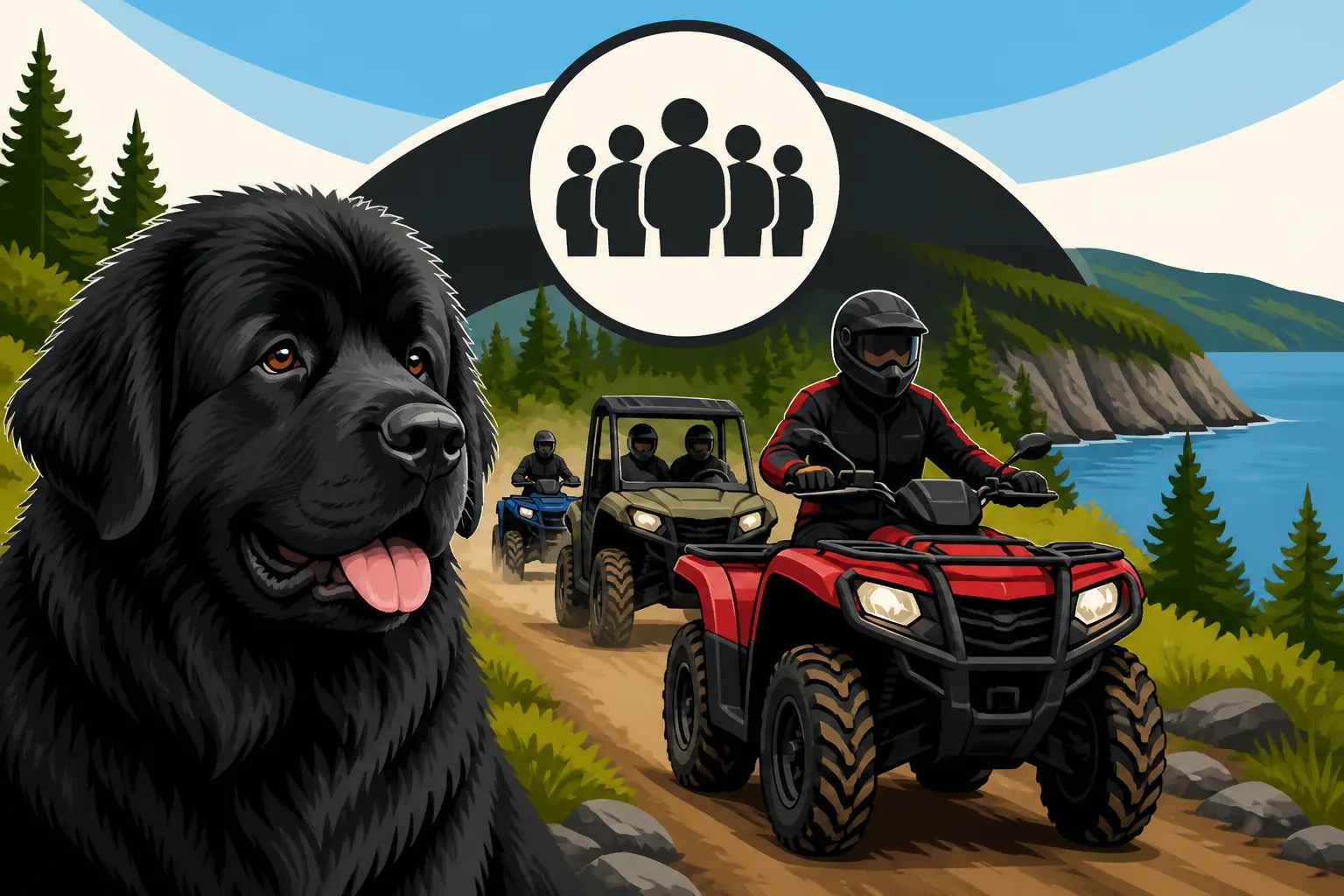
If the operator allows your planned outing, make the group manageable before anyone starts the engine. Decide who is leading, who is riding at the back, where the group will stop, and what riders should do if they become separated. For a large ride, divide machines into smaller units and keep a sensible gap between those units. That makes it easier for other trail users to pass and reduces the chance that a single stop will block a long stretch.
A split group should still operate as one coordinated outing. Agree on the route and regrouping locations in advance. Do not send riders onto an unapproved trail, private land, or a closed section to avoid congestion. If the lead unit stops, choose a safe place where following machines can pull over without blocking a corner, crossing, or narrow passage.
Use this planning sequence:
- Confirm the trail and operator. Identify every managed section on your route and check its current access conditions. Ask about group limits, temporary closures, and event approval if relevant.
- Count machines as well as people. Operators may define a limit by vehicles, participants, or another measure. Ask which count they use. A passenger does not turn one machine into two vehicles, but do not assume that a limit is based on machines unless the operator confirms it.
- Check the trailhead plan. Make sure there is suitable space for the group to arrive, unload, park, and leave without blocking other users.
- Set the riding order. Put a capable leader at the front and a dependable rider at the back. Pair inexperienced riders with someone who can keep an eye on them without pressuring them to ride beyond their ability.
- Choose regrouping points. Use safe, visible locations where everyone can stop clear of the trail. Make sure riders know what to do if they miss a turn or lose sight of the group.
- Review the access and safety requirements. Confirm that every machine and rider has the documents and equipment required for the ride. The checklist in What Gets Checked at a Managed Trail Gate can help you prepare.
- Recheck conditions before departure. A notice or closure can change your plan. If the operator’s instructions conflict with your plan, follow the current instructions and adjust the ride.
For club outings and other larger rides, a designated coordinator should handle questions with the operator instead of leaving each rider to interpret conditions independently. Share the operator’s instructions with the group before the day of the ride. If the group size changes, contact the operator again when the change could affect approval, parking, or trail use.
What visitors and group leaders should verify
Visitors should not treat an out-of-province registration or a managed-trail sticker as a substitute for checking Newfoundland’s other requirements. Access, registration, insurance, and rider qualifications are separate matters, and each rider or machine may need to meet the applicable rules. If someone in the group is visiting, review Newfoundland Visitor Rules and the 30-Day Limit and confirm the requirements for their circumstances. Trail access does not automatically make a machine compliant for every other part of the trip.
Before leaving, make sure the group knows who is responsible for carrying shared documents, contacting the operator, and handling a breakdown or separation. Each rider should still understand what they need to carry or produce themselves. For insurance questions, check [Newfoundland Insurance Proof at a Trailhead] and the relevant requirements for your situation.
Use this short checklist when speaking with the trail operator:
- Is there a maximum group size, and is it measured by machines or riders?
- Does the limit apply to the whole outing, each riding unit, or a particular section?
- Are there different conditions for a club ride or organized event?
- Is the planned trailhead suitable for the group’s trailers and vehicles?
- Are there closures, timing restrictions, or local instructions on the route?
- Where should the group check for updates on the day of the ride?
For trail-specific questions, Newfoundland Trail Operator Contacts can help you locate the right point of contact. Ask early enough to change the plan if needed. If the answer is unclear, ask the operator to explain what applies to your exact route and type of outing. Keep a note of the instructions and share them with the group, particularly if several smaller units will start at different times.
The safest planning rule is straightforward: confirm the current conditions for the managed trail, treat any operator or event limit as binding, and choose a group size that can travel without crowding the route or trailhead. When no specific maximum is stated, a smaller, well-coordinated group is usually easier to manage than one long convoy.
Disclaimer
This article is for general informational purposes only and does not constitute professional advice. Laws, prices and regulations vary by location and change over time. Consult a qualified professional for guidance on your specific situation.