Newfoundland Provincial Park Machine Rules
Planning an ATV or UTV ride through a Newfoundland provincial park can be confusing: permission to ride in the province does not automatically mean permission to ride inside a park. The practical rule is to confirm access for the specific park, route and machine before unloading. This article explains what to check, which documents and permits may matter, and how to avoid treating a trail sticker as park authorization.
Start With the Rules for the Specific Park
There is no safe blanket assumption that every provincial park allows off-road machines, or that the same conditions apply at every site. A provincial park may have roads, trails or service areas with different access rules, and some routes may be intended for vehicles other than ATVs or side-by-sides. A route that appears on a map, or connects to a nearby trail, is not proof that machines may use it.
Before you go, check the current information for the park and the exact route you plan to ride. Look for:
- Whether ATVs, UTVs or other off-road vehicles are allowed at all.
- Which roads, trails or access corridors are open to them.
- Whether access is limited to reaching a particular area, such as a launch point or permitted trail.
- Any seasonal closures, operating hours, temporary restrictions or local conditions.
- Whether the park requires advance permission, a site-specific permit or other arrangements.
- Whether trailers and tow vehicles can be parked at the intended access point.
If the park’s information is unclear, contact the park office or the provincial authority responsible for that site. Ask about the machine type, intended route and dates—not just whether “ATVs are allowed.” A side-by-side, a larger multi-passenger machine and a smaller quad may raise different practical questions about route width, parking and permitted use. Get the answer for the actual machine and plan, and keep a note of the contact details in case you need to follow up.
The same approach applies to a route that passes through or alongside a park. A public road or managed trail near the boundary does not necessarily authorize riding into the park, and a trailhead inside a park may have its own controls. Confirm where the boundary lies and where the permitted route begins and ends.
This distinction is especially important because Newfoundland’s rules can differ by land status. Park rules are not interchangeable with Crown land rules, private-land permission or a trail operator’s conditions. For a broader overview of Crown land access, see Newfoundland Crown Land Access Rules. If your route also enters a designated managed trail, review Newfoundland Managed Trail Rules separately.
A Registration, Sticker or Trail Permit Is Not the Same as Park Permission
Riders often use “permit” to mean several different things. In practice, you may need to deal with more than one requirement, and satisfying one does not necessarily satisfy the others.
| Requirement | What it generally addresses | What it does not automatically provide |
|---|---|---|
| Machine registration | Identifies the machine under provincial registration rules | Permission to enter every park or use every route |
| Managed trail sticker or marker | Meets access requirements for a managed trail where applicable | Authorization to ride on a park road or a closed route |
| Park-specific permission or permit | Addresses access conditions set for a particular park or activity | A replacement for registration, insurance or other riding obligations |
| Landowner permission | Allows access to private land when permission is required | Permission to cross unrelated land or enter a park |
| Safety training and riding documents | Helps meet rider requirements and prove compliance | A right to use land that is closed to machines |
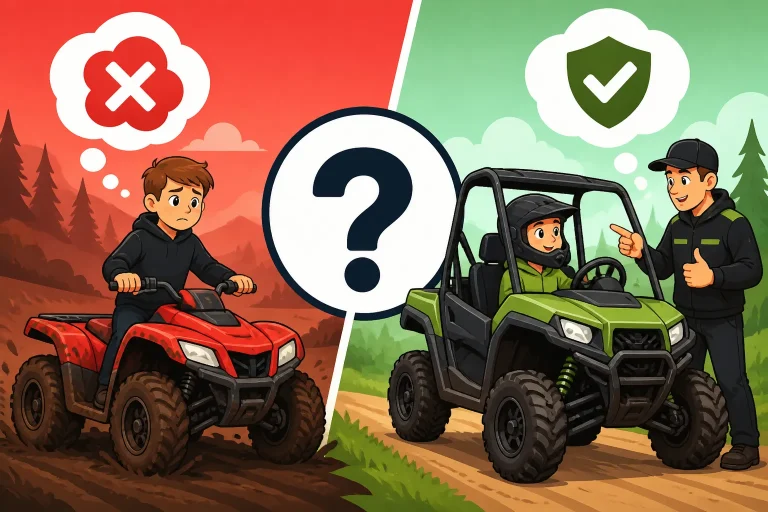
Treat each requirement as a separate check. A machine that is registered and properly equipped can still be prohibited from a park route. A sticker issued for a managed trail does not turn every connected road into an approved trail. And a park permit, if one is required, does not necessarily replace the registration or insurance obligations that apply to the machine.
If your trip includes managed trails, confirm the sticker requirement with the trail operator and check where the sticker must be attached or carried. The details are covered in Newfoundland Managed Trail Rules and Newfoundland Trail Sticker Cost. Ask whether the route you want is actually part of the managed trail system, rather than assuming that a nearby trail marker covers the whole outing.
Also verify that the machine itself is properly registered when required. Registration answers questions about the vehicle’s legal identification and status; it is not a land-access pass. Riders carrying documents can review Newfoundland Proof of Ownership on the Trail for practical guidance on what to keep available while riding.
For visitors bringing a machine from elsewhere, do not assume out-of-province registration settles every Newfoundland requirement. Visitor rules, park access and managed trail conditions are separate questions. Start with Newfoundland Rules for an Out-of-Province Machine, then check the park and trail operator directly.
What to Check Before You Unload
A few minutes of preparation can prevent a wasted trip or a ride into a closed area. Use this process before leaving home and again at the park entrance.
- Identify the exact park and route. Write down the intended entrance, trail or road, destination and turnaround point. A general plan to “ride around the park” is too vague to verify.
- Confirm that your machine type is permitted. Ask specifically about an ATV or UTV, including passenger capacity or size if relevant.
- Ask whether permission or a permit is needed. Confirm who issues it, whether it applies to the date and route, and whether any restrictions accompany it. If there is no permit requirement, ask what access rules still apply.
- Check for closures and seasonal limits. Conditions can change because of maintenance, weather, fire risk, wildlife concerns or other management needs. A route that was open on a previous visit may not be open now.
- Verify parking and unloading arrangements. Confirm that the planned parking area accepts trailers and that unloading does not block public access, emergency access or park operations.
- Confirm the separate riding requirements. Check registration, insurance, safety training, trail stickers and any equipment rules that apply to your ride.
- Save the information. Keep a copy of written permission, a permit confirmation or the relevant contact details where you can access them without relying on cell service.
If park staff or signs direct riders to stay on a particular route, follow that direction. Do not use an unmarked side track to bypass a closure or reach a destination more easily. A route that looks established may be an access road for park operations, a private route, or a path that is not open to off-road vehicles.
Pay close attention to posted signs at entrances and junctions. If a sign conflicts with an old map, an online discussion or advice from someone who visited earlier, treat the current on-site direction as a reason to stop and clarify. Never ride past a gate, barrier or closure sign on the assumption that it applies only to cars.
If you are unsure whether a route is inside the park, stop before entering and check your map or ask the responsible office. Mobile coverage may be unreliable in some riding areas, so save maps and contact information in advance. A paper map can be useful as a backup, but it does not establish legal access.
Ride Responsibly and Recheck Conditions
Park access is a privilege that depends on following the conditions set for the area. Stay on routes confirmed as open to your machine, avoid creating new tracks and do not ride around barriers. These habits reduce damage to vegetation and soft ground and help prevent conflicts with hikers, campers, cyclists, park staff and other visitors.
Before setting out, consider how the route will work for the whole group. A trail that is passable for one machine may not be suitable for a wide UTV or a group that needs room to stop. Plan meeting points where machines can pull safely off the route, and agree on a turnaround point before anyone rides ahead. Keep noise and speed appropriate to the setting, and yield courteously to other visitors.
Fire restrictions deserve particular attention during dry or high-risk periods. Check the applicable rules before your trip and follow any current closures or directions. Do not assume that a restriction elsewhere in the province either automatically applies to your park route or has no effect there. For related provincial information, see Newfoundland Fire Season Riding Restrictions, then confirm any additional park-specific conditions.
Do not rely on an old permit, an earlier visit or a general statement that a park is “open.” Park facilities may be open while machine access is limited, and access may change by route or season. Recheck shortly before departure, especially after heavy rain, fire notices, maintenance work or other events that could lead to a closure.
The same caution applies to national parks. Their rules are not the same as provincial park rules, and permission to ride in one type of protected area says nothing about access in another. If your trip crosses into a national park, review Newfoundland National Park Vehicle Rules and contact the park authority before planning a machine route.
If you are organizing a group ride, make one person responsible for verifying access and sharing the confirmed route with everyone. Ask the park about group size, parking capacity and any event authorization that may be needed. A large group can create congestion even where individual machine access is permitted. For other route-specific questions, Newfoundland Bylaw Lookups Before You Ride can help with the separate issue of local restrictions beyond park boundaries.
The safest working rule is simple: confirm the park, route, machine and date as a single plan. Registration, trail access and park permission are separate checks, and the answer for one does not settle the others. When information is incomplete, pause and ask the responsible office rather than testing the boundary on the trail.
Disclaimer
This article is for general informational purposes only and does not constitute professional advice. Laws, prices and regulations vary by location and change over time. Consult a qualified professional for guidance on your specific situation.