Newfoundland’s Fire Season Starts the First of May
Newfoundland’s Fire Season Starts the First of May
Planning an ATV or UTV ride in Newfoundland means thinking about more than trail conditions. Fire season affects when and how you can use fire outdoors, while dry weather or an active restriction can change what is sensible on a ride. Here’s how to understand the season dates, check for current rules, and reduce the chance your trip starts a wildfire.
What Newfoundland’s fire season dates mean
In Newfoundland, the provincial fire season starts on May 1 and ends on September 30. Labrador’s season starts later, in mid-May, and also ends on September 30. These dates mark the period when wildfire risk and fire-related rules need particular attention; they are not a forecast of when conditions will be dry or wet.
| Area | Typical fire season dates | What riders should take away |
|---|---|---|
| Newfoundland | May 1 through September 30 | Check for current restrictions before lighting an outdoor fire or travelling through an area with elevated fire risk. |
| Labrador | Mid-May through September 30 | The later start does not mean fire conditions cannot be dangerous earlier. Check local information before heading out. |
Season dates are useful for planning, but they do not tell you whether a specific campfire is allowed on a particular day. Fire danger can rise quickly after dry, windy weather, and restrictions may be announced or changed based on conditions. Conversely, being within fire season does not automatically mean every outdoor fire is prohibited.
Think of the calendar as a reminder to check, not as permission to burn. Before a ride, confirm the current provincial fire information and any restrictions that apply to your intended area. If you are riding on a managed trail or staying at a campground, check with the operator as well. Local instructions may be more specific than a general seasonal date.
There is also an important distinction between the fire season and permission to ride. The start of fire season does not, by itself, establish that all ATV or UTV trails are closed. Trail access can depend on the land designation, the trail operator, current closures, weather, and other rules. Check those separately through [Newfoundland Crown Land Access Rules] and [Newfoundland Managed Trail Rules].
Fire rules and trail-access rules can overlap in practice, but they answer different questions:
- Fire rules address whether and how you may light or maintain an outdoor fire.
- Trail and land rules address where you may ride and whether a route is open to your machine.
- Machine requirements address equipment such as the exhaust and muffler.
- Current notices may add temporary restrictions based on conditions.
If a notice is unclear, do not assume that a trail closure and a fire ban mean the same thing, or that one automatically creates the other. Follow the specific instruction that applies, and contact the relevant operator or authority for clarification before you travel.
Fire restrictions, campfires, and permits
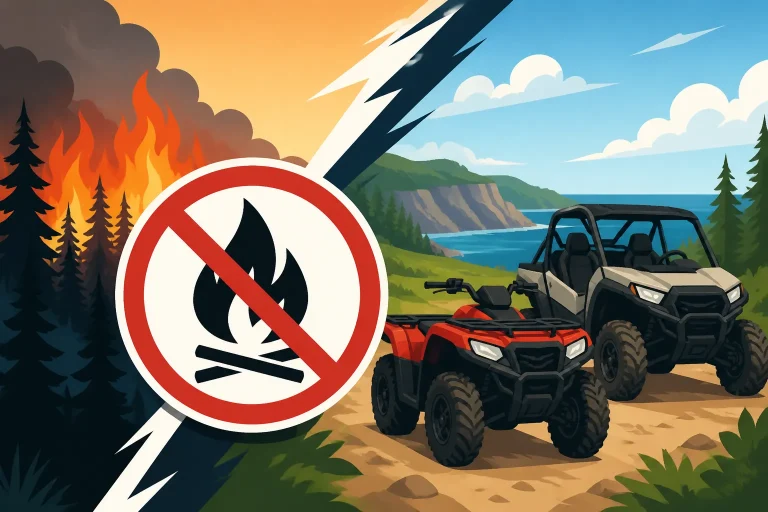
A fire season is not the same thing as a blanket fire ban. The season is a period when people should pay close attention to wildfire risk and the applicable rules. A separate restriction may prohibit or limit certain outdoor fires when conditions warrant it. The exact instruction matters: it may concern open fires, campfires, burning debris, or other kinds of burning.
Do not rely on an old trip plan, a social media post, or a sign you saw on a previous visit. Check for current fire notices shortly before leaving and again if conditions change during a longer trip. A permitted fire can still be unsafe if wind rises, vegetation is dry, or the fire cannot be kept under control.
A permit is not a general pass to ignore a restriction. If you are considering a campfire, confirm whether a permit is required, whether the proposed location and type of fire are allowed, and whether any active restriction overrides or changes the usual process. For current requirements, use the official provincial fire information or ask the appropriate land manager. Do not assume that permission to ride on a route includes permission to make a fire there.
Questions to settle before lighting a fire
Before you light anything, be able to answer these questions:
- Is a fire allowed today? Check for a current ban, restriction, or special notice in the area.
- Is this the right place? A fire that may be allowed at an established campsite may not be allowed beside a trail, on a barren, or on land where you lack permission.
- Does this fire need a permit? Confirm the requirement for the kind of fire you intend to have. A permit for one purpose or location should not be treated as permission for another.
- Can you control it? Consider wind, dry vegetation, nearby forest or brush, and whether you have enough water and tools to put it out completely.
- Can you leave it safely? If you cannot stay with the fire and extinguish it fully, do not light it.
If the answers are uncertain, choose a fire-free meal or stop instead. A stove or packed food may be a better option than a campfire on a dry or windy day, but any fuel-burning device still needs to be used according to its instructions and the restrictions in force.
For a campfire on or near Crown land, check the applicable rules rather than treating public land as unrestricted. Access to an area does not automatically grant permission to burn, camp, or use a particular site. The same caution applies to private land: get the landowner’s permission and check any applicable fire rules. Newfoundland Burning Permits for a Campfire on the Trail covers the permit question more specifically, while Newfoundland Crown Land Fines for Riders is useful background on why land-use rules deserve attention.
Do not assume a riding permit covers a fire
A managed-trail sticker, event permit, or permission to use a route is not necessarily a fire permit. These permissions serve different purposes. A trail sticker concerns access under the managed-trail system; an event permit relates to an organized ride; and a burning permit, when required, concerns a fire. One does not automatically replace another.
The same point applies to visitors. An out-of-province registration or visitor exemption concerns the machine’s registration status, not the right to start a fire. Visitors still need to follow local fire restrictions and land-use rules. For the separate question of machine access, see Newfoundland Visitor Rules and the 30-Day Limit.
Riding during fire season without starting a wildfire
A machine can create ignition risks even when the rider never lights a campfire. Hot exhaust components, dry grass, debris caught under the machine, and careless disposal of smoking materials can all create avoidable hazards. Risk depends on the machine, the terrain, and current conditions, so use a more cautious approach when vegetation is dry or the wind is strong.
Before leaving, inspect the area around the exhaust and underbody. Remove dried grass, leaves, peat, and other debris that could touch hot components. Check again during breaks, especially after riding through tall grass, brush, or boggy areas where plant material can collect. If the machine smells unusually hot or you see smoke, stop somewhere safe and investigate rather than continuing.
Good habits include:
- Keep exhaust components and the area around them clear of dry vegetation.
- Avoid parking over dry grass or brush when a bare, stable surface is available.
- Do not idle over combustible material.
- Carry smoking materials out with you and dispose of them safely; never flick a cigarette from a machine or vehicle.
- Stop and deal with smoke, a burning smell, or debris touching a hot part.
- Do not leave a campfire unattended, even briefly.
- Follow a closure or fire notice immediately rather than riding around it.
A small fire extinguisher suitable for vehicle use can be a useful backup, but it is not a substitute for prevention or for calling emergency services when a fire is beyond your control. Secure it so it cannot shift, and learn how to use it before an emergency. If you are shopping on Amazon or elsewhere, check the extinguisher’s rating, instructions, mounting requirements, and suitability for the risks you expect; product listings alone do not establish that it is right for your machine.
Fire preparedness also means making a practical trip plan. Tell someone where you expect to ride and when you plan to return. Carry a charged phone or other communication option suited to the route, while recognizing that coverage may be limited. Know your location well enough to describe it to responders. If an active fire, smoke column, or official warning affects your route, leave the area and follow instructions. Do not ride closer to a fire to get a better look.
Match the ride to conditions
A route that is reasonable after rain may be a poor choice in hot, dry, windy weather. Reduce unnecessary stops in dry vegetation, avoid unofficial shortcuts, and do not ride through a closure. If the weather has made fire conditions concerning, consider shortening the loop, postponing the outing, or choosing a route where you can quickly return to a safe staging area.
This is especially important when riding in a group. Agree on a turnaround point and a way to communicate if someone spots smoke or a restriction notice. Keep the group together at decision points, and do not let a desire to finish the planned loop override a safety warning. A ride plan is flexible; an active fire can change the situation quickly.
Check trail and land access independently from fire conditions. A dry spell may lead to temporary closures or local guidance, but do not infer a closure from weather alone. Use the current information from the trail operator or land manager. The same applies to a route that crosses Crown land, private parcels, or a managed trail system. Finding Approved Areas on the Provincial Map and [Newfoundland Restricted Area Permissions] can help with the separate question of where riding is allowed.
Do ATV exhaust and spark-arrestor rules change in fire season?
Fire season does not make every machine subject to a new equipment rule, but it is a good time to check that your machine is in sound condition. Newfoundland has no spark-arrestor rule for ATVs, according to the listed provincial guidance. That does not mean the exhaust system is unrestricted. Muffler and noise requirements still matter, and a missing or modified muffler can create legal and safety problems.
A spark arrestor and a muffler are not the same thing. A spark arrestor is intended to prevent hot particles from leaving an exhaust. A muffler reduces exhaust noise. The absence of a general spark-arrestor requirement should not be read as permission to operate a machine with an unsafe, excessively loud, or non-compliant exhaust.
Before a fire-season ride, inspect the exhaust for damage, loose parts, unusual noise, or signs that the system has been altered. Keep the machine maintained according to its manufacturer’s instructions. If you are unsure whether a modification is lawful, check the current rules rather than relying on an informal claim that “no spark arrestor is required.” See Newfoundland Has No Spark Arrestor Rule for the specific issue and Newfoundland Muffler and Noise Rules for the separate exhaust requirements.
A compliant machine is only one part of responsible riding. Hot exhaust surfaces can still ignite dry material if the machine is parked carelessly or vegetation is allowed to build up underneath. Avoid treating the absence of a spark-arrestor requirement as a guarantee that a machine cannot start a fire.
Riders should also keep basic fire safety separate from regulatory compliance. A machine may meet its equipment rules and still be poorly suited to a high-risk day. If the route is dry, the wind is strong, or official information advises caution, adjust the plan rather than relying on a particular component to eliminate the risk.
A practical fire-season checklist for ATV and UTV trips
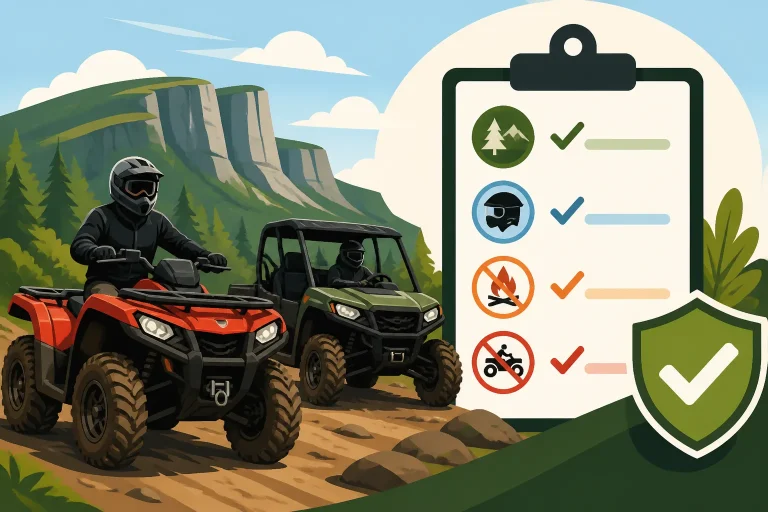
Use this checklist before a ride during the fire season. It is not a substitute for current official directions, but it helps catch common planning gaps.
Before you leave
- Check the fire-season dates for the area. Newfoundland’s season begins May 1; Labrador’s begins in mid-May. Both typically end September 30.
- Check current notices for fire bans, restrictions, warnings, and closures.
- Confirm that the route is open to your type of machine and that you have any required access permission or trail sticker.
- If you plan to have a fire, confirm the rules for that fire, site, and day. Do not assume a riding permission is enough.
- Inspect the exhaust and clear dry vegetation or debris from around the machine.
- Review the weather, especially recent dryness and wind conditions.
- Tell someone your route and return plan.
During the ride
- Watch for smoke, new signs, barriers, and instructions from trail staff or authorities.
- Keep the machine away from dry grass and brush when stopped.
- Check for debris around hot components during breaks.
- Avoid shortcuts, closed routes, and unnecessary travel through dry vegetation.
- Do not leave a fire unattended or leave a site before the fire is completely out.
- Turn back if conditions or official instructions make the route unsafe.
If you see smoke or fire
Move away from the danger and contact emergency services when appropriate. Give a clear location, using a trail name, nearby road, landmark, or coordinates if available. Do not approach the fire or attempt to cross smoke to continue the ride. If an authority directs you to evacuate or avoid an area, follow that instruction.
A paper map can help if your phone has no service, and a downloaded map can help when you do have a device but lose reception. Do not rely on a map alone for active closures or fire updates: those can change after you download it. For remote rides, pair navigation planning with a clear check-in plan and a realistic turnaround time.
Fire season is also a good reason to be conservative about carrying and using equipment. Secure tools, fuel, and other supplies so they cannot fall from the machine or contact hot parts. Pack out food wrappers, cigarette waste, and anything else that could become litter or a source of ignition. Responsible riding protects access for other users as well as the landscape.
The simplest decision rule is straightforward: check the current restriction, follow the specific instruction, and skip any fire you cannot confidently manage. The calendar tells you when to pay close attention; current conditions and official notices tell you what you can do today.
Frequently Asked Questions
Does fire season mean all ATV trails in Newfoundland are closed?
No. The fire-season dates alone do not mean all trails are closed. Check the current status of the route with the trail operator or land manager, and follow any specific closure or restriction.
When does fire season start in Labrador?
Labrador’s fire season starts in mid-May and typically runs through September 30. Check current provincial information before planning an outdoor fire or ride.
Can I have a campfire during fire season?
Possibly, but the season dates do not determine whether a particular fire is allowed on a particular day. Check whether a restriction is in effect, whether a permit is required, and whether the location allows fires.
Does an ATV need a spark arrestor in Newfoundland?
The listed provincial guidance says Newfoundland has no spark-arrestor rule for ATVs. Muffler and noise requirements still apply, and riders should confirm current rules if they are uncertain about their machine or a modification.
Disclaimer
This article is for general informational purposes only and does not constitute professional advice. Laws, prices and regulations vary by location and change over time. Consult a qualified professional for guidance on your specific situation.