Newfoundland Trails Shared With Hikers
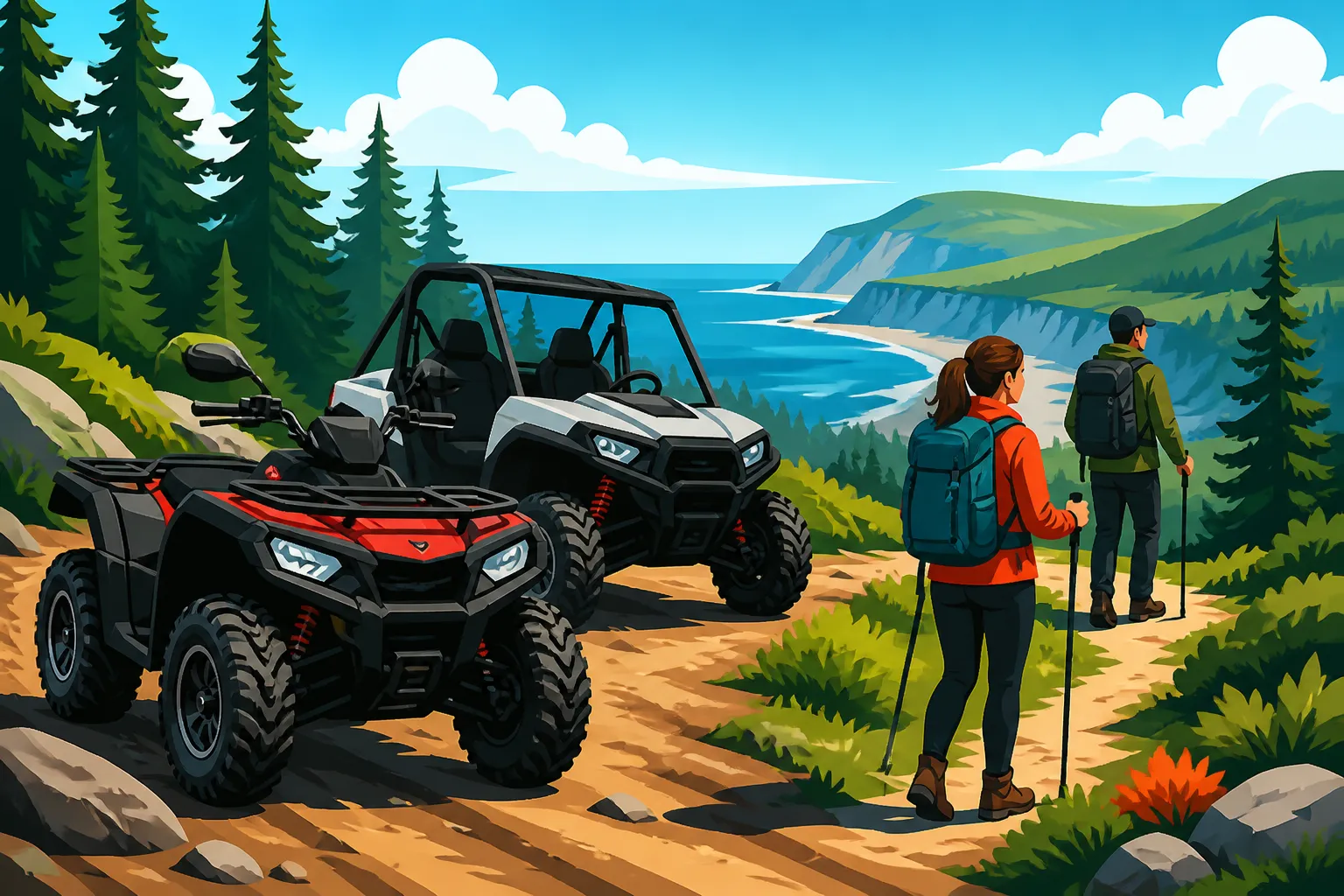
A shared trail can feel wide open until you round a bend and find hikers walking two or three abreast, a family with young children, or someone who never heard your ATV coming. In Newfoundland, considerate riding means slowing early, making your presence clear without startling people, and following the rules for that particular route. This guide explains how to share trails safely and respectfully.
What sharing a Newfoundland trail really means
Different users move at different speeds
A trail that feels roomy from the driver’s seat may feel very different on foot. Hikers often walk in groups, stop to take in a view, or step aside to let someone pass. Children may change direction suddenly, and a dog on a lead can move unpredictably. On a quad or side-by-side, you may cover ground quickly enough to reach a group before anyone has heard you.
That difference in speed is why shared use takes more than staying on the trail. Riders need to anticipate what other users might do, reduce speed before a blind corner, and leave enough room for people to move without pressure. A quiet approach gives hikers time to notice you and choose a safe place to stand.
The T’Railway is a well-known example of a long Newfoundland corridor where different kinds of recreation can overlap. Its old railbed character may offer a broad surface in some sections, but that does not make every stretch equally visible, quiet, or easy to share. Ground conditions, vegetation, curves, and user traffic all affect how cautiously you should ride.
“Shared trail” does not mean every route permits every machine
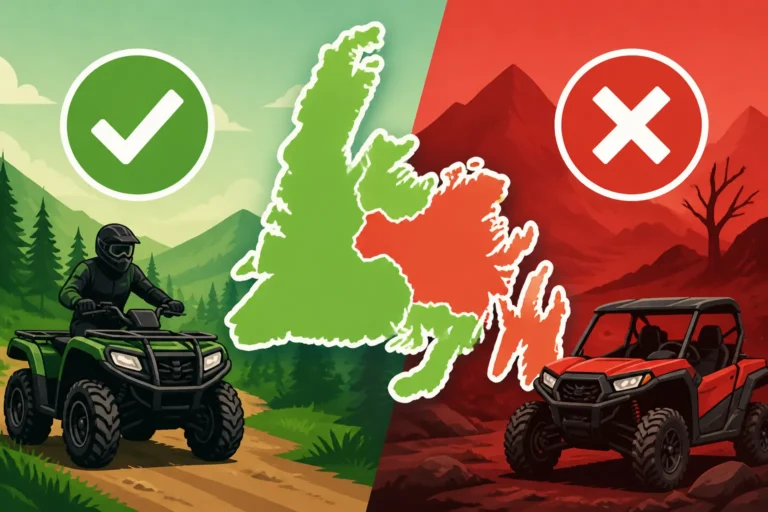
A trail’s appearance does not tell you whether your ATV or UTV is allowed there. Access can depend on the area, trail operator, land status, signage, seasonal restrictions, and the type of vehicle. A route open to hikers might not be open to off-road vehicles, and permitted access on one section does not automatically extend to a connecting trail.
Before setting out, check the route’s current designation and the rules that apply to the specific section you plan to ride. Use official maps and information from the relevant land manager or trail operator, and pay attention to signs at access points. For background on the distinction between permitted and restricted areas, see [Newfoundland Approved and Restricted Areas].
A mapping app can help you plan a route, mark waypoints, and see where you may lose cell service. Riders sometimes use onX Offroad for that kind of trip planning, but a map layer should not be treated as permission to ride. Confirm access through the appropriate official or local source, especially where the route crosses managed land, private property, a park boundary, or a seasonal closure.
A practical passing routine for hikers
Slow down before you reach people
The safest time to reduce speed is before the encounter becomes close. Ease off as soon as you see hikers ahead, approach a bend, or reach a section where brush blocks your view. A sudden hard stop can unsettle people, while maintaining speed until the last moment leaves everyone less room to respond.
If hikers are walking toward you, slow to a crawl and be ready to stop. If the trail is narrow, uneven, or edged by a ditch, wait for a spot where they can stand comfortably without stepping into bog, loose rock, or traffic. Do not pressure people to move quickly or make them feel they have to leave the trail to accommodate your machine.
When visibility is poor, treat the next short stretch as if someone could be just out of sight. That means controlled speed, hands ready for the brakes, and no attempt to take a corner wide or pass at pace. A ride that takes a little longer is better than a close call that frightens a child or causes someone to stumble.
Make your presence clear without startling anyone
A calm greeting or a brief, gentle signal can help hikers understand what is coming. Avoid revving the engine, sounding the horn unnecessarily, or accelerating toward a group to get their attention. The goal is to be noticed—not to demand space.
Give people time to acknowledge you and decide how they want to pass. Some hikers may step to one side; others may prefer to remain where the footing is safest. If you are unsure, stop at a comfortable distance, keep the machine under control, and ask politely whether there is room to proceed. If someone seems startled, wait until they are settled before moving.
When you do pass, use a walking pace or another very slow speed appropriate to the surface and conditions, and leave as much space as the trail allows. Keep your machine on the established route rather than cutting around people through vegetation. Once you have passed, ease away smoothly instead of accelerating sharply beside them.
Stop when the group needs time
A single hiker may step aside quickly, while a larger group can take longer to gather children, shorten a dog’s lead, or move out of the way. Give them that time. A patient stop is especially important when people are on a slope, near water, on loose stones, or carrying packs that affect their balance.
If a group has not noticed you, wait at a respectful distance and use a calm voice. Do not creep close behind them or follow so near that they feel hurried. If the trail is too narrow for a safe pass, remain stopped until there is a suitable place to go by.
A useful rule of thumb is to leave the encounter feeling ordinary. Hikers should not have to jump aside, cover their ears, or wonder whether a rider is going to slow down. For more trail-specific courtesies, see [Newfoundland ATV Trail Etiquette Locals Expect] and [Sharing the Railbed With Walkers and Cyclists].
Common trail encounters and how to handle them
| Encounter | Safer approach | Avoid |
|---|---|---|
| Hikers approaching around a bend | Slow early, stay to a predictable line, and stop if sightlines are short | Cutting the corner or entering at speed |
| A family with children | Stop or crawl, give the group time, and pass only when the children are settled | Assuming children will stay in place |
| A dog on a lead | Wait for the handler to gather the lead and confirm there is room | Passing close while the lead is stretched across the trail |
| A group walking abreast | Stop at a comfortable distance and let them organize | Revving or pressing them to move aside |
| Hikers stopped for a view | Slow quietly and give them room to resume walking | Squeezing between people and the trail edge |
| A narrow or muddy section | Wait for a wider, stable place to pass | Riding off-trail to get around the group |
Families and children need extra room
Children may be curious about a machine and step toward it, or they may react to the sound by moving suddenly. Reduce speed well before reaching them and give the adults time to bring the group together. If you are in a UTV, remember that a large vehicle can feel imposing even when you are moving slowly; leave generous space and keep your movements smooth.
Do not assume that a parent’s wave means you should immediately proceed. Make sure the children are safely positioned and that the adults know you are passing. If anyone is still moving around, stay stopped. A few extra seconds can prevent a frightening moment for the family and an awkward one for you.
Dogs and other unpredictable movement
Dogs can be difficult to read from a distance. One may stay beside its owner, while another may pull toward the trail edge or cross in front of a machine. Slow down early, stop if necessary, and let the handler gather the dog and lead. Never try to thread between a dog and its person.
The same patience applies when hikers are taking photographs, adjusting packs, or stepping around a wet section. People may not be looking behind them. Make your presence known calmly, then wait for a clear response before proceeding. If the group is unsure what to do, asking “Would you like me to wait here?” is often more helpful than guessing.
Oncoming riders and mixed traffic
Shared routes may have more than hikers on them. You might encounter cyclists, snowmobilers where permitted, other off-road vehicles, or people leading animals. The safest approach is to anticipate that someone else may be travelling faster than a walker and may appear suddenly on a narrow section.
Keep to a predictable line and avoid stopping where you block the full trail if there is a safer place nearby. On a broad, unobstructed stretch, leave room for others to pass without forcing anyone onto a soft or unstable edge. The general principles in [Newfoundland Trails Shared With Snowmobiles] also apply to mixed-use awareness: expect different speeds and give other users space to react.
Planning a ride around shared-use conditions
Choose the route and timing thoughtfully
A route that is easy to ride in quiet conditions may be busy during a popular weekend, community event, or pleasant-weather stretch. If your group wants a relaxed ride, consider choosing a less congested time or a route where sightlines and passing space are better suited to mixed use. A large group should be especially deliberate about spacing and regrouping.
Plan your route in sections rather than assuming the whole trail will feel the same. Old railbeds, forest paths, open barrens, and community access roads can each bring different visibility and surface challenges. The T’Railway’s former railway corridor is a significant route, but conditions and user activity vary along it. Learn about its character in [Newfoundland's Old Railbed Turned Trail].
If your plans include areas around St. John’s, Gander, Corner Brook, or another community, confirm the local access rules before you unload. A route that looks connected on a map may cross land with different restrictions or connect to a road governed by local rules. Planning around the actual permitted route avoids the frustration of reaching a gate or sign that changes your plans.
Prepare for weak signal and changing trail conditions
Cell service may be unreliable on remote stretches. Download or carry the information you need before leaving, and tell someone your general route and expected return. A map app such as onX Offroad may be useful for storing a planned route or locating your position, but keep an offline backup and do not depend on live connectivity for navigation.
Conditions can also change the way a shared trail feels. Rain can create slippery surfaces and muddy edges; fog can shorten sightlines; wind and engine noise can make it harder for hikers to hear an approaching machine. Check local trail information before departure and adjust your plan if conditions reduce visibility or make it difficult to pass safely. For preparation ideas, see [Newfoundland Trail Conditions Before You Ride].
If you expect to travel through an area with limited service, carry a paper map or another offline navigation option. Keep your route simple enough that everyone in the group can follow it, and agree on what to do if riders become separated. [Cell Dead Zones Along the Railbed] and [Carrying a Paper Map Where There Is No Signal] offer related planning guidance.
Set group expectations before starting
The lead rider should be responsible for noticing trail users, but every rider needs to follow the same cautious approach. Agree in advance that the group will slow early, stop for hikers when needed, and avoid splitting up around corners. If the first rider passes politely but the rest of the group comes through too quickly, the overall encounter can still feel unsafe.
Leave enough distance between machines for riders behind to see what is happening and brake smoothly. Avoid bunching close behind the lead machine, especially where dust, brush, or a curve limits visibility. If the trail is busy, let hikers pass through fully before the group resumes rather than sending machines by one at a time while people are still trying to move.
Choose regrouping spots that do not block a narrow trail or force hikers to walk around parked machines. Before moving again, check that no one is still behind the group or approaching from the other direction. A short briefing at the trailhead can prevent confusion later, when engine noise makes it harder to communicate.
Respectful riding protects access for everyone
Keep the machine on the established route
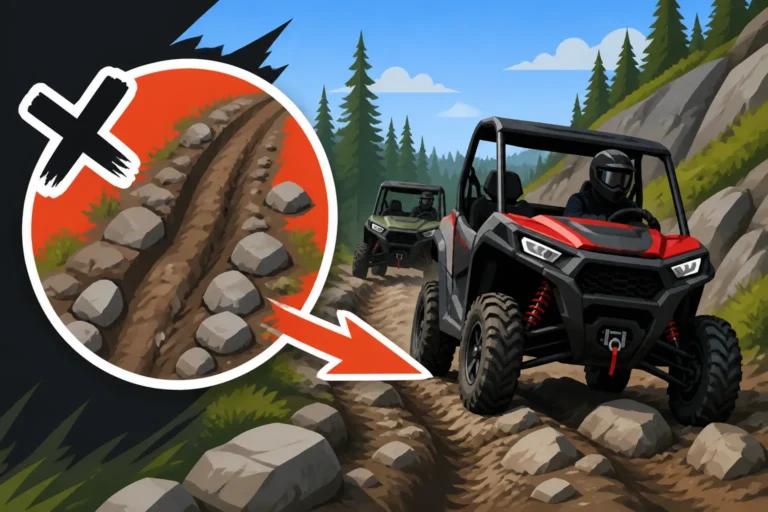
When a hiker is in your way, riding around them through vegetation may seem like the quickest fix. It can damage soft ground, widen the trail, disturb plants, and create a new path that other riders may follow. Wait for a suitable passing place instead of leaving the established route.
This matters particularly on wet or soft ground, where a tire can leave a rut even after a single pass. If the trail edge is fragile, the safest choice may be to stop and let the hikers move through first. Staying on the route is part of responsible riding, not just a way to avoid a conversation.
Respect posted closures and signs even when the trail looks passable. A closure may protect land, wildlife, trail work, or public safety, and a visible track is not proof that motorized access is allowed. If signage is unclear, do not assume the most permissive interpretation; check with the trail operator or relevant authority before continuing.
Control noise, dust, and exhaust
A machine can affect hikers even when there is plenty of physical room to pass. Loud acceleration, repeated revving, and heavy dust can make the encounter unpleasant and may reduce people’s ability to hear other users. Ease through the area smoothly and avoid spinning tires or accelerating hard after a pass.
On a dry trail, slowing down can also reduce the dust thrown toward people behind you. Give hikers enough distance before returning to normal riding speed, especially if the trail is narrow or the wind is carrying dust toward them. If another group is approaching, wait until the trail is clear rather than creating a cloud that obscures visibility.
Noise rules and equipment requirements still apply, but considerate riding goes beyond compliance. Keeping your machine in good working order and riding gently near other users helps preserve a positive impression of ATV and UTV riders. The more predictable and courteous the encounter, the easier it is for different users to share the same route.
Leave the trail in good shape
Pack out rubbish, secure loose gear, and do not leave food or other items where wildlife may find them. If you see a hazard such as a fallen branch or washout, report it to the appropriate trail operator rather than creating an unsafe detour. Avoid moving signs or barriers, even if they appear inconvenient.
If a near miss happens, stop somewhere safe and check whether anyone needs help. Do not turn a disagreement into an argument on the trail. A calm apology and a clear explanation can settle an uncomfortable moment; if access rules or trail conditions are genuinely unclear, follow up with the responsible operator afterward.
Above all, remember that hikers may be seeing several machines in a short span, not just yours. One careful pass can help build trust; one aggressive encounter can colour how a whole community views motorized users. When riders consistently slow down, communicate, and share space generously, trails are more welcoming for everyone.
Disclaimer
This article is for general informational purposes only and does not constitute professional advice. Laws, prices and regulations vary by location and change over time. Consult a qualified professional for guidance on your specific situation.