Does a Utility Trailer Need Its Own Registration?
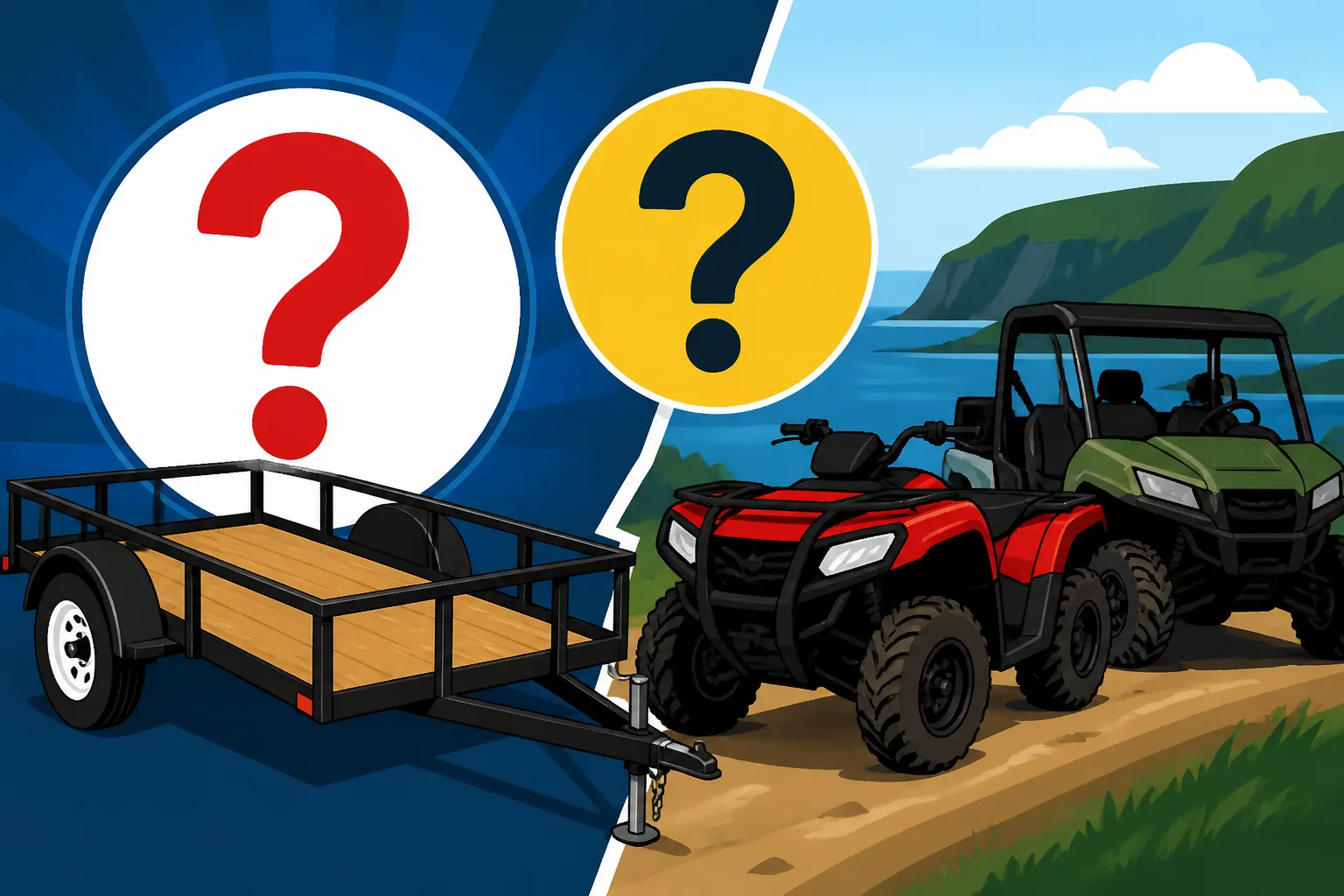
You've just hooked up your trusty utility trailer to the back of your ATV, ready to haul a load of firewood, a couple of fishing rods, or maybe even an extra fuel can for a long day on the barrens. But as you pull out of the driveway, a nagging question pops into your head: does this little trailer need its own registration? It's a common point of confusion for many off-road vehicle (ORV) enthusiasts in Newfoundland, and this guide is here to clear up exactly what the provincial rules say, and what they don't, about registering your utility trailer.
Understanding the Basics of Newfoundland Trailer Registration
The world of off-road vehicles comes with its own set of rules and regulations, and sometimes it feels like a completely different universe from the rules governing your everyday car or truck. When it comes to trailers, this distinction is absolutely critical. Many riders assume that if their ATV or side-by-side needs to be registered, then anything it pulls must also follow suit. However, that's not always the case, especially for those smaller utility trailers designed specifically for off-road use.
The 'Why' Behind Trailer Registration (or lack thereof for utility trailers)
When you register a motor vehicle – be it a car, a truck, or even your ATV – you're essentially telling the provincial government that this machine is on their radar. This registration serves multiple purposes: it ties the vehicle to an owner, facilitates tax collection, and often requires proof of insurance, all of which are crucial for public safety and administrative oversight when that vehicle is operated on public roads or designated trails. It's about accountability and ensuring that if something goes wrong, there's a clear record.
However, a small utility trailer, particularly one that's never intended for use on public highways, operates under a different set of assumptions. These trailers are often designed to be lightweight, simple, and rugged – perfect for hauling gear over rough terrain or around a cabin property. The perceived risk to the general public when such a trailer is used solely off-road is significantly lower than that of a vehicle traveling at highway speeds. This difference in risk and intended use is often why separate registration for these types of trailers isn't always mandated.
The focus of the Newfoundland government, specifically through the [Newfoundland's Off-Road Vehicles Act], is primarily on the motorized vehicle itself – the machine that propels you and your gear. The Act ensures that the operator is accountable, the machine is identifiable, and certain safety standards are met by the powered unit. The utility trailer, in this context, is often viewed as an attachment or accessory, similar to a cargo box or a snowplow blade, rather than a standalone vehicle requiring its own unique provincial identification number and annual renewal.
What the Off-Road Vehicles Act Says (or doesn't say) About Utility Trailers
It's natural to go straight to the rulebook when you have questions about what's required. The [Newfoundland's Off-Road Vehicles Act] is the primary legislation governing the registration and operation of ATVs, snowmobiles, side-by-sides, and other ORVs in the province. If you scour this Act and its associated regulations, you'll find extensive details about registering your ATV or snowmobile, the fees involved, and the conditions under which you can operate it. You'll read about things like [Newfoundland ORV Registration You Pay Once] and how [Newfoundland Registrations Never Expire].
However, what you won't find specifically outlined are registration requirements for the small, unpowered utility trailers pulled behind these ORVs when used solely off-road. The Act defines an "off-road vehicle" in a very specific way, focusing on self-propelled machines. A simple, unpowered utility trailer, by this definition, does not qualify as an "off-road vehicle" itself. Therefore, the general registration scheme that applies to your quad or side-by-side doesn't extend to the trailer you're hauling behind it, provided that trailer is only used off-road.
This distinction is crucial. It means that you won't need to visit Motor Registration to get a separate plate, decal, or registration document specifically for your small utility trailer if its life is confined to the trails, your cabin property, or similar off-road environments. This is a huge relief for many riders, as it simplifies the process and saves on additional fees. The focus remains on the machine that's doing the pulling, and that machine must be registered according to provincial law.
Distinguishing Between Road and Off-Road Trailer Requirements
Here's where things can get a little tricky and where clarity is essential. While your small off-road utility trailer likely doesn't need provincial registration for off-road use, the moment it touches a public road, even briefly, a whole new set of rules might come into play. It's vital to understand the difference between a trailer designed and used exclusively off-road and one that's considered "road-legal."
Road-Legal Trailers vs. Utility Trailers for ORVs
A "road-legal" trailer is typically designed and manufactured to meet specific safety standards for use on public highways. These trailers usually have features like proper lighting (brake lights, turn signals, running lights), reflective tape, safety chains, and sometimes even brakes, depending on their size and weight. Crucially, they always require their own registration and a provincial licence plate, regardless of what vehicle is towing them. Think of the trailer you use to haul your boat, your snowmobile, or even your ATV down the highway – that's a road-legal trailer.
On the other hand, a "utility trailer for ORVs" is generally smaller, lighter, and often lacks many of these road-specific features. It might have knobby tires, a simple hitch, and a robust, often homemade, construction. These trailers are built for durability and functionality on rough terrain, not for highway speeds or visibility. They're meant to carry firewood, tools, or game from a hunting trip back to the cabin. Because they are not designed for road use, they don't typically come with the necessary safety features or a manufacturer's compliance statement that would allow them to be registered for the highway.
The distinction lies in the intended use and design. If your trailer is factory-made with road-legal features and an official Vehicle Identification Number (VIN) for road use, it will need to be registered and plated for the road. If it's a simple, robust box on wheels with a hitch, designed only to be pulled by an ORV on non-highway routes, then typically, it doesn't fall under the same road registration requirements. This is why [Newfoundland Charges $95 for an ATV] but doesn't have a parallel charge for a small off-road utility trailer.
When Your Utility Trailer Might Need a "Road" Registration
Now, here's the critical caveat: if you ever intend to pull your utility trailer with your ORV on a public road or highway, even for a short distance, then you need to consider the implications. While the [Newfoundland ORV Road Rules Explained] allow for certain limited highway crossings or shoulder riding under specific conditions, these allowances are primarily for the ORV itself, not necessarily for unregistered attachments.
The moment any trailer, regardless of its size or original intent, is pulled on a public roadway, it becomes subject to the rules governing trailers on highways. This means it would generally be expected to have appropriate lighting, safety chains, and, yes, a valid provincial registration and licence plate. Trying to pull a small, unregistered off-road utility trailer down a public road, even for a quick hop, could lead to a conversation with law enforcement about unregistered equipment.
This often creates a dilemma for riders who use their utility trailers predominantly off-road but occasionally need to cross a short stretch of highway to get from one trail section to another, or to access their property. In such cases, the simplest and safest approach is to use a road-legal trailer, properly registered and plated, to transport both your ORV and your utility trailer to the trailhead. That way, your off-road utility trailer never technically "operates" on the highway. If you absolutely must take it on a road, even for a short segment, you'd need to ensure it meets all road-legal requirements, which can be a significant undertaking if it wasn't designed for it. Always err on the side of caution and safety when mixing off-road equipment with public roads.
| Feature | Road-Legal Trailer (e.g., for car/truck) | Off-Road Utility Trailer (e.g., for ATV/UTV) |
|---|---|---|
| Registration | Required by provincial Motor Registration | Generally NOT required (for off-road use only) |
| Licence Plate | Yes | No |
| Lighting | Brake, turn, tail, side markers, reflectors required | Usually none, or minimal aftermarket lights |
| Safety Chains | Required | Often used, but not always to road standards |
| Tires | Road-rated, often highway tread | Knobby, low-pressure, off-road specific |
| Primary Use | Hauling on public highways | Hauling gear on trails, private land, barrens |
| VIN | Manufacturer's VIN, recorded with registration | May have a serial number, often homemade |
| Road Operation | Permitted (when registered and properly equipped) | NOT permitted on public roads (unless road-legal) |
Practical Considerations for Off-Road Utility Trailers
So, you've confirmed your utility trailer is purely for off-road adventures and doesn't need to be registered with the province. That's fantastic! It simplifies things, but it doesn't mean you can completely forget about it. There are still some practical steps and considerations you should keep in mind to protect your investment and ensure smooth sailing, particularly if you ever need to prove ownership or deal with a sale.
Documentation and Proof of Ownership for Utility Trailers
Even though your off-road utility trailer doesn't require a provincial registration document or a licence plate, having proof of ownership is incredibly important. Think of it like any other valuable piece of equipment you own: if it's ever lost, stolen, or if you decide to sell it, you'll want to be able to clearly demonstrate that it belongs to you. Without a provincial registration certificate, this proof becomes even more critical.
For new trailers purchased from a dealer, you should receive a bill of sale or an invoice. Keep this document in a safe place! It's your primary proof of purchase and ownership. If you buy a used utility trailer from a private seller, always insist on a [Newfoundland Bills of Sale From Each Owner]. A handwritten bill of sale, clearly stating the date, the seller's and buyer's names and contact information, a description of the trailer (make, model if applicable, any serial numbers), and the purchase price, is invaluable. You can find templates for such documents on platforms like LawDepot, which can help ensure all necessary details are included. This simple step can save you a lot of headache down the road if any questions about ownership arise.
Having this paperwork also helps if you ever need to make an insurance claim (more on that in a moment). While the province doesn't mandate registration, financial institutions or insurance providers will still want to see a clear chain of ownership if your trailer is ever financed or needs a payout after an incident. Treat that bill of sale as seriously as you would the paperwork for your ATV – it's your legal link to the asset.
Homemade Trailers and Their Legal Status
Many off-road utility trailers are actually homemade, crafted by riders who need a specific size or design to suit their unique needs, whether it's hauling extra traps for fishing or carrying feed for livestock at a remote cabin. The good news is that homemade off-road utility trailers generally fall under the same "no provincial registration required" umbrella, as long as they are strictly used off-road. You won't need to go through any special inspection or registration process for a homemade unit as you would for a homemade road trailer.
However, even for homemade trailers, having some form of documentation is wise. If you built it yourself, keep records of the materials purchased, any design sketches, and maybe even photographs of the construction process. This can serve as your "proof of creation" if ever needed. If you acquired a homemade trailer from someone else, a clear bill of sale from them is paramount. Even if it doesn't have a manufacturer's serial number, you can always create your own unique identifying mark on the trailer (like etching a personal ID number into the frame) and record that on the bill of sale.
When dealing with transactions for unique items like homemade trailers, services like LawDepot can be helpful for generating generic bills of sale or even a [Newfoundland Sworn Affidavits and Indemnity Forms] if the ownership history is a bit murky. This ensures both parties are clear on the transfer of ownership, even for items that don't pass through a government registry. The key, as always, is clear, written documentation to avoid future disputes. Remember, while the province might not track your homemade trailer, proving it's yours is still your responsibility.
Common Questions and Misconceptions
Despite the relatively straightforward answer regarding off-road utility trailer registration, there are still a few lingering questions and common misconceptions that riders often have. Let's tackle some of these head-on, focusing on insurance and what happens if you decide to part ways with your trusty hauling companion.
Insuring Your Utility Trailer (Even Without a Registration)
One of the most frequent questions riders ask is about insurance. "If it's not registered, how do I insure it?" It's a fair question and touches on an important aspect of protecting your assets. While a utility trailer used exclusively off-road doesn't need to be registered with the province, it absolutely can and should be insured.
Typically, your off-road utility trailer can be added to your existing ATV or UTV insurance policy as an attachment or a separate scheduled item. When you speak with your insurance provider, explain that it's an unpowered utility trailer used solely with your off-road vehicle. They'll usually ask for details like its value, any unique features, and how it's primarily used. It's crucial to be clear that it's not a road-legal trailer. Adding it to your policy ensures that if your trailer is stolen, damaged in an accident while attached to your ORV, or suffers some other covered loss, you have financial protection. Imagine losing a custom-built, heavy-duty trailer full of gear – that's a significant financial hit you'd want covered.
Without provincial registration, your insurance policy and your bill of sale become your primary evidence of ownership and value. So, keep those documents together and accessible. While [Newfoundland Insurance Requirements for Riders] focuses on the motorized vehicle, your insurance broker can guide you on the best way to cover ancillary equipment like your utility trailer, making sure you're protected for your full investment out on the trails. Don't assume that because it's not registered, it's not insurable; a quick call to your insurance broker can clear this up and give you peace of mind.
Selling or Transferring an Unregistered Utility Trailer
Selling an unregistered off-road utility trailer is much simpler than selling a registered ATV or car, precisely because there's no government registry involved in the transfer. You don't need to go to Motor Registration to complete a transfer of ownership form, pay transfer fees, or worry about provincial tax implications beyond standard sales tax if you're a business. This can be a huge relief, as processes like [Newfoundland Transfer of Ownership Explained] can sometimes feel a bit cumbersome for ORVs.
When you sell an unregistered utility trailer, the key is to provide the buyer with a clear and comprehensive bill of sale. This document is the legal record of the transfer. It should include:
- The date of the sale.
- Your full name and address (the seller).
- The buyer's full name and address.
- A detailed description of the trailer (make, model, color, any unique features, and any identifying serial numbers or marks).
- The agreed-upon sale price.
- Signatures of both the buyer and the seller.
You can create a professional-looking bill of sale using templates from legal document services like LawDepot, ensuring all the necessary fields are covered. While the province won't be involved, this bill of sale is crucial for the new owner to prove their ownership, especially for insurance purposes or if there's ever a dispute. Always encourage the buyer to keep their copy of the bill of sale in a safe place. This straightforward process makes transactions for these types of trailers quick and efficient, relying purely on private agreement and proper documentation.
Disclaimer
This article is for general informational purposes only and does not constitute professional advice. Laws, prices and regulations vary by location and change over time. Consult a qualified professional for guidance on your specific situation.