Newfoundland Stickers Attached or Carried
A Newfoundland managed-trail sticker is easy to confuse with an ATV registration plate or a safety certificate. It is a separate trail marker, and riders may be able to attach it to the machine or carry it instead. Here’s how to tell what it does, when the choice matters, and what to check before riding.
What the Newfoundland trail sticker is for
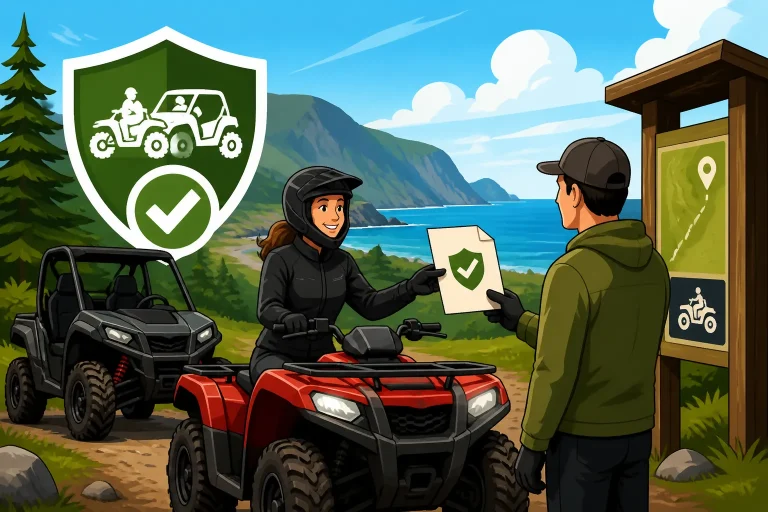
The sticker discussed here is a managed-trail marker. It relates to access on trails operated under Newfoundland and Labrador’s managed-trail system. It is not the same thing as the plate issued with your ATV or UTV registration, and it is not proof that you completed safety training.
Those requirements solve different problems:
| Item | What it relates to | What it does not replace |
|---|---|---|
| Registration plate and permit | The machine’s registration and identification | A managed-trail sticker or safety certificate |
| Managed-trail sticker or marker | Access requirements on applicable managed trails | Registration, insurance or training requirements |
| Safety certificate | Required safety training or proof of training, where applicable | Registration or the trail marker |
A machine that has a valid registration plate may still need the relevant trail marker for a managed trail. Likewise, having the marker does not authorize riding wherever you choose. Access rules depend on the trail and land, and may include restrictions that are separate from the sticker requirement.
The marker is generally obtained from a trail operator rather than through the same process as registering the machine. Check with the operator responsible for the trail you intend to use. If you are unsure which operator manages a particular route, Newfoundland Trail Operator Contacts can help you work out whom to ask.
It also helps to distinguish managed trails from other places where riding may be permitted. The sticker requirement is not a general substitute for checking access rules on Crown land, private land, roads, parks or other trails. A marker does not give permission to enter land that is closed or restricted, and it does not override a local bylaw. Before setting out, review [Newfoundland Crown Land Access Rules] and Newfoundland Municipal Road Bylaws if your planned route includes those areas.
The practical question is not simply “Do I have a sticker?” It is “Does this trail require its marker, do I have the right marker for the machine or ride, and can I produce it in an accepted way if asked?” Sorting that out before arriving at a trailhead avoids confusion when your machine is already unloaded.
Attach the sticker or carry it
For applicable managed-trail use, the marker may be attached to the machine or carried by the rider. That gives you a choice, but each option has practical trade-offs. The right choice depends on the sticker’s format, the machine’s surfaces and how you protect the marker from being lost or damaged.
When attaching it makes sense
Attaching the sticker can make it straightforward to keep with the machine. You are less likely to leave it in a different jacket or bag, and it is readily associated with the ATV or UTV it is being used for.
Before applying it, read any instructions supplied by the trail operator. Do not assume that every sticker can be placed anywhere or transferred between machines. If the operator specifies an attachment method or placement, follow that direction. If no location is specified, choose a clean, reasonably visible surface where the marker is unlikely to peel, scrape off or become covered during ordinary riding.
Avoid placing it where it could be hidden by mud, cargo, a cover or a passenger. A marker that is technically attached but difficult to find may slow down a roadside or trail check. It should also be kept away from surfaces that are unusually hot, oily or exposed to constant rubbing, since those conditions can damage an adhesive sticker.
Think about cleaning and maintenance, too. Pressure washing, solvents, repeated abrasion and harsh weather can affect a sticker. Check its condition before a ride, especially after a season in storage or a trip through wet, muddy terrain. If it is torn, unreadable or no longer stays attached, ask the operator what to do rather than relying on a damaged marker.
Some riders keep stickers on a particular machine for convenience. That does not automatically mean a marker can be moved freely to another machine, loaned to another rider or used for another season. Confirm the operator’s conditions for the marker you have. The fact that a sticker physically fits on another machine does not establish that it is valid for that use.
When carrying it is useful
Carrying the marker may suit a rider who does not want to stick it onto the machine, or who uses the machine in places where a sticker could be damaged. Keep it on your person in a secure, accessible place, such as a pocket or a small protective sleeve. A loose marker in a cargo box, storage compartment or trailer may not be as easy to produce when asked.
Protect it from moisture, dirt, tearing and loss. A small sleeve can help preserve the sticker, but it should not make the marker so difficult to retrieve that you cannot show it promptly. If the operator provides a specific way to carry it, follow that instruction.
Do not assume that one rider carrying a marker automatically covers every machine or every person in a group. Ask the trail operator whether the marker is issued for a machine, a rider or another defined use, and make sure the people in your group understand who must carry or display it. This is especially important when several people are riding different machines or swapping machines during a trip.
The marker should travel with the person or machine using it on the managed trail. Leaving it with the driver, in a parked vehicle or at camp can create a problem if another rider needs to produce it during the ride.
A simple decision table
| Situation | Practical option | What to check |
|---|---|---|
| You want the marker to stay with one machine | Attach it as directed by the operator | Placement, adhesion and whether it is valid for that machine |
| The machine’s surfaces make attachment awkward | Carry it securely on your person | Whether the operator accepts carried markers and who must carry it |
| The sticker is damaged or unreadable | Contact the trail operator before riding | Replacement or reissue procedure |
| You plan to switch machines | Confirm the marker’s terms first | Whether it can be transferred or needs to be issued for another use |
| You are riding in a group | Check each rider’s and machine’s requirements | Whether one marker covers only one person or machine |
If you want a quick rule of thumb, choose the method you can maintain and demonstrate reliably, then confirm that the trail operator accepts it for your marker. The operator’s instructions matter more than a general preference for sticking or carrying it.
How to get the marker and prepare for a ride
The trail operator is the practical starting point. Ask which marker applies to your intended route, how it is issued, and whether the marker must be attached or may be carried. Do this before departure, especially if you are travelling to a remote trailhead or riding during a busy period.
A short checklist can make the call or message more useful:
- Identify the managed trail or trail system you plan to use.
- Ask whether a trail sticker or marker is required for that route.
- Confirm where the marker is issued and what information the operator needs.
- Ask whether it is associated with a particular machine, rider or period of use.
- Confirm whether you may attach it or carry it, and whether there are placement instructions.
- Ask what to do if the marker is lost, damaged or already attached to another machine.
- Check whether separate safety-training proof or other documents must be carried.
Do not treat a marker from one operator as a universal pass for every managed trail. Trail access and operator arrangements can differ. If your itinerary crosses between trail systems, ask whether you need to contact more than one operator or meet different requirements along the way.
If you are a visitor bringing a machine from another province, out-of-province registration does not necessarily answer the managed-trail sticker question. Ask the operator about trail access for visiting riders and check Newfoundland’s 30-Day Visitor Exemption for the separate registration issue. The visitor exemption is about registration rules, not a blanket exemption from every trail condition. Visitors should also review Newfoundland Visitors Still Need Insurance and confirm other requirements that apply to their ride.
A machine rented from an operator or outfitter may have its own arrangements. Do not assume the sticker, registration, training or insurance questions are automatically handled just because the machine is rented. Ask the rental company what it supplies and what you are expected to carry. For a broader checklist, see [Newfoundland Rules for a Rented Machine].
If a dealer or another person has already placed a sticker on a used machine, check that it is still valid for your planned use. A sticker’s presence alone does not establish that it belongs with the current ride or that the operator accepts it. For a used machine, registration and ownership documents are separate matters; Newfoundland Transfer of Ownership Explained covers the change in registered ownership.
Keep the marker in good condition between rides. If it is attached, inspect it before loading. If you carry it, make sure it is still with you after changing outerwear, packing bags or swapping riders. A small pre-ride check is easier than finding out at the trail entrance that the marker is missing or unreadable.
What the sticker does not cover
A managed-trail sticker addresses a trail-access requirement. It does not settle every other question about whether you may ride, what equipment you need or which documents you must have with you.
It does not replace registration
Registration identifies the machine under the applicable registration system. The plate and registration permit are separate from the managed-trail marker. A registered ATV or UTV may still need the managed-trail marker to use a trail where it is required. Conversely, having a sticker does not make an unregistered machine legal to use where registration is required.
Keep the registration paperwork available as required, and make sure the plate is properly displayed and readable. The rules for the plate are different from where a trail sticker may be placed. See Newfoundland Permits, Plates and Decals for more on the distinctions.
It does not replace safety training
A sticker is not proof of rider training. Where training rules apply, riders may need a separate safety certificate or other accepted proof. Check the requirements for the rider’s age and circumstances, and carry proof as required. Newfoundland Safety Training Is Mandatory explains the training issue, while Carrying Your Safety Certificate on Every Ride focuses on having proof available during a trip.
This distinction matters when a group includes young riders. A parent or supervisor should not assume that a marker obtained for the trail also satisfies training obligations. Check each rider’s requirements independently.
It does not replace insurance or permission to ride
The marker does not establish that a machine is insured, nor does it grant permission to cross private land or use a closed route. Riders must still meet the insurance rules that apply and respect restrictions on land and trails. If a route crosses private ground, get permission where required. If it approaches a road, follow the applicable road-crossing and riding rules.
A trail sticker also does not authorize riding in a park or restricted area where machines are prohibited. Check signs, maps and current access information. If a managed trail connects with a different land type, do not assume the same access conditions continue beyond the managed section.
It does not settle every local rule
A town or community may have bylaws that affect where machines can travel. Trail operators can also set conditions for the trails they manage. These rules may apply alongside provincial requirements. Check the route from end to end, rather than relying only on the sticker or on what was permitted on a previous visit.
That is particularly important for routes involving roads, staging areas, private access roads or seasonal restrictions. An operator can clarify the marker requirement for its trail, but may not be able to approve riding on land managed by someone else.
Common mistakes and a practical pre-ride check
The most common sticker problems are not complicated. They usually come from treating the marker as interchangeable with another document, assuming it applies everywhere, or failing to keep it accessible.
Mistakes to avoid
- Confusing the marker with a registration plate. They serve different purposes, so one does not replace the other.
- Assuming a sticker is a general trail pass. Confirm that it applies to the managed trail you plan to use.
- Leaving a carried marker in the machine. Keep it with the person who needs to produce it.
- Transferring it without checking. Ask the operator whether a marker can be moved to another machine or used by another rider.
- Relying on a damaged sticker. If it is unreadable or will not stay attached, contact the operator.
- Assuming visitors are automatically exempt. Registration status and managed-trail access are separate questions.
- Forgetting other requirements. Registration, insurance, safety proof and land access rules may still apply.
- Waiting until the trailhead to ask. Contacting the operator beforehand is especially useful when travel or unloading takes time.
Before leaving home, check the marker, registration documents, insurance proof and any required safety certificate. Confirm that each rider knows whether the marker is attached or carried and who is responsible for keeping it accessible. Then verify the access rules for the route, including any local restrictions or closures.
A compact checklist is useful when several machines are travelling together:
| Before loading | Before entering the trail |
|---|---|
| Confirm the trail requires the marker | Make sure the marker is attached or carried as accepted |
| Check the operator’s current instructions | Ensure the marker is readable and accessible |
| Confirm marker use for each machine or rider | Carry separate registration and required safety proof |
| Check registration and insurance documents | Follow posted signs and route restrictions |
| Ask about damaged or missing markers | Do not ride beyond the permitted route |
For a group ride, assign responsibility clearly. Each rider should know where their marker is and whether it must be shown. A quick check at the staging area can catch a missing sticker before the group spreads out on the trail.
If an officer or trail representative asks to see the marker, produce it calmly and follow the instructions given. If you are carrying it, retrieve it from your person rather than rummaging through a trailer or asking another rider to go back to camp. If the marker is attached, make sure it has not become hidden under mud or cargo. And if you are uncertain whether your marker applies to that route, ask the operator before riding rather than treating the uncertainty as permission.
Frequently Asked Questions
Can I carry the Newfoundland trail sticker instead of attaching it?
For applicable managed-trail use, the marker may be attached to the machine or carried by the rider. Confirm the operator’s instructions for your particular marker and keep it secure and accessible.
Is the sticker the same as an ATV registration plate?
No. The registration plate and permit relate to the machine’s registration. The managed-trail sticker relates to trail access requirements. One does not replace the other.
Does a trail sticker let me ride anywhere in Newfoundland?
No. It does not grant general access to private land, restricted areas, roads or closed trails. Check the rules that apply to every part of your route.
Do visitors with an out-of-province machine need to ask about a sticker?
Yes, if they plan to use a managed trail where a marker is required. Out-of-province registration and visitor exemptions do not automatically answer the separate trail-marker question. Confirm with the trail operator.
Disclaimer
This article is for general informational purposes only and does not constitute professional advice. Laws, prices and regulations vary by location and change over time. Consult a qualified professional for guidance on your specific situation.