Riding an Exposed Ridge in Heavy Wind
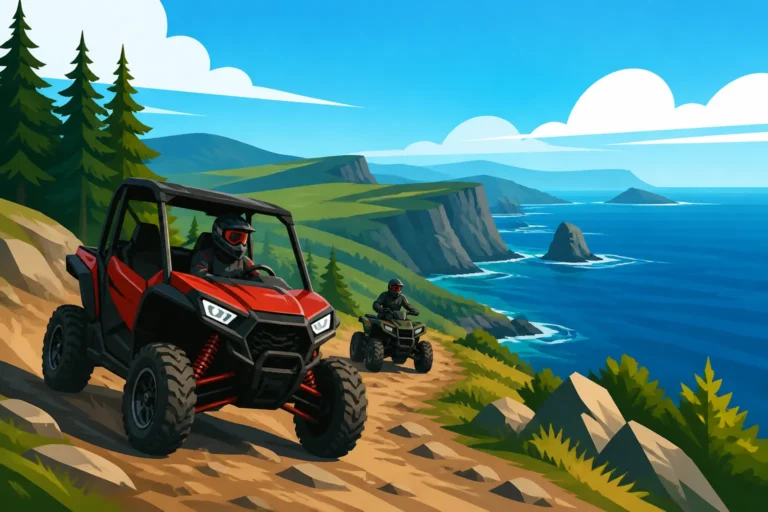
A gust can shove an ATV sideways on an exposed ridge before you have time to react, and a UTV’s larger profile can catch even more wind. Newfoundland’s barrens and open high ground can feel very different from sheltered trails below. This guide explains how to assess the conditions, prepare your machine and group, and decide when turning back is the safest choice.
Why heavy wind is a serious risk on an exposed ridge
Wind affects balance and control
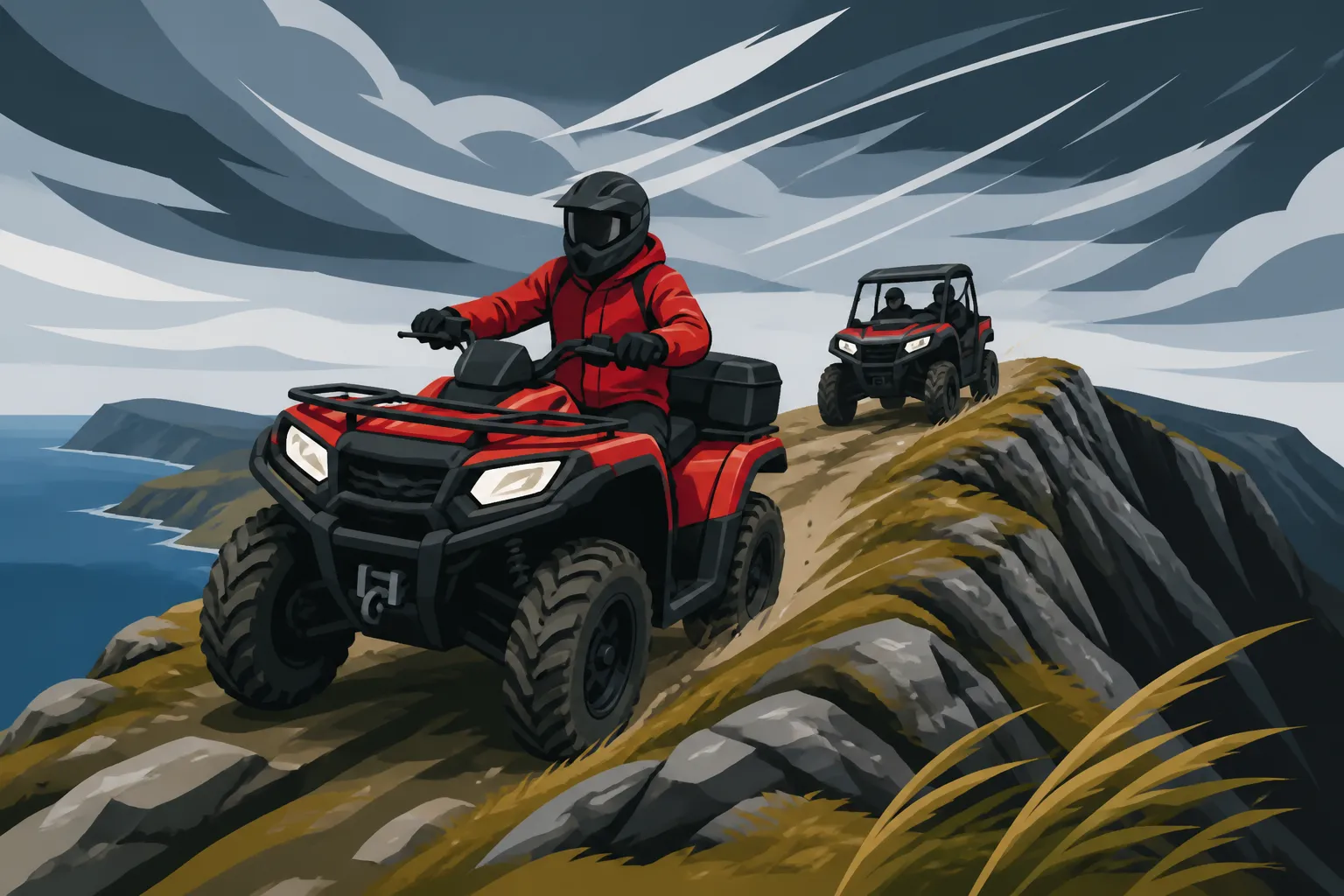
On a ridge, there may be little shelter between you and the wind. A steady crosswind can push a machine off its line, while a sudden gust can catch you during a turn, on a side slope, or as you pass an exposed gap. Loose gravel, wet rock, shallow ruts, and uneven ground make it harder to recover smoothly.
An ATV is relatively narrow, but that does not make it immune to wind. The rider is exposed, and a sudden push can affect steering and balance. A UTV has a broader profile, and its cab or windshield can catch the wind like a sail. The response depends on the machine, its load, the direction of the gust, and the ground beneath the tires.
The danger is not just being blown over. Wind can make it harder to hold a safe line, see clearly through blowing rain or dust, hear your riding partners, and stop where you intend. If a gust arrives while you are near an edge or navigating a narrow section, there may be little room to correct.
Ridges and barrens can hide changes in exposure
A trail that feels manageable in a sheltered hollow may become much more demanding as it climbs onto open ground. The wind can also change direction around a ridge, so a route that was into the wind on one side may become a crosswind or tailwind on another. A tailwind can feel easier, but it may make your speed harder to judge and can still affect control.
Newfoundland’s open barrens, coastal areas, and higher ground deserve extra attention when the forecast is unsettled. Fog, rain, and poor visibility can arrive alongside wind, leaving you with fewer visual clues about the trail ahead. For more on visibility issues in exposed terrain, see Fog on an Exposed Barren and Packing for Weather That Changes Every Hour.
Do not assume that a nearby tree line or dip will provide reliable shelter for the whole route. Conditions can vary over a short distance, and the most exposed part may be beyond the point where turning around is easy. Check Newfoundland Trail Conditions Before You Ride before setting out, and treat recent trail reports as helpful context rather than a guarantee of what you will encounter.
A group can make the decision harder
People often feel pressure to keep going when they have driven a long way to reach a trail, planned a group outing, or already climbed partway up a ridge. That pressure is understandable, but it should not decide whether the route is safe. A rider who is uneasy about the wind may be noticing a real change in conditions, not being overly cautious.
Groups also move at different speeds. A rider who is comfortable on an exposed section may not notice that someone behind them is struggling to hold a line. Agree in advance that anyone can call for a stop or a retreat, and that the group will respond without arguing on the trail.
If conditions make it difficult to communicate, maintain safe spacing, or keep track of every rider, the route is already asking too much of the group. Make the decision while you still have room to stop safely.
Prepare before you reach exposed ground
Check the forecast for the route, not only the town
A forecast for a nearby community may not describe the wind on an open ridge. Look at the expected wind direction and gusts, and consider how those conditions may affect the route you plan to ride. Coastal weather can shift, and the wind at a trailhead may not match what you meet at higher or more exposed ground.
Check the forecast shortly before departure and again when practical during the outing. Pay attention to rain, fog, temperature, and visibility as well as wind. A day with moderate wind can still become uncomfortable or risky if the surface is wet, visibility falls, or the group is getting cold and tired. The guide Checking the Marine Forecast Before You Ride offers another useful reminder: conditions near the coast can change the feel of a ride quickly.
If you use a digital map tool such as onX Offroad for planning, use it to understand the general route and identify possible alternatives, not to decide whether a ridge is safe in the moment. Confirm access and trail status through appropriate local information, and do not assume a mapped line is open or suitable for every machine.
| Before the ride | What to check | Why it matters |
|---|---|---|
| Wind | Direction, strength, and gusts | Crosswinds and sudden gusts can affect balance and steering |
| Visibility | Fog, rain, and low cloud | Poor visibility makes exposed terrain and trail edges harder to read |
| Trail status | Recent closures, damage, or reports | Conditions can change after weather or maintenance |
| Route options | Sheltered alternatives and safe turnaround points | A plan B is useful if the ridge becomes uncomfortable |
| Group readiness | Experience, equipment, and communication | The route should suit the least prepared rider |
Plan a route that allows you to turn back
Before leaving, identify the exposed sections and think about where you could stop or retreat without blocking other riders or putting anyone near a drop-off. A route plan should include a realistic alternative, such as returning by the way you came or choosing a lower, more sheltered section. Do not rely on improvising a detour once you are already on a ridge.
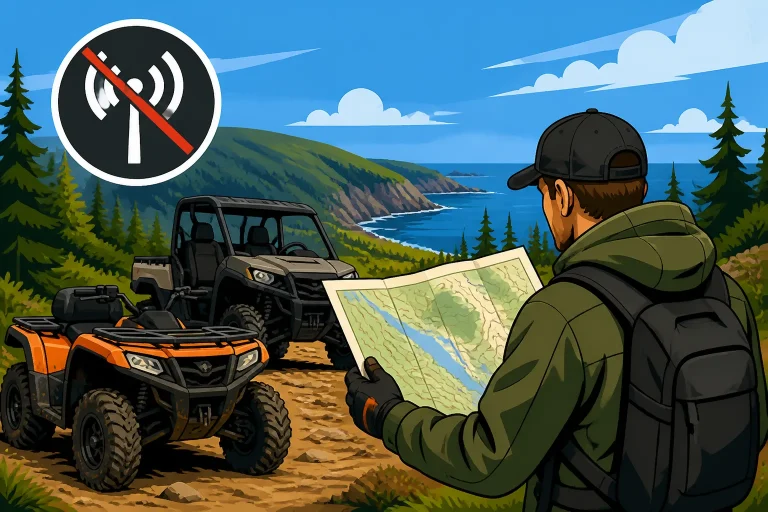
A mapping app, including onX Offroad, can help you review your intended route before departure. If you use digital maps, make sure you can access the information where mobile service is weak, and carry a paper backup when appropriate. A mapped trail does not tell you how strong the gusts feel at a particular bend, whether a surface has become slick, or whether a route is currently closed. Newfoundland ATV Trail Map Downloads and Carrying a Paper Map Where There Is No Signal can help with route-planning habits.
Share your plan with someone who is not riding with you. Include the general route, who is in the group, and when you expect to check in. This is a basic precaution, not a substitute for changing plans when the weather turns.
Secure gear and prepare the machine
Loose cargo can shift when a machine is buffeted by wind, and items that come free may distract or endanger the group. Secure bags, coolers, covers, and tools before riding. Avoid stacking bulky cargo high or wide when you can pack it more compactly. A load that changes the machine’s balance can make rough terrain and crosswinds harder to manage.
Check tires, steering, brakes, and the condition of your machine before leaving. Make sure your helmet is secured and that your clothing is suitable for wind, rain, and a sudden drop in comfort. A cold rider may become less attentive and less coordinated, especially during a long, exposed stretch.
In a UTV, secure doors, windows, and loose items according to the machine’s instructions. Do not assume that a cab eliminates the risk: it may reduce direct exposure to weather, but the vehicle can still be affected by gusts, and a windshield or side panel can catch the wind. Carry the protective equipment your machine and the conditions call for, and review Newfoundland ATV Trails: The T’Railway and Beyond for a broader look at riding options that may offer different terrain and exposure.
How to ride when wind increases
Slow down before the exposed section
Reduce speed while you still have room and control, rather than waiting until a gust surprises you. A slower pace gives you more time to respond to changing conditions and makes it easier to stop smoothly. Keep your hands positioned for steady control and avoid sharp steering or sudden braking, particularly on loose or uneven ground.
Choose a line that leaves you room away from the edge, while still staying on the permitted trail. Do not ride onto soft ground or vegetation to avoid a gust; that can damage the terrain or create a different loss-of-control hazard. If the trail narrows, slopes toward an edge, or becomes difficult to read, stop at a safe location before the difficult section rather than trying to assess it while moving.
Keep enough distance from the machine ahead to respond if it slows or stops. At the same time, do not let the gap become so large that you lose sight of the group in fog or blowing rain. Agree on a simple way to signal a stop, and use it early.
Avoid passing, stopping, or turning in risky places
Do not attempt to pass another machine on a narrow, exposed section in heavy wind. A passing maneuver takes space and can require sudden steering changes at precisely the moment the wind is making control less predictable. Wait for a broad, stable, sheltered area—or do not pass at all.
If you need to stop, choose a place away from edges, steep side slopes, and unstable ground. Park only where the machine can be left securely and where other trail users have room to pass. Avoid stopping at the crest of a ridge or just beyond a blind bend, where another rider may not see you in time.
Turning around can be more hazardous than continuing a short distance to a safe turnaround point. Do not attempt a tight turn on a slope or beside a drop simply because you have decided to retreat. Move only as far as needed to reach a suitable place to turn, and keep the group together. If that cannot be done safely, pause and reassess rather than rushing.
Keep communication and group spacing simple
Before the ride, agree on a lead rider, a sweep rider at the back, and a plan for stops. The lead should not move so far ahead that the group loses contact, and the sweep should be able to report if a rider is falling behind. In heavy wind, verbal communication may be difficult, so use agreed hand signals or stop in a sheltered location to discuss the next move.
A map app such as onX Offroad can be one part of your navigation plan, but do not make it your only way to communicate or find your way. Keep your group’s route understandable to everyone, and make sure each rider knows the retreat option. If the group becomes separated, wind, fog, and noise can make it harder to locate one another.
Good trail manners matter when you stop or change plans. Leave room for other riders, do not block a narrow trail, and avoid creating a new route around a difficult section. Newfoundland Trail Etiquette Locals Expect is a useful companion for thinking about shared trail use.
When to turn back and what to do next
Treat these signs as reasons to stop or retreat
Turn back or choose a safer route if gusts repeatedly move your machine off its intended line, you cannot keep a steady pace, or you feel you are making corrections with little room to spare. The same applies if a rider in the group is tense, struggling to control their machine, or asking to stop. Do not wait for a near miss to confirm that the route is too demanding.
Poor visibility is another clear warning. If fog or rain hides the trail ahead, makes it hard to see other machines, or obscures edges and hazards, continuing may leave you without enough information to ride safely. Likewise, if you cannot communicate reliably or keep the group together, pause in a safe spot and reconsider the plan.
Avoid treating a forecast threshold as a universal go-or-no-go rule. The effect of wind depends on the terrain, machine, rider, load, visibility, and surface. A route that may be manageable in one set of conditions can become unsafe when gusts combine with slick ground or fatigue. Your judgment should account for the whole situation, not just one number.
Make retreat an ordinary part of the plan
Turning around is not a failure or a wasted trip. It is a practical decision that preserves the option to ride another day. When you retreat, move calmly, keep the group together, and use the safest known route. Do not take an unverified shortcut simply because it appears sheltered on a map.
After returning to a safe location, check that everyone is warm, alert, and uninjured. Reassess whether to end the ride or choose a lower, less exposed route. If conditions continue to worsen, call the outing rather than searching for a different ridge to try.
Once the ride is over, note which parts of the route were exposed and what conditions changed your decision. You can use those observations when planning future trips, while remembering that the same route may behave differently on another day. Check for official closures or route changes before returning; Newfoundland Trail Closures After a Storm explains why conditions and access can change after severe weather. If you use onX Offroad or another navigation tool, update your plan with what you learned, but continue to confirm local access and conditions separately.
A conservative decision is especially worthwhile on open ground: if the wind makes you question whether you can control the machine, choose shelter or turn back before the trail removes your options.
Disclaimer
This article is for general informational purposes only and does not constitute professional advice. Laws, prices and regulations vary by location and change over time. Consult a qualified professional for guidance on your specific situation.