Where a Ten-Machine Group Can Unload Safely
A ten-machine ride can become stressful before anyone reaches the trail if the group arrives to find a narrow pull-off, nowhere to turn around, or trailers blocking other users. This guide explains how to choose and confirm a safe Newfoundland unloading area, plan space for the whole convoy, and avoid treating a map pin as permission to park or ride.
Start with the right kind of unloading area
Look beyond a convenient map pin
A spot that looks open on a map may be a private driveway, an active work area, a soft shoulder, or a small turnout that fits only one truck. For a group of ten, the question is not simply whether a machine can be unloaded there. You also need room for trucks, trailers, people moving around, and the other trail users who may arrive while you are organizing.
Start with the trail you intend to ride and identify possible staging areas along the route. The T’Railway has access points in communities such as Port aux Basques, Corner Brook, Gander, and Clarenville, but a nearby town name or trail crossing does not confirm that a particular spot is suitable for a large group. Check the exact location, the approach road, signs, and any local access restrictions before making it your meeting point.
Mapping tools such as onX Offroad can help you compare possible routes and locations while planning. Use them as a starting point, not as proof that a site is open, public, or large enough for your convoy. Confirm access with the relevant trail operator, land manager, municipality, or property owner. For more background on selecting and preparing a staging area, see Where a Ten-Machine Group Can Unload Safely and Newfoundland Trailheads With Trailer Parking.
Think about the whole convoy, not just the ATVs
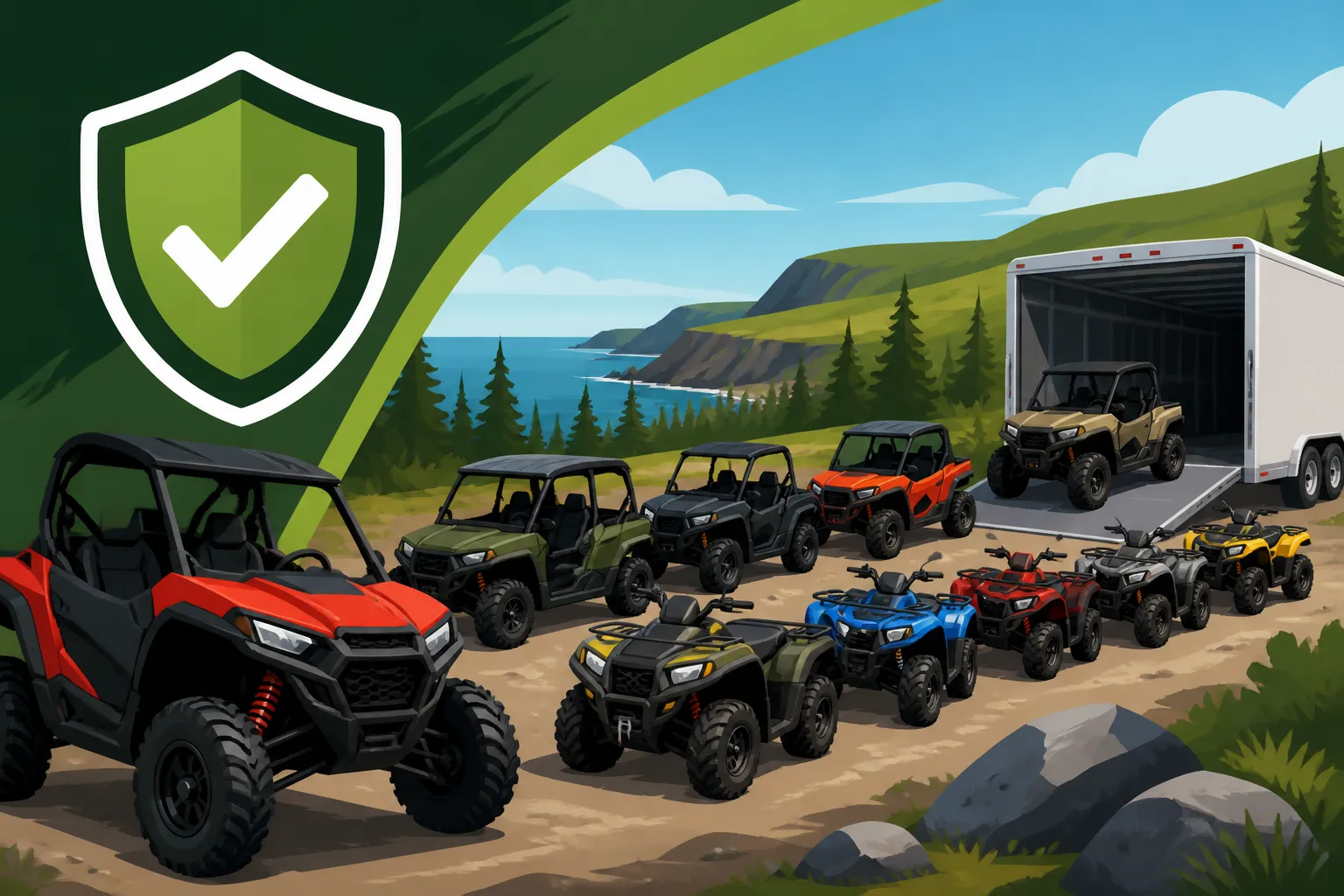
Ten machines can mean ten trailers, a mix of trucks and trailers, or a few vehicles transporting several machines. Each arrangement has different space needs. A truck pulling a long trailer may need a wider turning area than a pickup carrying a machine in its bed, and a vehicle that can pull into a spot may not be able to turn around safely once it is there.
Before choosing a location, estimate how many tow vehicles and trailers will arrive. Ask whether drivers can park without blocking an entrance, road, trail gate, or emergency access. Check whether there is enough room to unload one machine at a time without people stepping into moving traffic or standing behind vehicles that are backing up.
If the group has a mix of trailer lengths or drivers with different levels of towing experience, plan the arrival order in advance. The longest trailers or least experienced drivers may benefit from arriving while the area is quiet, with a designated spotter ready to guide them. Avoid assuming that everyone can simply “fit somewhere” when they get there.
Confirm permission, capacity, and access before the ride
Contact the person who manages the site
A location can be physically usable but still be off-limits for parking, unloading, or organized group staging. Before settling on a plan, contact the organization or person responsible for the area. Depending on the location, that may mean a trail operator, community council, town office, landowner, or provincial authority.
Be specific when you ask. Explain that the group has ten machines, how many tow vehicles and trailers you expect, when you plan to arrive, and how long you expect to leave vehicles parked. Ask whether there is a designated staging area, whether group use is allowed, and whether any construction, maintenance, seasonal closure, or local event could affect access. A general question such as “Can we ride here?” may not answer whether you can safely unload a large convoy.
Keep a record of the response and any directions you receive. If the answer is unclear, ask for clarification rather than assuming that silence or a map listing means permission. The guidance in Emailing a Trail Operator Before You Ride and Asking a Town Office Whether a Street Is Open can help you frame those questions.
Confirm every part of the route to the staging area
A suitable unloading spot is only useful if the convoy can reach it safely. Check the approach for narrow roads, steep grades, tight turns, low-clearance obstacles, soft shoulders, and places where a long vehicle cannot pass or turn around. A route that is fine for a single ATV may be awkward or unsafe for several trucks towing trailers.
Confirm that the access road is appropriate for the vehicles you are bringing, and check any posted restrictions at the entrance. If a road passes through private land, ask who has authority to grant access and whether permission covers both travel and parking. A gate or open-looking track is not an invitation to enter. For land-access questions, see Permission From a Landowner Before Crossing Private Ground.
Plan a backup location as well. If the primary area is occupied, closed, or too muddy to use, the group should know where to go instead. Do not improvise by spreading vehicles along a narrow roadside or leaving trailers where they obstruct a trail entrance. A backup is useful only if its access and permission have also been checked.
| What to confirm | Why it matters for ten machines | A practical check |
|---|---|---|
| Parking and unloading permission | A usable-looking area may not allow group staging | Ask the manager, operator, municipality, or landowner |
| Space for tow vehicles and trailers | Trailers need room to park, turn, and unload | Estimate vehicle count and trailer lengths before arrival |
| Clear entrance and turning room | A convoy can block a road or become stuck while reversing | Check the approach and turning area in daylight |
| Safe separation from trail traffic | People and machines may move through the staging area at once | Identify a place to unload away from the active trail |
| Ground conditions | Wet or soft ground can rut, bog down vehicles, or make loading difficult | Check recent conditions and have a backup plan |
| Emergency access | Parked vehicles must not block responders or maintenance vehicles | Keep gates, access roads, and marked routes clear |
Organize the unloading process as carefully as the ride
Assign roles before the first trailer arrives
A large group is easier to manage when everyone knows their job. Choose one person to coordinate the parking layout, another to guide vehicles backing into position, and a ride leader to manage the machines once they are unloaded. The spotter should stand where the driver can see them and stay out of the vehicle’s path. If the driver loses sight of the spotter, the driver should stop rather than keep reversing.
Agree on a simple arrival order and parking arrangement before leaving home. For example, the first vehicles can move to the far end of the designated parking area so later arrivals do not have to squeeze past loaded trailers. Keep a lane open for vehicles that need to enter or exit, and avoid parking in front of gates, signs, trail entrances, or nearby homes and businesses.
Do not start unloading all ten machines at once. Bring vehicles into position, secure them, and unload in a controlled sequence. Riders should keep children, passengers, and anyone not helping well away from reversing vehicles and trailer ramps. Once a machine is off its trailer, move it to the agreed waiting area rather than letting it idle or gather around the unloading zone.
Keep the staging area clear and low-impact
A trailhead or roadside turnout may be shared with walkers, cyclists, local residents, maintenance crews, or other riders. Keep machines and trailers within the area where parking is allowed. Do not block the route to the trail or leave vehicles across an entrance while the group gets organized.
Use a firm, stable surface whenever possible. Avoid soft ground, wetland edges, and vegetation that could be damaged by repeated turning or trailer wheels. If the ground is saturated, do not try to make the area work by driving across a grassy shoulder or creating a new pull-off. That can leave ruts and make access worse for everyone who follows.
Before the group departs, do a quick walk-around. Check that ramps, tie-downs, tools, and other equipment are secured in parked vehicles; that no one has left debris behind; and that emergency access remains clear. For broader planning on arrival, departure, and group conduct, review Newfoundland Group Ride Planning and Newfoundland Trail Etiquette Locals Expect.
Plan for Newfoundland conditions and verify the riding rules
Build a weather and ground-condition check into the plan
A location that was firm and easy to use on a dry day can become slippery or soft after rain. On Newfoundland’s exposed and changeable terrain, weather may also affect visibility, road conditions, and the group’s ability to unload safely. Check conditions close to departure, not only when the ride is first planned.
If the access road or staging area is wet, muddy, or crowded, be willing to postpone or use the backup location. A heavy truck and trailer can damage soft ground quickly, and getting stuck at the start of a ride can put the whole group behind schedule. The pressure to “make it work” is understandable when everyone has travelled to meet up, but a poor unloading decision can create a safety problem before the ride begins.
Mapping apps such as onX Offroad can be useful for reviewing a planned route and locating possible alternatives, but confirm current access and site conditions through the people who manage the area. A map may help you see where a road or trail appears to go; it does not settle whether a group can park there, whether the route is open, or whether a machine is permitted on it. For practical preparation around changing conditions, see Newfoundland Trail Conditions Before You Ride.
Separate parking approval from permission to ride
Permission to park and unload does not automatically mean the machines may ride every trail, road, or Crown land route nearby. Check the rules for the riding area itself, including whether the route is approved, whether a managed trail sticker is required, and whether any seasonal or local restrictions apply. The starting point and the riding route are related, but they are separate questions.
If your route includes the T’Railway or another shared corridor, plan for other users and be ready to adjust your pace or stop where needed. Confirm that the machines in your group are allowed on the intended route and that each rider has the required documents, equipment, and proof of compliance. Helpful background includes Newfoundland Approved and Restricted Areas and Managed Trails Require a Sticker on Your Machine.
A reliable plan for a ten-machine group is specific: confirm a permitted staging location, make sure it can handle your vehicles and trailers, check the access route and ground conditions, assign unloading roles, and keep a backup ready. Doing that work beforehand can spare the group from awkward roadside maneuvering and help keep the trailhead safe and welcoming for everyone.
Disclaimer
This article is for general informational purposes only and does not constitute professional advice. Laws, prices and regulations vary by location and change over time. Consult a qualified professional for guidance on your specific situation.