Newfoundland Riding in Fall Hunting Season
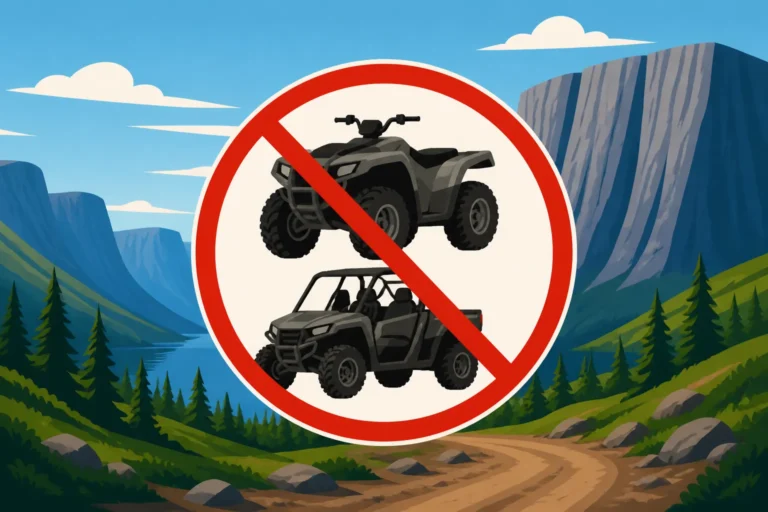
Fall riding in Newfoundland can turn a familiar trail into a busier, less predictable place: hunters may be travelling before daylight, visibility can drop quickly, and access rules may differ between a managed trail, Crown land and private ground. This guide explains how to plan an ATV or UTV ride around hunting activity, check your route and share the land safely.
Plan your Newfoundland ride around hunting activity
Check the season, area and access rules before leaving
“Fall hunting season” is not one set of dates that applies everywhere. Openings, closures and permitted activities can vary by species, management area and year. Before you load the machine, check the applicable hunting information and land-access rules for the exact area you intend to ride. A route that was open on a summer trip may be affected by a seasonal restriction, a local closure or a landowner’s conditions.
Start with the route, not just the destination. If you are heading toward a cabin road, a trailhead or a stretch of the T’Railway, identify the access point and the land you will cross. The province’s approved and restricted areas are not interchangeable, and a line on a recreational map does not necessarily establish that riding is permitted there. [Newfoundland Crown Land Access Rules] can help you understand why checking the land designation matters.
Also check whether your trip crosses private land. A woods road may look like a public trail, but that appearance is not permission to ride. Ask the landowner or responsible trail operator where access is allowed, and respect signs, gates and closures. If you are uncertain about a particular stretch, choose a route you can confirm rather than hoping to sort it out from the machine.
This matters especially in fall, when hunters may be walking in from a road, using a trail to reach a hunting area or transporting equipment. A route used by riders in August could be much busier in October. Give yourself time to check current notices, talk with local trail contacts where appropriate and make a backup plan.
Make the route manageable for shorter days and rougher weather
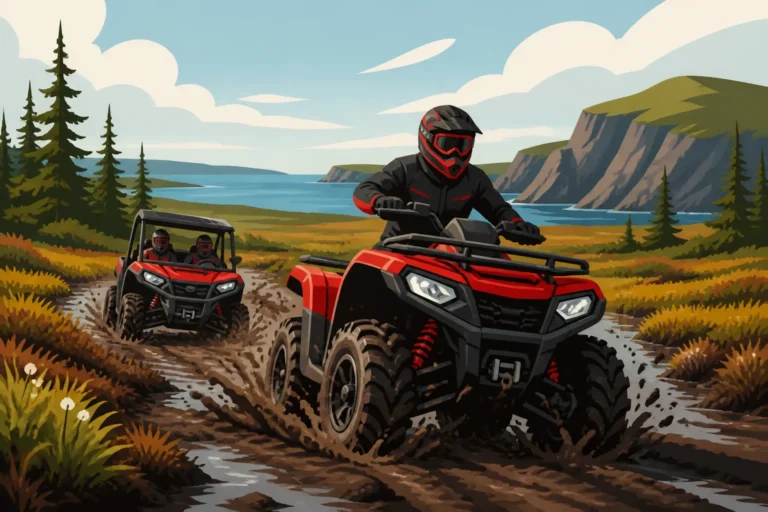
Fall conditions can change the character of a familiar ride. Rain can soften trail surfaces, fog can make an exposed section hard to read, and wet leaves or mud can hide rocks, ruts and drainage cuts. Temperatures may feel comfortable at the trailhead and much colder once you are moving through wind or stopping for a repair.
Build your day around the amount of usable daylight, rather than the distance you hope to cover. A group that plans a long loop late in the afternoon can end up returning in poor light, tired and rushed. Set a turnaround time before departure and stick to it, even if the group has not reached its intended destination.
Check more than one kind of information when planning. A map app such as onX Offroad can help you review a route and prepare a map for areas with weak cell coverage, but it should not be treated as proof that every line is legally open or passable. Compare your planned route with official access information and local notices, and carry a paper map or written route notes as a backup. [Newfoundland Trail Conditions Before You Ride] is a useful companion when weather or recent trail conditions could change your plans.
Leave your route and expected return time with someone who is not riding with you. Tell them where you expect to unload, which area you plan to cover and when they should check in if you have not returned. This simple step is easy to skip on a familiar outing, but it can make a difference if a machine breaks down or a group gets delayed.
Share trails thoughtfully with hunters and other users
Slow down where people may be walking or working
A hunter may be on foot just beyond a bend, near a pullout or crossing a trail with equipment. A person walking quietly can be difficult to spot until you are close, especially in brush, fog or low light. Approach blind corners and trail junctions at a speed that lets you stop safely. If you see people ahead, ease off early, give them room and wait until you can pass without creating pressure.
Do not assume that an empty trail is still empty around the next bend. In busy areas, riders may encounter hunters travelling in the opposite direction, vehicles parked near an access point, or people loading gear beside a road. Be especially careful near trailheads, woods-road intersections and places where sightlines are short.
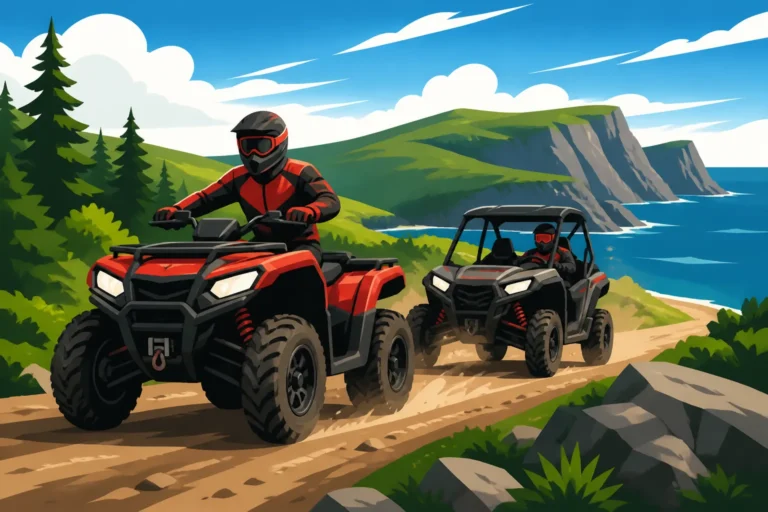
A group ride needs a little extra coordination. Keep enough space between machines to avoid dust, spray and sudden braking. Agree on a hand signal or another simple way to alert the group to a stop or hazard, and make sure the last rider knows when the group changes direction. If one rider stops, the people behind should stop in a safe place too, rather than bunching up in the middle of a shared route.
Respect quiet, private and work areas. Avoid revving engines near cabins, homes or parked vehicles, and never use a gate, marked access or hunting setup as an improvised turnaround. The guidance in [Riding Etiquette on a Shared Railbed] also applies to mixed-use routes: be predictable, keep control of your machine and make room for other users.
Keep your machine and group easy to see
Visibility is not just a question of headlights. Check that your machine’s required lamps and reflectors are clean and working, and use appropriate lighting when conditions call for it. Mud, dust and road spray can cover a plate or light without you noticing. Stop somewhere safe to clear anything that has become obscured. [Newfoundland Lighting Requirements on a Machine] explains why working lights matter when riding conditions become dim.
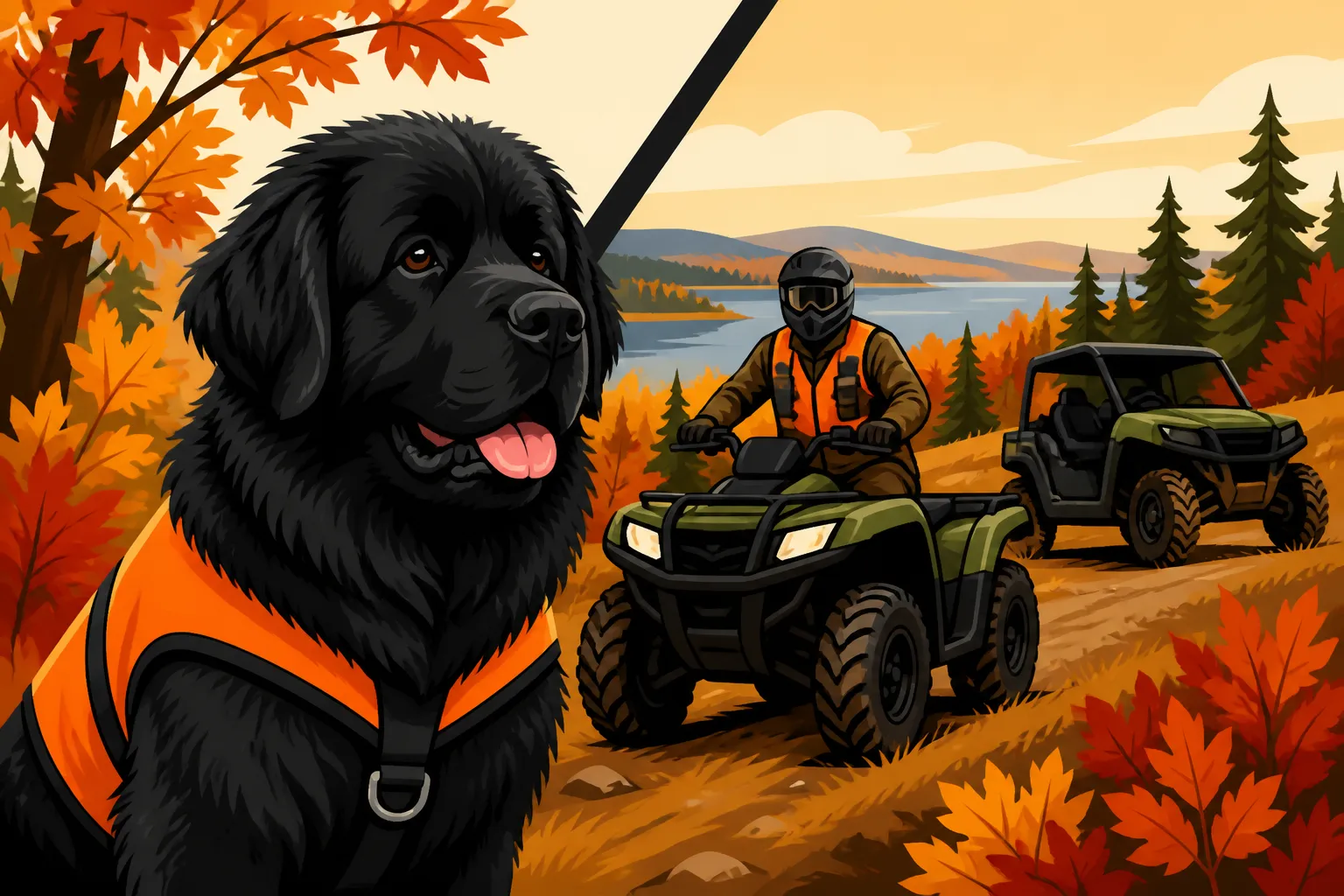
Wear conspicuous outer layers when practical, particularly if your route passes through areas where people may be hunting. Bright clothing does not replace safe riding or a proper helmet, but it can make you easier to distinguish from the background. Do not rely on clothing colour alone: keep your speed controlled and be ready to stop whenever visibility is limited.
Carry a charged phone, but do not assume it will work everywhere. Some sections of the railbed and remote riding areas have weak or no signal. Tell your group what to do if riders become separated, and agree on a clear meeting point rather than having everyone continue in different directions looking for one another. A paper map and an offline route plan provide useful backup when mobile coverage disappears.
If you come across a hunting party, parked vehicle or active work area, give people space and follow any posted directions. Do not ride close to equipment, animals or people to get a better look. If the route is blocked or feels unsafe, turn around or use a confirmed alternative. A few extra kilometres are preferable to forcing a pass in a place with poor visibility.
Prepare your ATV or UTV for a fall outing
Do a practical pre-ride inspection
A fall pre-ride check should cover the basics as well as anything the season makes more likely. Look over tires, wheels, brakes, steering, controls, belts, battery connections and fluid levels. Test the lights and make sure mirrors or other visibility equipment are clear and secure. Remove mud from the plate and any lighting surfaces before departure, then check again after riding through wet ground.
Think about the route when deciding what to carry. A short ride near a community and a remote loop across exposed terrain call for different levels of preparation. At a minimum, consider carrying a first-aid kit, basic tools, a tow strap, a charged phone, warm layers, rain protection, water and food. A spare belt may be useful for some machines, but check your owner’s manual and know how to use the tools you bring. Carrying gear without knowing how to use it is not much of a backup plan.
Fuel planning deserves attention in fall. Do not calculate fuel only for the distance shown on a map; mud, slow going, cold starts, detours and idling can all change consumption. Start with a full tank when practical, identify fuel options before leaving and keep a reserve for an unexpected delay. If a route depends on a particular service being open, confirm that before you count on it.
| Fall riding concern | What to check before departure | Safer riding response |
|---|---|---|
| Low light or fog | Weather, daylight, lamps and reflectors | Slow down, increase following distance and turn back if you cannot see far enough to stop |
| Wet or damaged trail | Recent notices, drainage, ruts and alternate routes | Avoid pushing through a section you cannot assess safely |
| Weak cell coverage | Offline map, paper notes and check-in plan | Stay with the group and use the agreed meeting point |
| Hunting activity | Area-specific access information and local notices | Give people room, reduce speed and follow posted directions |
| Cold rain or wind | Dry layers, gloves and weather protection | Stop before anyone becomes chilled or too tired to ride safely |
Keep required documents and equipment in order
Before riding, check the requirements that apply to your machine, the area and the people in your group. Registration, safety training, insurance, trail stickers and proof carried while riding may all be relevant, depending on the situation. Requirements can differ for visitors, young riders and machines using managed trails. [The Trail Sticker and Training Proof Newfoundland Requires] is a helpful place to start when checking those obligations.
Keep documents protected from rain and easy to produce if needed. You might use a waterproof pouch in a secure compartment, but make sure the pouch does not interfere with controls or safe storage. If you are riding with others, do not assume the group leader has all the required information for every machine and rider.
Families should discuss rules before setting out, not while a child is already waiting beside a running machine. Confirm that any young rider meets applicable age, training, supervision and machine requirements. A child passenger also needs a suitable seat and must be able to ride safely according to the machine’s design and the rules that apply. The age and supervision details are covered in [Newfoundland Supervision Rules for Young Riders].
If you are visiting Newfoundland with a machine registered elsewhere, check how long the visitor rules allow you to ride before registration requirements change, and confirm that your insurance and documents are suitable for the trip. Do not assume that being allowed to visit means every trail or road is open to you. [Newfoundland Visitor Rules and the 30-Day Limit] explains the visitor issue, while [Newfoundland Insurance Proof on the Trail] is relevant to carrying evidence of coverage.
Make a safer plan for the day
Use a simple ride-day routine
A reliable routine takes only a few minutes and prevents a lot of avoidable confusion. Before starting, confirm that every rider knows the route, the expected return time and the plan if someone has a mechanical problem. Pick a lead rider and a sweep rider, and agree that nobody leaves a stop or junction without checking that the rest of the group is accounted for.
At each stop, take a moment to check conditions. Is the weather closing in? Has the trail become wetter or more damaged than expected? Is anyone cold, tired or uncomfortable? A quick conversation can reveal a problem before it becomes a difficult decision on a remote section. If the group has mixed experience levels, set the pace for the least experienced rider rather than letting the fastest person dictate the day.
Be willing to shorten the route. On a clear morning near Gander, a planned loop might feel straightforward; by late afternoon, rain, fog or a mechanical issue can make the return more challenging. The same principle applies around Corner Brook, the Avalon, the Bonavista Peninsula and other parts of the island: local conditions can vary substantially, so a plan that includes a sensible exit route is stronger than one that depends on everything going perfectly.
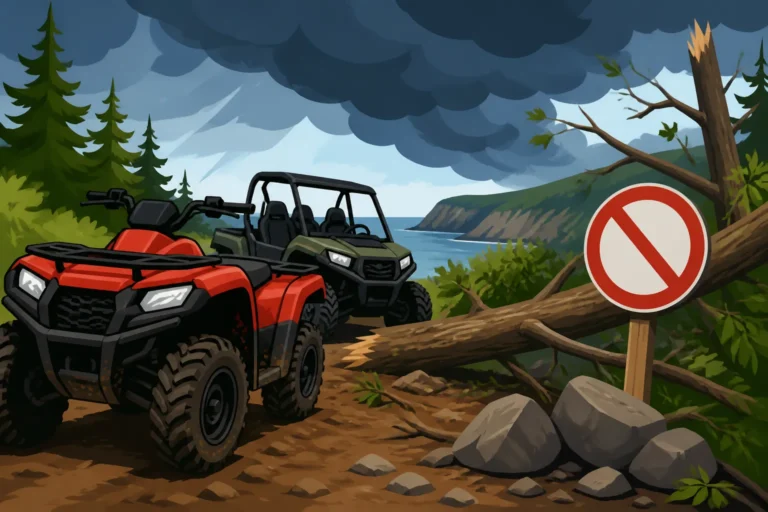
If you encounter a closure, a blocked route or an area where access is unclear, do not ride around a barrier or invent a detour through land you have not confirmed is open. Turn back, contact the relevant operator or land manager when possible, and note the location for future planning. [Newfoundland Restricted Area Permissions] can help clarify why a trail or area may have limits even when nearby routes remain accessible.
Know when to postpone, reroute or stop
There is a difference between a ride that is uncomfortable and a ride that has become unsafe. A light shower may be manageable with good gear and a suitable route. Dense fog, a rising water crossing, deep mud, poor visibility, a machine with failing brakes or a rider who is becoming exhausted should change the plan immediately.
Set decision points before you go. For example, agree that the group will turn around if visibility falls below what is needed to stop safely, if a trail becomes badly rutted, or if the weather makes the return route uncertain. These are not signs of a failed trip. They are ordinary risk decisions, especially when seasonal hunting activity and fall weather bring more variables into the day.
A useful check is to ask whether you would still choose the same route if you were starting from the trailhead at that moment. If the answer is no, do not keep going simply because you have already travelled partway. Turn around while the group is together and has enough daylight to return calmly.
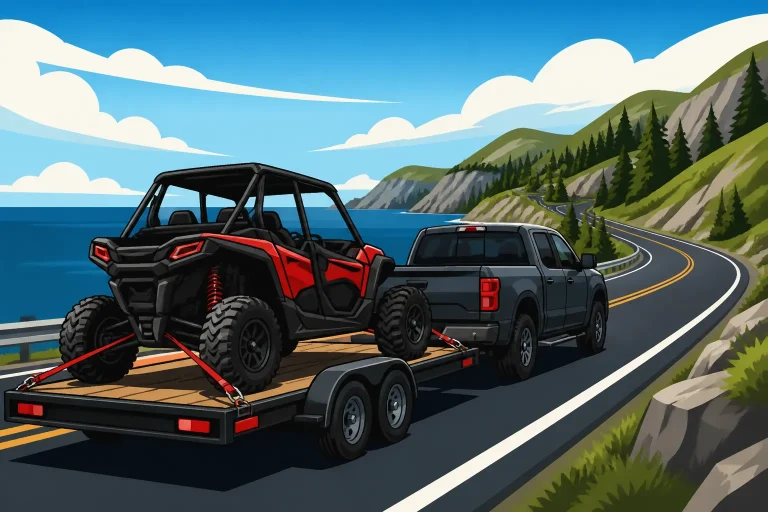
Keep the end of the day predictable. Leave time to refuel, inspect the machine and secure it for transport. If you have been riding near shared routes, check the machine for mud and debris before loading, and avoid carrying anything that could obscure a plate or light on the way home. A thoughtful finish is part of the ride plan, not an afterthought.
Disclaimer
This article is for general informational purposes only and does not constitute professional advice. Laws, prices and regulations vary by location and change over time. Consult a qualified professional for guidance on your specific situation.