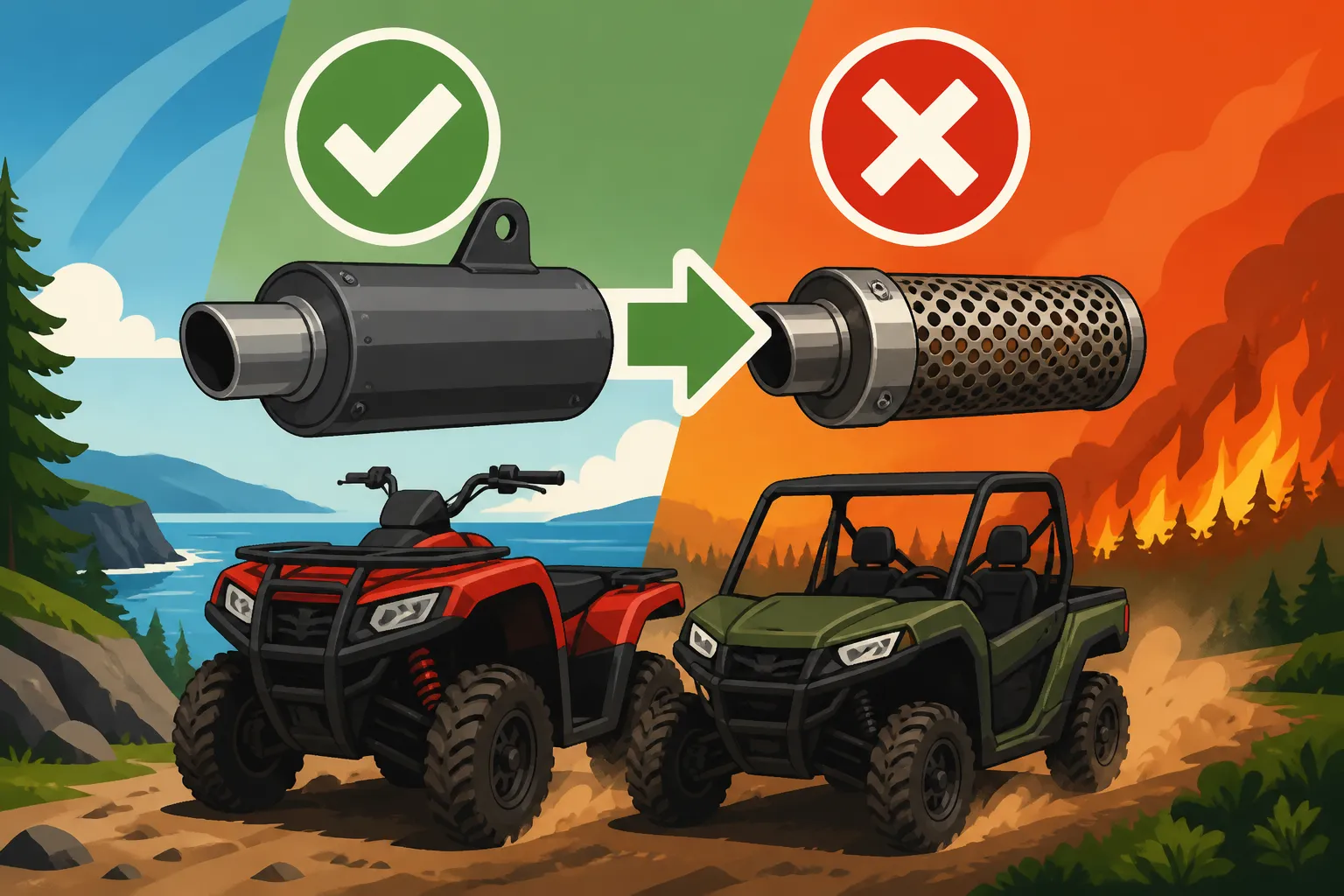
Muffler Rules Stand In for a Spark Arrestor Rule
Newfoundland riders sometimes assume an ATV or UTV needs a spark arrestor to be legal, especially when riding in wooded or dry areas. The provincial rule is different: the focus is on a properly functioning muffler and exhaust. Knowing what that means helps you choose replacement parts, avoid needless modifications and check for separate trail or land-use conditions.
What Newfoundland requires instead of a spark arrestor
Newfoundland does not have a general provincial spark-arrestor requirement for off-road vehicles. Instead, the equipment rule focuses on the exhaust system: gases must be cooled and expelled quietly. In practical terms, that means a muffler that works as intended matters more than adding a spark-arresting screen just to meet a province-wide rule.
A spark arrestor and a muffler do different jobs. A spark arrestor is designed to keep hot particles from leaving the exhaust. A muffler reduces exhaust noise and is part of the system that handles hot gases. One does not automatically replace the other. A muffler does not necessarily contain a spark arrestor, and fitting a spark arrestor does not make a loud or defective exhaust compliant.
The distinction is important because “no spark arrestor rule” does not mean “no exhaust rule.” A missing muffler, a damaged silencer or an exhaust modified to make more noise can still be a problem. The requirement is about the machine’s actual equipment and operation, not merely whether a particular part is installed. For a broader look at the provincial rule, see Newfoundland Has No Spark Arrestor Rule. For the exhaust standard itself, see Gases Cooled and Expelled Quietly.
| Part or condition | What it does | What to check |
|---|---|---|
| Muffler | Reduces exhaust noise and forms part of the exhaust system | It is present, secure and not damaged or bypassed |
| Spark arrestor | Helps prevent sparks or hot particles from leaving the exhaust | Whether a trail operator, land manager or equipment specification calls for one |
| Exhaust pipe and joints | Carry gases away from the engine | No loose joints, leaks or improvised openings |
| Modified exhaust | May alter sound and exhaust behaviour | Whether the change leaves the machine meeting applicable equipment rules |
A machine can have an intact muffler without a spark arrestor and still meet the provincial approach described here. Conversely, a machine with a spark arrestor can still fail the basic expectation if its muffler is absent, defective or altered so that it does not expel exhaust quietly.
It is also worth keeping provincial equipment rules separate from trail access conditions. A local land manager, event organizer or trail operator may set conditions for access that are more specific than the general provincial equipment rule. Do not assume every place has the same requirements just because the province does not impose a blanket spark-arrestor rule. Before travelling to a managed area or organized event, check its current rules directly.
Why the muffler still matters
A muffler is not just an accessory for making a machine more pleasant to ride. A functioning exhaust system helps control noise and directs hot gases away from the vehicle and its occupants. A damaged or removed muffler can make an ATV or UTV significantly louder, and an exhaust leak can send hot gases somewhere they should not go.
Noise can also create practical problems even when a rider is far from a paved road. A loud machine carries across open ground and through woods, and can disturb nearby residents, other trail users and wildlife. Complaints and access conflicts can affect the wider riding community. Newfoundland’s equipment rules and its separate noise concerns are covered in more detail in Newfoundland Muffler and Noise Rules and Newfoundland Exhaust and Muffler Rules.
Do not treat a machine’s age, purchase condition or previous use as proof that its exhaust is acceptable. A used vehicle may have a replacement muffler, a cut or modified pipe, missing fasteners or damage that is not obvious until the machine is running. A machine that sounds unusually sharp, rattly or loud deserves a closer look before it goes out.
Consider the following warning signs:
- The muffler is missing, loose or visibly cracked.
- A joint or clamp is loose, or there is evidence of exhaust escaping before it reaches the outlet.
- The exhaust note is much louder than expected for that machine.
- The muffler has been drilled, opened, cut or replaced with a short pipe.
- Parts of the exhaust are discoloured, damaged or positioned close to plastic, wiring or other components.
- The machine’s sound changed suddenly, which could indicate damage or a loose connection.
These signs do not by themselves settle every legal question, but they are good reasons to stop and inspect the machine. A quiet sound at idle is not conclusive either: the exhaust may become much louder under load, or a leak may show up only after the machine warms up.
The rule is not an invitation to remove equipment simply because a rider believes a machine will still run. The safe approach is to keep the exhaust system intact and in good repair, and to use parts that fit the specific machine. For an overview of other required equipment, see Newfoundland Equipment Requirements.
Choosing a replacement muffler or exhaust part
If the original muffler is damaged, look for a replacement designed for the machine’s make, model and configuration. Compatibility matters: a part that physically attaches may still have the wrong fit, outlet position or performance for the vehicle. Check the vehicle and part documentation, and ask a qualified repair shop or the manufacturer’s parts support when the match is uncertain.
A useful purchase checklist is:
- Identify the exact machine, including model and year from its identification information.
- Confirm whether the part is a complete muffler, a component of the exhaust, or an optional spark arrestor.
- Check that it is intended for that exact configuration and can be installed without bypassing other exhaust components.
- Read the installation instructions and any stated limitations.
- Keep the receipt and product information in case you need to confirm what was installed later.
When shopping on Amazon or another marketplace, do not rely on a short listing title or a claim that a part is “quiet” or “universal.” Check the fitment details, the manufacturer’s documentation and whether the part is actually a muffler or only an accessory. If the description does not make that clear, ask the seller or choose a part through a dealer or repair shop that can verify compatibility.
Avoid making a choice based solely on sound clips or rider comments. Recordings can make exhaust noise difficult to judge, and someone else’s machine may have a different engine, exhaust setup or local access conditions. Similarly, an aftermarket label does not automatically establish that a part meets the needs of your machine or any additional site-specific conditions.
A spark-arrestor accessory may still be useful in some settings, even though there is no general provincial requirement. If a trail operator or land manager asks for one, confirm exactly what they mean and what equipment they accept before you ride there. Do not assume that a screen sold as a spark arrestor is compatible with every muffler or can be installed safely on every machine.
For a more complete view of the equipment rules that apply to the vehicle, consult Newfoundland Equipment Requirements. Keep in mind that exhaust compliance is only one part of preparing to ride; other rules may apply to helmets, lights, tires, passengers and insurance.
Check conditions before you head out
Before a ride, take a few minutes to look over the exhaust system. Make sure the muffler and its fasteners are secure, inspect visible joints for damage, and listen for a sudden change in sound when the machine starts. Do not touch an exhaust while it is hot. If you find a crack, loose part or unusually loud exhaust, repair it before continuing.
Use this simple routine:
- Check that the muffler is installed and firmly attached.
- Look for loose clamps, visible gaps or damage around exhaust joints.
- Start the machine in a safe, open place and listen for unusual noise.
- Stop if you notice a change during the ride, especially a sharp increase in sound or a burning smell.
- Have a mechanic assess damage or a replacement that you are unsure how to fit.
You should also verify conditions for the particular area where you plan to ride. Provincial equipment rules do not guarantee access to every trail, road or parcel of land. Fire restrictions and land-management rules are separate matters, and may change with location or conditions. Check Newfoundland Fire Season Riding Restrictions before a ride during fire season, and confirm any additional instructions with the relevant trail operator or land manager.
If an officer checks the machine, a spark arrestor is not the only exhaust-related issue that matters. A missing or defective muffler, excessive noise or other equipment concern can still draw attention. Keep the machine in good repair rather than treating one absent component as the only compliance question. See Newfoundland Equipment Checks by Officers for more on equipment checks.
The practical takeaway is straightforward: Newfoundland’s general rule does not require every ATV or UTV to have a spark arrestor, but the exhaust still needs a functioning muffler that cools and expels gases quietly. Keep the system intact, choose replacement parts carefully, and check separate access conditions before riding.
Disclaimer
This article is for general informational purposes only and does not constitute professional advice. Laws, prices and regulations vary by location and change over time. Consult a qualified professional for guidance on your specific situation.