Provincial Trails That Set Their Own Rules
Provincial Trails That Set Their Own Rules
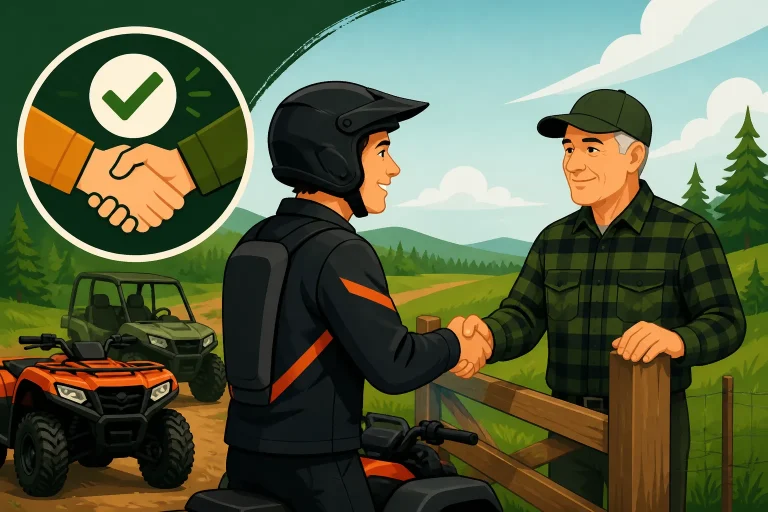
A trail may be open to ATV and UTV riders without being open on the same terms everywhere. In Newfoundland and Labrador, provincial law is only part of the picture: trail operators, land managers and municipalities may add conditions. Knowing who controls a route—and what their rules cover—helps you avoid a wasted trip or an access violation.
What “the trail sets its own rules” means
There is no single rulebook that automatically covers every route described as a provincial trail. A trail might pass through Crown land, private land, a managed trail network, or an area with separate restrictions. Different authorities can control different parts of the route.
Provincial laws still apply wherever you ride. A trail operator cannot waive requirements that come from legislation, such as applicable rules for vehicle registration, insurance, equipment or rider conduct. At the same time, a trail’s access conditions may be stricter than the legal minimum. An operator could set conditions on when a route is open, which vehicle types it accepts, or what proof riders must carry.
That distinction is useful:
- Provincial law sets requirements that apply to riders and machines within its scope.
- Land-use rules determine whether riding is allowed in a particular area and where you may travel.
- Trail-operator rules set conditions for using a route the operator manages.
- Municipal bylaws may apply to roads or areas within a municipality.
A sticker, registration document or safety certificate does not automatically give you permission to ride every trail. Each answers a different question: whether a particular requirement has been met, not whether every route is open to you.
The words “provincial trail” can also be used loosely in conversation. Before relying on a sign, map, online post or description, identify the route and the organization responsible for it. For a managed route, Newfoundland Managed Trail Rules provides a useful starting point on how operator rules fit into trail access.
Ask who manages the exact section
A named trail can change hands or pass through several types of land. The organization responsible for one section may not control the next. If a route crosses a restricted area, private property or municipal boundary, a trail operator’s permission may not be enough.
Check the authority for the specific segment you plan to ride, not just the trail’s general name. Confirm whether the route is currently open and whether any closures or seasonal restrictions apply. If you are uncertain about Crown land, consult Newfoundland Crown Land Access Rules and check the applicable provincial mapping and notices.
The same care applies around parks. Do not assume that a trail near or within a provincial park is open to off-road machines because it appears on a map or connects to another route. Park rules can be distinct from those of a nearby trail network. Check Newfoundland Provincial Park Machine Rules before planning a ride through a park area.
Requirements that may apply before you reach the trail
Trail access is not a substitute for the requirements that apply to your vehicle and the way you ride it. Before setting out, separate the questions of machine eligibility, rider eligibility and route permission.
| Check | What it tells you | What it does not guarantee |
|---|---|---|
| Vehicle registration | Whether the machine meets applicable registration requirements | Permission to use a particular route |
| Trail sticker or access authorization | Whether the operator’s access condition has been met | An exemption from provincial law or land restrictions |
| Insurance and safety documentation | Whether applicable coverage or proof requirements are in place | That the trail is open or accepts your machine |
| Land or route permission | Whether you may use the relevant area or section | Permission to ignore operator conditions |
| Local bylaws and posted notices | Whether additional local restrictions apply | That all connected roads or trails are also open |
Managed trail stickers are a separate access condition
Some managed trail systems require a trail sticker for access. That requirement is separate from vehicle registration and from any safety-training obligation that applies to the rider. A registered machine may still need the relevant sticker to use a managed trail.
Do not assume that a sticker issued for one purpose, area or period automatically covers another. Check which operator issues the sticker, what route it applies to, and what the operator requires you to do with it. The rules may explain whether the sticker must be attached to the machine or whether carrying it is acceptable. Managed Trails Require a Sticker on Your Machine explains why riders should check this separately from registration.
If you ride multiple managed networks, confirm that your authorization is accepted on each one. A sticker from one operator is not necessarily valid everywhere. Ask the operator directly if the wording on the sticker or its coverage is unclear.
Registration and visitor rules are not trail passes
Riders arriving from another province should check both vehicle rules and trail-access conditions. A visitor exemption from registering a machine in Newfoundland and Labrador for a limited stay does not, by itself, grant access to a managed trail. It also does not cancel other requirements, such as applicable insurance or operator rules. See Newfoundland’s 30-Day Visitor Exemption for the registration issue, then confirm access with the trail operator.
If you have moved to the province, do not treat visitor rules as a permanent arrangement. Registration obligations and trail access are separate questions; Newfoundland Registration for a New Resident can help with the former.
Similarly, a safety certificate is not a trail authorization. Check whether the operator requires proof of training, and make sure you meet any provincial requirements that apply to you. This matters particularly when a ride includes young operators or passengers, because age, supervision and training rules may affect who can use a machine and under what conditions.
Vehicle type matters
ATVs and UTVs may not be treated alike by every operator. A narrow trail, bridge, gate or surface can make a route unsuitable for a wider side-by-side, even when the machine is otherwise legal to operate. Before towing to a trailhead, ask whether the route permits your vehicle class and whether there are width, weight or other equipment limits.
Do not infer permission from another rider’s photos or a general trail listing. The images may show a different section, an older access arrangement or a machine that had permission for a specific event. Questions Worth Asking a Trail Operator offers a practical set of issues to confirm before you leave home.
How to confirm a trail’s rules before riding
A quick check before departure is more reliable than trying to interpret mixed signs at a trailhead. Use the route name and the exact access point when contacting the operator; that makes it easier to distinguish one section from another.
- Mark your planned route. Note the trailhead, intended turnaround point and any connecting roads or trail sections. A route that crosses several areas may have more than one authority.
- Identify the operator or land manager. Look for current contact details on official trail or land-management information. If the route is not managed by one organization, find out who controls the sections you plan to use.
- Confirm the route is open. Ask about seasonal closures, temporary restrictions, construction, weather damage and any access changes. A route shown on a map may not be available on the day you ride.
- Ask whether your machine is allowed. Give the operator the vehicle type, especially if you plan to use a UTV or a larger machine.
- Check access requirements. Ask whether a trail sticker or other authorization is required, where it is valid, and whether it must be displayed or carried.
- Check separate provincial and land rules. Verify registration, insurance, rider requirements and any land-use restrictions that apply. Use Finding Approved Areas on the Provincial Map when you need to check approved and restricted Crown land areas.
- Keep the answer accessible. Save written instructions or take a photo of current signs, and carry required documents while riding. This is useful if the route is remote or cell service is unreliable.
If an operator cannot confirm that a route is open to your machine, choose another route rather than assuming that silence means permission. A nearby trail may look connected but pass through a different management area or land status.
At the trailhead
Read signs before unloading or riding through a gate. Look for instructions about stickers, permitted vehicles, closures, direction of travel, speed, parking and shared use. Signs can provide important local information, but they do not necessarily show every provincial or land-use requirement. If a sign conflicts with what you were told, stop and seek clarification.
Respect a closed gate, barrier or posted restriction. Do not bypass it to reach a route that appears open beyond the obstruction. A closure may protect the land, respond to a hazard or apply only to a particular segment; either way, it is not an invitation to find another way around.
On a shared route, adjust your riding for other users and conditions. Walkers, cyclists, snowmobilers and other traffic may use the same corridor, and visibility or stopping distance can be limited. The operator’s instructions may add local expectations, but safe conduct remains the rider’s responsibility.
Common mistakes and a simple pre-ride check
The most frequent misunderstanding is treating one document as a universal pass. Registration is not a trail sticker; a sticker is not permission to enter restricted land; and a map showing a route is not proof that it is open today.
Other mistakes are just as avoidable:
- Assuming that rules are identical across a named trail’s full length.
- Treating a visitor registration exemption as an exemption from trail-access conditions.
- Assuming a sticker issued by one operator is accepted by another.
- Bringing a UTV to a route without checking vehicle-size restrictions.
- Relying on an old forum post or a sign photographed during a previous season.
- Riding past a closure because the trail looks passable.
- Assuming that a nearby park, road or Crown land area follows the same rules as the managed trail.
Before leaving, make sure you can answer these questions:
- Who manages the route and each section you plan to ride?
- Is the route open on your intended day?
- Is your ATV or UTV permitted?
- Do you need a sticker or other operator authorization?
- Are your registration, insurance and rider documents in order?
- Does any part of the route cross land with separate restrictions?
- Have you checked local notices and read the trailhead signs?
If any answer is uncertain, contact the relevant operator or land authority before riding. That small check can prevent a long tow to a closed trailhead, an unexpected turn-around or a violation. The safest approach is to treat provincial law as the baseline and each trail’s current access rules as an additional check—not as a replacement for the law.
Disclaimer
This article is for general informational purposes only and does not constitute professional advice. Laws, prices and regulations vary by location and change over time. Consult a qualified professional for guidance on your specific situation.