Newfoundland Training After a Cancellation
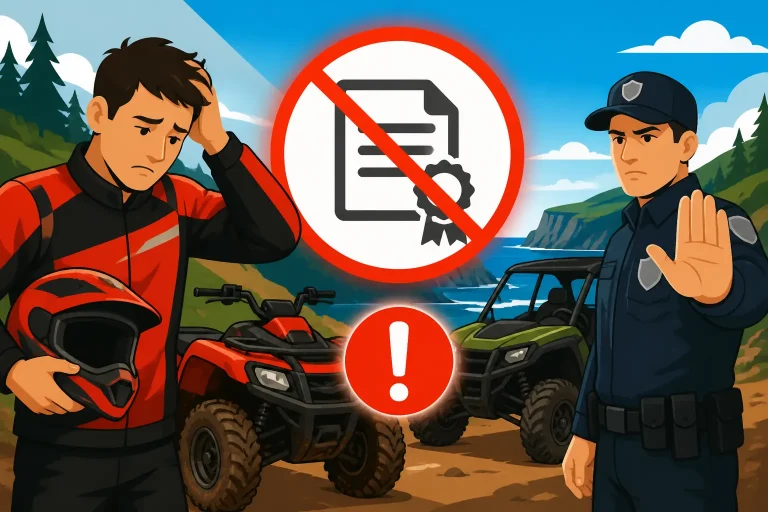
If your Newfoundland ATV or side-by-side registration has been cancelled, it can be hard to tell whether your safety training is affected too. The key is to identify what was cancelled: the machine’s registration, a training booking, or a training record. Those are different issues, and the next step depends on which one applies.
First identify what was cancelled
A cancelled registration and a cancelled training record are not automatically the same thing. Registration relates to a particular machine and its authorization to operate; training relates to the rider and any proof of training the rules require. If you received a cancellation notice, read it closely and note exactly what it says was cancelled, by whom, and why.
For example, you may be dealing with:
- A machine’s registration cancellation. This concerns the registration record for the ATV or side-by-side. It does not, by itself, tell you whether a safety course or test must be repeated.
- A cancelled training appointment or course booking. You may need to arrange a new booking or complete another training option, depending on what was cancelled and whether you had already completed the training.
- A missing, invalid, or cancelled training certificate. You may need to confirm whether the training provider or registry has a valid record and what proof is accepted.
- A suspension or other restriction. This can trigger different requirements from a routine registration cancellation. Check whether the notice specifically says training is required before you can ride again.
- A cancellation caused by an administrative error. If the record does not match what you completed, gather your documents and ask the office or provider to verify it before starting over.
Newfoundland’s training requirements depend on the rider’s circumstances. Do not assume that every rider with a cancelled machine registration must repeat a course, or that every previously completed course automatically satisfies a new requirement. The rules and the wording of the notice matter. For background, see Newfoundland Safety Training Is Mandatory and [Newfoundland Training for a First Registration].
| What may have been cancelled | What to check next |
|---|---|
| The machine’s registration | Ask whether your rider training record remains valid and whether the machine can be registered again |
| A course or test booking | Confirm whether you need a new booking or can choose another accepted training option |
| A certificate or training record | Ask the provider or registry to verify completion and how to obtain acceptable proof |
| Permission following a suspension | Read the conditions carefully and confirm whether retraining is required before riding |
| A record that appears incorrect | Provide your receipt, certificate, test confirmation, or other available evidence and request a record check |
The important first question is not simply, “Was something cancelled?” It is, “Which record was cancelled, and what does the notice require me to do?” That distinction can prevent paying for or repeating training unnecessarily.
Find out whether you actually need to train again
Before repeating a course or test, verify your current training status with the relevant office or provider. A rider may have completed a course but lack the document needed to prove it. That is different from never completing the training, and it may have a different solution.
Start with the cancellation notice. Look for wording about safety training, a certificate, a condition to reinstate registration, a suspension, or a deadline. If the notice only refers to the machine’s registration, do not infer that the rider’s training has also been cancelled. Contact the office that issued the notice and ask specifically whether your existing training record is still recognized.
If you trained through an approved provider, contact that provider as well. Give them the name you used when registering, the approximate date, the type of course or test, and any confirmation number or receipt you kept. If your name has changed, explain that so staff can search for the record under the right details. Keep copies of emails and any written response.
For an online test, check the account or service where you completed it and look for a certificate or confirmation. If you cannot find one, ask whether the result is on file and how to retrieve proof. The instructions for Taking the Free Safety Test on MyGovNL can help you understand the online-test route, but do not repeat the test solely because you misplaced a printed copy until you have checked whether a record can be recovered.
Ask clear, narrow questions. For example:
- Does the cancellation apply to the machine’s registration, my training record, or both?
- Is my previous course or test still accepted?
- If the training is on file, what proof should I carry or present?
- If I must train again, which course or test is currently accepted for my situation?
- Does the cancellation notice require any other step before I can ride or register the machine?
Keep the answer with your records. If the answer is given by phone, write down the date, the office or provider you spoke with, and the instructions. A follow-up email can help confirm what you understood, especially if the notice affects whether you are allowed to ride.
A previous completion may be relevant even if you need to produce proof again. The reverse is also true: having an old document does not necessarily mean it meets a new or different requirement. When the reason for cancellation is a suspension or another formal restriction, ask whether the conditions require additional training. Do not assume that ordinary first-time training and post-suspension training are interchangeable; Newfoundland Training After a Suspension covers that separate situation.
If retraining is required, take the right route
If the office confirms that you need to complete training again, ask which route applies before enrolling. Newfoundland training options can include an online test or an accepted course, but eligibility and acceptance depend on the rider’s circumstances. The right choice may differ for a first-time registrant, a younger rider, or someone whose riding privileges were suspended.
Confirm these details before you begin:
- Who must complete the training. Check whether the requirement applies to you based on your age, registration history, or the specific terms of the cancellation.
- Which course or test is accepted. Do not rely on an unrelated certificate or a course that has not been confirmed as acceptable for the requirement you face.
- Whether you need a new completion or only proof. A lost certificate and an uncompleted course are not the same problem.
- How completion will be recorded. Ask whether the provider sends results to the registry or whether you must provide a certificate yourself.
- What you need to do after passing. Confirm whether the machine’s registration must also be reinstated or reissued before riding.
If you use the online test, save the completion confirmation and certificate as soon as they are available. Keep a digital copy somewhere you can access and a printed copy with your vehicle documents if practical. For a course, retain the provider’s receipt and completion document. If staff tell you that your result will be recorded electronically, ask how long to allow for the record to appear and what to do if it does not.
You can find more detail about the options for adults in Newfoundland Training for an Adult. If you are arranging training for a young rider, verify the supervision and consent requirements too; completing a test does not automatically remove other age-related riding conditions.
Do not register for a course simply because a registration notice arrived. First determine whether the notice requires training, whether your prior result is still on file, and whether a new course would satisfy the specific condition. This is especially useful when the cancellation was administrative or when the only problem is that paperwork cannot be located.
Do not ride while the status is unclear
Training is only one part of being ready to ride. A machine with a cancelled registration may not be legal to operate even if the rider has completed all required training. Likewise, a valid registration does not prove that a rider has met a separate training condition. Treat the machine’s status and the rider’s status as two checks.
Until the office confirms what the cancellation means, avoid riding the machine on trails, roads, or other places where the registration or training requirement applies. If the cancellation notice sets a condition for reinstatement, follow it before riding. Ask whether the registration must be restored, whether a replacement permit or plate is needed, and whether any other documents must be submitted.
Once your status is confirmed, keep the relevant records together:
- The machine’s current registration document
- Your safety training certificate or other accepted proof
- The cancellation notice and any reinstatement confirmation
- Contact details or written instructions from the provider or registry
Check that the name and machine details on your paperwork are correct. If the training proof is electronic, make sure you can access it when needed and keep a backup. Guidance on Carrying Your Safety Certificate on Every Ride can help you plan how to keep proof available.
If the office says the cancellation was an error, ask for confirmation that the record has been corrected. If it says you must repeat training, ask for that requirement and the accepted route in clear terms before you proceed. For general questions about records, paperwork, and next steps, Newfoundland Registration Questions Staff Hear may also be useful.
The practical rule is simple: establish whether the cancellation applies to the machine, the training record, or a riding restriction. Verify your existing training before repeating it, and do not ride until both the machine’s registration and your own requirements are clear.
Disclaimer
This article is for general informational purposes only and does not constitute professional advice. Laws, prices and regulations vary by location and change over time. Consult a qualified professional for guidance on your specific situation.