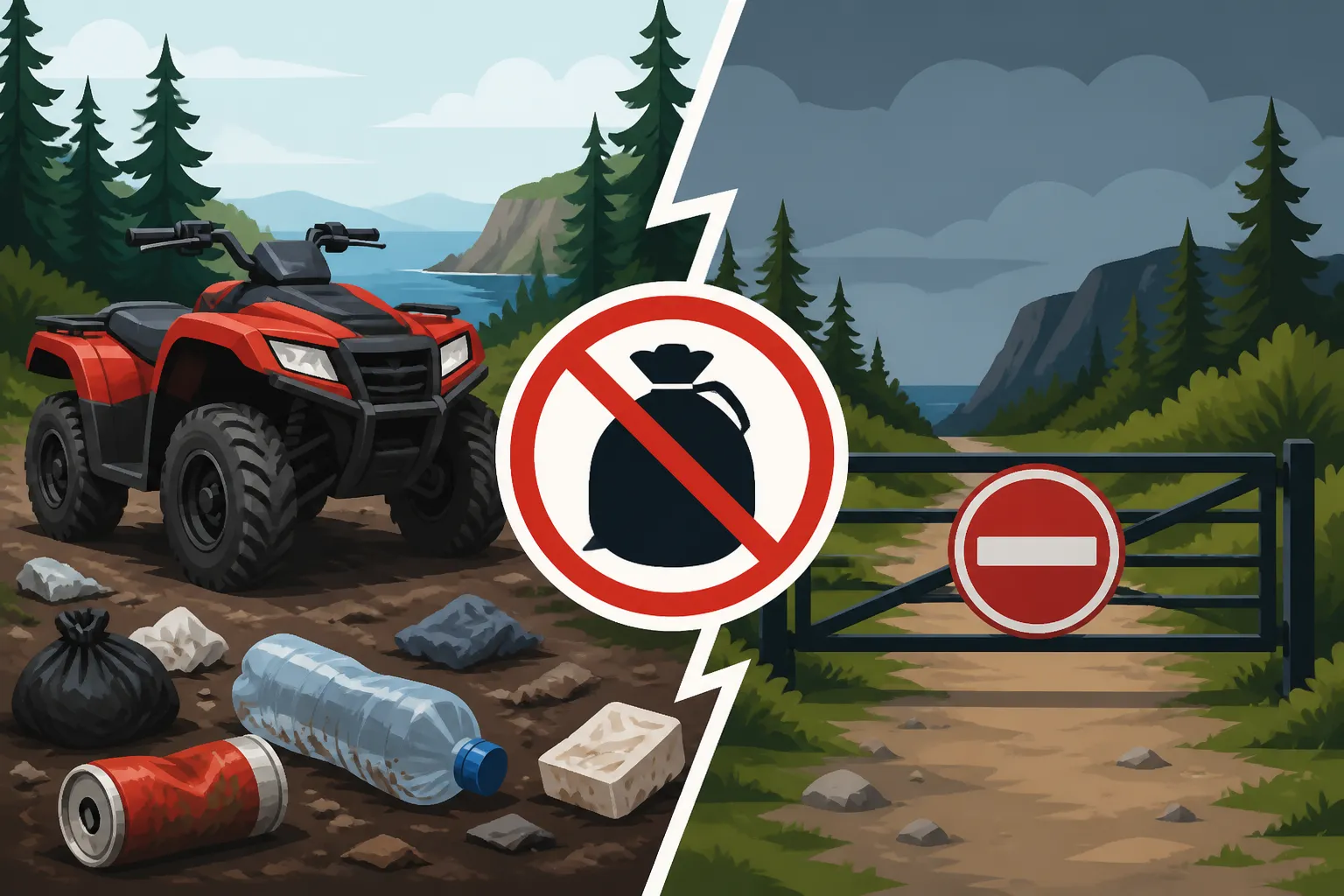
Why Trailhead Litter Closes Access for Everyone
A rubbish bag left beside a Newfoundland trailhead can create more than an eyesore: it can leave volunteers, nearby residents, landowners, or trail operators to deal with the mess—and make continued access harder to justify. This guide explains how litter can threaten shared riding areas, what riders can do to prevent it, and how to respond when they find a problem.
How litter puts Newfoundland trail access at risk
A dirty trailhead can damage trust
A trailhead is often the first place a landowner, community member, or visitor sees riders gathering. Overflowing bins, cans in the ditch, food scraps, and discarded parts can make it look as though the riding community does not care for the area. Even if only one person left the mess, the next person who sees it may blame riders as a group.
That perception matters because access is not always guaranteed. A route may cross Crown land, private property, a managed trail, or land subject to local restrictions. Continued riding may depend on permission, cooperation, maintenance, or compliance with posted rules. If litter becomes a recurring complaint, the people responsible for access may decide the inconvenience is no longer worth it.
A closure does not have to happen immediately for litter to have an effect. A community council might receive complaints, a landowner may reconsider permission, or a trail operator may need to spend volunteer time cleaning instead of maintaining the route. Riders who arrive later may find a gate closed or a restriction in place without knowing what led to it.
This is why good Newfoundland Trail Etiquette Locals Expect includes treating the parking area and access road with the same care as the trail itself. A clean trailhead helps show that riders can share a place responsibly, rather than leaving local people to manage the consequences.
The cleanup burden falls on people who may not ride
Trailhead rubbish does not disappear when riders leave. Someone has to pick it up, sort it, haul it away, or report it to the right person. That might be a volunteer, an operator, a nearby resident, a municipal worker, or a landowner who never agreed to take on that job.
The burden can be especially frustrating when volunteers already spend time clearing branches, checking signs, organizing maintenance days, and communicating trail conditions. A bag of household garbage left beside a parking area can require a special trip to remove. Broken glass or sharp metal may need extra care, and food waste can attract animals or create a mess that spreads beyond the original spot.
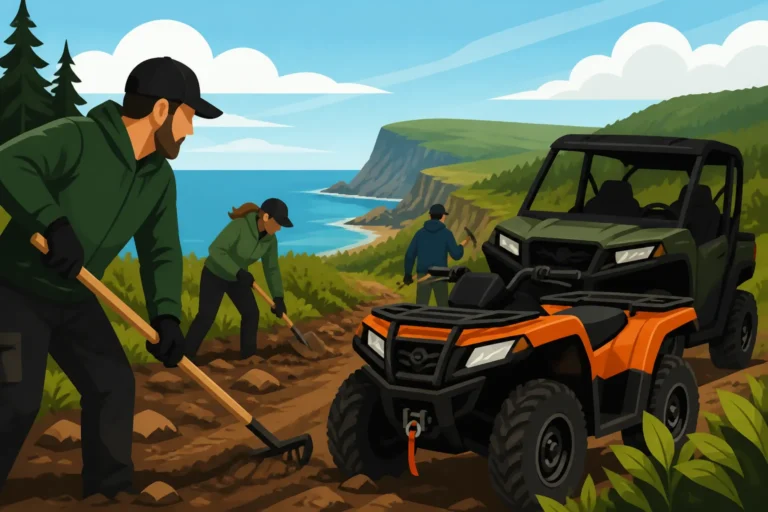
Repeated cleanups can also affect how much energy a group has for other work. When volunteers have to deal with avoidable litter, there may be less time for trail maintenance or community outreach. Riders can learn more about ways to contribute through Newfoundland Trail Volunteer Days, or contact the people responsible for a route through Newfoundland Trail Operator Contacts.
Litter is not the only factor in an access decision, and a single can does not automatically close a trail. But when rubbish keeps appearing, it can become one more reason for a landowner or operator to question whether public or recreational access is manageable.
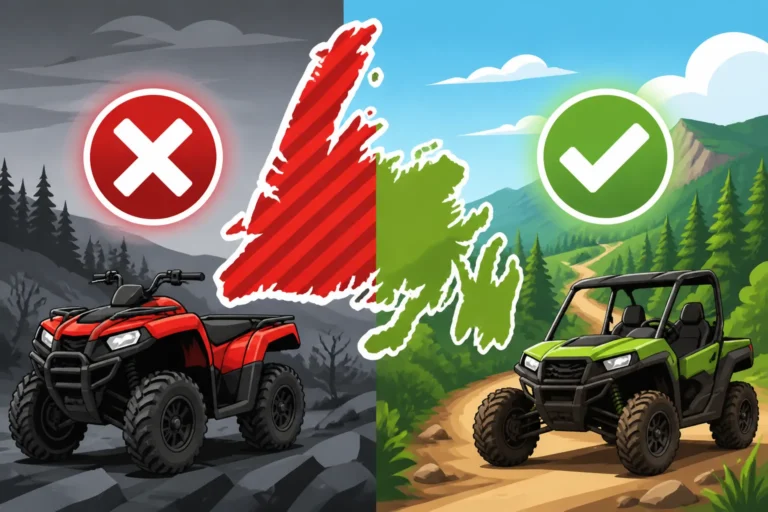
What happens when litter is left behind
Rubbish can affect wildlife, water, and the riding area
Food wrappers, drink containers, fishing line, cans, and broken equipment can all create problems beyond the parking area. Animals may investigate food scraps or packaging, while wind and runoff can carry lightweight litter into nearby brush, wetlands, or waterways. A bottle that seems easy to retrieve beside a vehicle can be much harder to find after it has blown into dense vegetation.
Some litter also creates a direct hazard. Broken glass, exposed wire, sharp metal, and damaged plastic can injure people, pets, or wildlife. Riders may not notice a small sharp object in a busy unloading area, particularly when several vehicles are arriving and machines are being secured.
Spills and discarded vehicle fluids need special attention. If you see a leak or a container of unknown liquid, avoid touching it or spreading it around. Note the location and report it to the relevant landowner, trail operator, or local authority. If there is an immediate danger, use the appropriate emergency channel rather than trying to manage a hazardous spill yourself.
Rubbish can also encourage more rubbish. When a spot already looks neglected, visitors may be more likely to leave another item behind. Keeping a trailhead clean interrupts that pattern and makes it easier for everyone to see that the area is cared for.
Access restrictions can affect responsible riders too
When a particular entrance becomes a problem, restrictions may affect every person who uses it—not just the person who left the rubbish. A landowner might limit parking, a community may review local access, or a trail operator may need to change how an area is managed. The details depend on who controls the land and what rules apply.
That can disrupt a whole ride. A group may have planned to unload at a familiar location, meet friends there, or use it as a starting point for a longer route. If access changes, riders may need a different legal place to park or may have to change their plans altogether. Checking Newfoundland Approved and Restricted Areas and following signs can help prevent confusion about where riding is permitted, but it does not replace respect for the people managing an entrance.
Newfoundland’s trail network includes places with different owners, operators, and access conditions. The Newfoundland ATV Trails: The T’Railway and Beyond guide can help riders think about the variety of riding areas, while [Newfoundland Crown Land Access Rules] is relevant when a ride involves Crown land. The key point is that a trail’s existence on a map does not necessarily mean every nearby parking area or connecting route is open for use.
If a trailhead is closed or access instructions have changed, do not move barriers, park in a way that blocks a gate, or assume a nearby track is an acceptable substitute. Check for posted information and contact the responsible operator or local authority if the situation is unclear. Respecting a closure helps preserve the possibility of future access.
How to prevent litter on an ATV or UTV ride
Pack out what you bring in
The simplest rule is to leave with everything you arrived with, including items that are easy to overlook. Before unloading, take a quick look through the truck, trailer, and machine storage areas for loose packaging, drink containers, straps, and small parts. Secure lightweight items so wind cannot carry them away while you are unloading or preparing to leave.
A practical pack-out routine can be simple:
- Bring a sturdy bag for rubbish, plus a separate container for recycling if you can carry it securely.
- Keep food waste contained rather than leaving it on the ground or in an open vehicle bed.
- Secure loose items before riding, especially wrappers, paper maps, and lightweight packaging.
- Check the ground around your parking space before you leave.
- Take your rubbish home or use a clearly designated disposal point. Do not leave it beside an overflowing bin.
If you ride with a group, agree on the plan before the machines start. One person can check the unloading area while another checks the parking spaces. This is not about turning a fun day into a cleanup exercise; it is about avoiding the familiar end-of-ride scramble when everyone is tired, muddy, and eager to get home.
A mapping tool such as onX Offroad may help with route planning and keeping track of a trip, but riders should still verify access with posted signs, the trail operator, or the relevant land manager. Do not treat a line on an app as proof that a trailhead is open or that parking is permitted. For a more complete pre-ride routine, see Newfoundland Trail Conditions Before You Ride.
Make the clean option easier for everyone
People are more likely to pack out rubbish when they have somewhere secure to put it. Bring a dedicated bag and store it where it will not spill into the cargo area. If your machine is carrying snacks or supplies, consider using a small sealed container for food wrappers and other scraps. A bin that is already full is not a reason to pile rubbish beside it; take your waste with you instead.
For group rides, decide in advance who is responsible for checking the stopping area. This can be as simple as asking everyone to look around their own machine before departure. If your group has a planned lunch stop, choose a place where you can safely gather without blocking access or leaving rubbish in a sensitive area.
Using onX Offroad or another mapping resource to plan a route can be useful, but it is worth confirming the practical details too: where the group can unload, whether the trailhead is open, and whether there are any current restrictions. Contacting a local operator ahead of time can prevent a group from arriving at an unsuitable entrance or parking area. If conditions or access rules are unclear, Emailing a Trail Operator Before You Ride is a sensible step.
Avoid making an informal rubbish dump out of an unstaffed trailhead. A container that looks like a public bin may belong to a nearby property or may not be serviced for trail users. Follow posted instructions, and if there are no disposal facilities, carry your rubbish out.
What to do if you find litter at a trailhead
Clean up what is safe and manageable
If you find a few ordinary items such as cans or wrappers, and you can pick them up safely, taking them with you is a helpful gesture. Use gloves or a tool if you have them, and avoid handling broken glass, needles, unknown substances, or anything that could be hazardous. Do not put yourself at risk to clean up someone else’s mess.
For a larger pile, dumped household waste, damaged containers, or a spill, record the location and report it to the relevant landowner, trail operator, or local authority. A clear description of the entrance, nearby signs, and the type of rubbish can help the right person understand the problem. If it is safe and appropriate, a photo can document the issue without requiring you to touch anything.
Do not assume every trailhead has the same reporting contact. Some locations are managed by an operator, while others may involve a community council, landowner, or public agency. If you are unsure who is responsible, begin with the posted contact information or ask a local organization that manages the riding area.
Respond in a way that protects future access
It can be upsetting to arrive at a beautiful riding area and find rubbish left behind. Still, confrontations can make a bad situation worse, particularly if you do not know who left it or who manages the property. Focus on what can help: remove safe, manageable litter, document serious dumping, and report the issue through the appropriate channel.
If your group caused the mess by accident, own it and fix it. A strap, wrapper, or bottle that falls out during unloading is easy to miss. Check the area before leaving, and if someone points out something your group dropped, retrieve it without turning the moment into an argument.
When access information changes, share accurate details with your riding group. Avoid repeating unconfirmed claims that a whole trail system is closed because of one incident. Check with the operator or local authority, and respect any signs or instructions in place. Responsible communication helps prevent confusion and shows that riders are willing to work with the people who maintain access.
Every rider has a small role in keeping trailheads usable. Pack out your own rubbish, leave shared spaces cleaner than you found them when it is safe to do so, and report serious dumping to the right people. Those simple habits reduce the burden on volunteers and landowners—and help make it easier for everyone to keep enjoying Newfoundland’s riding areas.
Disclaimer
This article is for general informational purposes only and does not constitute professional advice. Laws, prices and regulations vary by location and change over time. Consult a qualified professional for guidance on your specific situation.