Newfoundland Wildlife on the Trail
An ATV ride can feel quiet and remote until a moose steps onto the trail, a caribou herd appears across open barrens, or a bear moves through the trees nearby. Knowing what wildlife you may encounter in Newfoundland—and how to respond without crowding animals or putting your group at risk—helps you plan a safer, more respectful ride.
Wildlife you may encounter on Newfoundland trails
Newfoundland’s mix of forest, wetlands, barrens, and former rail corridors creates plenty of places for wildlife to cross or use the same routes riders travel. An animal can appear around a bend with little warning, especially where vegetation crowds the trail or the ground rises and blocks your view. The best approach is to ride as though wildlife could be just out of sight.
Moose near trails and wooded corridors
Moose are among the animals riders are most likely to notice. They may be feeding near a wetland, moving through a forest opening, or crossing a trail. A large animal can seem calm, but its size and quick reactions make close encounters dangerous. A moose that feels trapped or startled may charge, and a rider on a noisy machine has limited room to maneuver if it suddenly moves toward the trail.
Keep your speed low where you cannot see far ahead, particularly near brush, bends, water, and narrow cuttings. Scan the trail edges as well as the path directly in front of you. If you spot a moose, stop at a safe distance and give it space to leave. Do not ride closer for a photograph, rev the engine, or try to squeeze past it. If it does not move away, turn around when it is safe to do so and use another route.
A moose may be harder to see at dusk, in fog, or against dark vegetation. If visibility is poor, slow down enough to stop within the distance you can see clearly. For more specific encounter guidance, read [Newfoundland Moose Encounters While Riding].
Caribou, bears, and smaller wildlife
Caribou are more often associated with open or exposed country than with a busy trail, but riders may see them on barrens or near routes that cross their habitat. If caribou are present, do not follow a group, ride between animals, or keep moving toward them to get a closer look. Give the animals room to move away and pay attention to any closures or restrictions that apply to the area. [Newfoundland Caribou and Riding Restrictions] is useful background when planning a route through caribou country.
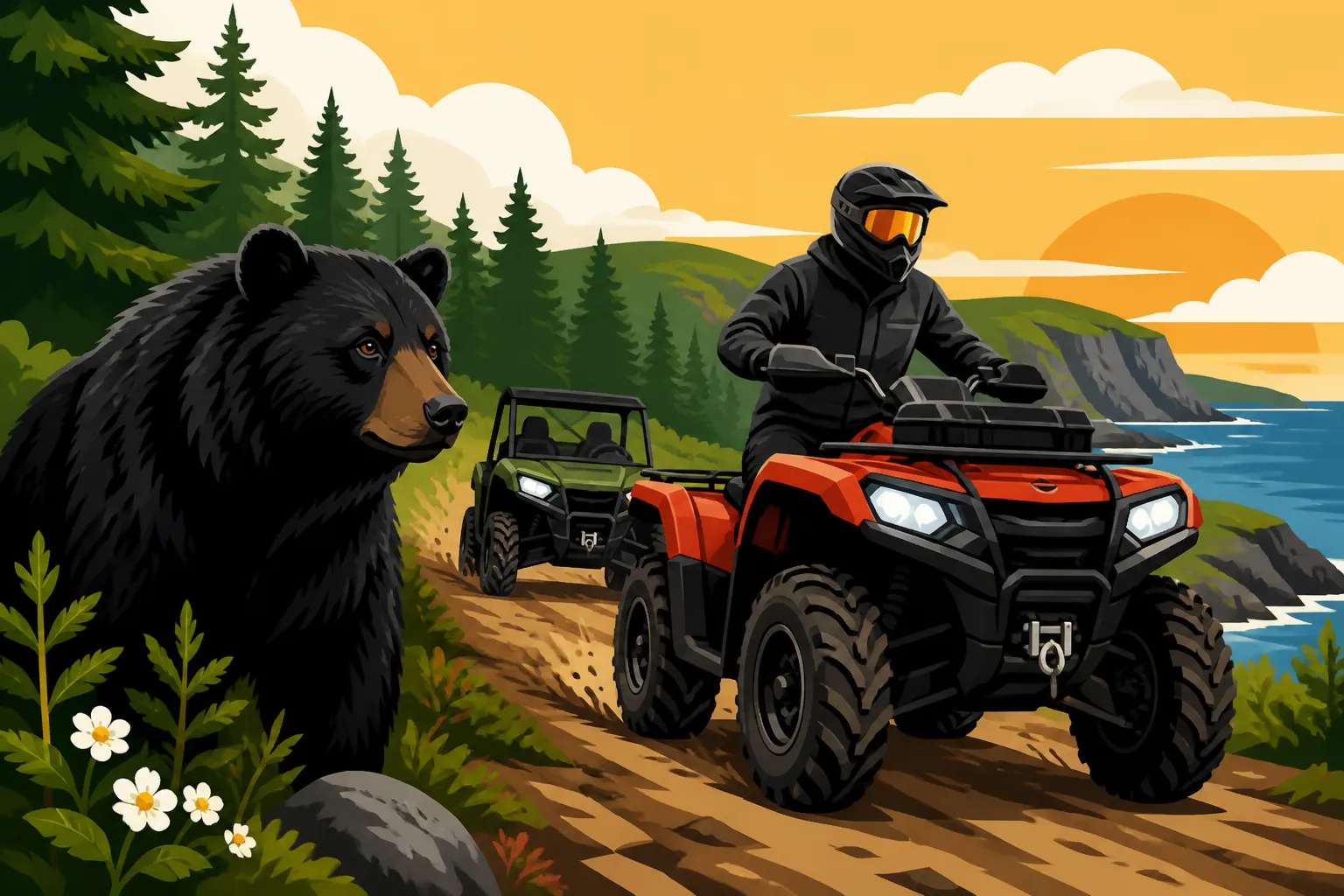
Black bears may also cross a trail or appear near food smells, camps, or other attractants. Do not approach, feed, surround, or attempt to move a bear with your ATV or UTV. If one is nearby, remain calm, keep a safe distance, and avoid blocking its route. Follow current provincial wildlife guidance for what to do if a bear behaves aggressively or does not move away.
Smaller animals and ground-nesting birds matter too. Avoid driving through wetland edges, soft ground, or vegetation away from established routes just to get around wildlife. A detour can damage habitat and create ruts that remain long after a ride. Wildlife sightings are a reason to pause and reassess, not an invitation to leave the trail.
How to respond when wildlife is on the trail
The first few seconds of an encounter can shape what happens next. Riders may be tempted to keep moving because stopping feels awkward, especially when a group is behind them. In practice, a calm stop gives the animal more room and gives riders time to decide whether to wait or turn back.
Stop, stay back, and make room
When an animal appears ahead, reduce speed smoothly and stop before you get close. Leave enough distance that the animal has a clear way to move away. Avoid surrounding it: riders should not fan out across the trail, follow it into the bush, or wait on both sides of its likely escape route.
Turn off the engine if it is safe and practical. The quieter setting can reduce pressure on the animal and make it easier for everyone to assess what is happening. Keep people together, speak calmly, and do not let anyone approach on foot. If the animal continues to stay on or near the trail, wait from a distance or back away carefully. Turning around is often the sensible choice when the trail is narrow or the animal has no obvious exit.
With a group, the lead rider should signal a stop without sudden movements. Riders behind should remain in place rather than bunching up around the animal. If the encounter is out of sight of the rest of the group, use your agreed communication plan before moving. Do not assume everyone has noticed the animal simply because the lead rider has stopped.
Avoid chasing, feeding, and risky workarounds
Never chase wildlife with a machine, even if the animal appears to be running away. The animal may be exhausted, injured, separated from young, or trying to reach cover. Following it can also bring riders into difficult terrain where visibility and control are poor. A UTV’s size and weight do not make it a safe barrier or a tool for steering an animal.
Do not feed wildlife or leave food scraps behind. Food can attract animals toward trails and camps, creating risks for the next rider as well as for the animal. Secure food and waste, and do not stop beside an animal to unpack snacks or take close-up photos.
Avoid creating an unsafe detour to get around an animal. Riding through a wet area, over a soft shoulder, or into unmarked vegetation can damage the ground and may take you into a restricted or unapproved area. Check [Newfoundland Crown Land Access Rules] and [Newfoundland Restricted Area Permissions] before choosing routes through unfamiliar land. If you cannot pass without approaching wildlife or leaving an appropriate route, wait or turn back.
| Situation | Safer response | Avoid |
|---|---|---|
| Moose or caribou on the trail | Stop well back and leave a clear route for the animal | Riding closer, following it, or surrounding it |
| Bear near the trail or camp | Keep your distance and follow current wildlife guidance | Feeding it, approaching it, or trying to drive it away |
| Animal does not move | Wait safely or turn around when you can do so without crowding it | Revving, honking repeatedly, or pushing past |
| Group encounters wildlife | Keep riders together and use a clear stop signal | Spreading out around the animal or rushing forward |
| Visibility is poor | Slow down and be ready to stop within the visible distance | Riding at normal speed around blind bends |
Plan a ride with wildlife in mind
A little preparation can make an encounter less stressful. Planning is not about predicting exactly where an animal will appear; it is about choosing routes and riding habits that leave room to respond. This is especially helpful on a long outing where conditions, visibility, and trail access can change along the way.
Check the route and conditions before setting out
Review the route before loading the machine, and check for closures or access restrictions that may affect where you can ride. An app such as onX Offroad can help you review route information, but map layers are not a substitute for confirming that a route is open and permitted. Compare mapping details with reliable local or official access information, and do not assume a line on a screen means the route is legal or passable.
Before you go, look at recent trail conditions and consider how weather might affect visibility and stopping distance. Fog, rain, and low light can make wildlife harder to spot. A route that feels straightforward in dry daylight may be a poor choice when the trail is slick or visibility is limited. [Newfoundland Trail Conditions Before You Ride] and [Newfoundland Riding After Heavy Rain] can help you think through conditions that affect both safety and trail impact.
Tell someone where you plan to ride and when you expect to return. Carry a charged phone, but do not rely on cellular service being available everywhere. Save the route information you need before leaving coverage, and bring a paper map if you are riding in an area where signal may be unreliable. onX Offroad can be one planning aid for reviewing a route, but it should not be your only source of navigation or access information.
Ride in a way that leaves room to react
Space between machines matters. If riders follow too closely, the person in front may have nowhere to stop when an animal appears, while the person behind may not see the reason for braking. Keep a sensible gap, especially on narrow trails, through brush, and around blind corners. Agree on hand signals or another way to communicate stops before the ride begins.
Keep speeds appropriate to sightlines and surface conditions. On a straight, open stretch, you may be able to see farther ahead; in dense woods or on a winding trail, you may have only a short view. Ride slowly enough to stop safely within that distance. A passenger should not distract the operator by leaning out, trying to approach an animal, or taking a photo while the machine is moving.
Respect the trail and other people using it. Walkers, cyclists, and other riders may also be looking for wildlife, and a sudden burst of engine noise can startle both people and animals. [Newfoundland Trail Etiquette Locals Expect] offers more on sharing trail space. If your group stops for a sighting, pull over only where it is safe and does not block the route, then leave the area as you found it.
Pack for a pause or an unexpected change of plan
A wildlife encounter can add time to a ride, and turning around may mean taking a longer route back. Bring enough water, weather-appropriate layers, and basic supplies for a delay. Make sure everyone in the group knows where essential items are and how to contact one another if the group becomes separated.
Pack a first-aid kit and know how to use what you carry. If someone is injured, move to a safe place only if doing so does not create more danger, and seek emergency help when needed. For remote rides, think through what you would do if a machine cannot be moved or a route becomes impassable. [What to Carry for First Aid on the Barrens] can help with planning for a ride where services may be far away.
Before setting off, agree that no one will chase wildlife, leave the route to get a closer look, or pressure the group to pass an animal. That conversation can feel unnecessary on the trailer, but it is much easier than trying to settle expectations when a moose is standing ahead and everyone is watching.
Disclaimer
This article is for general informational purposes only and does not constitute professional advice. Laws, prices and regulations vary by location and change over time. Consult a qualified professional for guidance on your specific situation.