Newfoundland Trails That Allow Side-by-Sides
A side-by-side can be a great way to explore Newfoundland, but a trail shown on a map is not automatically open to every off-road vehicle. Access can change by land type, local rules, closures, and trail width. This guide explains where to start looking, how to check whether a route suits your machine, and what to confirm before towing to a trailhead.
Where to look for side-by-side trails in Newfoundland
Start with the T’Railway and its connecting routes
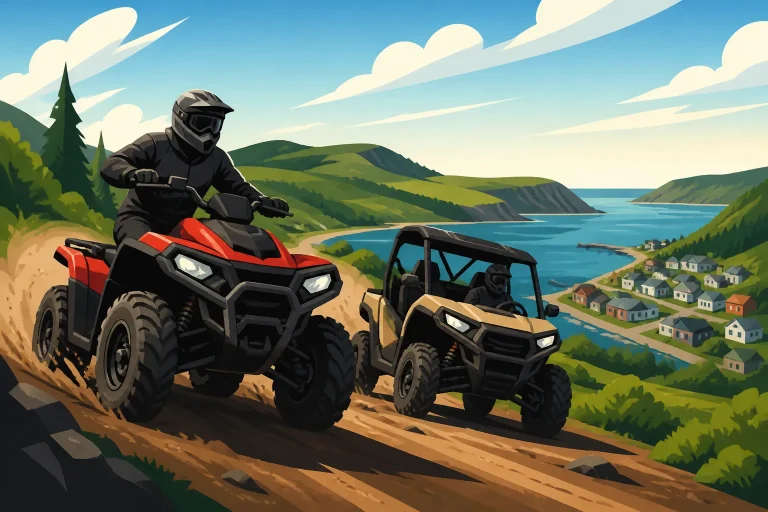
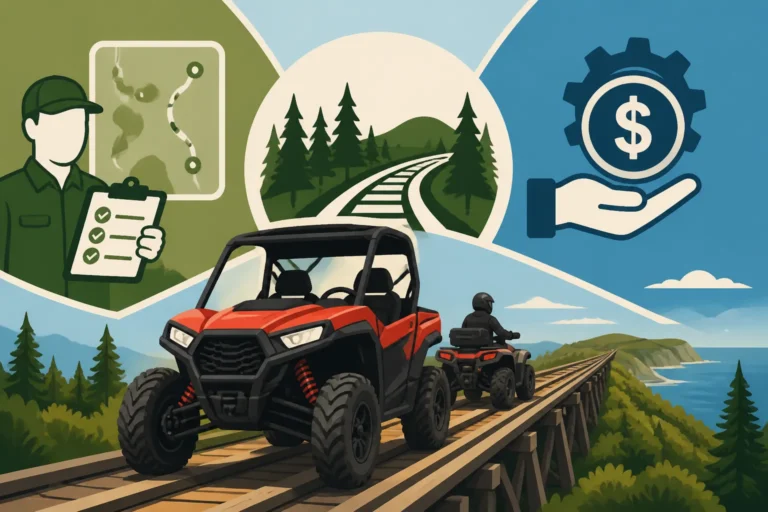
The T’Railway is one of the first places many riders consider when planning an off-road trip in Newfoundland. This long, former rail corridor crosses much of the island and connects communities, trail sections, and access points. It can be a useful starting point for side-by-side planning, but don’t assume every kilometre is equally suitable or that every connecting route has the same access rules.
The corridor is shared, and its surface and surroundings vary. A section that feels broad and straightforward near one community may become rougher, narrower, or more exposed farther along. Old railway ballast can be hard on tires and suspension, while washouts, standing water, and seasonal damage may make a route challenging for a heavier machine. Before setting out, check current notices and ask about the specific section you intend to ride. [Newfoundland Trail Conditions Before You Ride]
It also helps to plan around a realistic turnaround point rather than treating the entire corridor as one continuous day trip. Consider where you can safely unload, park a trailer, refuel, and get help if the machine develops a problem. Sections near communities such as Corner Brook, Gander, or Clarenville may make practical starting points, but local access and parking arrangements still need to be checked before arrival.
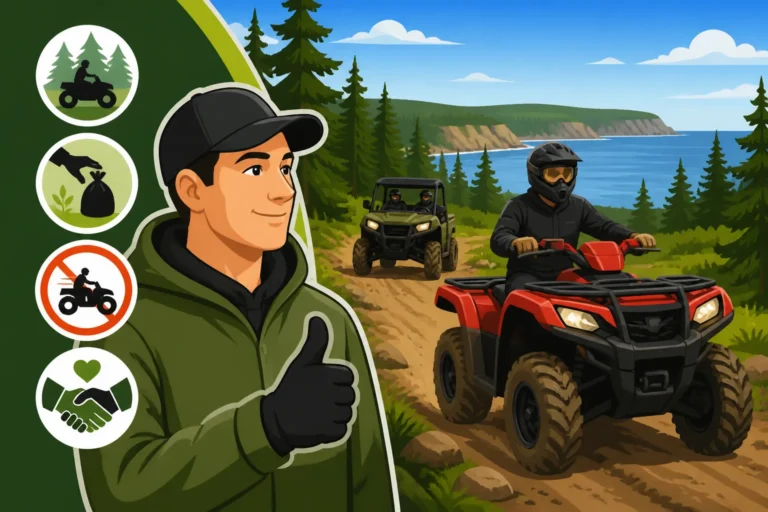
The T’Railway is shared with other trail users, so speed and visibility matter. Slow down near walkers, cyclists, road crossings, and community access points. Give other users room, watch for loose gravel, and avoid kicking up dust around people or homes. [Newfoundland Trail Etiquette Locals Expect]
Look for approved and managed riding areas
Beyond the T’Railway, look for designated riding areas and trails where motorized use is allowed. In Newfoundland, a route’s appearance can be misleading: a wide woods road, an old track, or a visible tire path does not by itself establish that the public may ride there. The land may be private, restricted Crown land, or subject to a local closure.
Start by identifying the land status and the trail operator, if there is one. Use official provincial mapping and local operator information to check whether the route is in an approved area and whether any restrictions apply. A general map app can help you navigate, but it may not show current closures, permission requirements, or machine-specific limitations. [Finding Approved Areas on the Provincial Map]
Managed trails have their own requirements, which can include a trail sticker and proof of safety training. Confirm what applies to your ride, your machine, and each person operating it before leaving home. These requirements are separate from the question of whether a particular route is physically wide enough for a side-by-side. [Newfoundland Managed Trail Rules]
Treat national parks and other restricted places separately
A trail through attractive scenery is not necessarily an off-road route. National parks have different rules from ordinary trails and riding areas, and you should not assume that a side-by-side is allowed on a park trail just because the route appears on an outdoor map. Check the specific park rules before planning a detour or choosing a trailhead nearby. [Newfoundland National Park Machine Rules]
The same caution applies to restricted Crown land and private property. Some areas may permit travel only on a marked trail, while others may require permission or prohibit motorized access. If a route crosses private land, get permission from the landowner rather than relying on tire tracks or the absence of a gate. For broader access guidance, see [Newfoundland Crown Land Access Rules].
How to confirm a route is suitable for your side-by-side
Check access, closures, and local rules first
Before you travel, confirm three separate things: whether motorized riding is allowed, whether your side-by-side is allowed, and whether the trail is open and passable now. Those are not interchangeable questions. A trail might be open to some off-road vehicles but unsuitable for a wider machine, or it may be temporarily closed after storm damage or for environmental protection.
Check the relevant provincial map or agency information, then contact the trail operator or local authority when the listing is unclear. Ask about the exact entrance and section you plan to ride, not simply whether “the trail” is open. A route can have several access points, different landowners, or a closure affecting only one segment. [Newfoundland Approved and Restricted Areas]
If you use onX Offroad to study a route, treat it as a planning aid rather than permission to ride. Compare its route information with official access details and ask locally about recent changes. The same habit is useful with any mapping app: a line on a screen helps you plan, but it cannot tell you with certainty that a gate is open or that a landowner has granted access.
Check the route’s width and obstacles
Side-by-sides are wider and heavier than many ATVs. A narrow trail that is comfortable on a quad may be awkward or impossible in a UTV, especially if it has tight turns, trees close to the edge, soft shoulders, or structures with limited clearance. Don’t wait until you reach a bridge or a steep-sided section to discover that your machine cannot pass safely.
Ask about bridges, gates, culverts, washouts, and turnaround areas. Find out whether there are sections where a wider vehicle has to squeeze between posts or where the trail narrows beside a ditch. If you cannot confirm clearance, choose a different route or arrange a way to check the access point before bringing the whole group.
This is where onX Offroad can help you think through distance, nearby access points, and possible route connections. But map details may not show a freshly fallen tree, a damaged bridge, or a gate that is narrower than your machine. If you are riding with several UTVs, have one person check the tightest pinch points before the group commits to a long section.
Plan for weather, surface, and support
Newfoundland trail conditions can change quickly. Rain may turn a firm track into a muddy stretch, while fog and wind can make exposed areas unpleasant or hard to navigate. A route that is manageable in dry weather may become a poor choice after heavy rain. Check local conditions close to departure and be ready to turn back if the surface is deteriorating. [Newfoundland Riding After Heavy Rain]
Think about recovery before you need it. Carry a suitable tow strap, basic tools, water, food, and a first-aid kit, and make sure someone knows your planned route and return time. Cell reception can be unreliable away from communities, so download or carry useful navigation information before leaving. onX Offroad can support route planning, but a second navigation option and a paper map are sensible backups on longer rides.
| What to check | Why it matters for a side-by-side | Where to confirm |
|---|---|---|
| Legal access | A visible track is not proof that riding is permitted | Provincial land information, local authority, landowner, or trail operator |
| Machine eligibility | Rules may distinguish vehicle classes or restrict certain routes | Official rules and the trail operator |
| Trail status | Closures, storm damage, and seasonal restrictions can change access | Current notices and local contacts |
| Width and clearance | Gates, bridges, trees, and narrow turns may not fit a UTV | Operator, local riders, or an in-person check |
| Managed trail requirements | Stickers and training proof may be required | Trail operator and provincial guidance |
| Road crossings | Riders must understand the applicable crossing rules | Provincial riding rules and posted signs |
| Weather and communications | Conditions and cell coverage can change along the route | Local forecasts, operator updates, and route planning |
Prepare for the ride and follow the rules
Confirm registration, training, and trail requirements
Before the trip, check that the side-by-side is properly registered and that you understand the requirements for operating it in Newfoundland. Side-by-sides are recognized as a vehicle class under the province’s off-road vehicle rules, but registration alone does not give you permission to ride anywhere. [Newfoundland Rules for a Side-by-Side Driver]
If your route includes a managed trail, ask the operator what documentation or sticker is required. Make sure the person driving meets the applicable training and supervision rules, particularly if a young rider will be part of the trip. Keep required proof accessible rather than buried beneath luggage or equipment.
It is also worth reviewing the rules for road crossings and any short road or shoulder sections that connect trail segments. Do not assume that a gravel road is an unrestricted shortcut. Posted signs, municipal bylaws, provincial requirements, and landowner rules may all affect where you can ride. For crossing requirements, read [Newfoundland's 150-Metre Crossing Visibility Rule].
Set up the machine for a shared trail
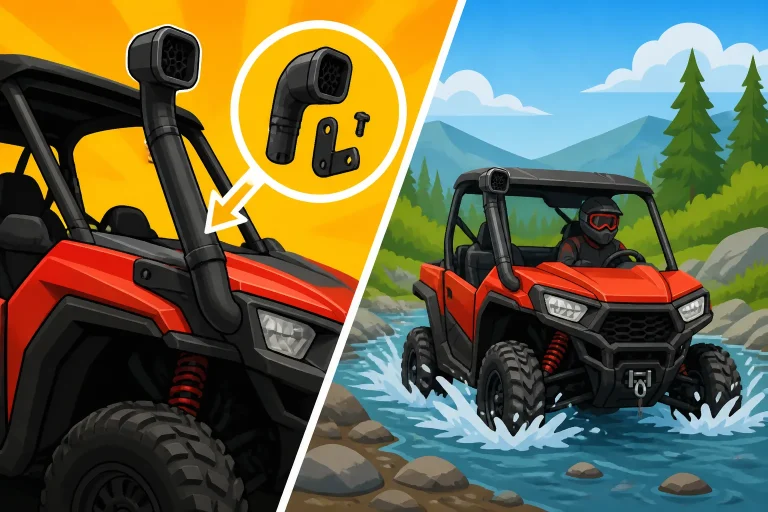
A side-by-side should be in good working order before a long ride. Check the tires, brakes, steering, lights, belt, and fluid levels, and secure any cargo so it cannot shift or block the driver’s view. If the route includes rough ballast, boggy ground, or water crossings, consider whether the machine’s tires and equipment are appropriate for those conditions.
Carry only what you can secure safely. A cooler or storage box can be useful on a cabin run, but cargo should not interfere with visibility, passengers, or access to safety equipment. Keep your registration and other required papers protected from rain and easy to produce if asked. [Newfoundland Proof of Ownership on the Trail]
On a shared route, ride at a speed that gives you time to react. Slow down around blind corners, trailheads, homes, and other users. Leave space between machines so dust and stones do not become a problem for the rider behind you. If you meet people on foot or bicycle, ease off and pass carefully rather than expecting them to move out of your way.
Make a practical route plan
A good side-by-side day does not need to cover the greatest distance. Choose a route that suits the least experienced driver, the widest machine in the group, and the weather you actually have. Set a turnaround time, identify a backup route, and agree on what the group will do if someone gets separated or a machine breaks down.
If you are visiting an area for the first time, call ahead. Ask whether side-by-sides are accepted, whether the trail is currently open, whether there are width restrictions, and where you can park a truck and trailer. A quick conversation can prevent a long tow to a gate or a frustrating discovery that the last section is not suitable for your vehicle.
Use onX Offroad or another navigation tool to sketch out options, then cross-check with official access information and local knowledge. Save key points before you lose service, and share the route with someone who is not riding with you. The best plan includes an easy way to stop, turn around, or change course without putting the machine or other trail users at risk.
A simple pre-ride checklist
Before leaving for a Newfoundland side-by-side trail, make sure you can answer these questions:
- Is this exact route open to motorized riding?
- Is a side-by-side allowed, and can the trail accommodate its width?
- Are there current closures, land permissions, or local bylaws to consider?
- Does the route require a managed trail sticker or other proof?
- Is the machine registered and ready for the surface and weather?
- Do all drivers understand the applicable training, supervision, and road-crossing rules?
- Have you planned for limited cell service, a breakdown, and a safe turnaround?
If any answer is uncertain, pause and confirm it with the trail operator, land manager, or relevant local authority. That small bit of preparation is far easier than reaching a closed access point with a trailer behind you—or getting stuck on a narrow section that your side-by-side cannot safely pass.
Disclaimer
This article is for general informational purposes only and does not constitute professional advice. Laws, prices and regulations vary by location and change over time. Consult a qualified professional for guidance on your specific situation.