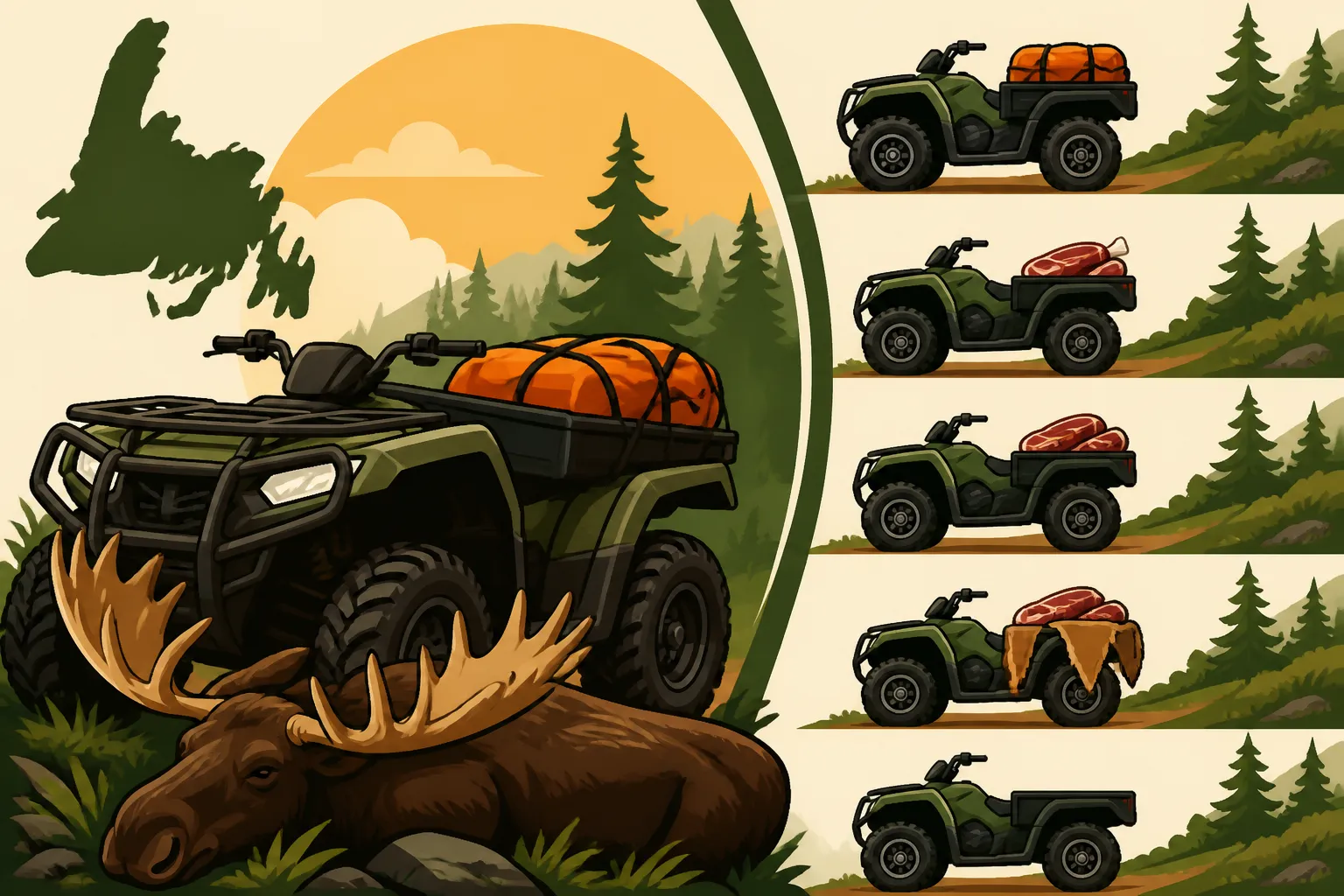
Five Trips to Move a Big Game Animal
A successful hunt can turn stressful when an animal is down far from a road, the ground is soft, or the route crosses a trail with access restrictions. Newfoundland’s five-trip limit for moving big game by machine is easy to misunderstand. This guide explains how to plan a legal, careful retrieval, protect the meat, and avoid damaging trails or wetlands.
What the five-trip limit means
Separate the retrieval rule from ordinary trail riding
The five-trip limit is about using a motorized machine to retrieve big game from the place it was killed. It is not a general allowance to ride wherever you like during hunting season, and it does not replace rules about where a machine may travel. A licensed hunter still needs to follow access restrictions, landowner permissions, seasonal closures, and other applicable requirements.
It helps to think of the limit as a narrow retrieval exception, not a hunting-area pass. For example, a hunter may be on foot in a place where access by machine is restricted. The fact that an ATV could make the return easier does not automatically make that route legal. Before starting the hunt, check whether the area is approved for the kind of access you are planning. [Newfoundland Crown Land Access Rules] and [Newfoundland Approved and Restricted Areas] are useful starting points for understanding that distinction.
Do not assume that a route used by other riders is open to motorized hunting access. A trail can pass near a restricted area, wetland, private parcel, or other land with its own conditions. A map app can help you orient yourself, but it should not be treated as proof that a route is authorized.
Plan around five trips, not five chances to improvise
A retrieval plan works best when you decide in advance how the animal will be moved, who will help, and what equipment will be needed. The five-trip limit is not a reason to make repeated scouting runs, test several routes, or shuttle gear without a clear plan. If you expect a difficult recovery, work through the logistics before you leave home rather than trying to solve them after dark with a loaded machine on soft ground.
The phrase “five trips” can sound deceptively simple in the field. A hunter might wonder whether a trip means one-way travel, a return journey, or a particular load movement. Don’t rely on a casual interpretation when your plan depends on counting each movement. Confirm how the applicable rule is administered with the relevant wildlife or land-management authority, and build a conservative plan that stays within the limit.
For background on why the rule is tied to a licence and retrieval, see [Why a Big Game Licence Allows Only Five Trips]. If the animal is far from a usable route or lies in a sensitive area, the safest option may be to retrieve it by hand, use a different lawful access point, or get guidance before moving it. The goal is to bring the animal out without turning a recovery into an access or habitat problem.
| Planning question | Why it matters | Practical step |
|---|---|---|
| Is motorized access allowed here? | A retrieval limit does not authorize travel through a restricted area. | Check official area information and permissions before the hunt. |
| How will each trip be used? | Unplanned shuttling can use up the limited retrieval movements. | Decide who rides, what each load carries, and where the route begins. |
| Can the machine handle the route and load? | Soft ground, steep terrain, and excess weight raise injury and damage risks. | Choose a conservative route and avoid overloading the machine. |
| What if the animal is not safely retrievable? | A machine may be unsuitable or prohibited at the kill site. | Have a backup plan that does not depend on forcing access. |
Check the area before riding
Confirm that the route is open to machines
Newfoundland includes a mix of approved areas, restricted areas, private land, managed trails, and places where motorized travel may be limited. Those boundaries matter even when the purpose of the ride is retrieving an animal. A route that appears to be a convenient shortcut on a screen may cross land where machines are not permitted, or where only a marked trail is open.
Before a hunt, identify the legal access route and the point where you will leave the machine. If you are hunting on Crown land, check the relevant access guidance and map information rather than assuming that all Crown land is open to off-road vehicles. In a restricted area, permission to hunt does not necessarily mean permission to drive a machine wherever you want.
Digital mapping can help you plan, and onX Offroad can be useful for viewing routes and terrain while preparing. Treat it as a planning aid, not the final authority on legal boundaries. Compare what you see with official information, posted signs, and any permissions you have received. If a boundary or access condition is unclear, resolve that question before the hunt rather than at the trail junction with a harvested animal waiting.
Get permission and account for seasonal restrictions
A route may cross private land even when it connects two familiar sections of trail. Ask the landowner for permission before crossing, and be specific about the intended route and whether a machine will be involved. A general invitation to hunt does not necessarily cover every use of the property, especially if the route passes through a yard, field, work area, or sensitive ground.
Seasonal rules can also change where riding is allowed. Hunting activity may overlap with trail closures, wetland protections, fire restrictions, or other area-specific controls. Review [Newfoundland Hunting Season Trail Rules] and [Newfoundland Wetland Protection Rules] as part of your preparation. Do not assume that hunting season itself creates an exception to those requirements.
A simple route plan can prevent an uncomfortable conversation later. Mark the approved trail, the point where you intend to park or stop, and the private or restricted areas you must avoid. Share the plan with everyone in the party. If an access point is blocked, a sign indicates a closure, or conditions have changed, do not treat the obstacle as permission to make a new route through the bush.
Prepare a practical retrieval plan
Choose the route for the ground, not just the shortest distance
On a screen, the shortest line between the animal and the trailhead can look obvious. In the field, that line may cross a bog, steep slope, dense brush, soft stream bank, or other ground that is hard on both the machine and the land. A slightly longer route on firm, established ground is often safer and more responsible than a direct cut through fragile terrain.
Before the hunt, look at the route as a series of decisions: where the machine can travel lawfully, where it can be parked safely, how the animal will be moved, and where the load will be transferred. Ask whether a machine can turn around, whether the trail can support the weight, and whether the route remains usable if it rains. Use onX Offroad to help visualize terrain and route options, then confirm access with official maps and local permissions.
For a retrieval from an exposed barren or similarly open area, weather and visibility deserve special attention. Fog, wind, rain, and changing ground conditions can make a route that seemed manageable in the morning much harder later. [Retrieving an Animal From a Barren] is relevant if that terrain is part of your plan. Carry a paper map or another offline navigation option; cell service should not be your only way to find the return route.
Set equipment and load limits before leaving
A successful recovery is not about carrying everything on one machine. Overloading can affect steering, braking, and stability, particularly on uneven ground. Check the manufacturer’s guidance for your ATV or side-by-side, and consider the combined weight of the animal, riders, fuel, tools, and any other cargo. If the load cannot be carried securely within the machine’s limits, choose another lawful method rather than forcing it.
Bring equipment that suits the terrain and the plan, such as a suitable tow strap, basic tools, gloves, and a first-aid kit. A winch may help in some circumstances, but it should not be treated as permission to enter a wetland or pull a machine across fragile ground. A recovery that leaves deep ruts can make conditions worse for the next rider and damage habitat. [Newfoundland Trail Damage and Bog Ruts] explains why avoiding unnecessary ground disturbance matters.
Agree on roles before setting out. Decide who is responsible for navigation, who handles the load, and who stays with the machine if conditions become unsafe. Make sure every rider knows the intended route and the backup plan. If the animal is too heavy, the route is too soft, or the machine cannot safely carry the load, stop and reassess. One extra moment of planning is better than a rollover, a damaged trail, or a retrieval that breaks the rules.
Move the animal carefully and protect the meat
Keep the load secure and the machine controllable
A harvested animal can shift as a machine moves over uneven ground. Secure the load so it cannot slide into the operator, obstruct controls, or change the machine’s balance. Keep cargo from covering the plate or interfering with required equipment. Avoid carrying passengers or extra gear in a way that makes the vehicle unstable, and never let the pressure to finish the retrieval override safe handling.
If the route includes steep ground, water, loose rock, or narrow trail sections, reassess whether the machine is appropriate for that section while loaded. Riding slowly and smoothly can reduce jolts, but speed alone does not solve a route that is too steep or too soft. A machine that is safe when empty may behave very differently when carrying substantial weight.
Keep the party together and communicate before anyone changes the plan. If riders split up to shuttle loads, make sure everyone understands where to meet and which route is authorized. Avoid sending someone alone into an unfamiliar section without a working way to navigate back. The trip limit is a legal constraint; it is not a reason to rush or take a dangerous shortcut.
Reduce the risk of meat spoilage
Retrieval can take longer than expected, especially when the animal is far from the machine or the route is difficult. Plan to keep the meat clean, protected, and moving toward appropriate cooling as soon as practical. Carry clean bags and the tools needed for field dressing, and avoid placing meat directly on muddy ground, a dirty rack, or a surface contaminated with fuel or oil.
Warm conditions, rain, and delays can all complicate meat care. Think through what happens after the animal reaches the trailhead: who is driving, where the vehicle is parked, and how quickly the meat can be transported to a suitable place for cooling and processing. If the recovery is likely to take a long time, bring enough help and supplies rather than assuming one rider can manage the entire job.
Keep the retrieval orderly. Separate clean supplies from dirty equipment, and avoid allowing a winch line, strap, or machine part to come into contact with meat. If you need to pause because of weather, mechanical trouble, or unsafe terrain, secure the load and make a sensible decision about the next step. A careful recovery protects not only the machine and trail but also the quality of the harvest.
Avoid common mistakes on a big-game recovery
Don’t treat a hunting licence as blanket trail permission
One of the easiest mistakes is assuming that because the hunt is lawful, every related machine movement is lawful too. Hunting access and motorized access are separate questions. A licence does not automatically open a closed trail, grant permission to cross private land, or remove a restriction on travel through a sensitive area.
This misunderstanding often appears when a hunter sees tire tracks heading into the woods and assumes the route is allowed. Tracks show that someone went there; they do not prove that access was authorized. Signs, closures, land boundaries, and official rules should guide the decision, not the presence of another machine’s tracks.
Before the season, review the rules that apply to your specific area and route. Keep permission details accessible, and make sure every person in the party understands where the machine may go. If you are uncertain about a boundary or the retrieval rule, stop and ask the appropriate authority rather than trying to settle the question after a violation has occurred.
Don’t use extra trips to compensate for poor planning
A trip limit can be exceeded unintentionally when riders make repeated runs for forgotten equipment, change the route several times, or discover too late that the load will not fit. Write down the plan beforehand. Assign the equipment to specific riders, decide what each retrieval movement is for, and check the machine before leaving the staging area.
Weather and terrain can force a change, so the plan should include a safe fallback. That might mean leaving the machine on an authorized trail and carrying the animal out by another suitable method, or pausing to get advice. A fallback is not an excuse to keep using a machine in an area where it is prohibited. It is a way to avoid making a risky decision under pressure.
If the route or counting of trips is unclear, don’t rely on a guess. Verify the rule with the relevant authority before the hunt and keep the plan conservative. The best retrieval is one that brings the animal out safely, respects the applicable trip limit, and leaves the route in good condition for other users. For more on shared access and responsible trail use, see [Newfoundland ATV Trails: The T'Railway and Beyond].
Disclaimer
This article is for general informational purposes only and does not constitute professional advice. Laws, prices and regulations vary by location and change over time. Consult a qualified professional for guidance on your specific situation.