Lights and Reflectors for Riding After Dark
It's one of the most exciting parts of owning an ATV or UTV in Newfoundland: those twilight rides, heading back to the cabin under a canopy of stars, or getting an early start on a hunting trip before the sun even thinks about peeking over the horizon. But let's be honest, trying to navigate those trails, barrens, and woods roads when visibility is low can be a real challenge, not to mention downright dangerous. There's a lot of confusion out there about what lights you actually need and what's just extra flair. This guide is here to cut through the noise, explaining exactly what's required for your machine to be safely seen and to see where you're going when riding after dark in our beautiful, rugged province.
Why Good Lighting Isn't Just a "Nice-to-Have" After Dark
When the sun dips below the horizon, or when a thick fog rolls in off the ocean, your machine's lighting goes from a convenience to a critical safety feature. It's not just about illuminating the path directly in front of you; it's about a whole lot more that keeps everyone safer.
Visibility for Your Safety and Others'
Think about those moments on a trail: you're coming around a blind turn, or cresting a hill, and suddenly there's another rider, a moose, or even a hiker. Without proper lighting, these encounters can turn dangerous in a blink. In Newfoundland, our trails aren't always straight and flat; they weave through dense forests, climb over rocky barrens, and can even cross through boggy areas. Riding any of these after dark, or even in heavy overcast conditions, demands that you're not only able to see what's coming but that you are also seen.
This isn't just about preventing collisions with other riders. It's about being visible to anyone who might be sharing the backcountry, from other recreationists to forestry workers or even emergency services if you ever find yourself in a bind. Imagine needing help out on an isolated trail after dark; search and rescue will have a much easier time spotting your machine if its lights and reflectors are in top-notch condition. It's a small effort that can make a world of difference.
Meeting the Legal Requirements in Newfoundland
Beyond personal safety, there's a legal side to proper lighting. The [Newfoundland Off-Road Vehicles Act] isn't shy about outlining what's expected of riders, and lighting is a big part of it. This isn't just some suggestion; it's a regulation that carries penalties if ignored. You don't want to be out on a fun ride only to get stopped by a peace officer because your lights aren't up to snuff. Getting a ticket for a defective muffler or inadequate lighting can quickly put a damper on your day.
The Act specifies minimum requirements for headlamps and tail lamps, and for good reason. These rules are in place to ensure a baseline level of safety for everyone on or near trails, whether you're on a provincial managed trail or just a private woods road. Knowing these rules, and adhering to them, protects you from fines and helps keep our riding community safer overall. Always make sure your machine meets the standards before you head out, especially if you're planning any [Newfoundland Riding After Dark].
Headlamps and Tail Lamps: The Essentials of ATV & UTV Lighting
These aren't just decorative items; your headlamps and tail lamps are the cornerstone of safe night riding. They are the bare minimum, but getting them right is crucial.
Understanding Your Headlamps
Your headlamp is your primary tool for seeing the trail ahead. On a basic level, the Act requires at least one white headlamp on the front of your machine that illuminates the path for a reasonable distance. But "reasonable" can be subjective when you're hurtling over rough terrain. Most modern ATVs and UTVs come with decent factory headlamps, but some older models or budget machines might leave you wanting more. When thinking about your headlamps, consider a few factors.
Beam pattern is key: Do you need a wide "flood" beam to see what's on either side of the trail, or a focused "spot" beam to pierce through the darkness far ahead? Many riders find a combination of both to be ideal, perhaps through an upgraded headlight or supplementary lighting. Lumens, which measure brightness, are important, but so is the quality of the light itself. A good headlamp should offer clear, consistent illumination without hot spots or dark patches. And while the law might not explicitly demand high and low beams, having the ability to switch between them is incredibly valuable, especially when encountering other riders or traffic on [Newfoundland Rules for Crossing a Highway].
The Critical Role of Tail Lamps
It's easy to focus all our attention on what's in front, but what's behind you is just as important. Your tail lamp, a single red lamp visible from the rear, is crucial for being seen by others, whether they're following closely or approaching from behind on a shared path. Imagine you're riding a railbed trail, perhaps a section of the T'Railway, and another rider is coming up behind you. Your tail lamp is their first warning of your presence.
A bright, properly functioning tail lamp prevents rear-end collisions and ensures that your presence is known, especially on dusty trails where visibility can be compromised even during the day. It needs to be securely mounted, clean, and functioning reliably every time you ride. Just like headlamps, inspect your tail lamp regularly for damage, dirt, or burnt-out bulbs. Don't assume it's working just because your headlamps are. This simple check is a fundamental part of [Newfoundland Equipment Requirements].
Reflectors and Auxiliary Lighting: Boosting Your Visibility
While headlamps and tail lamps cover the basic legal requirements, adding reflectors and auxiliary lights can significantly enhance your safety profile, making you more visible and improving your ability to navigate challenging conditions.
Where Reflectors Make a Difference
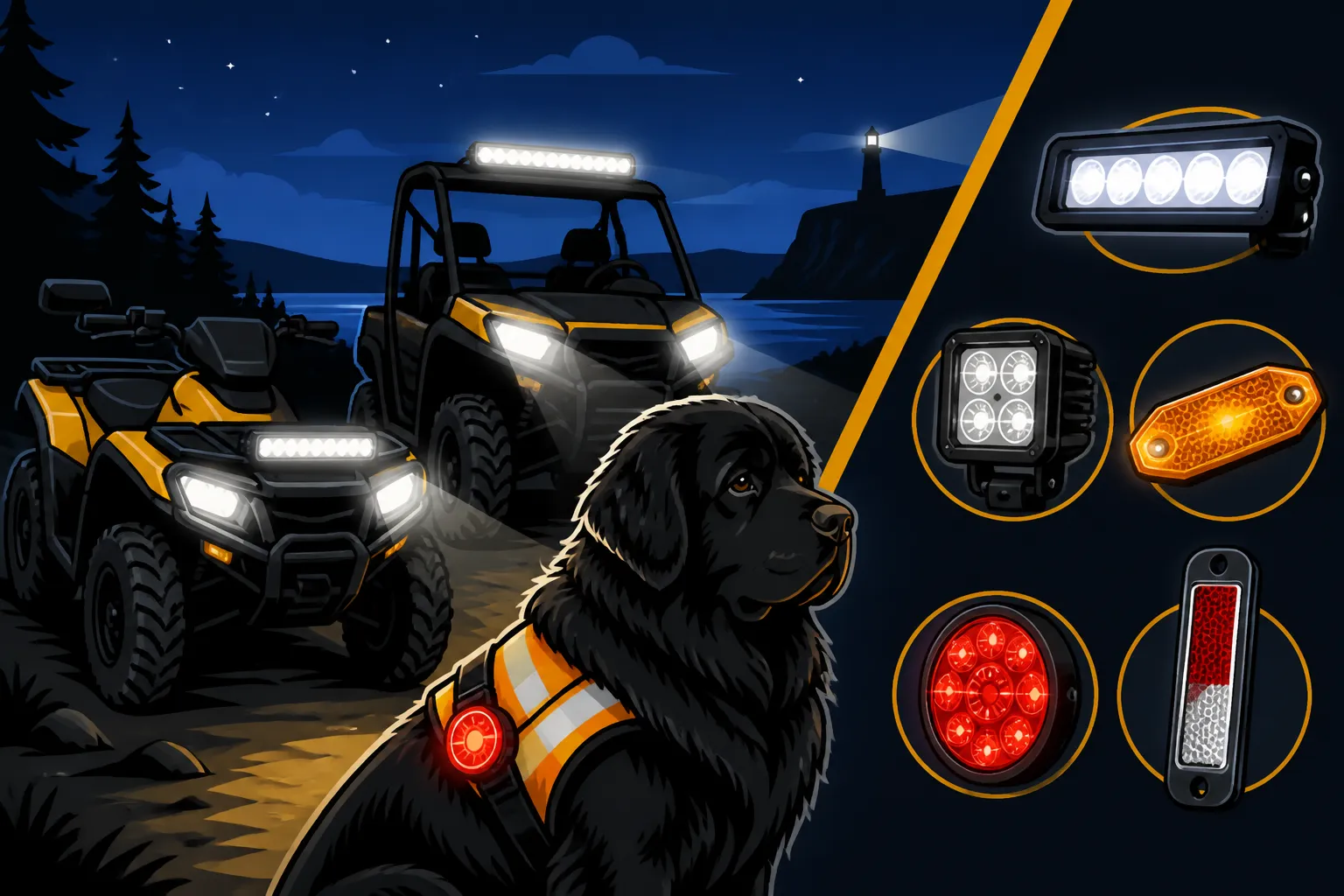
Reflectors are often overlooked, but they're a passive safety feature that works even if your electrical system fails. The Off-Road Vehicles Act mandates specific reflectors for all ATVs and UTVs. You need an amber reflector on each side, positioned as far forward as practical, and a red reflector on each side at the rear, positioned as far back as practical. This creates a visible outline of your machine from the front, sides, and rear, even if your powered lights are off or damaged.
Think about a breakdown on a remote trail after dark. Your machine's lights might go out, but those reflectors will still catch the light from an approaching machine or a searchlight, providing a crucial indicator of your location. They are inexpensive and easy to install, making them a no-brainer for enhancing safety. Make sure they're kept clean and aren't obstructed by cargo or mud, as the law explicitly states that [Newfoundland Plates Unobstructed by Cargo] applies to all identification elements, including reflectors.
Beyond the Basics: Auxiliary Lights and Their Benefits
This is where you can really customize your machine for specific riding needs. Auxiliary lights aren't always legally required, but they offer immense practical benefits. Light bars, for instance, throw an incredible amount of light, often with a wide beam pattern perfect for open barrens or broad trails. Pod lights are smaller, more focused lights that can be mounted to illuminate specific areas, like rock crawling obstacles, or for reverse lighting. Rock lights, mounted underneath your machine, are fantastic for seeing the ground directly below, making it easier to navigate tricky terrain at night.
For those who frequently ride in deeper mud or water, or just want to stand out, LED whip lights can dramatically increase your visibility, especially from a distance or above. When considering aftermarket lighting, brands like SuperATV offer a wide range of options, from powerful LED light bars to durable pod lights designed to withstand the harsh conditions of off-road riding in places like Newfoundland. Just remember to use these powerful lights responsibly. While they're great for seeing far down a dark trail, they can be blinding to oncoming riders or even wildlife. Always be ready to dim or switch off auxiliary lights when approaching others.
Maintenance and Best Practices for Night Riding
Even the best lights won't do you any good if they're not working, or if they're obscured by mud. A little proactive maintenance and smart riding habits go a long way.
Keeping Your Lights and Reflectors Clean and Functional
Newfoundland riding is glorious, but it's also messy. Bog, mud, dust, and coastal spray are all part of the experience, and they love to coat everything, including your lights and reflectors. A layer of grime can significantly reduce the effectiveness of your lights, dulling their output and making you less visible. It's not enough to simply have the lights; you need to ensure they're clean before and after every ride, especially if you know you'll be out past sunset or heading into fog.
Regularly check your bulbs (if applicable), fuses, and wiring for any signs of wear, corrosion, or damage. A loose connection can cause intermittent flickering, which is not only annoying but also dangerous. Modern LED lights are generally more durable, but even they can suffer from impact damage or water ingress if seals fail. Make this part of your routine [Newfoundland Equipment Checks by Officers] as they will certainly be looking at your lights if you're out after dark.
Preparing for a Safe Night Ride
Before you even turn the key for a night ride, a thorough pre-ride check is essential. Confirm all your lights – headlamps, tail lamps, brake lights, and any auxiliary lighting – are functioning correctly. Carry spare fuses and, if your machine uses them, spare bulbs. Having a reliable flashlight or headlamp with fresh batteries in your riding kit is also a wise backup, in case your machine's electrical system has an unexpected issue.
Adjusting your speed is paramount. Even with powerful lights, your reaction time is reduced, and hazards can appear much more suddenly than in daylight. Ride within the limits of your vision and your machine's capabilities. Be extra cautious around water crossings, uneven ground, and heavily wooded areas where shadows can play tricks on your eyes. Remember, the goal is to enjoy the ride safely, not to set a speed record.
Etiquette on Shared Trails After Dark
Newfoundland's trails are often shared spaces, whether with other ATVs, snowmobiles, hikers, or even local residents accessing their cabins. Your powerful lights, especially those aftermarket light bars from companies like SuperATV, can be extremely bright. While fantastic for your own visibility, they can be blinding to others. Good trail etiquette dictates that you dim your lights for oncoming traffic, just as you would in a car on a highway.
If you're approaching another machine, a pedestrian, or a campsite, switch off your auxiliary lights and use your low beams. This simple act shows respect and prevents creating a dangerous situation for others. Also, avoid shining your lights directly into cabins or tents. Remember, we're all out here to enjoy the backcountry, and a little consideration goes a long way to ensure everyone has a positive and safe experience. [Newfoundland Trail Etiquette Locals Expect] really emphasizes these kinds of considerations.
Disclaimer
This article is for general informational purposes only and does not constitute professional advice. Laws, prices and regulations vary by location and change over time. Consult a qualified professional for guidance on your specific situation.