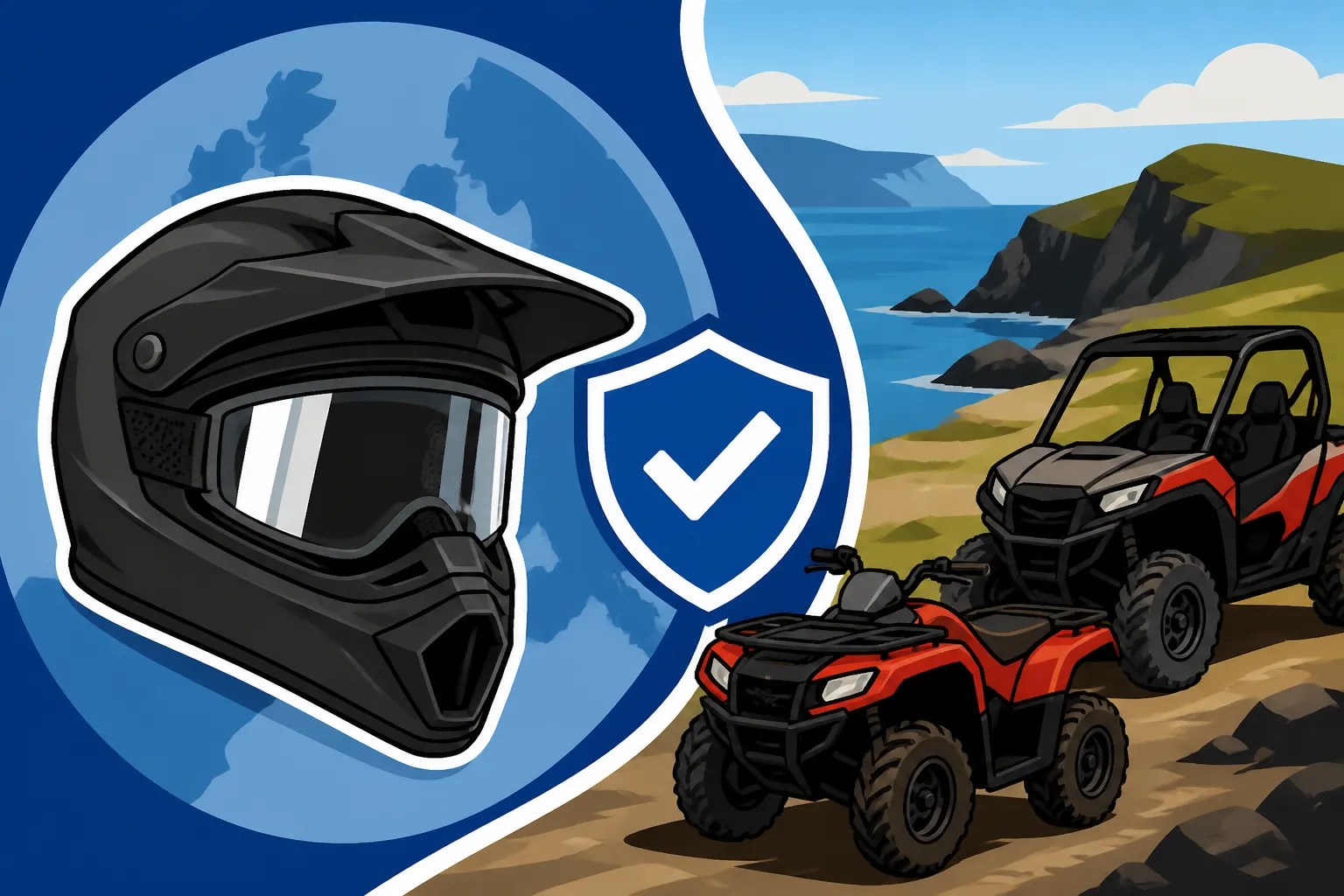
European ECE Helmets and What the Marking Means
It’s a common scenario for ATV and UTV riders here in Newfoundland: you’re shopping for a new helmet, perhaps online or from a larger dealer, and you keep seeing terms like DOT, CSA, and ECE. While you know you need a helmet to ride legally and safely, understanding what these certifications actually mean can feel like trying to decipher an ancient map. This guide is here to untangle the mystery of European ECE helmet markings, explain what they signify for your safety, and help you confidently choose head protection for your adventures on our province’s rugged trails and barrens.
The Global Standard for Safety: What ECE Means
When you see "ECE" stamped on a helmet, you're looking at a certification that carries significant weight in the world of motorsports safety. ECE stands for "Economic Commission for Europe," and its standard, ECE Regulation 22, is widely recognized as one of the most stringent and comprehensive helmet safety certifications globally. It's not just for Europe; many countries worldwide either adopt ECE standards directly or use them as a foundation for their own regulations, a testament to their rigorous testing protocols. For us riders in Newfoundland, knowing a helmet is ECE certified means it meets a high bar for protection.
Origins and Authority: Why ECE Matters to Riders
The ECE 22 standard is developed and enforced under the auspices of the United Nations Economic Commission for Europe (UNECE). The most common versions you'll encounter are ECE 22.05, which was prevalent for many years, and the newer ECE 22.06, introduced to address more modern understanding of helmet impacts, particularly rotational forces. The shift to 22.06 brought even more rigorous testing, including a wider range of impact points, different impact speeds, and specific tests for accessories like visors and communication systems.
This continuous evolution means that when you buy an ECE-certified helmet, especially a newer 22.06 model, you're investing in protection that has been scrutinized by leading experts. Unlike some standards that rely heavily on manufacturer self-certification, ECE requires helmets to be batch-tested by independent labs. This oversight provides an extra layer of assurance for riders. Here in Newfoundland, where the terrain can be unpredictable and conditions can change rapidly, having a helmet with such a robust certification offers immense peace of mind. The provincial regulations for off-road vehicles simply state that helmets must meet certain recognized standards, and ECE is absolutely one of them. In fact, European ECE Helmets and What the Marking Means is accepted on provincial trails right alongside North American standards.
Decoding the ECE Label: Where to Find the Proof
So, you've got an ECE helmet, but what do all those numbers and letters actually mean? The ECE marking is usually found on a sticker sewn into the chin strap or an official label inside the helmet's liner. It’s not just a fancy logo; it's a code providing critical information about the helmet's certification.
Look for a circle containing an uppercase "E" followed by a number. This number indicates the country where the helmet received its type approval. For example:
- E1: Germany
- E2: France
- E3: Italy
- E4: Netherlands
- E6: Belgium
- E11: United Kingdom (even post-Brexit, this is often still used for existing approvals)
- E13: Luxembourg
- E22: Russia
After the circle, you'll see a series of numbers. The first two digits denote the regulation series – usually 05 for ECE 22.05 or 06 for ECE 22.06. This is followed by the actual approval number, which is unique to that specific helmet model and manufacturer. Further digits might indicate the type of helmet (e.g., "J" for jet/open-face, "P" for protective full-face, "NP" for non-protective chin bar, or "P/J" for modular helmets approved for use with the chin bar both open and closed).
For example, a label might read something like: E11 051234/J-12345.
- E11: Approved in the United Kingdom.
- 05: Meets ECE Regulation 22.05.
- 1234/J: The helmet's unique approval number, and it's a jet (open-face) helmet.
- 12345: The production serial number.
Understanding this marking confirms that your helmet is genuinely certified, giving you confidence that it adheres to the strict safety requirements. When you're gearing up for a ride through the woods near your cabin or heading out on a multi-day trip on the [Newfoundland ATV Trails: The T'Railway and Beyond], knowing your helmet's certification is clear and recognized is a vital part of your preparation.
Comparing ECE to Other Helmet Standards Accepted in Newfoundland
While ECE stands out for its comprehensive approach, it's not the only recognized standard for helmets in Newfoundland. Our provincial regulations accept helmets that meet a few different certifications. This can sometimes cause confusion for riders trying to figure out if their lid is legal or, more importantly, safe enough for the demands of off-road riding. Let’s break down how ECE compares to some of the other common standards you’ll encounter.
ECE vs. DOT: A Look at Testing Philosophies
The DOT certification, issued by the U.S. Department of Transportation, is arguably the most common standard seen on helmets available in North America. While DOT-certified helmets are perfectly legal for riding ATVs and UTVs here, the philosophy behind its testing differs quite a bit from ECE.
DOT standards (specifically FMVSS 218) generally focus on impact attenuation and penetration resistance. They ensure the helmet can protect your head from single, sharp impacts. However, the DOT system relies heavily on manufacturer self-certification. This means manufacturers test their own helmets according to DOT guidelines, and while random audits do occur, there isn't the same level of independent batch testing as with ECE.
ECE, especially the 22.06 standard, goes further. Beyond impact and penetration, ECE 22.06 includes tests for:
- Rotational forces: Addressing oblique impacts that can cause dangerous twisting of the brain.
- A wider range of impact points: Testing more areas of the helmet shell.
- Multiple impact speeds: Simulating different crash scenarios.
- Accessory testing: Ensuring visors, chin guards, and other components don't compromise safety.
For a rider navigating the rocky terrain or dense wooded paths of Newfoundland, these additional considerations in ECE testing can be a significant advantage. While both standards ensure a baseline of safety, ECE's approach often leads to helmets designed to handle a broader spectrum of real-world accident dynamics. It's good to know that [US-Approved Helmets Are Accepted on Provincial Trails], so a DOT helmet is fine, but ECE often offers that extra layer of engineering.
ECE vs. CSA: The Canadian Context
The Canadian Standards Association (CSA) also publishes helmet standards, primarily CSA D230 for motorcycle helmets. While CSA is a respected Canadian authority, CSA-certified ATV and motorcycle helmets are not as common on the market as DOT or ECE alternatives. Often, helmets sold in Canada will carry a DOT or ECE certification, or sometimes both.
CSA standards are rigorous and focus on impact absorption and retention system effectiveness, much like DOT. However, they are specifically Canadian in origin and address the specific needs and regulatory environment here. If you encounter a helmet with a CSA sticker, rest assured that it too meets a recognized standard for safety in Canada. Many riders in Newfoundland are most familiar with seeing the [Helmets Carrying the Canadian CSA Approval Marking] on industrial hard hats or bicycle helmets, but it does apply to motorized recreational vehicles as well.
Ultimately, the choice comes down to availability and personal preference. All three standards—ECE, DOT, and CSA—are designed to protect your head. However, the ECE standard is often perceived by many safety experts and riders as having the most comprehensive and up-to-date testing protocols, particularly with the introduction of ECE 22.06.
Here’s a quick overview of how these helmet standards stack up:
| Standard | Authority | Key Testing Aspects | Acceptance in Newfoundland |
|---|---|---|---|
| ECE | UN Economic Commission for Europe | Rigorous impact (wide range of points, speeds), rotational forces, penetration, abrasion, accessory testing, batch testing. | Fully accepted and highly regarded. |
| DOT | US Department of Transportation | Impact attenuation, penetration resistance, retention system strength; manufacturer self-certification with audits. | Fully accepted. |
| CSA | Canadian Standards Association | Impact absorption, retention system effectiveness; similar to DOT in scope. | Fully accepted, though less common on ATV/UTV helmets. |
Why Choosing an ECE-Certified Helmet is a Smart Move for Newfoundland Riders
For anyone who hits the trails, barrens, or cabin roads in Newfoundland, safety is paramount. The unique challenges of our landscape – from dense forest tracks to wide-open, windswept bogs – demand reliable gear. An ECE-certified helmet, particularly one meeting the latest 22.06 standard, brings a level of protection and confidence that makes it an exceptionally smart choice.
Advanced Protection for Diverse Riding Conditions
The comprehensive testing behind ECE certification directly translates to enhanced protection for the varied riding conditions we experience here. Newfoundland trails aren't just flat, manicured paths; they feature unexpected dips, rocky ascents, muddy descents, and sudden encounters with wildlife. An impact isn't always a direct, straight-on hit. It can be an oblique strike against a tree branch, a glancing blow from a fall, or a multi-directional force.
ECE’s emphasis on rotational impact testing, which simulates those twisting, glancing blows that can cause significant brain injury, is a huge benefit. Older standards often focused solely on linear impacts. With an ECE 22.06 helmet, you're getting a helmet engineered to better dissipate these complex forces, reducing the risk of concussion and other brain trauma. Furthermore, ECE testing scrutinizes the entire helmet system – the shell, the liner, the retention system, and even the visor. This means components like your visor or goggles (especially important if you're not riding with a full windshield, even if companies like SuperATV offer excellent accessory options to enhance visibility) are also held to high safety standards, ensuring they won't shatter dangerously or detach during an impact. [Goggles Unless There Is a Windshield] are a critical part of your [Newfoundland Equipment Requirements], and an ECE helmet will ensure their interaction with the helmet shell is designed for maximum safety.
Imagine you're riding a [Newfoundland Rules for a Side-by-Side Driver] through a thick forest and a low-hanging branch catches your helmet. An ECE-certified helmet is designed to withstand such unpredictable forces, offering superior shell integrity and energy absorption to protect your head.
Comfort, Fit, and Durability on Long Newfoundland Journeys
Beyond raw protection, ECE certification often implies a higher standard of overall helmet design and construction, which directly impacts comfort, fit, and durability – all crucial for enjoyable and safe long rides. When you're spending hours on the machine, perhaps on a multi-day trip across the T'Railway or exploring remote [Newfoundland Rules for Riding Crown Land], a comfortable helmet is not a luxury; it's a necessity.
ECE-approved helmets tend to feature more advanced shell materials and construction techniques, leading to lighter helmets with better weight distribution. This reduces neck strain over extended periods. The interior liners are often made from high-quality, moisture-wicking materials that can be removed and washed, which is a blessing after a sweaty summer ride or a muddy excursion. Proper ventilation, also a factor in ECE design, helps keep your head cool and fog-free, improving visibility and reducing fatigue.
A correct fit is absolutely non-negotiable for helmet safety. An ECE helmet, while rigorously tested, still needs to fit you perfectly. When you're trying one on, it should feel snug all around your head, without any painful pressure points. It shouldn't move side-to-side or up-and-down easily. And remember, your [Your Chin Strap Has to Be Fastened] at all times. A well-fitting, ECE-certified helmet not only offers superior protection but also enhances your riding experience by providing comfort and reducing distractions, allowing you to focus on the trail ahead, whether it's [Newfoundland Rules for Riding After Dark] or in the bright afternoon sun.
Practical Advice for Purchasing and Maintaining Your ECE Helmet
Choosing and caring for your ECE-certified helmet is just as important as the certification itself. A top-tier helmet won't do its job if it doesn't fit right or if it's been neglected. For Newfoundland riders, whose machines and gear endure everything from sea spray to freezing temperatures, proper maintenance is key to longevity and consistent safety.
Finding the Right Fit and Features
The first rule of helmet safety, regardless of certification, is fit. An ill-fitting helmet can shift during an impact, negating much of its protective capability. Here's how to ensure a proper fit:
- Measure Your Head: Use a cloth measuring tape and wrap it horizontally around your head, just above your eyebrows and ears, at the widest point. Note the measurement in centimetres.
- Consult Size Charts: Every helmet manufacturer has a size chart that corresponds to head measurements. Use this as your starting point.
- Try It On: This is crucial. When you put the helmet on, it should feel snug all over your head, with no uncomfortable pressure points. Your cheeks should be slightly compressed.
- The Shake Test: With the chin strap fastened, try to move the helmet from side to side and up and down. Your scalp should move with the helmet; the helmet shouldn't slide independently. If it does, it's too big.
- The Strap Test: Fasten the chin strap securely. Try to roll the helmet off your head from the back. If it rolls forward, the strap isn't tight enough, or the helmet might be the wrong shape for your head.
When considering features, think about Newfoundland's climate and riding style. Good ventilation is important for warmer days and preventing fogging. If you wear prescription glasses, ensure the helmet accommodates them comfortably. Also, consider the type of riding you do: a full-face helmet offers maximum protection, while a modular or open-face helmet might be preferred by some for communication or airflow, though with reduced facial protection. Always buy from a reputable dealer, online or in person, to ensure you're getting a genuine, uncompromised product. Companies that specialize in off-road accessories, such as SuperATV, may also offer helmet-related gear or advice for enhancing your riding comfort and safety.
Caring for Your Investment: Longevity and Safety
Your helmet is a critical piece of safety equipment, and it deserves proper care to maintain its protective qualities over time.
- Cleaning: Use mild soap and water for the exterior shell and visor. Harsh chemicals can degrade helmet materials, especially the shell's finish or the visor's anti-fog/scratch coatings. For removable liners, follow the manufacturer's washing instructions, usually a gentle hand wash and air dry.
- Storage: Store your helmet in a cool, dry place, away from direct sunlight and extreme temperatures. Avoid hanging it by the chin strap or placing it on surfaces where it might roll off. A helmet bag is an excellent investment to protect it from scratches and dust. Ensure it's not stored where it could be exposed to chemicals like gasoline fumes, which can subtly degrade the helmet's structural integrity over time.
- Inspection: Regularly inspect your helmet for any signs of damage. Look for cracks, dents, or deep scratches on the shell, any fraying or damage to the chin strap, and compression or tearing of the interior liner. Even seemingly minor damage can compromise the helmet's ability to protect you in a crash.
- Replacement: This is the most important, and often overlooked, aspect of helmet care.
- After an Impact: Even if a helmet looks fine after a drop or crash, its internal impact-absorbing EPS (Expanded Polystyrene) liner can be compressed and damaged. Always replace a helmet after it has sustained any significant impact, regardless of visible exterior damage.
- Age: Helmet manufacturers generally recommend replacing helmets every five to seven years from the date of manufacture, or three to five years from the date of first use, even if they haven't been in an accident. Over time, materials like resins, adhesives, and liner foams can degrade due to exposure to UV light, sweat, oils, and general wear and tear, reducing their effectiveness.
By diligently selecting an ECE-certified helmet that fits perfectly and maintaining it meticulously, you’re not just following [Newfoundland Helmet Law for Every Rider]; you're actively ensuring you have the best possible protection for all your adventures across Newfoundland’s incredible landscapes. Don't forget that [Helmets Are Required for Operators and Passengers Alike], so everyone in your riding party needs this level of attention to safety. Following [Newfoundland Trail Etiquette Locals Expect] includes being prepared and safe, and your helmet is at the top of that list.
Disclaimer
This article is for general informational purposes only and does not constitute professional advice. Laws, prices and regulations vary by location and change over time. Consult a qualified professional for guidance on your specific situation.