Newfoundland Exhaust and Muffler Rules
There's nothing quite like the roar of a powerful ATV or UTV as you hit the trails or navigate a barren, but that very sound can quickly become a source of frustration, not just for other trail users and nearby residents, but for you if your machine falls afoul of Newfoundland's off-road vehicle rules. This guide is here to help you understand the specific exhaust and muffler regulations in our beautiful province, ensuring your rides are enjoyable and penalty-free.
The Heart of the Matter: Why Exhaust Rules Exist
It's easy to think of your machine's exhaust as just a pipe that sends fumes out, but it’s so much more than that. It's a critical component that manages emissions, directs hot gases safely away from the engine and rider, and, perhaps most importantly in a regulatory sense, controls noise. The rules around exhaust and mufflers are designed to strike a balance: allowing riders to enjoy their passion while minimizing disturbance to wildlife, other people, and the environment.
Understanding the Off-Road Vehicles Act
In Newfoundland, the rules governing off-road vehicles, including their exhaust systems, are primarily found within the Off-Road Vehicles Act and its associated regulations. This legislation isn't just a suggestion; it's the law, and peace officers are empowered to enforce it. The Act aims to promote safe and responsible operation of machines on all types of terrain, and that includes ensuring your machine isn't an auditory nuisance or a fire hazard because of a faulty or modified exhaust. It’s about keeping our shared spaces pleasant for everyone, from hikers on the T'Railway to families enjoying a quiet cabin weekend. [A Statute in Force Since May 2022]
The Role of Mufflers and Exhaust Systems
Your muffler isn't just there to make your machine sound pleasant; it's a vital part of its operation. A well-maintained exhaust system ensures that your engine operates efficiently, that dangerous exhaust gases are properly vented, and that the noise produced is within acceptable limits. When you start tinkering with these systems, you risk not only voiding warranties but also creating a machine that's illegal to operate on many, if not all, public access areas. Riders often overlook the importance of these components until they receive a ticket or have their machine seized, which is a lesson no one wants to learn the hard way.
Deciphering Newfoundland's Noise and Equipment Standards
When it comes to your ATV or UTV, the sound it makes is a big deal to regulators. Newfoundland has clear expectations about how loud your machine can be and what kind of equipment it needs to have. It's not just about what sounds good to you; it's about what's permissible under the law.
The "Gases Cooled and Expelled Quietly" Mandate
One of the foundational principles in the regulations is that exhaust gases must be "cooled and expelled quietly." This isn't just a poetic phrase; it's a legal requirement. What it boils down to is that your machine's exhaust system, including the muffler, must be fully functional and effective at reducing engine noise to a reasonable level. It means no excessive noise, no loud popping, and certainly no wide-open headers. When you're out riding on Crown land or along a shared railbed, the expectation is that your machine's sound should blend into the background as much as possible, not dominate the soundscape. [Gases Cooled and Expelled Quietly]
The exact decibel limits might not always be posted on every trail, but the general rule is clear: if your machine sounds significantly louder than a stock equivalent, you're likely running afoul of this regulation. This is where many riders get into trouble, especially those who think "louder is better." While a throaty rumble might appeal to some, it quickly draws unwanted attention from peace officers and can lead to fines. It’s always best to err on the side of caution and keep your exhaust system as close to its original, factory-installed state as possible.
Prohibitions Against Modifying or Removing Mufflers
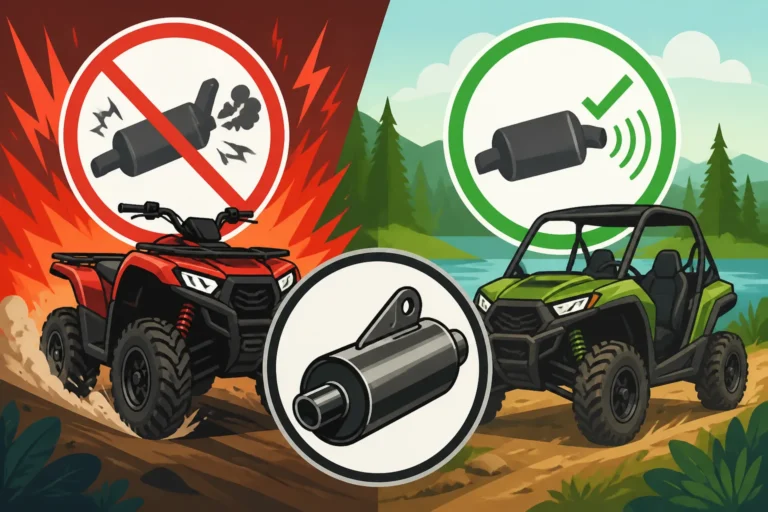
This is a big one, and it's where many aftermarket modifications run into trouble. The Off-Road Vehicles Act explicitly states that no person shall operate an off-road vehicle where the muffler or exhaust system has been removed, altered, or modified in a way that increases its noise output beyond factory specifications. This means those "straight pipes" or "muffler deletes" you see on some machines are a definite no-go. Even installing an aftermarket performance exhaust that claims to boost horsepower might be illegal if it doesn't meet the noise suppression standards. [Newfoundland Exhaust and Muffler Rules]
It's not just about outright removal; even internal modifications, like removing baffles or drilling holes, can fall under this prohibition. The intent of the law is to keep noise levels down, and any alteration that compromises this intent is likely illegal. Riders need to be incredibly careful when considering performance upgrades for their machines. While companies like SuperATV offer fantastic accessories and performance parts, it's always the rider's responsibility to ensure that any modification, especially to the exhaust, complies with local laws before hitting the trails. Otherwise, that performance boost might come with a hefty fine.
Aftermarket Exhausts: Navigating the Upgrade Landscape
The world of aftermarket parts for ATVs and UTVs is vast and exciting. There are countless options for improving performance, aesthetics, and durability. However, when it comes to exhaust systems, this is an area where caution is paramount. Many riders dream of a more aggressive sound or a few extra horsepower, but these desires can quickly lead to legal headaches if not approached correctly.
When Is an Aftermarket Exhaust Legal?
An aftermarket exhaust system can be legal in Newfoundland, but it's a narrow path. The key is that the replacement system must still meet or exceed the original equipment manufacturer's (OEM) noise suppression standards. This means it cannot be louder than the stock exhaust. Some aftermarket manufacturers produce "street legal" or "quiet core" options that are specifically designed to comply with noise regulations. If you're considering an upgrade, look for systems that are clearly marked as compliant with SAE J1287 or other similar noise emission standards, and always double-check with the manufacturer or a reputable dealer to confirm its legality in Newfoundland.
It's not enough for a system to claim it's quiet; it has to actually be quiet. Peace officers often rely on their ears and experience to determine if a machine is excessively loud. If they flag your machine, the burden of proof often falls on you to demonstrate its compliance. This is why keeping documentation for any aftermarket exhaust, verifying its noise rating, can be incredibly helpful if you ever face a stop. Remember, the goal isn't just to be quiet enough to avoid a ticket, but to be a respectful rider in shared environments.
The Problem with "Cut-Out" Exhausts and Other Modifications
The regulations specifically target modifications that increase noise, and "cut-out" exhausts are a prime example of what's absolutely not allowed. A cut-out system is essentially a valve that allows exhaust gases to bypass the muffler entirely, resulting in a dramatically louder machine at the flip of a switch. These systems are designed for closed-course racing or off-highway use where noise isn't a concern, but they are illegal for use on public trails, roads, or any area governed by the Off-Road Vehicles Act. [Cut-Out Exhausts Draw Fines From $250 Up]
Other problematic modifications include:
- Straight pipes: Removing the muffler altogether and replacing it with a straight section of pipe. This is a guaranteed ticket.
- Muffler deletes: Removing the muffler and replacing it with a small, less restrictive resonator, which still increases noise significantly.
- Baffle removal: Taking out the internal baffles from a stock or aftermarket muffler to make it louder. This alters the original design and increases noise.
- Drilling holes in the muffler: A common, ill-advised modification to create a louder sound, which also reduces the muffler's effectiveness and can lead to premature failure.
Any of these modifications are a clear violation of the Act and will likely result in penalties. While you might see riders on trails with these modifications, they are taking a significant risk. Enforcement can happen anywhere, and the consequences can be quite severe.
Penalties and Enforcement for Exhaust Violations
Nobody wants to face fines or have their machine impounded, but these are very real consequences for operating an ATV or UTV with an illegal exhaust system in Newfoundland. Peace officers, including the RCMP, municipal police, and provincial park wardens, are well aware of the regulations and are actively on the lookout for machines that violate them.
Fines for Defective or Modified Mufflers
The Off-Road Vehicles Act outlines specific penalties for equipment violations, and muffler issues fall squarely into this category. If you're caught operating a machine with a defective, removed, or illegally modified muffler or exhaust system, you can expect a fine. While specific amounts can vary, the Act sets ranges for these penalties. For instance, initial fines for such offences can start at a couple of hundred dollars and go up significantly for repeat offenders or more egregious violations. It's a quick way to turn an enjoyable ride into a very expensive one. [Newfoundland Fines for a Defective Muffler]
Beyond the immediate fine, you might also be issued an order to fix the issue, meaning you can't ride your machine again until the exhaust system is brought into compliance. This can be a real hassle, especially if you're far from home or have to source specific parts. It’s far better to invest in a compliant system upfront or maintain your stock exhaust properly than to deal with the financial and logistical nightmare of a violation.
Potential for Machine Seizure and Early Release Fees
This is the consequence that really stings. In some cases, if your machine is deemed to be in violation of the Act, particularly for significant equipment issues like a drastically illegal exhaust, a peace officer has the authority to seize your off-road vehicle. Imagine your quad being loaded onto a tow truck right there on the trail – not a fun scenario. If your machine is seized, you'll not only face the initial fine but also impoundment fees, towing charges, and potentially an early release fee if you want to get it back sooner. [Newfoundland Machine Seizure Rules]
These costs can quickly add up, often exceeding the cost of the fine itself. The process of getting a seized machine back can be complicated, requiring proof that the violations have been rectified and all associated fees have been paid. This is a severe deterrent meant to ensure compliance and responsible operation. It highlights just how seriously the province takes these regulations, especially those that impact public safety and enjoyment.
Maintaining Your Exhaust System for Compliance
Keeping your exhaust system in good working order isn't just about avoiding fines; it's about ensuring your machine runs safely and efficiently. A well-maintained system prevents leaks, reduces noise, and keeps harmful emissions in check. This is an area where proactive care pays dividends.
Regular Inspections and Repairs
Just like any other part of your ATV or UTV, the exhaust system takes a beating out on the trails. It's exposed to mud, water, rocks, and vibrations, all of which can lead to wear and tear. Make it a habit to regularly inspect your exhaust system for signs of damage:
- Cracks or holes: These can allow exhaust gases to escape prematurely, increasing noise and potentially allowing harmful fumes into the rider compartment on UTVs.
- Loose connections or hangers: Vibrations can loosen bolts and mounts, causing rattles or even allowing parts of the exhaust to fall off.
- Corrosion: Especially in our coastal climate, rust can be a major issue. Inspect welds and seams for signs of rust that could lead to perforations.
- Muffler packing: Over time, the sound-dampening material (packing) inside the muffler can degrade or blow out, leading to a much louder machine. Some mufflers are serviceable, allowing for repacking, while others require replacement.
Addressing these issues promptly prevents them from becoming bigger, more expensive problems, and ensures your machine remains compliant with noise regulations. If you're unsure about a repair, it's always best to consult a qualified mechanic.
OEM vs. Aftermarket Parts for Repairs
When it comes time to replace parts of your exhaust system, you generally have two choices: OEM (Original Equipment Manufacturer) parts or aftermarket components.
- OEM parts: These are identical to the parts your machine came with from the factory. They are guaranteed to fit perfectly and meet all original specifications, including noise levels. While sometimes more expensive, they offer peace of mind regarding compliance.
- Aftermarket parts: Many companies, including those like SuperATV, offer high-quality replacement exhaust components. When choosing aftermarket parts for repair, ensure they are designed as direct replacements and explicitly state compliance with noise regulations. Avoid anything marketed as "race-only" or "off-road use only" if you plan to ride on public lands, as these are almost certainly too loud.
The general rule of thumb for repairs is to replace damaged components with parts that maintain the original noise suppression levels. If your muffler is rusted out or has a hole, replacing it with a new, quiet-core aftermarket muffler or an OEM unit is the way to go. Trying to patch up significant damage often leads to short-term fixes that eventually fail and can still leave you exposed to fines.
The Broader Impact: Noise, Environment, and Trail Access
The noise your ATV or UTV makes isn't just about legality; it has real-world implications that affect everyone's enjoyment of our outdoor spaces and, ultimately, the future of off-road riding in Newfoundland. Understanding these broader impacts can help foster a more responsible riding culture.
Minimizing Disturbance to Wildlife and Residents
Excessive noise from off-road vehicles can be incredibly disruptive. For wildlife, sudden loud noises can cause stress, alter feeding and breeding patterns, and drive animals away from important habitats. This is particularly critical in sensitive areas like caribou migration routes or nesting grounds. [Newfoundland Caribou Migration Protection] For residents living near trails or in cabin country, constant loud exhaust noise can be a significant source of frustration, leading to complaints to authorities and calls for stricter regulations or even trail closures.
As riders, we have a shared responsibility to be good neighbours to both nature and people. Operating machines with properly functioning, quiet exhaust systems is a fundamental part of this responsibility. It demonstrates respect for the environment we cherish and for the communities we ride through. Thinking about the cumulative impact of many machines all making excessive noise really puts the individual responsibility into perspective. [Newfoundland Noise Complaints About Quads]
The Link Between Noise and Trail Access
There's a direct correlation between rider behaviour, especially concerning noise, and the availability of trails. When noise complaints spike, local municipalities, provincial land managers, and even federal parks can be pressured to impose more restrictions, limit access, or even close trails entirely. We've seen this happen in various places, where a few irresponsible riders spoil it for everyone else.
Ensuring your machine meets exhaust noise standards is a key factor in maintaining positive relationships with landowners, residents, and government agencies. It helps preserve the privilege of accessing our incredible network of trails, from the expansive T'Railway to the countless miles of woods roads and barrens. If we want to keep riding free and open, collective adherence to rules like muffler requirements is absolutely vital. [Newfoundland Crown Land Riding Rules]
| Exhaust System Component | Purpose | Compliance Requirement | Common Issues |
|---|---|---|---|
| Header Pipes | Collect exhaust gases from engine cylinders | Must be leak-free and properly sealed | Cracks, loose flanges, rust, bent pipes from impacts |
| Muffler | Reduces exhaust noise | Must be fully functional, not modified to increase noise, and expel gases quietly | Internal packing degradation, rust-through, holes, removed baffles, "straight pipe" modifications |
| Spark Arrestor | Prevents hot carbon particles from exiting exhaust (not universally required in NL, but good practice) | Not explicitly required in NL's Off-Road Vehicles Act, but often integrated into OEM mufflers. Always recommended, especially in dry conditions. | Clogging (requires cleaning), damage, removal (can increase fire risk) |
| Exhaust Tip | Directs exhaust gases away from machine/rider | Must be properly secured and functional | Bent, broken, or missing; can lead to increased noise if damaged |
| Catalytic Converter | Reduces harmful emissions (more common on UTVs/newer ATVs) | Must be present and functional if originally equipped | Clogging, damage from impacts, removal (illegal and increases emissions) |
| Mounting Hardware | Secures the exhaust system to the machine | Must be present and tight to prevent rattles/damage | Loose bolts, worn rubber hangers, broken brackets |
Final Thoughts for Responsible Riders
Navigating the rules and regulations for ATVs and UTVs in Newfoundland can sometimes feel like a maze, but when it comes to exhaust and muffler rules, the message is clear: keep it quiet, keep it compliant. This isn't just about avoiding a ticket; it's about respecting our environment, our communities, and the future of off-road riding in our province.
Always aim for a stock or factory-equivalent sound level. If you're thinking about an upgrade, do your homework, ensure it's street-legal, and remember that "louder" usually means "illegal" when it comes to public trails. Let's all do our part to keep the trails open and our riding experiences positive for everyone.
Disclaimer
This article is for general informational purposes only and does not constitute professional advice. Laws, prices and regulations vary by location and change over time. Consult a qualified professional for guidance on your specific situation.