Hauling a Machine to a Railbed Trailhead
Heading out to hit the railbed trails in Newfoundland with your ATV or UTV is always an exciting prospect, but the journey to the trailhead itself can sometimes feel like a whole separate adventure. Many riders face the challenge of safely and legally transporting their valuable machines, worrying about proper securing, road regulations, and knowing where to actually unload once they arrive. This comprehensive guide is here to walk you through everything you need to know about hauling your off-road vehicle to a Newfoundland railbed trailhead, ensuring a smooth start to your ride.
The Initial Haul: Gearing Up Your Rig for Newfoundland Roads
Before you even think about hitting the highway, getting your ATV or UTV safely onto a trailer and ready for the road is paramount. This isn't just about avoiding a ticket; it's about protecting your investment, other drivers, and yourself. Newfoundland's roads, with their varying conditions and winding paths, demand a well-prepared transport setup.
Choosing the Right Trailer for Your Machine
The first step in any successful haul is having the right equipment. Your off-road vehicle needs a trailer that can handle its weight, dimensions, and the rigours of travel. Whether you own a compact ATV or a larger side-by-side, the trailer must be appropriately sized and rated. An open utility trailer is a common choice, offering flexibility for various loads, while dedicated ATV/UTV trailers often feature integrated ramps and tie-down points that make loading and unloading a breeze. For those who frequently transport multiple machines or require added security and weather protection, an enclosed cargo trailer might be worth the investment, though they come with higher costs and greater towing demands.
Consider the gross vehicle weight rating (GVWR) of your trailer, which specifies the maximum allowable weight of the trailer plus its cargo. Your machine’s weight, plus any gear, must fall comfortably within this limit. Overloading isn't just dangerous; it can lead to excessive wear on your tow vehicle and trailer, and could even result in fines if stopped by law enforcement. Also, think about the braking system. Many larger trailers, especially those carrying heavier UTVs, are equipped with surge brakes or electric brakes, which are crucial for maintaining control, particularly on Newfoundland's hilly terrain or during emergency stops.
It's also wise to consider the material and construction of the trailer. Aluminum trailers are lighter, reducing the overall towing weight and potentially improving fuel economy, but often come at a higher price point. Steel trailers are more robust and generally less expensive, but they are heavier and susceptible to rust, especially with exposure to road salt during winter hauling or the coastal air. Regardless of your choice, ensure the trailer is in good condition, with functioning lights, good tires, and a sturdy frame, before you load up for any trip, long or short.
Securing Your ATV or UTV for the Journey
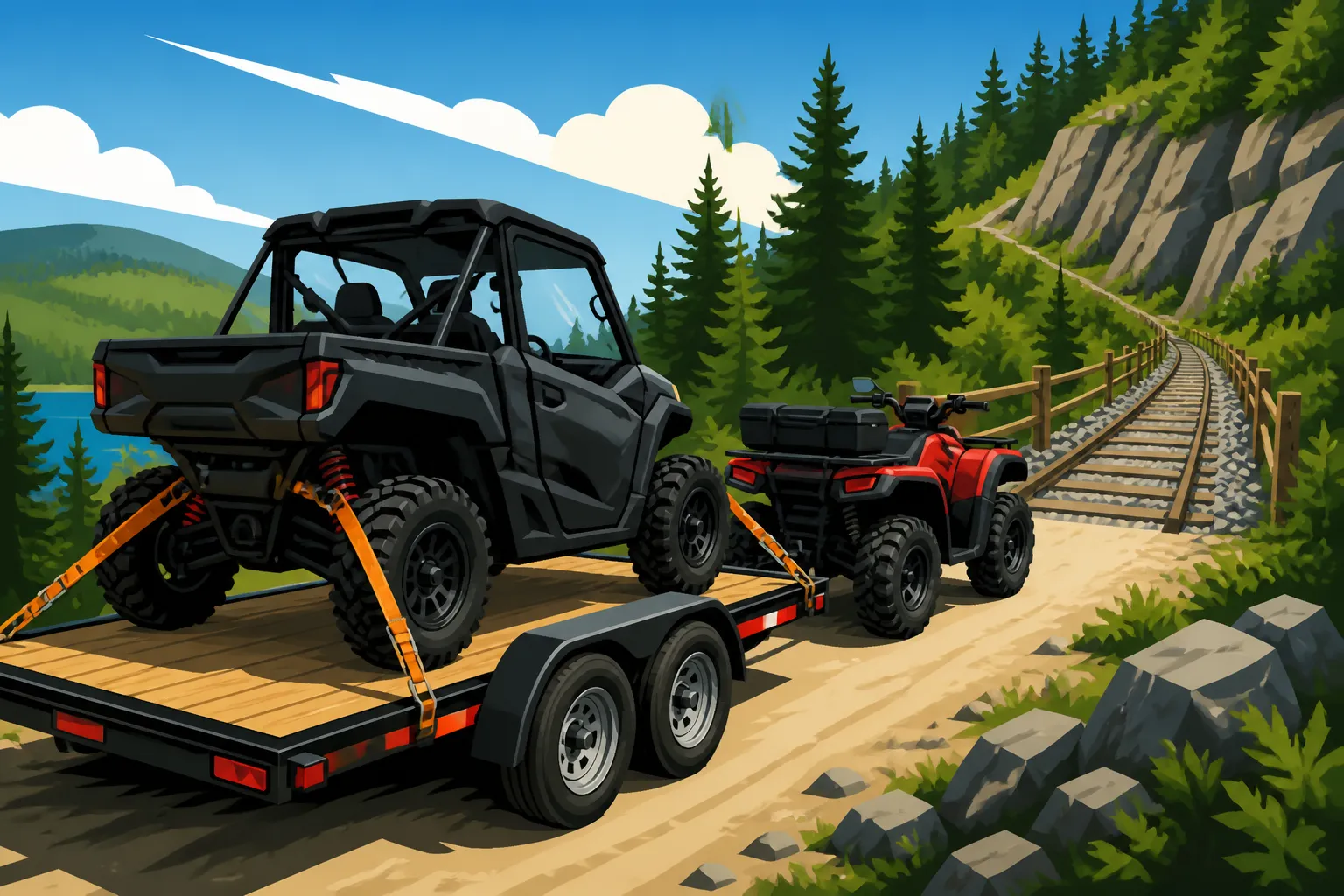
Once you’ve got your machine loaded onto the trailer, the next critical step is securing it properly. This isn't a task to rush or skimp on; a loose ATV or UTV can shift during transit, causing instability for your tow vehicle or, worse, detaching completely. Use heavy-duty ratchet straps rated for more than the weight of your machine. You’ll want at least four tie-down points, one at each corner, pulling the machine forward and backward, as well as downwards. Avoid using cheap ropes or bungee cords, which are prone to stretching, breaking, or simply not providing enough holding power.
Focus on securing the frame of your ATV or UTV, rather than suspension components or handlebars. Strapping down the suspension too tightly can compress it for the entire journey, potentially damaging shocks or springs over time. Instead, find solid points on the machine's frame or dedicated tie-down loops. Many modern side-by-sides have specific points designed for transport. Before tightening, ensure the machine is in park and the emergency brake is engaged. Once everything is snug, give the machine a good shake to confirm it won't budge.
It’s also a good practice to double-check your tie-downs after driving a short distance, say 10-15 minutes down the road. Road vibrations and initial movements can sometimes cause straps to loosen slightly. Pull over safely and re-tension as needed. Additionally, consider removing any loose accessories from your ATV or UTV, such as fuel cans, coolers, or detachable windshields, and store them securely in your tow vehicle or inside the trailer. This prevents them from becoming projectiles or flying off during transit, protecting both your gear and other drivers.
Understanding Newfoundland's Trailer Registration and Regulations
Just like your ATV or UTV, your trailer needs to be properly registered and equipped to be legal on Newfoundland and Labrador roads. If you're using a utility trailer that's not exclusively for your off-road vehicle, it still needs its own registration and a valid license plate. The requirements can vary slightly depending on the size and weight of the trailer, so it's always a good idea to confirm with Motor Registration Division. If you're buying a new trailer, the dealer will typically handle the initial registration process, but if you're acquiring a used one, you'll need to handle the transfer of ownership yourself. You can find more information on general vehicle registration by looking up [Newfoundland Registration Paperwork Explained].
Beyond registration, ensure your trailer meets all lighting requirements. This includes brake lights, turn signals, and tail lights that are visible and functioning. Many trailers also require side marker lights and reflectors, especially if they are wider or longer. A safety chain, correctly rated for the trailer’s weight, is a non-negotiable item that provides a backup connection to your tow vehicle in case of hitch failure. This chain should be crossed under the tongue of the trailer to cradle it, preventing the tongue from hitting the road if it separates.
Finally, remember that if you're borrowing a trailer from a friend or renting one, it’s a good idea to have some form of written agreement. While not strictly required by law for informal borrowing, a simple document can clarify responsibilities in case of damage or an accident. You could even use online resources like LawDepot to draft a basic loan agreement, detailing the duration of use and any conditions. This protects both you and the trailer owner and adds a layer of professionalism to the arrangement, giving you peace of mind as you head to the trails.
| Checklist Item | Description | Why It Matters |
|---|---|---|
| Trailer Lights | Brake lights, turn signals, tail lights, and marker lights are all functional. | Essential for road safety and legal compliance, especially after dark. |
| Tires (Trailer & Tow) | Correct pressure, good tread, no visible damage. Check spare tire too. | Prevents blowouts, ensures stable towing, and keeps you moving. |
| Hitch Connection | Securely latched, safety pin in place, no excessive play. | Critical for keeping the trailer attached to the tow vehicle. |
| Safety Chains | Properly crossed and attached to the tow vehicle frame, not the bumper. | Provides a fail-safe in case of hitch failure. |
| Tie-Down Straps | Four heavy-duty ratchet straps, properly secured to machine frame and trailer, tightened firmly. | Prevents machine movement or detachment during transit. |
| Wheel Chocks/Brake | Trailer wheels chocked or parking brake engaged during loading/unloading. | Prevents trailer from rolling unexpectedly. |
| Load Distribution | Machine centered, with ~10-15% of total trailer weight on the tongue. | Crucial for stable towing and preventing sway. |
| Cargo Securement | All loose items (coolers, fuel cans, gear) either removed or securely stowed. | Prevents hazards on the road and loss of your personal belongings. |
| Mirrors | Tow vehicle mirrors adjusted to clearly see behind the trailer. | Improves visibility and awareness of surroundings, reducing blind spots. |
| Paperwork | Valid registration for machine and trailer, driver's licence, insurance proof. | Essential for any roadside checks or in case of an accident. |
Navigating to the Trailhead: Driving Smart with a Load
With your machine securely trailered, the next phase is the actual drive to your chosen railbed trailhead. This involves not just knowing your route, but also understanding the specific road rules and best practices for driving with a trailer in Newfoundland's unique environment. Safety and awareness are your best allies on the highway.
On-Road Driving Laws for Off-Road Vehicles Transported by Trailer
While your ATV or UTV is on a trailer, it's considered cargo, and the road rules primarily apply to your tow vehicle and trailer combination. However, there are nuances specific to how off-road vehicles interact with public roads, even when being transported. For instance, while you can haul your machine on any public road, you need to be aware of local municipal bylaws regarding large vehicles or specific routes that might be restricted for certain types of transport. Generally, the Trans-Canada Highway and provincial routes are fair game for trailering, but always exercise caution and respect posted speed limits.
When towing, your vehicle's stopping distance increases significantly, and its maneuverability is reduced. This means you need to allow extra space between yourself and other vehicles, especially when travelling at highway speeds or in less-than-ideal weather conditions. Anticipate turns and stops much earlier than you would without a trailer. Remember that while your machine is on the trailer, it's considered to be off the road, but the moment you start to unload or if you were to ride it on a shoulder to get to a trail, different rules kick in. You can learn more about these rules by checking out [Newfoundland ORV Road Rules Explained].
Also, be mindful of the overall length and height of your setup. Low overhead clearances, like underpasses or bridge structures, can be a concern for enclosed trailers or those carrying tall side-by-sides. Always pay attention to road signs indicating height restrictions. While rare on major provincial routes, smaller access roads or paths to trailheads might have these limitations. Being prepared and knowing your exact dimensions will prevent costly and frustrating incidents, and ensure your trip to the [Newfoundland ATV Trails: The T'Railway and Beyond] is stress-free.
Identifying Safe and Legal Trailhead Access Points
Newfoundland’s T’Railway, an 883-kilometre former railbed, offers incredible riding opportunities, but knowing how to access it safely and legally is key. Not every point where the trail crosses a road is a designated trailhead with ample parking. Many riders mistakenly assume they can simply pull over anywhere and unload. However, this can lead to dangerous situations, obstruct traffic, or result in fines if you're on private property or an unauthorized area. Identifying official or commonly used access points is crucial for a smooth start to your ride.
Official trailheads often feature clear signage, ample parking space for vehicles with trailers, and sometimes even amenities like washrooms or kiosks. These are your best bet for a stress-free experience. Many local ATV clubs and the provincial government maintain maps or online resources that highlight these designated [Newfoundland Trailheads With Trailer Parking]. It's always a good idea to consult these before you head out, especially if you're exploring a new area. Trying to improvise a trailhead often means navigating tight turns, soft ground, or narrow shoulders that weren't designed for heavy trucks and trailers.
Sometimes, a designated trailhead might be busy, or you might be looking for a less-travelled access point. In these situations, look for areas with wide, stable shoulders or gravel pull-offs that are clearly not private land and don't impede traffic flow. Always ensure there's enough room for other vehicles to pass safely while you're unloading. If you're unsure about property lines or access rights, it's always better to err on the side of caution. Remember, just because a gate is open doesn't mean it's a public right-of-way. Using a resource like LawDepot to understand land access agreements (if you were, for example, getting permission to cross private land) could be helpful, though less common for public trailheads.
Best Practices for Driving with a Trailer in Newfoundland's Conditions
Driving with a trailer, especially in Newfoundland, demands a different approach than everyday driving. Our weather can change on a dime, from clear skies to thick fog or heavy rain, and road surfaces can be unpredictable. Maintaining a steady, moderate speed is vital; avoid sudden acceleration or braking. This helps prevent trailer sway, a dangerous condition where the trailer begins to oscillate from side to side, which can be difficult to correct, especially on winding roads or in strong crosswinds.
Always adjust your speed for prevailing conditions. If it's raining or foggy, reduce your speed further and increase your following distance. Watch for wildlife, particularly moose, which are a common hazard on Newfoundland roads, especially at dawn, dusk, and night. A collision with an animal, particularly with a trailer in tow, can have devastating consequences. Furthermore, be extra cautious on descents. Downshift your vehicle to use engine braking, which helps control your speed and reduces wear on your service brakes. This is especially important on the longer, steeper grades you might encounter heading into some of our coastal communities or through national park areas.
Mirrors are your best friends when towing. Ensure your side mirrors are properly adjusted to give you a clear view down both sides of your trailer, minimizing blind spots. Consider auxiliary towing mirrors if your standard mirrors don’t provide adequate visibility. When changing lanes or making turns, always signal well in advance and make wide turns to account for the trailer's length. This is particularly important in urban areas or around tight intersections. Practicing these habits will not only make your journey safer but also more relaxed, setting a positive tone for your upcoming ride on [The T'Railway's 883 Kilometres in Newfoundland].
Arrival and Offloading: Getting Ready to Ride
You’ve made it! After a careful drive, you’re finally at the trailhead. But the process isn’t over yet. Safe and respectful offloading, combined with a thorough pre-ride check, ensures your adventure starts on the right foot and respects fellow trail users.
Safe and Efficient Unloading at the Trailhead
The moment you pull into a trailhead, your focus shifts from driving to safely preparing for your ride. Choose a level spot, away from main thoroughfares and other parked vehicles. Ensure you have ample room to maneuver your trailer and deploy your ramps without obstructing traffic or blocking other parking spots. Once parked, engage your tow vehicle's parking brake and, if possible, place wheel chocks under the trailer wheels, especially if there's any incline.
Ramps are critical for safe unloading. Ensure they are securely attached to the trailer and rest firmly on solid ground. Avoid placing ramps on loose gravel, soft dirt, or uneven surfaces where they might slip or shift. Walk the ramps before driving up or down them to check for stability. When driving your ATV or UTV off the trailer, do so slowly and deliberately. If your trailer has a high deck, consider having a spotter guide you, especially for side-by-sides with a higher centre of gravity. Maintain a low gear and avoid sudden movements that could cause the machine to tip or lose traction on the ramps.
Once your machine is safely on the ground, immediately move it to an area where it won't impede other trail users or block access. Secure your ramps and stow them safely on your trailer. This is also a good time to ensure your trailer is re-secured to your tow vehicle if you've disconnected it, or to make sure all hitch components are snug if you're keeping it attached. This careful approach not only prevents accidents but also demonstrates good [Newfoundland Trail Etiquette Locals Expect], fostering a positive environment for everyone.
Essential Pre-Ride Checks After Transport
Even if your ATV or UTV was in perfect running order when you loaded it, the vibrations and jostling of transport can sometimes affect components. Before you hit the trail, take a few minutes for a quick but thorough pre-ride inspection. Start with the tires: check the pressure, looking for any signs of deflation or damage that might have occurred during loading or transport. Ensure lug nuts are tight. If you have low-pressure tires, make sure they are within the manufacturer's recommended range for trail riding, which is often lower than for road travel.
Next, check all fluid levels – oil, coolant, brake fluid. A loose cap or a minor leak might have developed. Briefly start the engine and listen for any unusual noises. Test the brakes, both front and rear, and ensure the throttle operates smoothly and returns to idle correctly. Inspect the steering and suspension components for any obvious damage or looseness. If you plan to ride after dark, verify that your headlamps, tail lamps, and brake lights are all fully functional. Even during the day, these lights are crucial for visibility, especially on shared trails.
This quick once-over helps catch potential issues before they become serious problems miles from your truck. It's also the perfect moment to ensure you have all your required safety gear, like a helmet (which is mandatory under [Newfoundland Helmet Law for Every Rider]) and eye protection, and that you have proof of your [Newfoundland Safety Training Is Mandatory] and machine [Newfoundland Permits, Plates and Decals] on hand. Having copies of your registration (which you can draft with LawDepot if needed for personal record-keeping, though official ones come from the province) and insurance is always smart. Remember, prevention is always better than dealing with a breakdown on a remote railbed trail.
Trailhead Manners and Parking Your Rig
How you conduct yourself at the trailhead can significantly impact the experience for other riders and local communities. Trailhead etiquette is about respect: respect for the environment, for other users, and for the local rules. Always park your truck and trailer in designated spots, ensuring you don't take up more space than necessary. Avoid blocking access roads, trail entrances, or private driveways. If the parking area is full, consider having a backup plan or waiting patiently for a spot to open up rather than parking illegally or haphazardly.
Be mindful of noise levels, especially early in the morning or late in the evening. While the excitement of a ride is understandable, excessive noise from loud exhausts or boisterous conversations can disturb residents in nearby communities or other trail users seeking a peaceful experience. Keep your area tidy; pack out everything you pack in, including all trash, fuel containers, and any maintenance waste. Leaving litter behind can lead to trail closures and gives all off-road enthusiasts a bad name.
Finally, remember that many railbed trails, like the T'Railway, are shared-use paths. You'll likely encounter hikers, cyclists, and other types of off-road vehicles. Always yield to non-motorized users and pass with caution, reducing your speed and giving them plenty of space. A friendly nod or wave goes a long way in fostering a positive multi-use environment. By being a courteous and responsible trail user, you help ensure that these incredible riding opportunities remain open and enjoyable for everyone in Newfoundland.
Disclaimer
This article is for general informational purposes only and does not constitute professional advice. Laws, prices and regulations vary by location and change over time. Consult a qualified professional for guidance on your specific situation.