Land You or Your Family Own
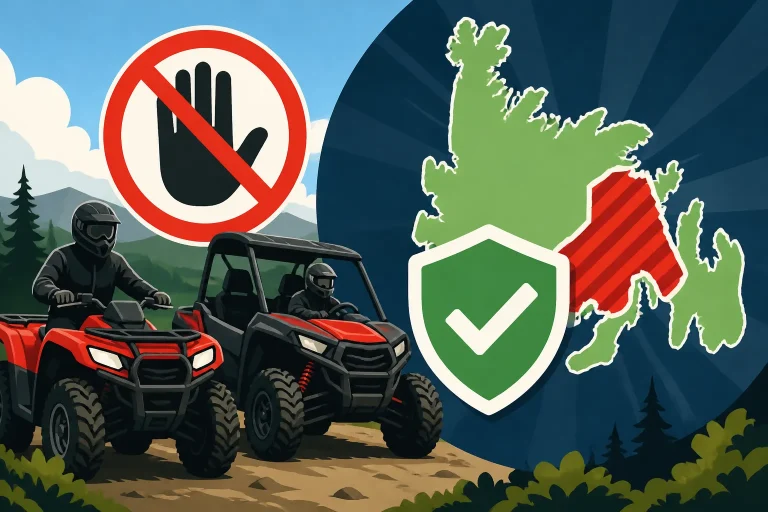
Owning a cabin lot or riding on a relative’s property can make Newfoundland’s managed-trail sticker rules confusing. The family-land exemption is narrower than a general pass to ride without paperwork: it relates to where you operate and does not automatically waive other requirements. Here’s how to think through the exemption, what it may cover, and when you should expect to need a sticker.
What the family-land exemption means
Newfoundland’s family-land exemption concerns the managed-trail sticker requirement. In general, a sticker is required when an ATV or UTV is used on a managed trail. The exemption may apply when you are riding on land that you or a qualifying family member owns, rather than using a managed trail.
That distinction matters. A landowner’s permission to ride somewhere is not necessarily the same as meeting the family-land exemption. The exemption is tied to ownership, so don’t assume that a friend’s property, a leased cabin lot, or a relative’s land qualifies just because you have permission to be there. If the ownership relationship or land status is unclear, confirm it with the relevant trail operator or provincial office before relying on the exemption.
The exemption is also specific to the sticker. It should not be treated as a blanket exemption from registration, training, insurance, equipment, or other rules. Those obligations can depend on the machine, where you ride, and the requirements in force. For a broader overview of when stickers are required, see Managed Trails Require a Sticker on Your Machine and Newfoundland Managed Trail Rules.
| Riding situation | How to approach the sticker requirement |
|---|---|
| Riding only on land you own | The family-land exemption may apply to the managed-trail sticker requirement. |
| Riding on land owned by a qualifying family member | The exemption may apply if the land and family relationship meet the applicable rules. |
| Riding on a friend’s or unrelated landowner’s property | Permission alone should not be treated as a family-land exemption. |
| Entering a managed trail from private land | Expect the managed-trail sticker requirement to apply once you use the managed trail, unless another valid exemption applies. |
| Riding on Crown land or a public trail | Do not assume private family ownership rules apply; check the rules for that area and route. |
The practical rule is to assess each part of your ride separately. A machine might be exempt from the sticker requirement while it stays on qualifying family land, but require a sticker once it enters a managed trail. A private access road, a trail crossing someone else’s property, and a designated managed trail are not automatically interchangeable just because they connect.
Where the exemption applies, and where it stops
The exemption is about riding on qualifying land, not about who owns the machine or where it is stored. Keeping an ATV at a family cabin does not, by itself, establish that the exemption applies to every route taken from there. The relevant question is whether you are riding on land that meets the ownership condition, and whether you remain within the exemption while doing so.
Permission is not the same as ownership
A landowner can give you permission to ride on private property, but permission does not necessarily make that property eligible for a family-land exemption. If a cousin, neighbour, or friend owns the land, check the applicable definition rather than assuming any family connection is enough. The exact scope of “family” can matter, especially when ownership is shared or held through a company or estate.
If the land is co-owned, inherited, leased, or held in a business name, don’t guess at the result. Ask the relevant authority or trail operator what documentation or relationship is accepted. A property tax bill, deed, or other ownership record may help answer questions, but it does not replace confirmation where the circumstances are unusual.
A route can leave the exempt property
A common mistake is treating a ride as exempt because it starts at home or a cabin. The route matters. If you travel from family land onto a managed trail, a public road, Crown land, or another person’s property, different requirements may apply to that part of the trip.
For example, riding a short distance across a managed trail to reach another section is still use of that trail. Likewise, a route that crosses land owned by someone else is not automatically covered by the exemption for your own or family land. Check the status of the whole route, not just the starting point.
This is especially important around trailheads and access corridors. A track may look informal or run beside private property, but that does not tell you whether it is a managed trail or whether riding there is permitted. If you are unsure, ask the trail operator or check the applicable local and provincial access rules before riding.
The exemption does not grant land access
A sticker exemption does not give you permission to enter land. You still need lawful access, whether the property is privately owned, Crown land, or part of a managed trail system. For guidance on Crown land, see Newfoundland Crown Land Access Rules. For private property, obtain permission where required and respect signs, gates, and restrictions.
The same caution applies if you are using someone else’s access road to reach family land. The fact that your destination qualifies for an exemption does not automatically authorize travel across the intervening property. Confirm the route and permissions before setting out.
Other requirements to check before riding
Because the family-land exemption is limited, make separate checks for the machine and the ride. Don’t treat a sticker exemption as proof that the ATV or UTV is otherwise ready or legal to operate.
Registration and ownership paperwork
Registration is a separate question from managed-trail stickers. Whether your machine needs to be registered can depend on its use and the applicable rules. Don’t assume that riding on family property automatically settles the registration question. Start with Do You Need to Register an ATV in Newfoundland? and confirm how the rules apply to your machine and where you plan to ride.
Keep ownership documents and registration information accessible, particularly if you travel beyond the property. If the machine was bought used, inherited, or has incomplete paperwork, resolve those issues before relying on an exemption. The exemption does not establish that you own the machine or cure a problem with its records.
Training, insurance, and equipment
A sticker exemption does not automatically exempt a rider from training requirements. Check whether the training rules apply to the operator and the situation, and keep any required proof available. The overview at Newfoundland Safety Training Is Mandatory can help you identify the questions to confirm.
Insurance and equipment rules are also separate. Requirements may differ depending on whether you are on private land, a managed trail, or a road. Check your policy and the rules that apply to your intended route. Do not assume that a machine can be operated on public routes simply because it may be ridden without a trail sticker on qualifying family land.
Before a ride, also make sure the machine is in safe condition and that riders use the required protective equipment. A family-land exemption is not a substitute for safe operation, supervision, or compliance with rules that apply to the rider and vehicle.
Sticker placement and carrying proof
When a sticker is required, follow the trail operator’s directions for obtaining and displaying it. If the rules allow a marker to be carried rather than attached, use the permitted method and be ready to show it when asked. See Attach the Sticker or Carry It in Your Pocket for the distinction.
If you believe the family-land exemption applies, it is sensible to be able to explain why: identify the land, the owner, and how your relationship meets the relevant condition. That preparation is particularly useful if your ride passes near a managed trail or if the ownership arrangement is not straightforward. Ask the operator in advance if you are uncertain whether a particular route falls within the exemption.
A practical check before you set out
Use this sequence rather than relying on a broad assumption that “family land” means no rules apply:
- Identify the land you will ride on. Separate your own or family-owned property from managed trails, Crown land, roads, and other private land.
- Confirm ownership and eligibility. If the property is jointly owned, held by a business, inherited, leased, or owned by a more distant relative, check the exact rule instead of assuming it qualifies.
- Map the full route. The exemption may not cover a trail or access segment simply because the ride begins or ends on family land.
- Check the other obligations. Confirm registration, training, insurance, equipment, and rider requirements separately.
- Ask about the sticker if any part is unclear. A trail operator or provincial office can help determine whether the route uses a managed trail and what proof is expected.
The most useful takeaway is simple: the family-land exemption may remove the managed-trail sticker requirement while you ride on qualifying land, but it is not a general permission to ride anywhere without a sticker or other paperwork. If a route leaves that land, reassess the requirements for the next section before you continue.
Disclaimer
This article is for general informational purposes only and does not constitute professional advice. Laws, prices and regulations vary by location and change over time. Consult a qualified professional for guidance on your specific situation.