Newfoundland Hunting Season Trail Rules
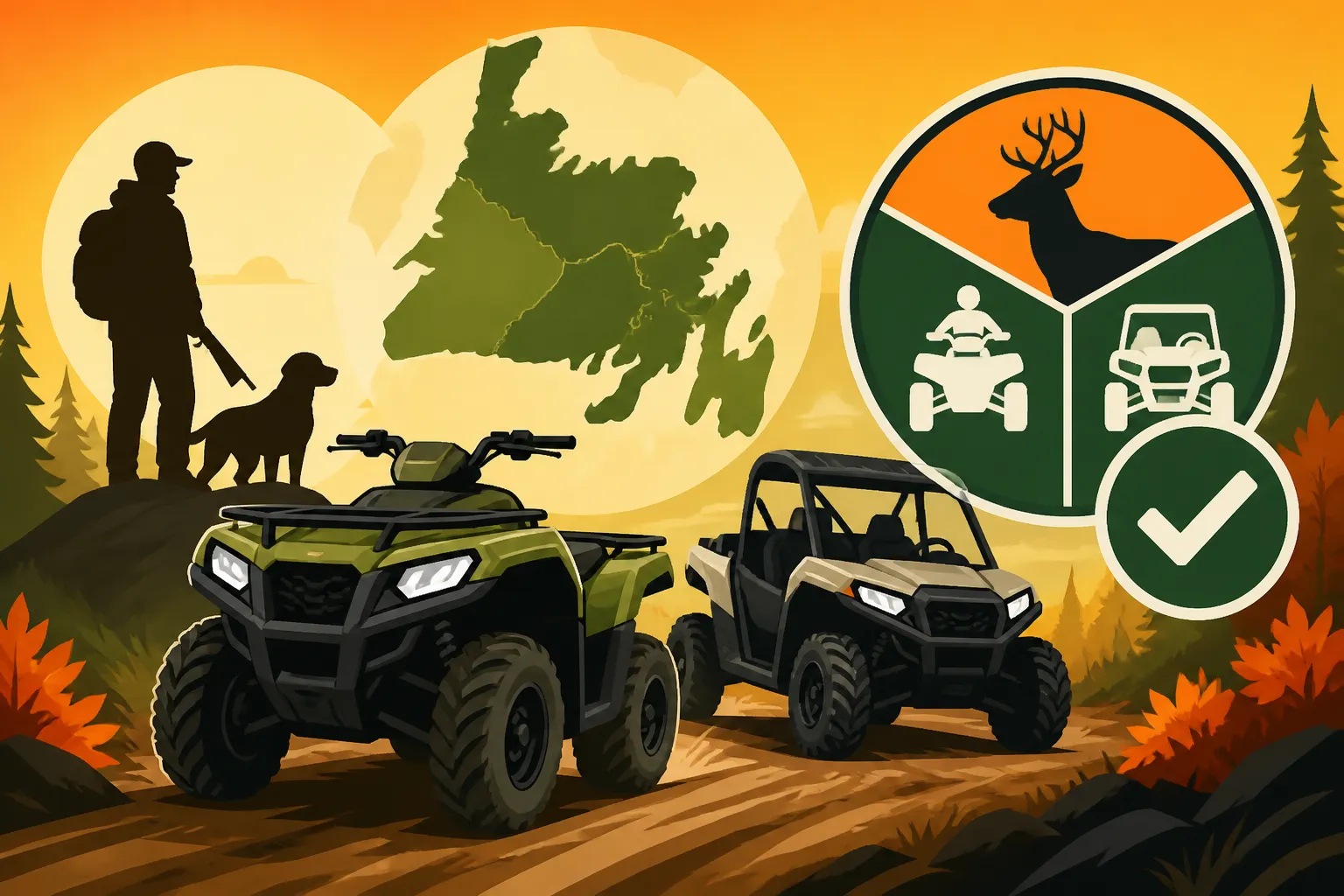
Newfoundland hunting season can make a familiar ATV route busier, harder to read and subject to closures or access limits you did not encounter on a summer ride. The key is to treat hunting permission and trail permission as separate questions. Check both before setting out, then plan for shared use, changing conditions and the rules for moving game.
Confirm that both the hunt and the route are allowed
A hunting licence does not automatically authorize ATV travel wherever you want to hunt. Likewise, an open trail does not mean every hunting activity is permitted beside it. Before riding, check the applicable hunting rules and confirm the current status of the land and route you plan to use.
Start by identifying the kind of land under your tires. A marked trail, an approved Crown land area, a restricted area and private property can have different access rules. A route that appears on a map may cross more than one type of land, and conditions or restrictions can change. Use current provincial information and posted signs rather than relying on an old route description. For a starting point on access categories, see Newfoundland Crown Land Access Rules and Finding Approved Areas on the Provincial Map.
A hunting season can also bring temporary restrictions, conservation measures or extra traffic. Do not assume that a route remains open because you used it earlier in the year. Check for current notices before leaving, and pay particular attention to seasonal closures, signs at access points and instructions from land managers. If a route enters a restricted area, find out whether travel is limited to a particular marked trail or whether a separate permission is required. Newfoundland Restricted Area Permissions explains why a route through a restricted area needs more checking than an ordinary trail ride.
Private land needs its own check. A trail, woods road or old track crossing private property is not automatically open to riders just because it is passable. Get the landowner’s permission before crossing where required, and follow any conditions about where you may travel. For practical guidance, see Permission From a Landowner Before Crossing Private Ground.
| Before the ride | What to confirm | Why it matters |
|---|---|---|
| Hunting location | Whether hunting is allowed in the area and under the applicable licence | A hunting licence does not settle ATV access |
| ATV route | Whether the trail or road is open to machines now | Seasonal closures and restrictions can affect access |
| Land status | Whether the route crosses Crown land, restricted land or private property | Different areas can have different rules |
| Managed trail | Whether a sticker, training proof or other requirement applies | Trail access requirements are separate from hunting permission |
| Game retrieval | Whether a machine may be used, and what limits apply | Permission to hunt does not mean unlimited machine travel |
| Local access | Whether a municipality or trail operator has additional rules | A provincial rule may not answer every local access question |
For managed trails, check the operator’s current requirements as well as the province’s rules. If a sticker or safety training proof is required for the route, hunting does not replace that requirement. The related articles Managed Trails Require a Sticker on Your Machine and Carrying Your Safety Certificate on Every Ride can help you sort out those separate obligations. When in doubt, contact the trail operator before hauling your machine to the trailhead.
Share the trail carefully during hunting season
During hunting season, a trail may be used by riders, hunters on foot, landowners, forestry workers and other visitors. Reduced visibility, brush close to the trail and changing light can make it harder to notice people ahead. Ride at a speed that lets you stop safely, especially near trail junctions, parking areas, gates and places where hunters may leave the main route.
Use extra care when approaching a person, parked vehicle or group. Slow down well before you reach them, leave room to pass only when it is safe, and stop if the trail is too narrow for a considerate pass. Avoid revving the engine, spinning the tires or forcing your way past people. Noise and dust can make a busy trail less comfortable for everyone and may interfere with a hunt.
Do not treat a hunting activity as a reason to leave an authorized route. Riding off the trail can damage wet ground, disturb wildlife and take you onto land where machine access is not allowed. If a hunter’s vehicle, equipment or activity blocks the trail, wait for a safe opportunity or turn back rather than making a new path around it.
Trail etiquette matters even when no one is hunting. People on foot may be difficult to see around bends or over uneven ground, and a vehicle approaching from behind can surprise them. Give walkers and other trail users time and space. The advice in Riding Etiquette on a Shared Railbed is useful on shared routes beyond the railbed as well.
Weather can make the same route much more difficult during the season. Rain, fog, early darkness and soft ground all reduce visibility or traction. A trail that was easy to follow in dry weather may become rutted or hard to distinguish from nearby tracks. Check conditions before departure, and turn around if the route is deteriorating or signs indicate that access has changed. Newfoundland Riding After Heavy Rain covers why wet conditions call for a cautious approach.
Plan to avoid relying on a phone signal. Save route information before leaving, carry a paper map where appropriate, and tell someone your planned route and expected return. If a closure or posted notice changes your plan, follow the notice rather than assuming that a map or a previous ride takes priority.
Know the limits on using a machine to move game
Using an ATV to travel to a hunting area and using one to move harvested game are not necessarily treated as the same activity. A licence that authorizes hunting does not grant unlimited permission to operate a machine across a barren, through a restricted area or off an approved route.
For big-game retrieval, Newfoundland’s rules include a limit of five machine trips to move an animal. That limit is not a general permit to ride wherever the animal is located. The route, land status, access restrictions and details of the applicable licence still matter. Read Why a Big Game Licence Allows Only Five Trips and Retrieving an Animal From a Barren before relying on a machine for retrieval.
The practical distinction is important: a rule allowing a limited number of trips for a specific purpose does not necessarily authorize a ride to scout, pursue or reach every hunting location. Do not assume that driving to the animal is allowed simply because a limited retrieval allowance exists. Confirm the current conditions for the species and licence involved, and ask the relevant provincial office if the wording is unclear.
Before hunting, decide what you will do if the animal is down beyond the route you can legally ride. A responsible plan may mean retrieving it on foot, using an authorized route, arranging help or accepting that machine access is not available. Do not expand a trail or cross a wetland, private parcel or signed closure as a shortcut. Damage to fragile ground can persist, and an improvised route can create access problems for other riders.
If the animal is near a trail, take care not to block the route or create a hazard for other users. Keep the machine in a permitted location and avoid leaving equipment where it forces people to ride around it. If the retrieval involves crossing a boundary or entering land with different restrictions, stop and confirm permission before proceeding. The five-trip limit should be treated as a ceiling for the specific activity it covers, not as permission to ignore other rules.
Make a season-specific riding plan
A little preparation can prevent a long ride from turning into an access or safety problem. Before departure, write down the route, check its current status and identify places where you can safely turn around. If you are hunting with others, agree on where the machine will be parked and how the group will communicate if people separate.
Use this checklist before starting:
- Check the hunting requirements. Confirm that your licence and planned activity match the current rules for the species and area. Do not rely on a general hunting-season calendar alone.
- Check machine access separately. Verify that the route is open to ATVs and that you are not entering a restricted or closed area.
- Confirm any trail requirements. Find out whether the route is managed and whether a sticker, training proof or other condition applies.
- Ask about private land. Get permission before crossing private property, even if the track looks like a public woods road.
- Plan for retrieval. Understand the limits on machine-assisted transport before you hunt, rather than trying to interpret them in poor conditions after a harvest.
- Prepare for changing conditions. Bring appropriate clothing, basic repair and recovery equipment, water and a way to navigate without dependable cell service.
- Leave a trip plan. Tell someone where you expect to ride and when you expect to return.
Also make sure the machine itself is ready for the conditions. Check tires, brakes, lights, fuel, cargo security and the equipment needed for your route. Keep any required documents accessible, and do not let game or cargo block the plate or interfere with safe control of the machine. If a local trail operator, land manager or municipality has specific instructions, follow those as well.
When rules are unclear, ask before riding. A trail operator can clarify managed-trail requirements, while the appropriate provincial office can help with hunting and Crown land questions. A municipality may be the right place to ask about a local road or bylaw. Be precise about the route, land type, hunting activity and machine use you have in mind; a general question such as “Can I ride there?” may not get you a useful answer.
The safest approach is straightforward: confirm that the hunt is lawful, confirm that the route is open to your machine, and treat any game-retrieval allowance as narrow and specific. Hunting season does not suspend ordinary access rules, and an open trail does not grant permission to hunt. Keeping those questions separate helps protect wildlife, land access and everyone sharing the route.
Disclaimer
This article is for general informational purposes only and does not constitute professional advice. Laws, prices and regulations vary by location and change over time. Consult a qualified professional for guidance on your specific situation.