Which T’Railway Sections Slow You to a Crawl
The slowest parts of Newfoundland’s T’Railway are usually not defined by one fixed stretch of track. Loose ballast, wet ground, damaged drainage, bridge approaches, and crowded crossings can turn a comfortable ride into a careful crawl. This guide explains what to watch for, how conditions change along the route, and how to plan a safer pace between places such as Port aux Basques, Corner Brook, Gander, and St. John’s.
Why some T’Railway stretches take so long
Loose railway ballast can make steady riding difficult
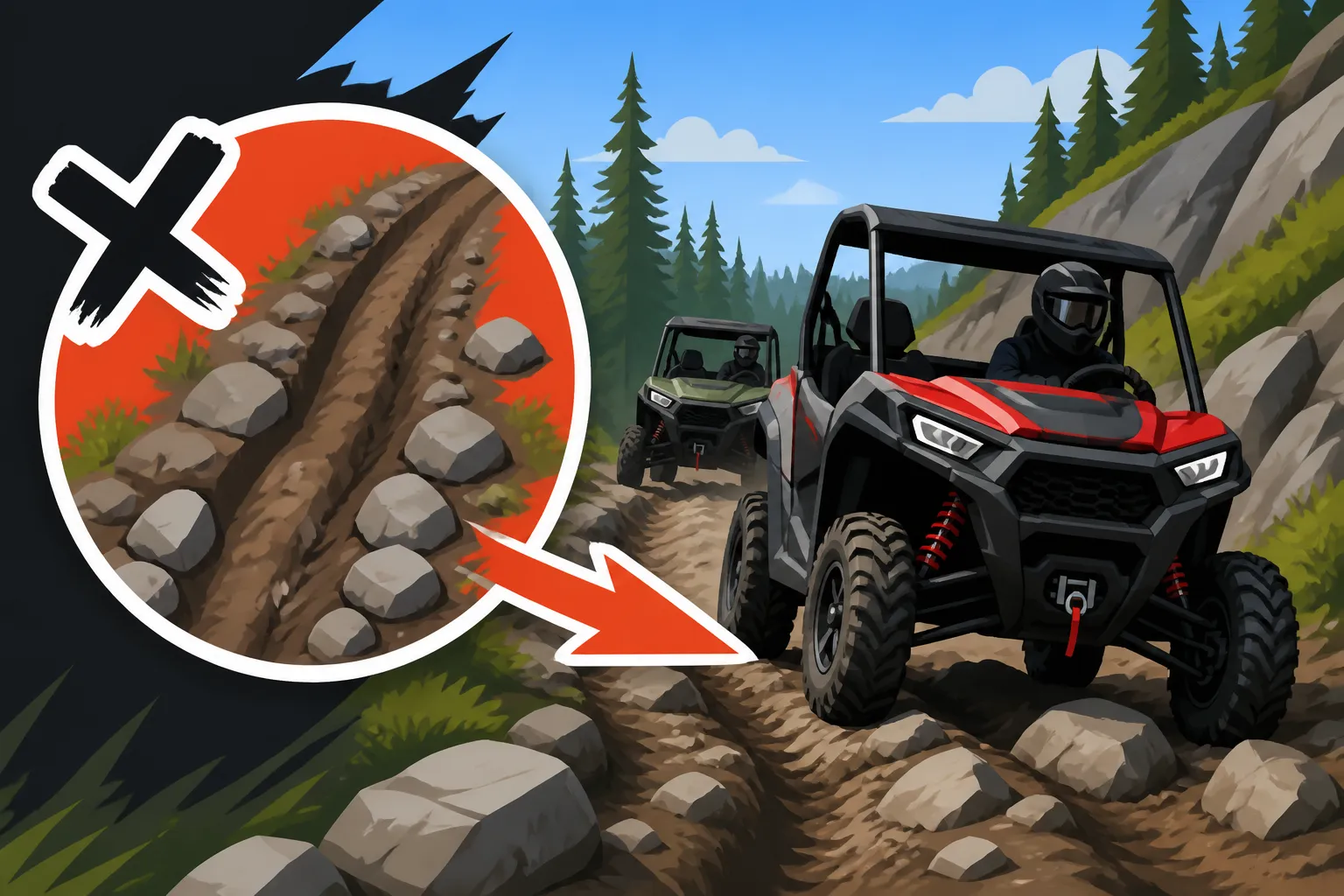
The T’Railway follows an old railway corridor, and its surface can include coarse, loose stone rather than the compact dirt riders may expect from a smooth trail. Ballast can shift under tires, especially where the surface is uneven or has been disturbed by water and traffic. A machine may feel unsettled even when the trail appears wide and relatively flat.
This is one reason a stretch that looks easy on a map can take longer than expected. Instead of holding a consistent speed, you may need to ease off, pick a line, and leave more room between machines. A heavier side-by-side and a lighter ATV can respond differently to loose stone, so a group should not assume everyone will travel at the same pace. For a closer look at how the surface affects a ride, see What Old Railway Ballast Does to Your Tires.
Loose ballast is particularly frustrating when it forms ridges, piles up at the side of the track, or gives way around a rut. Avoid sudden steering or hard braking where you can; smooth, deliberate inputs make it easier to keep control. If a section feels unstable, slow down before reaching the roughest part rather than waiting until the machine starts wandering.
Wet ground, drainage and seasonal damage create bottlenecks
Water is another major reason riders slow down. The railbed crosses low, wet areas, and rain or snowmelt can leave soft shoulders, muddy dips, or water pooled across the trail. A stretch that was firm on a previous trip may feel very different after a prolonged wet spell. In Newfoundland, weather can shift quickly, so it is worth treating old trail reports as clues rather than guarantees.
Drainage problems can make a short section disproportionately slow. A shallow-looking rut may conceal soft ground, while a narrow passage around a puddle can leave little room to turn. Riders sometimes lose time trying to avoid mud by riding along the edge, only to find that the edge is softer or more damaged than the middle. If you cannot tell how deep or firm a section is, pause somewhere safe and assess it before committing.
After storms, washouts or erosion can also affect the surface and approaches to structures. Check Newfoundland Trail Closures After a Storm and Newfoundland Trail Conditions Before You Ride as part of your planning, and be prepared to change your route if conditions are poor. The key is not to treat the T’Railway as a uniformly maintained road: its condition can vary noticeably over a single day’s ride.
Places and features where riders often need to slow down
Bridge approaches and crossings deserve a cautious pace
Bridge approaches are natural places to slow down, especially where the ground changes from gravel to a deck or another surface. The transition can be uneven, and the approach may have loose stone, a rut, or a sharp change in level. Even when the crossing itself looks straightforward, it is sensible to approach slowly enough to inspect the surface and give yourself room to stop.
Some old railway structures have been adapted for trail use, but riders should never assume that every structure has the same design or condition. Look for signs, barriers, surface changes, and instructions at the crossing. Stay on the designated route and avoid passing another machine where the approach or crossing is narrow. For background on these transitions, see Crossing Where a Railway Trestle Became a Bridge.
Bridges can also become pinch points when hikers, cyclists, or other riders are present. Slow down early, make your presence known in a courteous way, and let other trail users clear the structure before proceeding. The T’Railway is shared, so a careful pace is not just about protecting your machine; it helps prevent a tense encounter in a place where there may be little room to maneuver. Riding Etiquette on a Shared Railbed is useful reading before setting out.
Town edges, access points and busy trail junctions interrupt the ride
The T’Railway runs through a long corridor connecting communities and rural areas, and the riding rhythm changes near towns, road crossings, trail access points, and junctions. These are not necessarily the roughest parts, but they can slow a group because riders need to watch for traffic, signs, other trail users, and changes in the route. A long, straight stretch can suddenly become a place where everyone needs to regroup and make a decision.
Near communities such as Port aux Basques, Corner Brook, Deer Lake, Grand Falls-Windsor, Gander, Clarenville, and St. John’s, plan for interruptions rather than assuming uninterrupted travel. Stop in a safe area to check directions or regroup; avoid stopping where you block the trail or a crossing. If you are riding a long section, take a moment before reaching a junction to confirm who is leading and who is bringing up the rear.
Map tools can help you understand how a section fits into a larger trip, but they should not replace signs, local information, or on-the-ground judgment. Some riders use onX Offroad to organize route notes and identify points they want to check before leaving. It is also sensible to carry an offline map or paper backup, particularly where mobile coverage is unreliable. See Cell Dead Zones Along the Railbed and Carrying a Paper Map Where There Is No Signal.
| Trail feature | Why it can slow you down | A practical response |
|---|---|---|
| Loose or coarse ballast | Tires may shift, and the surface may feel uneven | Reduce speed, keep a steady line, and leave space between machines |
| Muddy or waterlogged ground | The firm-looking edge may be soft, and ruts can hide depth | Assess the route before entering; turn back if it is unsafe |
| Bridge approaches | Surface changes, uneven transitions, or narrow space require care | Approach slowly and follow signs and barriers |
| Road crossings and junctions | Traffic, navigation, and other trail users interrupt the flow | Stop only in a safe place and regroup before proceeding |
| Busy shared sections | Passing room may be limited, and other users may be difficult to see | Slow early, communicate politely, and yield where appropriate |
How to plan a ride around slower sections
Build a realistic schedule instead of relying on distance alone
The T’Railway extends across a long part of Newfoundland, but distance by itself is a poor way to estimate how long a ride will take. A route may appear simple because the railbed follows a former railway corridor, yet a rough surface, a wet section, a bridge crossing, or repeated stops can change the day’s pace. Riders travelling with children, inexperienced operators, or a mix of ATV and side-by-side machines should plan for the slowest person in the group.
Break the ride into manageable sections and choose stopping points where you can safely get off the trail. Before departure, agree on a pace that leaves time for breaks, navigation checks, and unexpected delays. If your group has a fixed ferry departure, accommodation booking, or daylight limit, avoid planning the day so tightly that one muddy stretch creates pressure to ride faster than conditions allow. Riding the T’Railway From St John’s to Port aux Basques provides useful context for thinking about the corridor as a longer journey rather than one continuous quick run.
It can help to mark likely regrouping points before leaving. Use onX Offroad or another mapping tool to keep route notes organized, then compare those notes with signs and local information. Do not rely on a digital map to confirm that a particular section is open or passable: maps may not reflect a recent washout, closure, or temporary change. If something looks different from what you expected, stop safely and reassess rather than pushing onward because the screen shows a line ahead.
Match your riding style to the surface
On loose stone, a smooth and predictable approach is usually more useful than trying to maintain a high speed. Look farther ahead than the front tires, keep both hands ready, and avoid abrupt throttle or steering changes. If the trail has deep ruts or loose edges, choose a line that gives you room to correct without riding close to a drop-off, soft shoulder, or other hazard.
In mud and standing water, do not assume that the shallowest-looking path is the safest. Water can hide holes, soft peat, and uneven ground. If you are travelling with others, avoid crowding the machine ahead; a rider who stops suddenly should have space behind them. A recovery strap and basic repair supplies can be useful on a longer trip, but carrying equipment is not a substitute for turning around when a section is beyond the group’s ability or the machine’s limits.
Keep your group together without pressuring slower riders. Choose a lead rider who knows the plan and a sweep rider who makes sure no one is left behind. Use safe pull-offs for checks, and avoid spreading out so far that the group loses contact. In a remote stretch, the delay from a minor breakdown can grow quickly if the group has not agreed on a plan for communication and regrouping.
How to decide whether to continue or turn back
Use conditions on the ground, not a promised pace
A useful way to judge a difficult section is to ask whether the group can cross it without risking a loss of control, getting stuck, or damaging the trail. If the answer is unclear, stop before the obstacle and look for signs of a safe passage. Watch what the surface is doing under each tire, whether water is moving or standing, and whether the trail edge looks firm enough to support the machine.
One rider getting through does not automatically mean the whole group should follow. A machine with different tires, clearance, weight, or passenger load may behave differently. If someone is already struggling, take that as information about the section rather than a reason to hurry them. The group may be better off turning around, choosing another route, or waiting for conditions to improve.
Do not let sunk time make the decision for you. It is tempting to continue because you have already crossed several slow sections, especially when the destination feels close. But a difficult stretch late in the day can be more dangerous when riders are tired, daylight is fading, or weather is worsening. Choose a turnaround point based on conditions and the group’s capacity, not just how far you have already travelled.
Check route information and prepare for poor coverage
Before departure, confirm the route plan, check for closures or local notices, and make sure everyone knows where the group intends to stop. The T’Railway’s length and changing terrain mean that the section you are riding matters: a general report about the route cannot tell you exactly what is happening at every crossing or wet spot. Ask a trail operator or local contact when you need information about a specific access point or current restriction.
Download or prepare your map information before leaving an area with reliable service. onX Offroad may help you keep waypoints or route notes together, but take a backup that does not depend on a phone signal or battery. A paper map is especially useful when a group needs to compare locations or make a turn-around decision in a dead zone. Keep your phone protected from rain and cold, and carry a charging option for a long outing.
Finally, make the ride plan flexible. The fastest sections may be smooth enough for steady progress, while ballast, wet ground, bridge approaches, and busy crossings demand patience. For broader route context, read 883 Kilometres End to End and Where the T’Railway Runs Smooth and Fast. Knowing where the trail may slow you down makes it easier to enjoy the journey without treating every delay as a problem to overcome.
Disclaimer
This article is for general informational purposes only and does not constitute professional advice. Laws, prices and regulations vary by location and change over time. Consult a qualified professional for guidance on your specific situation.