Newfoundland Fines Riders Ask About
A ticket can turn a fun ride into a confusing day, especially when the alleged problem is something as ordinary as a hidden plate, missing insurance proof, or an unclear road rule. This guide explains the Newfoundland ATV and UTV penalties riders commonly ask about, what can make an offence more serious, and how to reduce the risk of a stop.
How Newfoundland ATV and UTV fines work
There is no single fine for every riding mistake
Newfoundland’s off-road vehicle rules cover many different situations, so the penalty depends on what an officer says happened. Riding where machines are prohibited, operating an unsafe vehicle, failing to carry required documents, and riding impaired are not interchangeable offences. A fine range listed for one type of offence should not be treated as the automatic price of every ticket.
The general range associated with first offences under the rules runs from $100 to $1,500. The precise amount depends on the offence and how the matter is handled. A repeat offence can carry a fine of up to $2,500. Those ranges are a reason to take a citation seriously, not a prediction of what a particular rider will owe.
The details on the ticket matter. Read the cited offence, the instructions for responding, and any deadlines carefully. If the wording is unclear, ask the court or the appropriate government office how to understand the process. For a closer look at the underlying rules, see Newfoundland's Off-Road Vehicles Act and Newfoundland Penalties for Riding Illegally.
What can change the consequences
The same trail outing can involve more than one concern. For example, a rider might be stopped for riding on a prohibited route and also be unable to produce required paperwork. A second issue may mean a separate allegation or additional consequences, depending on the circumstances and the law that applies. Avoid assuming that resolving one issue automatically settles every part of a stop.
A previous conviction can also matter. Newfoundland’s penalty structure allows higher fines for repeat offences, so a rider who has already been cited should be especially careful to understand the charge and response options rather than simply paying without reading the paperwork. A citation is not a useful place to guess about deadlines or consequences.
If you are unsure whether a road, shoulder, trail, or piece of land is open to your machine, check before riding. The rules for a brief crossing are not the same as permission to travel along a highway, and a route that looks like a familiar woods road may still have restrictions. [Can You Ride an ATV on the Road in Newfoundland?] is a useful companion read for understanding the road-use question.
| Situation riders ask about | Why it can lead to a penalty | Practical step before or during a ride |
|---|---|---|
| Riding in a prohibited area | The route or land may not be open to off-road vehicles | Check signs, access rules, and local restrictions before entering |
| Riding on a highway or shoulder | Road use is limited and subject to specific conditions | Confirm whether the movement is permitted and follow the applicable limits |
| Missing required insurance proof | Riders may have to produce proof when asked | Keep the required proof accessible and check that coverage is in force |
| Defective or non-compliant equipment | Required safety equipment may be missing, obscured, or altered | Inspect the machine before leaving and verify aftermarket changes |
| Riding impaired | Impaired operation can bring especially serious consequences | Do not operate after consuming alcohol or drugs that impair you |
| Repeat offence | Prior offences can affect the potential penalty | Read the ticket and seek qualified advice if the consequences are unclear |
Offences that can catch riders off guard
Road and shoulder riding
A common source of confusion is the belief that an ATV or UTV can use a public road whenever the rider needs to connect two trails. Newfoundland rules place limits on highway and shoulder riding. In particular, shoulder travel is not a general substitute for an open trail, and riders should confirm the conditions that apply before relying on it.
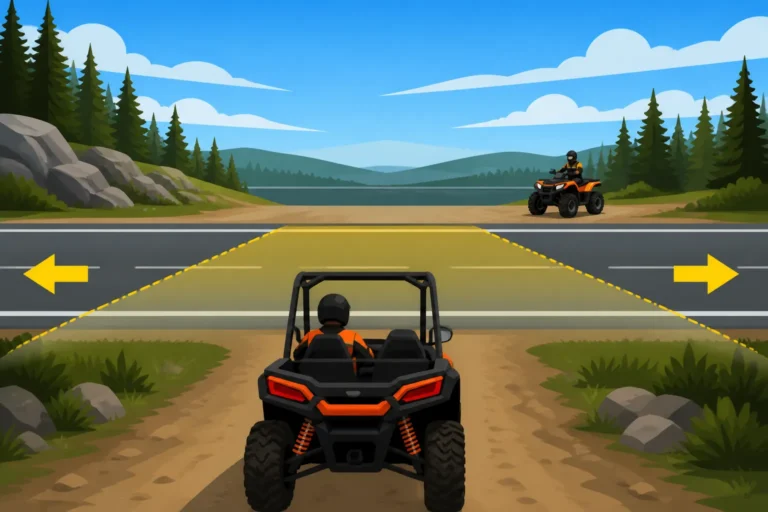
Crossing a highway is different from riding along it. A crossing may be permitted only when the required visibility and other conditions are met. Riders also need to yield to highway traffic and follow the applicable speed and route restrictions. A quick shortcut can become a costly mistake if the rider assumes that seeing tire tracks means the route is legally open.
Before heading out, map the route rather than deciding at the last minute that a road shoulder will be convenient. If a town street or local road is part of the plan, check municipal rules as well as provincial requirements. [Newfoundland Municipal Road Bylaws] explains why local rules can matter alongside the provincial framework.
Insurance, registration, and documents
Riders often discover a paperwork problem only when they are stopped. Check that the machine is registered where required, that the registration information matches the vehicle, and that you can produce the required documents. If you are using a borrowed machine, ask the owner where the paperwork is kept and confirm who is responsible for insurance.
Insurance is not a detail to leave until after the first ride. Rules can require coverage and proof, and visitors should not assume that an out-of-province plate settles every local requirement. Carry documents in a secure, accessible place that can withstand rain and mud. Avoid storing papers where they can slide out or become unreadable during a bumpy ride.
If you have questions about the insurance requirement itself, start with [Newfoundland ATV Insurance Requirements]. If you ride on managed trails, remember that trail access requirements can be separate from vehicle registration and insurance. [The Trail Sticker and Training Proof Newfoundland Requires] covers those additional obligations.
Equipment and plate problems
A machine may be properly registered and still attract attention if its plate is obscured by cargo, packed with mud, or mounted where it cannot be seen. Check visibility before you leave and again after riding through deep mud or brush. A clean plate is a small maintenance task that can prevent an avoidable roadside dispute.
Equipment rules can also be easy to overlook after modifying a machine. A replacement exhaust, lighting change, windshield, tire, or other accessory may affect whether the vehicle continues to meet the requirements that apply to it. Do not assume that a part marketed for off-road use is automatically compliant for every Newfoundland riding situation.
For example, if you are considering an aftermarket component from SuperATV, check its specifications and installation instructions against the requirements for your machine and intended use. SuperATV is not a substitute for checking the law, and a retailer’s product description is not proof that a setup meets every provincial rule. If you have altered lighting or other required equipment, review the relevant requirements before riding; [Newfoundland Equipment Requirements] is a helpful starting point.
The most serious consequences to understand
Impaired riding is not a minor ticket issue
Operating an ATV or UTV while impaired can bring consequences well beyond an ordinary equipment or paperwork citation. Newfoundland treats impaired operation seriously, and the possible outcomes can include substantial penalties and jail. A repeat impaired offence can carry especially severe consequences, so there is no sensible “short trip” exception to rely on.
The practical rule is simple: if alcohol, cannabis, medication, or another substance may affect your ability to operate safely, do not ride. A machine can be difficult to control on uneven ground even when a rider feels capable. Add darkness, fog, fatigue, passengers, or a narrow trail, and the margin for error becomes smaller still.
Plan a safe way back before the ride begins. If someone in the group has consumed a substance that could impair them, have another sober person operate the machine or arrange another way home. For a deeper explanation of this issue, read [Newfoundland Impaired Riding Consequences].
A machine can be seized in some circumstances
A roadside stop does not automatically mean the machine will be seized. However, the rules provide for seizure in certain situations, and a conviction can have consequences beyond a fine. Riders should not assume that an impounded machine will be released immediately or without a process to follow.
If a machine is seized, get clear information about where it has been taken, what documents are needed, and what steps apply to its release. The listed application fee to seek release of a seized machine is $100. That cost is separate from any other consequence that may apply, so it is worth understanding the full process rather than focusing only on the ticket.
Do not try to retrieve, move, or use a seized machine without authorization. Keep copies of the paperwork and note any instructions or deadlines you are given. [When a Peace Officer Can Seize a Machine] and [Paying to Release a Machine From Impound] explain the seizure and release questions riders commonly face.
Default penalties and court instructions
Some penalty provisions include a period of imprisonment in default of payment, with the period depending on the offence and circumstances. This is not a reason to ignore a fine or assume that a missed payment will simply disappear. It is a reason to read the court documents closely and contact the appropriate office if you cannot meet a payment requirement.
If you receive a ticket, do not rely on a friend’s experience with a different offence or an old citation. The charge, deadlines, and available options can differ. Ask the court or a qualified professional what the document requires, and keep a record of any payment, response, or communication.
How to lower your risk before the next ride
Do a short pre-ride compliance check
A few minutes of checking can prevent the most common avoidable problems. Before leaving home, make sure the route is open to your type of machine, your registration and insurance are in order, required documents are available, and the vehicle’s required equipment is working. If you are riding with a group, make sure everyone understands the route and the rules for shared roads and trails.
A practical check might look like this:
- Confirm the trail or land is open to ATV or UTV use.
- Check that the machine’s plate is visible, secure, and free of heavy mud.
- Confirm required registration, insurance, and training documents are available.
- Inspect lights, brakes, tires, muffler, belts, and other required equipment.
- Make sure passengers have appropriate seats and safety gear.
- Agree on a plan for road crossings, fuel stops, and communication if the group separates.
- Choose a sober operator for the full ride.
If you are using an accessory from SuperATV or another aftermarket supplier, include it in the equipment inspection rather than treating the purchase as proof of compliance. Check fitment, installation, and whether the change affects a required component. An accessory that works well on a trail may still need to meet different requirements when the machine is near a highway or used in a particular setting.
Know what to do during a stop
Stay calm, stop safely, and follow the officer’s instructions. Keep your hands visible and avoid sudden movements toward a storage box or bag. If you are asked to produce documents, provide the requested information without turning the roadside conversation into an argument.
If you disagree with the allegation, avoid trying to settle the legal issue on the trail. Make a note of what happened as soon as it is practical: the location, time, route, weather, signage, and names of people who witnessed the stop. Keep the citation and any related documents together. Those details may be useful if you later seek advice or respond through the formal process.
Do not assume that an officer’s explanation replaces the written citation or court instructions. Read the document carefully once you are in a safe place. If the charge is serious, involves impairment or seizure, or could affect your ability to ride in the future, consider getting advice from a qualified professional.
Check local access and equipment separately
Provincial rules do not necessarily answer every local access question. A municipality may have rules for streets or roads, a landowner may control private property, and a trail operator may set conditions for a managed route. Check all three when your plan crosses different types of land.
The same is true of equipment. A machine can meet one requirement and still fail another. For instance, having a registration plate does not establish that the vehicle is allowed on a particular route, and being on an approved trail does not automatically excuse missing insurance proof or unsafe equipment. Treat each requirement as its own check.
SuperATV products or accessories may be relevant when riders are repairing or modifying a machine, but the final responsibility is to operate a compliant vehicle. Check the provincial rules and any local requirements after making changes, especially if the work affects lighting, exhaust, tires, seats, or visibility. When in doubt, ask a qualified mechanic or the relevant authority before the next ride.
Disclaimer
This article is for general informational purposes only and does not constitute professional advice. Laws, prices and regulations vary by location and change over time. Consult a qualified professional for guidance on your specific situation.